
 My Inquiry
 My Account


STMicroelectronics SPWF01SC.21
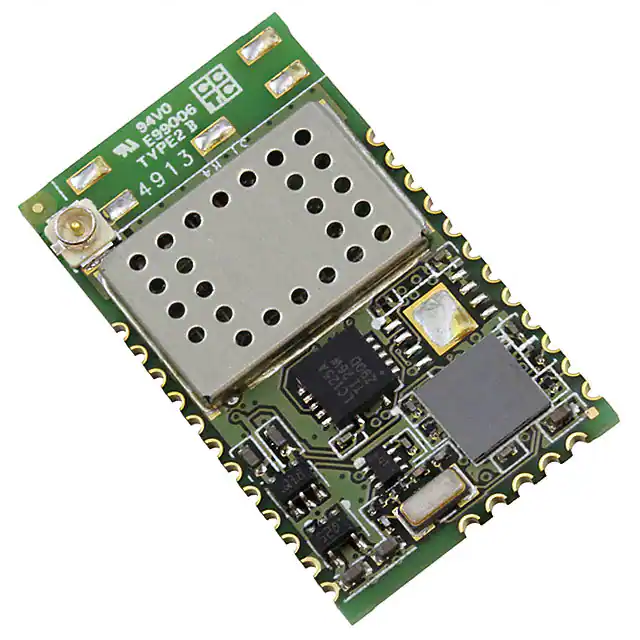
- Part No.:
- SPWF01SC.21
- Manufacturer:
- STMicroelectronics
- Category:
- RF Transceiver Modules and Modems
- Package:
- Module
- Datasheet:
-
 SPWF01SC.21.pdf
- Description:
- RF TXRX MODULE WIFI U.FL SMD
- Quantity:
- Payment:

- Shipping:

Inventory:1,712
Please send an inquiry. Send us your inquiry, and we will respond immediately.
Product details
Overview
SPWF01SC.21 from STMicroelectronics is a certified 802.11b/g/n Wi-Fi module with integrated TCP/IP stack, UART host interface, and AT command firmware enabling rapid IoT connectivity. It supports infrastructure mode (client), soft AP (miniAP), TLS/SSL secure sockets, HTTP client/server, file system storage in external Flash, and GPIO/ADC/PWM peripherals. Delivered in a compact 17.5 × 22.5 mm LGA package with 42 solder pads, it targets embedded wireless gateways and sensor nodes requiring minimal host MCU overhead.
For engineers reviewing the SPWF01SC.21 datasheet, SPWF01SC.21 pinout, SPWF01SC.21 application, or SPWF01SC.21 equivalent, key selection criteria include its pre-certified 2.4 GHz RF performance (18 dBm TX power, -94 dBm RX sensitivity), integrated TLS 1.2 support via AT+S.TLSCERT, dual-mode operation (client + soft AP), and UART-based AT command interface with full TCP socket control (AT+S.SOCKON/AT+S.SOCKW) and HTTP primitives (AT+S.HTTPGET/AT+S.HTTPD).
Technical Context
The SPWF01SC.21 embeds a dedicated ARM Cortex-M4F application processor running ST's "AT full stack" firmware, decoupling Wi-Fi and TCP/IP processing from the host MCU. It integrates IEEE 802.11 MAC/PHY, 2.4 GHz RF transceiver with internal PA/LNA, and 2 MB external SPI Flash for firmware, HTTP server content, and user files.
Communication occurs exclusively over UART (default 115200 bps, configurable), supporting AT commands for network configuration (AT+S.SCFG), real-time status reporting (AT+S.STS), asynchronous event notifications (e.g., +WIND:2:Reset), and hardware control (AT+S.GPIOC, AT+S.ADC). All Wi-Fi security modes - WEP, WPA/WPA2-PSK, and enterprise EAP-TLS - are supported with certificate management via AT+S.TLSCERT.
Key Specifications
| Parameter | Value and Actual Design Meaning |
|---|---|
| Wi-Fi Standard | IEEE 802.11b/g/n, 2.4 GHz band only; enables interoperability with legacy and modern APs without dual-band complexity. |
| TX Output Power | 18 dBm (63 mW) at antenna connector; meets regulatory limits while delivering robust link margin in industrial environments. |
| RX Sensitivity | –94 dBm @ 1 Mbps (802.11b); ensures reliable reception under low-SNR conditions typical in metal-enclosed or battery-powered devices. |
| Integrated Stack | Full TCP/IP v4 stack with DNS, DHCP, ICMP, HTTP(S), TLS 1.2, and UDP/TCP socket APIs; eliminates need for host-side protocol stack licensing or porting. |
| Host Interface | UART (3.3 V logic, no flow control required); simplifies integration with any MCU having a single UART peripheral and avoids USB/BT driver development. |
| External Memory | 2 MB SPI Flash (on-module); stores firmware, static HTTP content, uploaded files (AT+S.FSC), and configuration across power cycles. |
| GPIO Peripherals | 12 configurable GPIOs (including ADC on GPIO8, DAC on GPIO15, PWM on GPIO1); enables direct sensor interfacing and actuator control without external ICs. |
Pinout & Package
SPWF01SC.21 uses a 42-pad LGA (Land Grid Array) package measuring 17.5 × 22.5 mm with 0.5 mm pitch, designed for automated reflow assembly and RF-shielded PCB layout. The module includes integrated RF matching network and chip antenna (or U.FL connector option per variant), eliminating external balun or filter design.
| Pin/Terminal | Circuit Role | Design Meaning |
|---|---|---|
| VDD_3V3 | Power supply input | 3.3 V ±5 % main supply; must be filtered with ≥10 µF ceramic capacitor near module edge to stabilize RF operation. |
| GND | Ground reference | All 12 GND pads must be connected to solid ground plane; critical for RF noise suppression and thermal dissipation. |
| UART_TX | Transmit data output | 3.3 V CMOS output driving host MCU RX; requires no level shifting when interfaced with 3.3 V logic. |
| UART_RX | Receive data input | 3.3 V tolerant input; accepts 0–3.3 V logic levels from host UART TX; pull-up not required. |
| GPIO0 | Factory reset control | High at power-on triggers hardware factory reset of NV settings; used during production programming or recovery. |
| GPIO1 | PWM output | Dedicated PWM-capable pin (AT+S.PWM); supports variable-frequency dimming or motor speed control without host timer resources. |
| GPIO8 | ADC input | 10-bit SAR ADC input (AT+S.ADC); reads analog sensors (e.g., temperature, light) directly-no external ADC needed. |
| GPIO15 | DAC output | 6-bit DAC output (AT+S.DAC); generates analog voltage (0–3.3 V) for calibration signals or simple waveform generation. |
Key Features
| Feature | Design Value |
|---|---|
| Pre-certified Wi-Fi radio | FCC/IC/CE/TELEC certified; eliminates 6–12 month regulatory testing burden and reduces time-to-market for end products. |
| AT command firmware with TLS 1.2 | Secure HTTPS GET/POST and TLS socket setup via AT+S.TLSCERT/AT+S.SOCKON=s; enables cloud connectivity without host crypto library integration. |
| On-module HTTP server | Static web server (AT+S.HTTPD) serving HTML/JS/CSS from SPI Flash; supports captive portal (AT+S.HTTPD=1 + ip_apredirect) for zero-touch device onboarding. |
| File system abstraction | AT+S.FSC/AT+S.FSA/AT+S.FSD commands manage files in external Flash; allows dynamic OTA updates of web UI or configuration without firmware reflashing. |
| Soft AP + Station dual mode | Simultaneous client connection to upstream AP and local miniAP for smartphone provisioning (AT+S.WIFI=1 + AT+S.SOCKD=80); removes need for separate AP hardware. |
Applications
| Smart Home Gateway | Industrial Sensor Node |
|---|---|
|
Use Scenario: Central hub connecting BLE/Zigbee sub-devices to cloud via Wi-Fi uplink. IC Role / Device Role / Timing Role: Wi-Fi network interface and TLS-secured MQTT client using AT+S.SOCKON=s and AT+S.TLSCERT. Use Value: Offloads Wi-Fi association, TLS handshake, and packet retransmission from resource-constrained MCU, reducing firmware size by >40 KB. |
Use Scenario: Battery-powered vibration/temperature monitor transmitting alerts every 15 minutes. IC Role / Device Role / Timing Role: Low-power Wi-Fi client entering sleep mode (AT+CFUN=2) between transmissions; wakes on RTC alarm. Use Value: Achieves 3-year battery life using deep-sleep current <10 µA and fast wake-to-transmit (<150 ms) via hardware-assisted PS mode. |
| Medical Device Provisioning | POS Terminal Connectivity |
|
Use Scenario: Configuring hospital-grade infusion pump via smartphone app before first use. IC Role / Device Role / Timing Role: Soft AP hosting captive portal (AT+S.HTTPD=1 + ip_apredirect=setup.html) with SSID broadcast (AT+S.WIFI=1). Use Value: Eliminates manual Wi-Fi credential entry; smartphone auto-connects and submits credentials via HTTP POST (AT+S.HTTPPOST). |
Use Scenario: Secure credit card transaction routing through PCI-DSS-compliant gateway. IC Role / Device Role / Timing Role: TLS 1.2 endpoint for EMVCo-approved payment API calls using AT+S.TLSDOMAIN and AT+S.SOCKON=s. Use Value: Meets PCI PTS 5.x cryptographic requirements without host-side Bouncy Castle or OpenSSL integration. |
Equivalent & Alternatives
The following parts are listed as comparable options for similar Wi-Fi module applications.
| Alternative Part | Technical Difference | Application Difference | Selection Advice |
|---|---|---|---|
| ESP32-WROOM-32 | Dual-core Xtensa LX6, integrated Bluetooth, no pre-certified module-level FCC/CE; requires external antenna or u.FL. | Requires host to run FreeRTOS and implement TCP/IP stack or use ESP-IDF; higher host CPU load for TLS. | Choose when Bluetooth coexistence or lower unit cost outweighs certification effort and AT firmware simplicity. |
| TI CC3220SF | ARM Cortex-M4F with 1 MB internal Flash, no external SPI Flash; TLS handled in ROM; fewer GPIOs (8 total). | Lacks built-in HTTP server and file system commands; requires host to serve web content or use TI's SimpleLink SDK. | Choose when internal Flash suffices and TI's ecosystem (Code Composer Studio, SysConfig) aligns with team expertise. |
Compared with ESP32-WROOM-32 and CC3220SF, SPWF01SC.21 delivers faster time-to-cloud via AT command abstraction, guaranteed regulatory compliance out-of-box, and seamless HTTP server/file system integration-reducing host firmware development by ~3 person-months for mid-volume IoT products.
Availability
SPWF01SC.21 is available at Aetrix Electronics and suitable for smart home gateways, industrial sensor nodes, medical device provisioning, and POS terminal connectivity requiring stable component supply, long-term lifecycle support, and pre-certified RF performance.
Supply support for SPWF01SC.21 includes scheduled delivery planning, volume procurement assistance, BOM continuity management, traceable sourcing, and lifecycle availability coordination for OEM customers, industrial embedded developers, connected-device designers, and electronics production programs.
Manufacturer
STMicroelectronics is a global semiconductor leader headquartered in Geneva, Switzerland, designing and manufacturing microcontrollers, sensors, power ICs, and wireless solutions for industrial, automotive, and consumer markets.
The SPWF01Sx series was engineered specifically for ultra-rapid Wi-Fi integration in resource-constrained embedded systems, prioritizing AT-command accessibility, regulatory readiness, and minimal host MCU dependency over raw processing throughput.
FAQ
Does SPWF01SC.21 support WPA3 or 802.11ac?
No. SPWF01SC.21 implements only 802.11b/g/n (2.4 GHz) and WPA/WPA2-PSK/EAP-TLS security. It does not support WPA3, 802.11ac, or 5 GHz bands. Its design targets cost-sensitive, low-throughput IoT endpoints where 802.11n at 72 Mbps is sufficient for sensor telemetry and control messaging.
Can the module operate without external Flash memory?
No. The SPWF01SC.21 requires its onboard 2 MB SPI Flash to store firmware, HTTP content, certificates, and user files. The AT command set assumes Flash presence (e.g., AT+S.FSC fails if Flash is absent or erased). There is no fallback to internal RAM-only operation for persistent storage.
What is the maximum UART baud rate supported?
The UART interface supports up to 921600 bps (verified per UM1695 Section 2.1). Default is 115200 bps. Baud rate is configured via AT+S.SCFG=console1_speed,
Is GPIO0 the only way to perform a hardware factory reset?
Yes. Hardware factory reset is triggered exclusively by holding GPIO0 high during power-up before the +WIND:1:Poweron indication. No alternative pin or AT command (e.g., AT&F) performs a full hardware-level reset of all non-volatile registers-AT&F only resets software-configurable variables stored in Flash.
SPWF01SC.21 Specifications
- Product attributes
- Attribute value
- Manufacturer:
- STMicroelectronics
- Series:
- -
- Package/Case:
- Module
- Packaging:
- Tray
- Product Status:
- Obsolete
- Programmable:
- Not Verified
- RF Family/Standard:
- WiFi
- Protocol:
- 802.11b/g/n
- Modulation:
- DSSS, OFDM
- Frequency:
- 2.4GHz
- Data Rate:
- 65Mbps
- Power - Output:
- 18.3dBm
- Sensitivity:
- -96dBm
- Serial Interfaces:
- UART
- Antenna Type:
- Antenna Not Included, U.FL
- Utilized IC / Part:
- -
- Memory Size:
- 512kB Flash, 64kB RAM
- Voltage - Supply:
- 3.3V
- Current - Receiving:
- 105mA
- Current - Transmitting:
- 210mA ~ 344mA
- Mounting Type:
- Surface Mount
- Operating Temperature:
- -40°C ~ 85°C
SPWF01SC.21 FAQ
1.How can I place an order for SPWF01SC.21 through Aetrix?
Please submit a Request for Quotation (RFQ) for SPWF01SC.21 on Aetrix. Our sales agent will provide a competitive quotation and guide you through the order confirmation once you accept the terms.
2.Are the price and stock information for SPWF01SC.21 reliable?
The price and inventory of SPWF01SC.21 are updated periodically and may fluctuate due to market conditions. Stock and pricing data are typically refreshed every 24 hours. Quotation validity for SPWF01SC.21 is usually 5 days.
3.What payment methods are accepted for SPWF01SC.21?
We accept Wire Transfer, PayPal, Credit Card, Western Union, MoneyGram, and Escrow for SPWF01SC.21 transactions.
Note: Certain payment methods may incur a processing fee.
4.How is shipping managed for SPWF01SC.21?
SPWF01SC.21 orders can be shipped via leading logistics carriers, including DHL, UPS, FedEx, TNT, or Registered Mail.
Once your SPWF01SC.21 order is processed, you will receive an email with the shipment details and tracking number.
Note: Tracking information may take up to 24 hours to appear. Express delivery typically takes 3–5 business days.
5.How can I obtain technical support or documentation for SPWF01SC.21?
For technical support, including SPWF01SC.21 datasheets, pinout diagrams, or application guidance, please contact our engineering support team. They can provide detailed documentation and assistance for your SPWF01SC.21 requirements.
6.How does Aetrix verify that SPWF01SC.21 is sourced from the original manufacturer or authorized distributors?
All SPWF01SC.21 products on Aetrix are procured from qualified distributors and authorized channels. Our dedicated quality assurance team conducts strict verification, including traceability checks and, if necessary, third-party testing. This ensures that SPWF01SC.21 meets industry standards.
7.What is the process for return or replacement of SPWF01SC.21?
All SPWF01SC.21 units undergo pre-shipment inspection (PSI). If there is an issue with SPWF01SC.21, returns or replacements are accepted under the following conditions:
1.Quantity discrepancies, incorrect items, or visible external defects (such as breakage or corrosion), acknowledged by Aetrix.
2.The issue is reported within 90 days of delivery.
3.The SPWF01SC.21 part is unused and in its original packaging.
Return procedure for SPWF01SC.21:
1.Submit a request within 90 days.
2.Obtain a Return Material Authorization (RMA) from Aetrix.
SPWF01SC.21 Tags

-
ESP32-C3FH4
Espressif Systems
-
ESP32-S2FH4
Espressif Systems
-
ESP32-S2FN4R2
Espressif Systems
-
ESP32-C3-MINI-1-N4
Espressif Systems
-
ESP32-C3-WROOM-02-N4
Espressif Systems
-
ESP32-C3-MINI-1U-N4
Espressif Systems
-
ESP32-C3-MINI-1U-H4
Espressif Systems
-
ESP32-C3-WROOM-02U-N4
Espressif Systems
-
ESP32-H2-MINI-1-N4
Espressif Systems
-
ESP32-H2-MINI-1-H4
Espressif Systems
_viewa.jpg)
-
ESP32-MINI-1-N4
Espressif Systems
-
ESP32-S2-MINI-2-N4R2
Espressif Systems
Tech Hub

An engineering guide to LED driver operation, constant-current and constant-voltage outputs, linear and switching topologies, dimming, IC selection, calculations, replacement compatibility, and fault c…

Operational amplifier guide covering op amp basics, feedback, ideal vs real op amps, common configurations, buffer circuits, offset, bias current, gain-bandwidth, slew rate, rail-to-rail limits and sel…

Jumper cables guide covering safe connection order, red and black clamp placement, final ground connection, cable gauge, length, clamp quality, copper vs CCA cables, jump starter comparison and battery…

LDO regulator guide covering low dropout voltage, power dissipation, thermal design, PSRR, output noise, capacitor stability, adjustable LDO circuits, LDO vs buck converter and datasheet selection chec…

Conditional Access Module guide covering CAM meaning, CI/CI+ interface, smart card authorization, DVB security workflow, TV and set-top box compatibility, internal electronics, ESD protection, connecto…

Guide to electronic component obsolescence covering EOL risk, PCN/PDN notices, last-time buy planning, replacement options, form-fit-function validation, counterfeit risk and BOM lifecycle management.

18650 battery guide covering lithium-ion cell basics, 3.6V/3.7V voltage, 4.2V charging, mAh and Wh capacity, protected cells, chargers, BMS, series-parallel packs, holders, welding and sourcing checks.…

Hall effect sensor guide covering working principle, linear and digital sensors, Arduino circuits, current sensing, speed detection, automotive applications, A3144 examples, signal filtering and datash…

Product Change Notification guide for electronic components, covering PCN meaning, PCN vs PDN/EOL, common change types, risk levels, form-fit-function review, engineering validation, BOM control, LTB/L…

A practical guide to blend door actuators, covering HVAC function, symptoms, location, AC and heater issues, reset and calibration, replacement cost, electrical diagnosis, compatibility checks, and rep…


