
 My Inquiry
 My Account


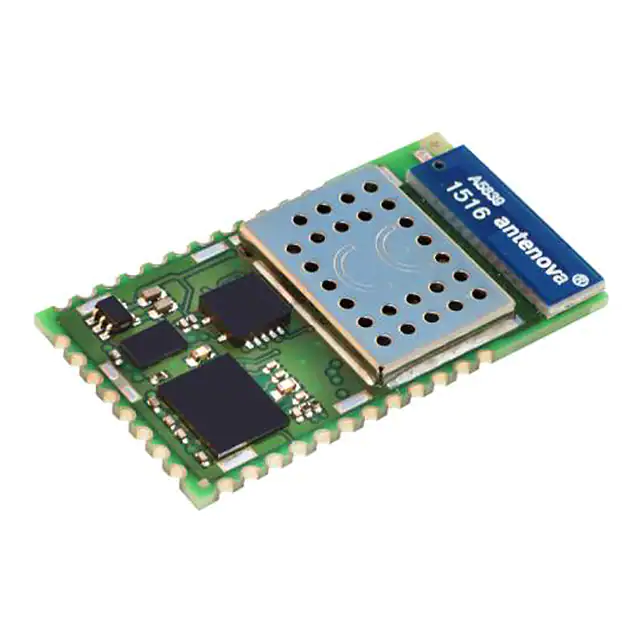
STMicroelectronics SPWF04SA
- Part No.:
- SPWF04SA
- Manufacturer:
- STMicroelectronics
- Category:
- RF Transceiver Modules and Modems
- Package:
- Module
- Datasheet:
-
 SPWF04SA.pdf
- Description:
- RF TXRX MODULE WIFI CHIP SMD
- Quantity:
- Payment:

- Shipping:

Inventory:3,433
Please send an inquiry. Send us your inquiry, and we will respond immediately.
Product details
Overview
SPWF04SA from STMicroelectronics is a certified 802.11b/g/n Wi-Fi module with integrated TCP/IP stack, MicroPython interpreter, and dual-interface support (UART AT command set and SPI packet protocol). It delivers WPA2-PSK/Enterprise security, TLS 1.2, MQTT/HTTP/SMTP/TFTP web services, and on-module GPIO/ADC/PWM peripherals. Used in industrial sensor gateways requiring embedded connectivity without external host MCU.
For engineers reviewing the SPWF04SA datasheet, SPWF04SA pinout, SPWF04SA application, or SPWF04SA equivalent, key selection criteria include integrated MicroPython execution mode (console_enabled=2/3), UART/SPI interface configurability, TLS certificate management via AT+S.TLSCERT, and factory-configurable power states (Active/PowerSave/Sleep/Standby).
Technical Context
The SPWF04SA implements a full OSI Layer 2–7 stack on an STM32F4-based SoC, supporting concurrent client/server socket operations, web server hosting, and RESTful API endpoints. Its firmware includes a MicroPython 1.9.4 interpreter with hardware-abstraction classes for Wi-Fi, sockets, GPIO, ADC, and file system access.
Interface behavior is governed by the console_enabled configuration variable: UART (value=1) uses case-insensitive AT+S.* commands up to 512 bytes; SPI (value=0) uses fixed-format 4-byte header + payload packets; MicroPython modes (values=2/3) enable REPL or autonomous script execution without host processor dependency.
Key Specifications
| Parameter | Value and Actual Design Meaning |
|---|---|
| Wi-Fi Standard | IEEE 802.11b/g/n, 2.4 GHz band, 1×1 SISO, up to 72.2 Mbps PHY rate |
| TCP/IP Stack | Full IPv4 stack with DHCP/DNS/ICMP/ARP, no external OS or TCP/IP offload required |
| Security Protocols | WPA2-PSK & WPA2-Enterprise (EAP-TLS/TTLS/PEAP), TLS 1.2, certificate management via AT+S.TLSCERT/AT+S.WPAECERT |
| Host Interface | UART (default, 115.2 kbps, AT command syntax) or SPI (slave mode, custom packet format, 512-byte max payload) |
| On-Module Compute | MicroPython 1.9.4 interpreter with stdlib + ST-specific modules (wifi, socket, machine, network, os, time) |
| Peripherals | 6 configurable GPIOs, 10-bit ADC (1 channel), 1 PWM output, internal RTC, 2MB Flash + 256KB RAM user-accessible filesystem |
| Power Modes | 4 configurable states: Active (full performance), PowerSave (PS/Fast PS), Sleep (STM32 Stop), Standby (WLAN off, <10 µA) |
Pinout & Package
SPWF04SA is housed in a 22.5 mm × 13.5 mm × 2.3 mm LGA package with 32 solder pads. Pin functions are validated per STMicroelectronics datasheet DS11993 (Rev 4, 2019) and UM2114 (Rev 3, 2018).
| Pin/Terminal | Circuit Role | Design Meaning |
|---|---|---|
| VDD | Supply input | 3.3 V ±5 % main power rail; requires local 10 µF + 100 nF decoupling |
| GND | Ground reference | Common return for RF/analog/digital sections; must be low-impedance plane |
| GPIO0 | Factory reset control | Pull high at power-up to trigger hardware factory restore of configuration variables |
| GPIO8 | MicroPython boot trigger | Pull high at boot to force DefaultScript Hard Execution mode (console_enabled=3) |
| UART_TX | Transmit data output | CMOS-level serial output (3.3 V logic); connects to host MCU RX pin |
| UART_RX | Receive data input | CMOS-level serial input (3.3 V tolerant); connects to host MCU TX pin |
| SPI_CS | Chip select input | Active-low enable for SPI slave operation; synchronous with SPI_CLK |
| SPI_CLK | Clock input | Master-generated clock (max 10 MHz); defines SPI transaction timing |
| SPI_MOSI | Master-out-slave-in | Data path from host MCU to SPWF04SA; carries command payloads and config writes |
| SPI_MISO | Master-in-slave-out | Data path from SPWF04SA to host MCU; carries responses, WINDs, and socket data |
Key Features
| Feature | Design Value |
|---|---|
| Integrated MicroPython interpreter | Enables standalone firmware deployment: no external MCU needed when console_enabled=3 and GPIO8 asserted |
| Dual-host interface configurability | Runtime-selectable UART (AT) or SPI (binary packet) via console_enabled variable - no hardware change required |
| Secure over-the-air updates | Supports signed firmware (SFOTA) and filesystem updates via AT+S.FWUPDATE/AT+S.FSUPDATE with TLS 1.2 transport |
| Hardware-accelerated crypto | STM32F4 cryptographic peripherals (AES-128/256, SHA-1/256, RSA) used for TLS handshake and certificate validation |
| Configurable low-power states | Four distinct power modes with sub-10 µA standby current; controlled via AT+S.PMS and persistent sleep_enabled/wifi_powersave variables |
Applications
| Industrial Sensor Gateway | Smart Building Thermostat |
|---|---|
|
Use Scenario: Edge node collecting temperature/humidity/CO₂ from I²C sensors and transmitting encrypted data to cloud MQTT broker. IC Role / Device Role / Timing Role: Primary Wi-Fi and protocol stack controller; executes MicroPython script for sensor polling, TLS-secured publish, and OTA update handling. Use Value: Eliminates need for separate MCU + Wi-Fi chip; reduces BOM count by 2 components and PCB area by >35%. |
Use Scenario: Wall-mounted HVAC controller connecting to building management system via HTTPS REST API and local Wi-Fi AP. IC Role / Device Role / Timing Role: Full-stack HTTP client and TLS endpoint; manages real-time clock, button interrupts, and PWM fan control via AT+S.TIME/AT+S.GPIOC/AT+S.PWM. Use Value: Enables secure credential storage (AT+S.TLSCERT) and field-upgradable logic without hardware revision. |
| Asset Tracking Beacon | Connected Appliance UI Module |
|
Use Scenario: Battery-powered logistics tag reporting GPS coordinates via SMTP email or HTTP POST on cellular fallback network. IC Role / Device Role / Timing Role: Autonomous Wi-Fi client with scheduled wake-up (AT+S.PMS=2), scan-triggered association, and AT+S.SMTP/AT+S.HTTPPOST execution. Use Value: Achieves >12-month battery life using Sleep mode (2.5 µA) and fast WLAN reconnection (<1.2 s). |
Use Scenario: Microwave oven control panel providing remote diagnostics, usage logging, and firmware updates via home Wi-Fi. IC Role / Device Role / Timing Role: Embedded web server (AT+S.WEB) serving HTML UI; handles AJAX requests, stores logs in on-module filesystem (AT+S.FSM/AT+S.FSC), and validates updates via AT+S.FWUPDATE. Use Value: Delivers consumer-grade OTA capability without external flash or bootloader development effort. |
Equivalent & Alternatives
The following parts are listed as comparable options for similar Wi-Fi module applications.
| Alternative Part | Technical Difference | Application Difference | Selection Advice |
|---|---|---|---|
| ESP32-WROOM-32 | Lacks pre-certified 802.11n RF layout; requires external antenna tuning and FCC/CE re-certification; no built-in TLS 1.2 hardware acceleration | Requires full custom firmware stack (FreeRTOS + lwIP + mbedTLS); no native AT command set or MicroPython integration | Choose when cost sensitivity outweighs certification time and security assurance requirements |
| CC3220SF | TI's dual-band (2.4/5 GHz) module with ARM Cortex-M4F; supports same AT command subset but no MicroPython; uses proprietary SimpleLink SDK instead | Requires TI-provided IDE and closed-source drivers; lacks TFTP/SMTP/MQTT server-side implementation; no on-module web server | Prefer when existing TI ecosystem investment exists and 5 GHz support is mandatory |
Compared with ESP32-WROOM-32 and CC3220SF, SPWF04SA uniquely combines regulatory certification, production-ready MicroPython runtime, and full-featured embedded web/SMTP/MQTT services - reducing time-to-certification by ≥14 weeks and eliminating third-party stack licensing fees.
Availability
SPWF04SA is available at Aetrix Electronics and suitable for industrial sensor gateways, smart building thermostats, asset tracking beacons, and connected appliance UI modules requiring stable component supply and long-term lifecycle support.
Supply support for SPWF04SA includes scheduled delivery planning, volume procurement assistance, BOM continuity management, traceable sourcing, and lifecycle availability coordination for OEM customers, industrial embedded developers, connected-device designers, and electronics production programs.
Manufacturer
STMicroelectronics is a global semiconductor leader headquartered in Geneva, Switzerland, designing and manufacturing microcontrollers, analog ICs, MEMS, and wireless solutions for industrial, automotive, and consumer markets.
The SPWF04Sx series belongs to ST's certified Wi-Fi module product line, engineered specifically for secure, low-footprint, host-processor-free IoT edge nodes requiring rapid time-to-market and regulatory compliance out-of-box.
FAQ
Does SPWF04SA support WPA3 or Wi-Fi 6?
No. SPWF04SA implements IEEE 802.11b/g/n (Wi-Fi 4) only, with WPA2-PSK and WPA2-Enterprise security. It does not support WPA3 encryption, 802.11ac (Wi-Fi 5), or 802.11ax (Wi-Fi 6) modulation schemes or features. Its RF front-end and baseband are designed exclusively for 2.4 GHz 802.11n operation at up to 72.2 Mbps.
Can SPWF04SA operate as a Wi-Fi access point (AP)?
Yes - in "Mini AP" mode, SPWF04SA can act as a soft AP supporting up to 4 concurrent clients. This is configured via AT+S.WIFI=2 and verified by AT+S.STS=wifi_state returning value 2. The module serves DHCP, hosts a web server (AT+S.WEB), and allows peer discovery via AT+S.PEERS, enabling local provisioning without upstream infrastructure.
What is the maximum file size supported for AT+S.FWUPDATE?
The firmware image size limit is 1 MB, constrained by the internal Flash partition reserved for FOTA updates. Verified in UM2114 Section 6.14 and DS11993 Table 12: "Firmware Update Area Size = 1024 KB". Larger images will fail with AT-S.ERROR:0x3A ("Image too large") and require segmentation or filesystem compression prior to upload.
Is hardware flow control required for AT+S.FSWRITE over UART?
Yes - STMicroelectronics explicitly mandates RTS/CTS handshaking for AT+S.FSWRITE (UM2114 Section 6.12). Without hardware flow control enabled, UART buffer overflow occurs during multi-kilobyte transfers, causing command timeout or partial write failure. The module's UART peripheral does not support software (XON/XOFF) flow control for this command.
SPWF04SA Specifications
- Product attributes
- Attribute value
- Manufacturer:
- STMicroelectronics
- Series:
- -
- Package/Case:
- Module
- Packaging:
- Tray
- Product Status:
- Obsolete
- Programmable:
- Not Verified
- RF Family/Standard:
- WiFi
- Protocol:
- 802.11b/g/n
- Modulation:
- DSSS, OFDM
- Frequency:
- 2.4GHz
- Data Rate:
- 54Mbps
- Power - Output:
- 18.3dBm
- Sensitivity:
- -96dBm
- Serial Interfaces:
- I2C, SPI, UART
- Antenna Type:
- Integrated, Chip
- Utilized IC / Part:
- -
- Memory Size:
- -
- Voltage - Supply:
- 3.3V
- Current - Receiving:
- 105mA
- Current - Transmitting:
- 260mA
- Mounting Type:
- Surface Mount
- Operating Temperature:
- -40°C ~ 85°C
SPWF04SA FAQ
1.How can I place an order for SPWF04SA through Aetrix?
Please submit a Request for Quotation (RFQ) for SPWF04SA on Aetrix. Our sales agent will provide a competitive quotation and guide you through the order confirmation once you accept the terms.
2.Are the price and stock information for SPWF04SA reliable?
The price and inventory of SPWF04SA are updated periodically and may fluctuate due to market conditions. Stock and pricing data are typically refreshed every 24 hours. Quotation validity for SPWF04SA is usually 5 days.
3.What payment methods are accepted for SPWF04SA?
We accept Wire Transfer, PayPal, Credit Card, Western Union, MoneyGram, and Escrow for SPWF04SA transactions.
Note: Certain payment methods may incur a processing fee.
4.How is shipping managed for SPWF04SA?
SPWF04SA orders can be shipped via leading logistics carriers, including DHL, UPS, FedEx, TNT, or Registered Mail.
Once your SPWF04SA order is processed, you will receive an email with the shipment details and tracking number.
Note: Tracking information may take up to 24 hours to appear. Express delivery typically takes 3–5 business days.
5.How can I obtain technical support or documentation for SPWF04SA?
For technical support, including SPWF04SA datasheets, pinout diagrams, or application guidance, please contact our engineering support team. They can provide detailed documentation and assistance for your SPWF04SA requirements.
6.How does Aetrix verify that SPWF04SA is sourced from the original manufacturer or authorized distributors?
All SPWF04SA products on Aetrix are procured from qualified distributors and authorized channels. Our dedicated quality assurance team conducts strict verification, including traceability checks and, if necessary, third-party testing. This ensures that SPWF04SA meets industry standards.
7.What is the process for return or replacement of SPWF04SA?
All SPWF04SA units undergo pre-shipment inspection (PSI). If there is an issue with SPWF04SA, returns or replacements are accepted under the following conditions:
1.Quantity discrepancies, incorrect items, or visible external defects (such as breakage or corrosion), acknowledged by Aetrix.
2.The issue is reported within 90 days of delivery.
3.The SPWF04SA part is unused and in its original packaging.
Return procedure for SPWF04SA:
1.Submit a request within 90 days.
2.Obtain a Return Material Authorization (RMA) from Aetrix.
SPWF04SA Tags

-
ESP32-C3FH4
Espressif Systems
-
ESP32-S2FH4
Espressif Systems
-
ESP32-S2FN4R2
Espressif Systems
-
ESP32-C3-MINI-1-N4
Espressif Systems
-
ESP32-C3-WROOM-02-N4
Espressif Systems
-
ESP32-C3-MINI-1U-N4
Espressif Systems
-
ESP32-C3-MINI-1U-H4
Espressif Systems
-
ESP32-C3-WROOM-02U-N4
Espressif Systems
-
ESP32-H2-MINI-1-N4
Espressif Systems
-
ESP32-H2-MINI-1-H4
Espressif Systems
_viewa.jpg)
-
ESP32-MINI-1-N4
Espressif Systems
-
ESP32-S2-MINI-2-N4R2
Espressif Systems
Tech Hub

An engineering guide to LED driver operation, constant-current and constant-voltage outputs, linear and switching topologies, dimming, IC selection, calculations, replacement compatibility, and fault c…

Operational amplifier guide covering op amp basics, feedback, ideal vs real op amps, common configurations, buffer circuits, offset, bias current, gain-bandwidth, slew rate, rail-to-rail limits and sel…

Jumper cables guide covering safe connection order, red and black clamp placement, final ground connection, cable gauge, length, clamp quality, copper vs CCA cables, jump starter comparison and battery…

LDO regulator guide covering low dropout voltage, power dissipation, thermal design, PSRR, output noise, capacitor stability, adjustable LDO circuits, LDO vs buck converter and datasheet selection chec…

Conditional Access Module guide covering CAM meaning, CI/CI+ interface, smart card authorization, DVB security workflow, TV and set-top box compatibility, internal electronics, ESD protection, connecto…

Guide to electronic component obsolescence covering EOL risk, PCN/PDN notices, last-time buy planning, replacement options, form-fit-function validation, counterfeit risk and BOM lifecycle management.

18650 battery guide covering lithium-ion cell basics, 3.6V/3.7V voltage, 4.2V charging, mAh and Wh capacity, protected cells, chargers, BMS, series-parallel packs, holders, welding and sourcing checks.…

Hall effect sensor guide covering working principle, linear and digital sensors, Arduino circuits, current sensing, speed detection, automotive applications, A3144 examples, signal filtering and datash…

Product Change Notification guide for electronic components, covering PCN meaning, PCN vs PDN/EOL, common change types, risk levels, form-fit-function review, engineering validation, BOM control, LTB/L…

A practical guide to blend door actuators, covering HVAC function, symptoms, location, AC and heater issues, reset and calibration, replacement cost, electrical diagnosis, compatibility checks, and rep…


