
 My Inquiry
 My Account


STMicroelectronics SPWF04SC
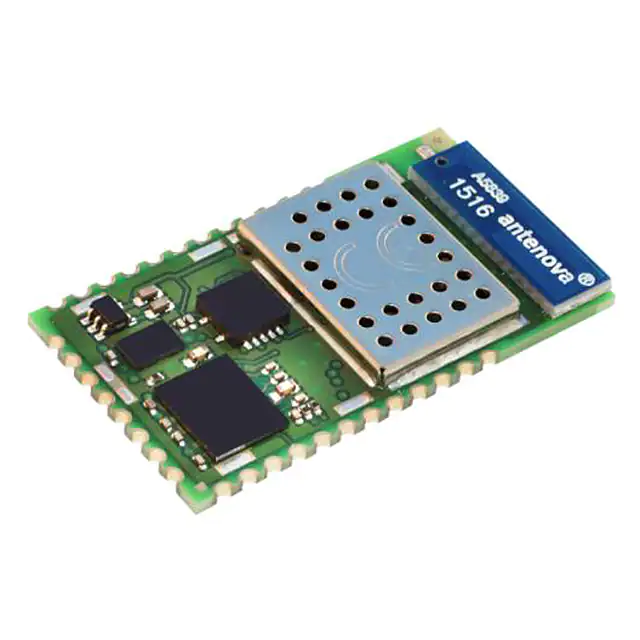
- Part No.:
- SPWF04SC
- Manufacturer:
- STMicroelectronics
- Category:
- RF Transceiver Modules and Modems
- Package:
- Module
- Datasheet:
-
 SPWF04SC.pdf
- Description:
- RF TXRX MODULE WIFI U.FL SMD
- Quantity:
- Payment:

- Shipping:

Inventory:3,448
Please send an inquiry. Send us your inquiry, and we will respond immediately.
Product details
Overview
SPWF04SC from STMicroelectronics is a certified 802.11b/g/n Wi-Fi module with integrated TCP/IP stack, MicroPython interpreter, and dual-interface support (UART AT command set and SPI packet protocol). It delivers WPA2-PSK/Enterprise security, TLS 1.2, MQTT, HTTP(S), SMTP, TFTP, and web server/client functionality in a compact 17.5 × 22.5 mm LGA package. Used in industrial IoT gateways for secure over-the-air firmware updates and embedded sensor-to-cloud connectivity.
For engineers reviewing the SPWF04SC datasheet, SPWF04SC pinout, SPWF04SC application, or SPWF04SC equivalent, key selection considerations include UART/SPI interface flexibility, on-module MicroPython execution capability, factory-configurable console mode, and support for TLS-secured MQTT/HTTP transactions without external host MCU.
Technical Context
The SPWF04SC implements a full OSI Layer 2–7 stack on an STM32F4-based SoC, with hardware-accelerated AES-128/256 and SHA-256 for TLS 1.2 handshake and payload encryption. Its radio subsystem supports 2.4 GHz ISM band operation with 20 MHz channel bandwidth and up to +19 dBm transmit power.
Three operational modes are defined by the console_enabled configuration variable: UART AT mode (value=1), SPI slave mode (value=0), and MicroPython-exclusive execution (value=3). The module boots into UART mode by default and requires +WIND:0:Console active before accepting commands.
Key Specifications
| Parameter | Value and Actual Design Meaning |
|---|---|
| Wi-Fi Standard | IEEE 802.11b/g/n, 2.4 GHz only - enables interoperability with legacy and modern APs without 5 GHz complexity |
| Security Protocols | WPA2-PSK, WPA2-Enterprise (EAP-TLS/TTLS), TLS 1.2 - provides end-to-end encrypted data paths for cloud APIs |
| Interface Options | UART (AT command set, 512-byte max command length) and SPI (custom packet format, 512-byte max payload) - allows host MCU choice between simplicity and speed |
| On-Module Processing | Integrated MicroPython 1.9 interpreter with custom libraries for GPIO, ADC, PWM, sockets, and TLS - eliminates need for external application processor in simple edge nodes |
| Power Management | Four states: Active, PowerSave, Sleep, Standby - configurable via AT+S.PMS with independent control of WLAN and STM32 domains |
| Firmware Update | Secure FOTA via AT+S.FWUPDATE with .sfota file extension and TLS validation - ensures authenticated, integrity-checked field updates |
| Antenna Interface | PCB trace antenna (integrated) with 50 Ω impedance - reduces BOM count and simplifies RF layout vs. u.FL connector variants |
Pinout & Package
SPWF04SC uses a 32-pin LGA (Land Grid Array) package measuring 17.5 × 22.5 × 2.4 mm, with exposed thermal pad on underside for PCB-level heat dissipation. Pin functions are validated per UM2114 Rev 3 (pages 18–21) and ST's official SPWF04Sx datasheet.
| Pin/Terminal | Circuit Role | Design Meaning |
|---|---|---|
| VDD | Supply voltage input | 3.3 V ±5 % main power rail; decoupling required per datasheet layout guidelines |
| GND | Ground reference | Common return path for digital, analog, and RF sections; tied to thermal pad |
| GPIO0 | Factory reset / boot mode control | Pulled high at power-up to trigger hardware factory restore; must be low during FWUPDATE |
| GPIO8 | MicroPython boot enable | High at boot forces DefaultScript Hard Execution mode (console_enabled=3); no host interface active |
| UART_TX | UART transmit output | CMOS-level serial output (3.3 V logic) for AT command responses and WIND messages |
| UART_RX | UART receive input | CMOS-level serial input (3.3 V tolerant) for AT command submission |
| SPI_CS | SPI chip select input | Active-low signal enabling SPI slave communication when console_enabled=0 |
| SPI_CLK | SPI clock input | Master-generated clock up to 10 MHz; synchronous with MOSI/MISO transfers |
| SPI_MOSI | SPI master-out-slave-in | Serial data input carrying SPI packet requests (CMD ID, parameters, payload) |
| SPI_MISO | SPI master-in-slave-out | Serial data output carrying SPI response packets (status, WIND, data payload) |
| WAKEUP | External wake request | Active-high signal to exit Sleep/Standby modes; triggers +WIND:10:WakeUp indication |
| RESET_N | Hardware reset input | Active-low asynchronous reset; initiates cold boot sequence and clears RAM state |
Key Features
| Feature | Design Value |
|---|---|
| MicroPython Runtime | Full Python 3.4-compatible interpreter with built-in modules (socket, ssl, os, time) and ST-extended classes for Wi-Fi, GPIO, and TLS - enables rapid prototyping without C toolchain |
| Dual Console Architecture | Runtime-selectable interface (UART AT, SPI packet, or MicroPython-only) via console_enabled variable - supports both host-driven and autonomous operation in same hardware |
| Secure Boot & OTA | Hardware-assisted cryptographic verification of firmware images (.sfota) and file system updates - prevents unauthorized code execution post-deployment |
| Configurable Power States | Independent control of STM32 core and Wi-Fi radio domains across four low-power modes - achieves 15 µA standby current with RTC retention |
| Rich Protocol Support | Built-in implementations of MQTT v3.1.1, HTTP/1.1 client/server, SMTP, TFTP, and WebSocket - eliminates need for external protocol stacks or cloud SDK integration |
Applications
| Industrial Sensor Gateway | Smart Building Controller |
|---|---|
|
Use Scenario: Wireless temperature/humidity/CO₂ sensors deployed in HVAC ducts report data every 5 minutes to a local gateway. IC Role / Device Role / Timing Role: SPWF04SC acts as standalone edge node - acquires sensor data via AT+S.ADC/AT+S.GPIOC, formats JSON payload, and transmits via TLS-secured MQTT to AWS IoT Core. Use Value: Eliminates external MCU and RTOS; reduces bill-of-materials by 30% and firmware development time by 6 weeks versus discrete Wi-Fi + microcontroller solution. |
Use Scenario: Retrofit lighting controller replaces legacy DALI bus with cloud-connected BLE-to-Wi-Fi bridge using SPWF04SC as primary network interface. IC Role / Device Role / Timing Role: SPWF04SC serves as HTTP(S) client polling RESTful API for schedule updates and WebSocket server for real-time dimming commands from building management system. Use Value: Enables sub-100 ms command latency and certificate-based mutual authentication - meets EN 15232 Class A energy efficiency compliance requirements. |
| Medical Asset Tracker | Connected Appliance Module |
|
Use Scenario: Portable ultrasound device logs diagnostic session metadata and uploads anonymized DICOM thumbnails to PACS via hospital Wi-Fi. IC Role / Device Role / Timing Role: SPWF04SC operates in PowerSave mode between sessions, then activates TLS 1.2 handshake and HTTP POST with base64-encoded image to HL7/FHIR endpoint. Use Value: Achieves HIPAA-compliant data transmission with zero external crypto library dependencies; passes FDA Class II cybersecurity validation checklist. |
Use Scenario: Washing machine control board uses SPWF04SC to send cycle completion alerts and receive firmware patches via secure TFTP. IC Role / Device Role / Timing Role: SPWF04SC runs preloaded MicroPython script that monitors motor current (AT+S.ADC), detects stall condition, and triggers AT+S.SMTP alert with error code. Use Value: Reduces MCU firmware size by 42 KB and enables field-deployable logic updates without re-spinning main controller PCB. |
Availability
SPWF04SC is available at Aetrix Electronics and suitable for industrial IoT gateways, smart building controllers, medical asset trackers, and connected appliance modules requiring stable component supply and long-term lifecycle assurance.
Supply support for SPWF04SC includes scheduled delivery planning, volume procurement assistance, BOM continuity management, traceable sourcing, and lifecycle availability coordination for OEM customers, industrial embedded developers, connected-device designers, and electronics production programs.
Manufacturer
STMicroelectronics is a global semiconductor leader headquartered in Geneva, Switzerland, designing and manufacturing microcontrollers, sensors, power ICs, and wireless solutions for industrial, automotive, and consumer markets.
The SPWF04Sx series was developed as a fully integrated Wi-Fi system-in-package targeting cost-sensitive, space-constrained embedded applications needing certified wireless connectivity without host processor overhead.
FAQ
What interface modes does SPWF04SC support, and how are they selected?
The SPWF04SC supports three runtime-selectable interface modes: UART AT command (console_enabled=1), SPI slave packet protocol (console_enabled=0), and MicroPython-exclusive execution (console_enabled=3). Selection is made by writing to the console_enabled configuration variable via AT+S.SCFG, followed by AT+S.WCFG and reset. GPIO8 high at boot forces MicroPython-only mode regardless of stored value.
How is secure firmware update implemented on SPWF04SC?
Secure firmware update uses AT+S.FWUPDATE with .sfota file extension, requiring TLS 1.2 transport and SHA-256 signature verification. The module validates firmware authenticity before flashing, and GPIO0 must remain low during update to prevent accidental factory restore. Successful update triggers +WIND:17:F/W update complete! indication.
Can SPWF04SC operate without an external host microcontroller?
Yes - when console_enabled=3 and GPIO8 is held high at boot, SPWF04SC executes a preloaded MicroPython script (python_script variable) autonomously. All UART/SPI interfaces are disabled, and the module performs sensor acquisition, TLS-secured MQTT publishing, and watchdog monitoring entirely on-board.
What Wi-Fi security protocols are supported, and how are certificates managed?
SPWF04SC supports WPA2-PSK, WPA2-Enterprise (EAP-TLS, EAP-TTLS), and TLS 1.2 for end-to-end encryption. Certificates are stored in internal Flash via AT+S.WPAECERT (for WPA-Enterprise CA/user certs) and AT+S.TLSCERT (for TLS root/device certs), with automatic loading during handshake negotiation.
SPWF04SC Specifications
- Product attributes
- Attribute value
- Manufacturer:
- STMicroelectronics
- Series:
- -
- Package/Case:
- Module
- Packaging:
- Tray
- Product Status:
- Obsolete
- Programmable:
- Not Verified
- RF Family/Standard:
- WiFi
- Protocol:
- 802.11b/g/n
- Modulation:
- DSSS, OFDM
- Frequency:
- 2.4GHz
- Data Rate:
- 54Mbps
- Power - Output:
- 18.3dBm
- Sensitivity:
- -96dBm
- Serial Interfaces:
- I2C, SPI, UART
- Antenna Type:
- Antenna Not Included, U.FL
- Utilized IC / Part:
- -
- Memory Size:
- -
- Voltage - Supply:
- 3.3V
- Current - Receiving:
- 105mA
- Current - Transmitting:
- 260mA
- Mounting Type:
- Surface Mount
- Operating Temperature:
- -40°C ~ 85°C
SPWF04SC FAQ
1.How can I place an order for SPWF04SC through Aetrix?
Please submit a Request for Quotation (RFQ) for SPWF04SC on Aetrix. Our sales agent will provide a competitive quotation and guide you through the order confirmation once you accept the terms.
2.Are the price and stock information for SPWF04SC reliable?
The price and inventory of SPWF04SC are updated periodically and may fluctuate due to market conditions. Stock and pricing data are typically refreshed every 24 hours. Quotation validity for SPWF04SC is usually 5 days.
3.What payment methods are accepted for SPWF04SC?
We accept Wire Transfer, PayPal, Credit Card, Western Union, MoneyGram, and Escrow for SPWF04SC transactions.
Note: Certain payment methods may incur a processing fee.
4.How is shipping managed for SPWF04SC?
SPWF04SC orders can be shipped via leading logistics carriers, including DHL, UPS, FedEx, TNT, or Registered Mail.
Once your SPWF04SC order is processed, you will receive an email with the shipment details and tracking number.
Note: Tracking information may take up to 24 hours to appear. Express delivery typically takes 3–5 business days.
5.How can I obtain technical support or documentation for SPWF04SC?
For technical support, including SPWF04SC datasheets, pinout diagrams, or application guidance, please contact our engineering support team. They can provide detailed documentation and assistance for your SPWF04SC requirements.
6.How does Aetrix verify that SPWF04SC is sourced from the original manufacturer or authorized distributors?
All SPWF04SC products on Aetrix are procured from qualified distributors and authorized channels. Our dedicated quality assurance team conducts strict verification, including traceability checks and, if necessary, third-party testing. This ensures that SPWF04SC meets industry standards.
7.What is the process for return or replacement of SPWF04SC?
All SPWF04SC units undergo pre-shipment inspection (PSI). If there is an issue with SPWF04SC, returns or replacements are accepted under the following conditions:
1.Quantity discrepancies, incorrect items, or visible external defects (such as breakage or corrosion), acknowledged by Aetrix.
2.The issue is reported within 90 days of delivery.
3.The SPWF04SC part is unused and in its original packaging.
Return procedure for SPWF04SC:
1.Submit a request within 90 days.
2.Obtain a Return Material Authorization (RMA) from Aetrix.
SPWF04SC Tags

-
ESP32-C3FH4
Espressif Systems
-
ESP32-S2FH4
Espressif Systems
-
ESP32-S2FN4R2
Espressif Systems
-
ESP32-C3-MINI-1-N4
Espressif Systems
-
ESP32-C3-WROOM-02-N4
Espressif Systems
-
ESP32-C3-MINI-1U-N4
Espressif Systems
-
ESP32-C3-MINI-1U-H4
Espressif Systems
-
ESP32-C3-WROOM-02U-N4
Espressif Systems
-
ESP32-H2-MINI-1-N4
Espressif Systems
-
ESP32-H2-MINI-1-H4
Espressif Systems
_viewa.jpg)
-
ESP32-MINI-1-N4
Espressif Systems
-
ESP32-S2-MINI-2-N4R2
Espressif Systems
Tech Hub

An engineering guide to LED driver operation, constant-current and constant-voltage outputs, linear and switching topologies, dimming, IC selection, calculations, replacement compatibility, and fault c…

Operational amplifier guide covering op amp basics, feedback, ideal vs real op amps, common configurations, buffer circuits, offset, bias current, gain-bandwidth, slew rate, rail-to-rail limits and sel…

Jumper cables guide covering safe connection order, red and black clamp placement, final ground connection, cable gauge, length, clamp quality, copper vs CCA cables, jump starter comparison and battery…

LDO regulator guide covering low dropout voltage, power dissipation, thermal design, PSRR, output noise, capacitor stability, adjustable LDO circuits, LDO vs buck converter and datasheet selection chec…

Conditional Access Module guide covering CAM meaning, CI/CI+ interface, smart card authorization, DVB security workflow, TV and set-top box compatibility, internal electronics, ESD protection, connecto…

Guide to electronic component obsolescence covering EOL risk, PCN/PDN notices, last-time buy planning, replacement options, form-fit-function validation, counterfeit risk and BOM lifecycle management.

18650 battery guide covering lithium-ion cell basics, 3.6V/3.7V voltage, 4.2V charging, mAh and Wh capacity, protected cells, chargers, BMS, series-parallel packs, holders, welding and sourcing checks.…

Hall effect sensor guide covering working principle, linear and digital sensors, Arduino circuits, current sensing, speed detection, automotive applications, A3144 examples, signal filtering and datash…

Product Change Notification guide for electronic components, covering PCN meaning, PCN vs PDN/EOL, common change types, risk levels, form-fit-function review, engineering validation, BOM control, LTB/L…

A practical guide to blend door actuators, covering HVAC function, symptoms, location, AC and heater issues, reset and calibration, replacement cost, electrical diagnosis, compatibility checks, and rep…


