
 My Inquiry
 My Account


NXP Semiconductors SSL5031CTS/1X
- Part No.:
- SSL5031CTS/1X
- Manufacturer:
- NXP Semiconductors
- Category:
- LED Drivers
- Package:
- SC-74, SOT-457
- Datasheet:
-
 SSL5031CTS/1X.pdf
- Description:
- IC LED DRIVER OFFL SC74
- Quantity:
- Payment:

- Shipping:

Inventory:1,718
Please send an inquiry. Send us your inquiry, and we will respond immediately.
Product details
Overview
SSL5031CTS from NXP Semiconductors is a non-isolated buck LED driver controller with external MOSFET, operating in Boundary Conduction Mode (BCM) for fixed-output-current LED lighting up to 25 W. It delivers high power factor (>0.9) and low THD (<15%) across universal mains (90–277 VAC), features on-time regulation, adaptive switching frequency, and integrated valley detection for ZCS turn-on. Its primary role is precision current control in cost-sensitive, single-layer PCB LED lamp designs.
For engineers reviewing the SSL5031CTS datasheet, SSL5031CTS pinout, SSL5031CTS application, or SSL5031CTS equivalent, key selection considerations include BCM-based constant-current accuracy (±3%), ultra-low operating supply current (<150 µA), TSOP6 package thermal resistance (Rth(j-a) = 259 K/W), and integrated protections including OVP, OSP, OTP, and cycle-by-cycle OCP - all critical for reliable mains-connected LED driver design.
Technical Context
The SSL5031CTS implements a source-switched, BCM-controlled buck topology with internal switch (RDS(on) = 0.75 Ω typ. at 25 °C) and valley-sensing via DEMOVP pin to enable zero-current switching. Its on-time regulation uses average voltage feedback from ISNS (Vintregd(AV) = 0.410 V) to maintain precise LED current independent of line and load variations.
Startup occurs directly from an external resistor without auxiliary winding or dV/dt supply; VCC is internally clamped to 15.8 V (typ.) with UVLO hysteresis (Vstartup = 12.65 V, Vth(UVLO) = 9.9 V). Protection architecture includes cycle-by-cycle OCP triggered at VI(max)ISNS = 1.8 V, output short detection via demagnetization timeout (>40 µs), and latched OVP requiring VCC discharge to 6.2 V before restart.
Key Specifications
| Parameter | Value and Actual Design Meaning |
|---|---|
| VIN Range | 90–277 VAC universal mains input; enables single-BOM global lighting deployment |
| Output Power | Up to 25 W; supports compact non-isolated LED lamp designs with fixed current output |
| Power Factor | >0.9 at full load; meets EN61000-3-2 Class C harmonic limits for lighting |
| THD | <15% typical; reduces EMI filter complexity and improves system efficiency |
| LED Current Accuracy | ±3% over line/load/temperature; achieved via regulated ISNS average voltage (0.410 V) |
| Operating Supply Current | 125 µA typical at 100 kHz; enables minimal VCC bias resistor power loss |
| Thermal Resistance | Rth(j-a) = 259 K/W; defines maximum power dissipation (0.28 W) in free-air JEDEC board |
| OVP Threshold | 1.81 V on DEMOVP pin; sets accurate LED string overvoltage trip with 3-cycle noise immunity |
Pinout & Package
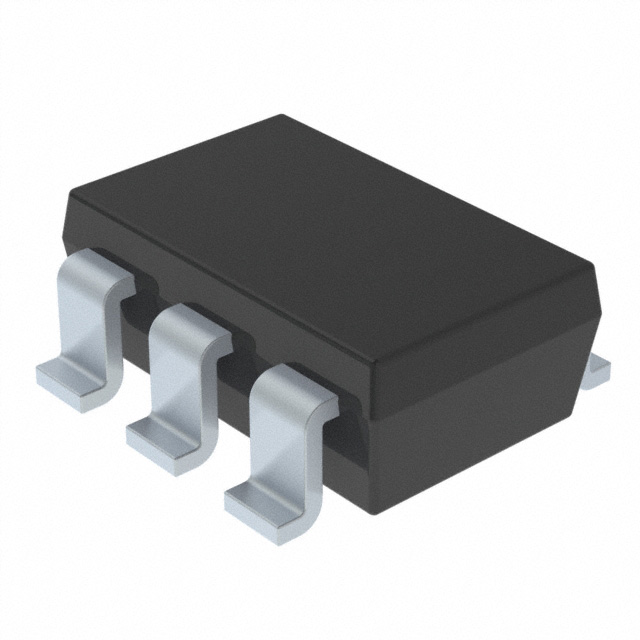
The SSL5031CTS is housed in a plastic surface-mounted TSOP6 (SOT457) package measuring 2.9 × 1.5 × 1.05 mm, optimized for high-density LED driver PCB layouts and thermal performance on single-layer boards.
| Pin/Terminal | Circuit Role | Design Meaning |
|---|---|---|
| ISNS (Pin 1) | Current sense input | Measures inductor peak current via external shunt; regulates on-time to maintain precise average LED current |
| VCC (Pin 2) | Supply voltage input | Internally clamped to 15.8 V; accepts direct resistor bias without auxiliary winding or Zener diode |
| SW (Pin 3) | Internal switch drain | Drives external MOSFET gate; integrates RDS(on) = 0.75 Ω (25 °C) for low-loss startup and control |
| DEMOVP (Pin 4) | Demagnetization timing & OVP sensing | Detects valley for ZCS turn-on and monitors LED voltage via resistive divider for accurate OVP |
| GND (Pin 5) | Ground reference | Common return for ISNS, COMP, and internal regulators; requires low-impedance PCB connection |
| COMP (Pin 6) | Loop compensation node | Connects external RC network to stabilize current regulation loop; clamped at 4.7 V max |
Key Features
| Feature | Design Value |
|---|---|
| Boundary Conduction Mode (BCM) operation | Enables constant LED current accuracy (±3%) without secondary-side feedback or optocoupler |
| Valley detection with ZCS turn-on | Reduces switching losses by triggering SW at inductor current zero-crossing; improves efficiency to 91% |
| Integrated OVP, OSP, OTP, UVLO, and cycle-by-cycle OCP | Provides full-system protection without external components; eliminates need for discrete fault management circuitry |
| Single-resistor VCC startup | Eliminates auxiliary winding and dV/dt circuitry; simplifies BOM and reduces PCB footprint by >30% |
| Leading-edge blanking (100 ns typ.) | Suppresses false OCP triggering from MOSFET drain capacitance spikes during turn-on |
| Hotaru switch compatibility | Supports wall switches with built-in standby LEDs without flicker or false triggering during dimming transitions |
Applications
| LED Tube Replacement | Downlight Retrofit Module |
|---|---|
Use Scenario: Retrofitting fluorescent T8 tubes with LED equivalents in commercial office lighting using universal AC input. IC Role / Device Role / Timing Role: SSL5031CTS acts as the primary buck controller regulating constant LED current without isolation, managing demagnetization timing and valley switching. Use Value: Enables compact, single-layer PCB design with <25 W output, high PF (>0.9), and THD <15%, meeting IEC62384 requirements for LED modules. | Use Scenario: Integrating into recessed downlights powered directly from 120/230 VAC mains with no transformer. IC Role / Device Role / Timing Role: SSL5031CTS provides boundary-mode current regulation and adaptive frequency control to minimize EMI while maintaining tight current tolerance. Use Value: Delivers ±3% LED current accuracy across temperature and line variation, extending LED lifetime and ensuring consistent lumen output. |
| LED Panel Light Driver | Commercial Bulkhead Fixture |
Use Scenario: Driving edge-lit LED panels in retail signage where space and thermal constraints limit heatsink size. IC Role / Device Role / Timing Role: SSL5031CTS serves as the non-isolated buck controller with integrated valley detection to reduce conduction losses and improve thermal efficiency. Use Value: Achieves 91% peak efficiency and ultra-low operating current (125 µA), reducing self-heating and enabling smaller thermal pads on FR-4 PCB. | Use Scenario: Powering emergency-rated bulkhead fixtures requiring robust protection and stable operation under fluctuating mains conditions. IC Role / Device Role / Timing Role: SSL5031CTS executes cycle-by-cycle OCP, latched OVP, and OTP to ensure fail-safe shutdown during overvoltage, short-circuit, or thermal overload events. Use Value: Eliminates need for external protection ICs or discrete thermal cutoffs, simplifying certification for EN61347-1/2-13 compliance. |
Equivalent & Alternatives
The following parts are listed as comparable options for similar buck LED driver controller applications.
| Alternative Part | Technical Difference | Application Difference | Selection Advice |
|---|---|---|---|
| SSL5031BTS | Includes high-temperature foldback function; identical pinout and core BCM control but adds thermal derating above 118 °C | Better suited for enclosed fixtures with limited airflow where junction temperature exceeds 130 °C | Select SSL5031BTS when ambient temperature exceeds 75 °C or enclosure thermal resistance is >40 K/W |
| SSL5021BTS | Optimized for low-ripple operation with different OCP threshold and valley detection timing; not pin-compatible | Targets applications requiring <5% LED current ripple, such as video studio lighting | Choose SSL5021BTS only when ripple specification dominates over power factor and THD requirements |
Compared with SSL5031BTS, the SSL5031CTS offers higher efficiency at nominal temperature but lacks thermal foldback; compared with SSL5021BTS, it prioritizes PF/THD over ripple suppression and maintains full pin compatibility with TSOP6 layout reuse.
Availability
SSL5031CTS is available at Aetrix Electronics and suitable for LED tube replacement, downlight retrofit modules, panel light drivers, and commercial bulkhead fixtures requiring stable component supply, long-term lifecycle support, and RoHS-compliant packaging.
Supply support for SSL5031CTS includes scheduled delivery planning, volume procurement assistance, BOM continuity management, traceable sourcing, and lifecycle availability coordination for OEM customers, industrial embedded developers, connected-device designers, and electronics production programs.
Manufacturer
NXP Semiconductors is a global semiconductor company headquartered in Eindhoven, Netherlands, specializing in secure connectivity solutions for automotive, industrial, and IoT applications.
The SSL5031CTS belongs to NXP's SSL (Solid-State Lighting) controller family, engineered specifically for cost-effective, high-efficiency, non-isolated LED drivers targeting universal-mains residential and commercial lighting.
FAQ
What is the primary function of the SSL5031CTS in an LED lighting system?
The SSL5031CTS functions as a boundary conduction mode (BCM) buck LED driver controller that regulates precise constant current to LED strings directly from rectified universal AC mains (90–277 VAC). It integrates valley detection, on-time regulation, and comprehensive protection-enabling non-isolated, high-power-factor (>0.9), low-THD (<15%) LED driver designs without optocouplers or auxiliary windings. The SSL5031CTS achieves this using its internal switch, ISNS current sensing, and DEMOVP-based demagnetization timing.
Does the SSL5031CTS require an auxiliary winding or external Zener diode for VCC supply?
No, the SSL5031CTS does not require an auxiliary winding or external Zener diode for VCC supply. It starts up and operates directly from a single external resistor connected to the rectified mains, thanks to its internal clamp circuit limiting VCC to 15.8 V (typ.). The datasheet confirms that if the external resistor current minus IC operating current remains below 8.8 mA (II(VCC) max), no Zener is needed-simplifying design and reducing BOM count. This capability is intrinsic to the SSL5031CTS architecture.
How does the SSL5031CTS achieve high power factor and low THD?
The SSL5031CTS achieves high power factor (>0.9) and low THD (<15%) through boundary conduction mode (BCM) operation combined with on-time regulation and adaptive switching frequency. BCM ensures near-sinusoidal input current draw aligned with the AC voltage waveform, while the internal controller dynamically adjusts switching frequency based on inductor value and load-optimizing conduction timing without requiring complex active PFC stages. These features are inherent to the SSL5031CTS control algorithm and do not depend on external components.
What protections are integrated into the SSL5031CTS?
The SSL5031CTS integrates UnderVoltage LockOut (UVLO), cycle-by-cycle OverCurrent Protection (OCP), internal OverTemperature Protection (OTP), Output OverVoltage Protection (OVP), Output Short Protection (OSP), and cycle-by-cycle maximum on-time protection. All are implemented internally with dedicated pins (e.g., ISNS for OCP, DEMOVP for OVP/OSP, VCC for UVLO) and require no external components. For example, OVP triggers after three consecutive DEMOVP voltage violations above 1.81 V, initiating a controlled VCC discharge to 6.2 V before restart-ensuring robust, self-contained fault handling in the SSL5031CTS.
Is the SSL5031CTS pin-compatible with other devices in the SSL50xx family?
Yes, the SSL5031CTS is pin-compatible with the SSL5031BTS, sharing identical TSOP6 (SOT457) pinout, pin functions, and electrical characteristics for ISNS, VCC, SW, DEMOVP, GND, and COMP. This allows direct PCB layout reuse between the two variants. However, it is not pin-compatible with SSL5021BTS, which differs in internal timing and protection thresholds and is intended for low-ripple-not high-PF-applications. Pin compatibility is explicitly confirmed in NXP's ordering information table for the SSL5031CTS.
SSL5031CTS/1X Specifications
- Product attributes
- Attribute value
- Manufacturer:
- NXP Semiconductors
- Series:
- GreenChip™
- Package/Case:
- SC-74, SOT-457
- Packaging:
- Tape & Reel (TR)
- Product Status:
- Discontinued at Digi-Key
- Type:
- AC DC Offline Switcher
- Topology:
- Step-Down (Buck)
- Internal Switch(s):
- Yes
- Number of Outputs:
- 1
- Voltage - Supply (Min):
- 9.5V
- Voltage - Supply (Max):
- 16V
- Voltage - Output:
- -
- Current - Output / Channel:
- -
- Frequency:
- -
- Dimming:
- -
- Applications:
- Lighting
- Operating Temperature:
- -40°C ~ 160°C (TJ)
- Grade:
- -
- Qualification:
- -
- Mounting Type:
- Surface Mount
- Supplier Device Package:
- SC-74
SSL5031CTS/1X FAQ
1.How can I place an order for SSL5031CTS/1X through Aetrix?
Please submit a Request for Quotation (RFQ) for SSL5031CTS/1X on Aetrix. Our sales agent will provide a competitive quotation and guide you through the order confirmation once you accept the terms.
2.Are the price and stock information for SSL5031CTS/1X reliable?
The price and inventory of SSL5031CTS/1X are updated periodically and may fluctuate due to market conditions. Stock and pricing data are typically refreshed every 24 hours. Quotation validity for SSL5031CTS/1X is usually 5 days.
3.What payment methods are accepted for SSL5031CTS/1X?
We accept Wire Transfer, PayPal, Credit Card, Western Union, MoneyGram, and Escrow for SSL5031CTS/1X transactions.
Note: Certain payment methods may incur a processing fee.
4.How is shipping managed for SSL5031CTS/1X?
SSL5031CTS/1X orders can be shipped via leading logistics carriers, including DHL, UPS, FedEx, TNT, or Registered Mail.
Once your SSL5031CTS/1X order is processed, you will receive an email with the shipment details and tracking number.
Note: Tracking information may take up to 24 hours to appear. Express delivery typically takes 3–5 business days.
5.How can I obtain technical support or documentation for SSL5031CTS/1X?
For technical support, including SSL5031CTS/1X datasheets, pinout diagrams, or application guidance, please contact our engineering support team. They can provide detailed documentation and assistance for your SSL5031CTS/1X requirements.
6.How does Aetrix verify that SSL5031CTS/1X is sourced from the original manufacturer or authorized distributors?
All SSL5031CTS/1X products on Aetrix are procured from qualified distributors and authorized channels. Our dedicated quality assurance team conducts strict verification, including traceability checks and, if necessary, third-party testing. This ensures that SSL5031CTS/1X meets industry standards.
7.What is the process for return or replacement of SSL5031CTS/1X?
All SSL5031CTS/1X units undergo pre-shipment inspection (PSI). If there is an issue with SSL5031CTS/1X, returns or replacements are accepted under the following conditions:
1.Quantity discrepancies, incorrect items, or visible external defects (such as breakage or corrosion), acknowledged by Aetrix.
2.The issue is reported within 90 days of delivery.
3.The SSL5031CTS/1X part is unused and in its original packaging.
Return procedure for SSL5031CTS/1X:
1.Submit a request within 90 days.
2.Obtain a Return Material Authorization (RMA) from Aetrix.
SSL5031CTS/1X Tags
-
BCR402RE6327HTSA1
Infineon Technologies

-
BCR430UXTSA2
Infineon Technologies
-
BCR420UE6433HTMA1
Infineon Technologies
-
BCR420UE6327HTSA1
Infineon Technologies
-
BCR421UE6327HTSA1
Infineon Technologies
-
LYT1604D-TL
Power Integrations

-
HV9910CLG-G
Microchip Technology
-
CL2N8-G
Microchip Technology
-
BCR420UW6-7
Diodes Incorporated
-
BCR421UW6-7
Diodes Incorporated
-
BCR420UFD-7
Diodes Incorporated
-
BCR421UFD-7
Diodes Incorporated
Tech Hub

A practical engineering guide to 3.3V and 5V logic compatibility, input thresholds, resistor dividers, translator ICs, MOSFET level shifting, I2C pull-ups, timing limits and power-sequencing risks.

The 74HC595 uses push-pull logic outputs, while the TPIC6B595 uses 50 V open-drain DMOS sinks for higher-power loads. This guide compares timing, current limits, 3.3 V interfacing, load wiring, thermal…

The 74HC595 converts serial data into eight stable parallel outputs. This guide covers pin functions, shift and storage timing, OE and MR behavior, drive-current limits, cascading, voltage compatibilit…

A technical comparison of level-sensitive latches and edge-triggered flip-flops, covering timing windows, setup and hold limits, master–slave operation, time borrowing, race-through, HDL inference and…

A D latch stores one bit while Enable controls when data can pass. This reference covers gate-level operation, truth tables, transparency, setup and hold timing, LE versus OE, common ICs and practical …

An SR latch stores one bit through cross-coupled feedback. This engineering reference covers NOR and NAND implementations, truth tables, forbidden-state recovery, gated operation, switch debouncing, fa…

Latch circuits retain one bit through feedback. This technical reference covers SR and D latches, truth tables, transparency, timing limits, latch-versus-flip-flop behavior, applications and common log…

An engineering guide to LED driver operation, constant-current and constant-voltage outputs, linear and switching topologies, dimming, IC selection, calculations, replacement compatibility, and fault c…

Operational amplifier guide covering op amp basics, feedback, ideal vs real op amps, common configurations, buffer circuits, offset, bias current, gain-bandwidth, slew rate, rail-to-rail limits and sel…

Jumper cables guide covering safe connection order, red and black clamp placement, final ground connection, cable gauge, length, clamp quality, copper vs CCA cables, jump starter comparison and battery…


