
 My Inquiry
 My Account


STMicroelectronics ST7538QTR
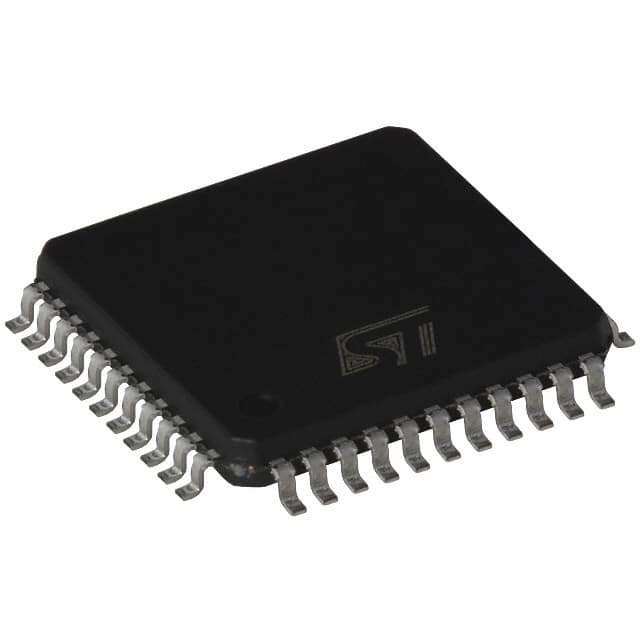
- Part No.:
- ST7538QTR
- Manufacturer:
- STMicroelectronics
- Category:
- Drivers, Receivers, Transceivers
- Package:
- 44-LQFP Exposed Pad
- Datasheet:
-
 ST7538QTR.pdf
- Description:
- IC TRANSCEIVER HALF 1/1 44TQFP
- Quantity:
- Payment:

- Shipping:

Inventory:2,733
Please send an inquiry. Send us your inquiry, and we will respond immediately.
Product details
Overview
ST7538QTR from STMicroelectronics is a half-duplex FSK power line transceiver IC integrating a programmable line driver, dual linear regulators (5V/3.3V), UART/SPI host interface, and mains zero-crossing detection. It supports 8 carrier frequencies (60–132.5 kHz), up to 4800 BPS baud rate, 250 µVrms receiving sensitivity, and operates from a single 7.5–12.5 V supply. Used in CENELEC-compliant smart metering and home automation PLC networks.
For engineers reviewing the ST7538QTR datasheet, ST7538QTR pinout, ST7538QTR application, or ST7538QTR equivalent, key selection criteria include its integrated voltage/current-controlled PLI driver, dual-regulator power architecture, carrier/preamble detection logic, and register-programmable FSK modulation parameters for EN 50065-compliant deployment.
Technical Context
The ST7538QTR implements a fully integrated FSK modem with synchronous/asynchronous operation, PLL-based synchronization recovery, and digital filter-based demodulation. Its transmission path includes Automatic Level Control (ALC) with programmable gain steps (0.6–1.4 dB) and 30 dB dynamic range, while reception uses high-sensitivity analog front-end with selectable normal/high modes.
Control is executed via an internal 24- or 48-bit register accessed through UART or SPI; register bits configure carrier frequency (3-bit select), baud rate (2-bit), deviation mode (1-bit), header recognition length (8/16 bit), and auxiliary functions including watchdog timeout (1.5 s), band-in-use detection threshold (77–85 dB/µVrms), and zero-crossing synchronization delay (1 µs).
Key Specifications
| Parameter | Value and Actual Design Meaning |
|---|---|
| Supply Voltage | 7.5–12.5 V single supply powers analog/digital sections and enables direct connection to AC mains-derived rails. |
| Receiving Sensitivity | 250 µVrms in high-sensitivity mode enables reliable signal capture under noisy power line conditions. |
| Carrier Frequencies | 8 programmable options (60, 66, 72, 76, 82.05, 86, 110, 132.5 kHz) support CENELEC A/B/C bands and multi-frequency hopping. |
| Baud Rate | Configurable up to 4800 BPS with 600/1200/2400/4800 options - determines symbol timing resolution and data throughput. |
| Integrated Regulators | 5V/50mA and 3.3V/50mA linear regulators with short-circuit protection eliminate need for external LDOs in system power design. |
| PLI Output Capability | ATOP1/ATOP2 deliver up to 6 Vpp AC output (differential) with programmable current limiting (250–370 mArms) into line impedance. |
| Zero-Crossing Detection | Sub-µs propagation delay (1 µs) and ±45 mV thresholds enable precise phase-aligned transmission triggering for reduced EMI. |
Pinout & Package
TQFP44 Slug Down package with exposed thermal pad (pin 6 and 41 are substrate ground); 44-pin layout optimized for power line coupling, analog isolation, and digital interface separation.
| Pin/Terminal | Circuit Role | Design Meaning |
|---|---|---|
| ATOP1 / ATOP2 | Power Line Driver Outputs | Differential high-voltage outputs driving mains-connected coupling network; require external LC filter per EN 50065. |
| VSENSE | Voltage Control Feedback Input | Monitors output AC amplitude to close voltage control loop; sets 160–200 mVPK reference for ALC stability. |
| CL | Current Limiting Feedback Input | Resistor-to-ground sets 1.80–2.00 V threshold for programmable current limit (250–370 mArms) on ATOP outputs. |
| RxTx | Transmit/Receive Mode Control | Active-low input selects TX (0) or RX (1) state; controls internal analog switch routing and driver enable. |
| CD_PD | Carrier/Preamble Detect Output | Open-drain active-low flag indicating presence of valid carrier, preamble, or frame header at input. |
| ZCIN / ZCOUT | Zero-Crossing Input/Output | ZCIN accepts AC mains waveform; ZCOUT delivers synchronized digital edge for time-stamped transmission initiation. |
| REG_DATA / CLR/T | Register Access Interface | Serial clock (CLR/T) and data/control select (REG_DATA) pins enable configuration of all internal registers via SPI/UART. |
Key Features
| Feature | Design Value |
|---|---|
| Programmable FSK Modem | 8 carrier frequencies + 4 baud rates + 2 deviation modes enable flexible channel adaptation per regional PLC standards. |
| Integrated Dual Regulators | On-chip 5V/3.3V supplies with PG outputs simplify power sequencing and reduce BOM count in metering applications. |
| Band-in-Use Detection | Real-time RF activity monitoring (77–85 dB/µVrms threshold) prevents collisions in shared power line channels. |
| Security Checksum Register | 24- or 48-bit programmable register with hardware checksum validation ensures configuration integrity against corruption. |
| Watchdog & Time-Out Logic | Configurable 1.5 s watchdog timeout and 1–3 s TX timeout prevent firmware lock-up and stuck transmission states. |
Applications
| Smart Electricity Meters | Home Automation HAN |
|---|---|
|
Use Scenario: Two-way communication between utility meter and concentrator over low-voltage distribution lines. IC Role / Device Role / Timing Role: FSK transceiver handling physical layer modulation/demodulation, zero-crossing synchronized burst transmission, and EN 50065-compliant spectral shaping. Use Value: 250 µVrms sensitivity and programmable carrier selection ensure robust link budget in high-noise residential feeders. |
Use Scenario: Inter-device control messaging among thermostats, lighting controllers, and energy monitors within dwelling units. IC Role / Device Role / Timing Role: Half-duplex PLC modem providing UART-bridged command/response transport with automatic preamble detection and header validation. Use Value: Integrated 3.3V regulator and SPI interface reduce external component count and accelerate HAN node integration. |
| Streetlight Control Systems | Industrial Substation Monitoring |
|
Use Scenario: Centralized dimming and fault reporting across municipal LED streetlight clusters using existing power infrastructure. IC Role / Device Role / Timing Role: Power line transceiver executing scheduled, zero-crossing-triggered transmissions to minimize conducted emissions during peak load periods. Use Value: Output voltage freeze and watchdog timer ensure fail-safe behavior during grid voltage sags or transient disturbances. |
Use Scenario: Remote telemetry collection from protective relays, CT/VT sensors, and breaker status indicators in MV substations. IC Role / Device Role / Timing Role: Robust FSK modem supporting long-distance (>1 km) PLC links over aging distribution transformers with high common-mode noise. Use Value: High-sensitivity receive mode and band-in-use detection maintain channel availability amid variable substation EMI environments. |
Equivalent & Alternatives
The following parts are listed as comparable options for similar FSK power line transceiver applications.
| Alternative Part | Technical Difference | Application Difference | Selection Advice |
|---|---|---|---|
| ST7537QTR | Pin-compatible predecessor with identical pinout and register map but lacks 132.5 kHz carrier and 4800 BPS support. | Supports only 6 carrier frequencies and max 2400 BPS; suitable for legacy CENELEC A-band deployments only. | Select when backward compatibility with ST7537 firmware and lower data rate requirements apply. |
| MAX2992ETM+ | Higher integration: includes integrated coupler transformer driver, but requires external crystal and lacks zero-crossing sync output. | Optimized for BPSK/QPSK in G3-PLC systems; not compliant with EN 50065 FSK mandates without additional filtering. | Choose for G3-PLC stack compatibility where higher PHY layer abstraction is preferred over raw FSK control. |
Compared with ST7538QTR, ST7537QTR offers simpler register programming but limited frequency agility, while MAX2992ETM+ provides broader protocol support at the cost of reduced EN 50065 compliance out-of-box and no hardware zero-crossing trigger.
Availability
ST7538QTR is available at Aetrix Electronics and suitable for smart metering, home area networks, streetlight control, and industrial substation monitoring requiring stable component supply across extended product lifecycles.
Supply support for ST7538QTR includes scheduled delivery planning, volume procurement assistance, BOM continuity management, traceable sourcing, and lifecycle availability coordination for OEM customers, industrial embedded developers, connected-device designers, and electronics production programs.
Manufacturer
STMicroelectronics is a global semiconductor leader headquartered in Geneva, Switzerland, specializing in microcontrollers, power management, and analog/mixed-signal ICs for industrial, automotive, and consumer markets.
The ST7538QTR belongs to ST's dedicated power line communication transceiver product line, engineered specifically for EN 50065-compliant FSK-based smart grid infrastructure with emphasis on integration, noise resilience, and regulatory alignment.
FAQ
What is the maximum AC output voltage swing achievable on ATOP1/ATOP2?
The ST7538QTR delivers up to 6 Vpp differential AC output on ATOP1 and ATOP2 pins under specified conditions (PAVCC = 10 V, RLOAD = 50 Ω, carrier frequency = 132.5 kHz). This is achieved with active voltage control loop engagement and proper Vsense feedback configuration; output is programmable down to 3.5 Vpp via Vsense threshold adjustment.
Does the ST7538QTR support both UART and SPI interfaces simultaneously?
No - the interface type is selected at power-up via the UART/SPI pin (Pin 13): logic high configures UART mode, logic low selects SPI mode. The device does not support concurrent operation or runtime switching; the chosen interface governs all register access and data transfer operations throughout the session.
How is mains zero-crossing synchronization implemented in hardware?
Zero-crossing detection uses internal comparators monitoring ZCIN (Pin 16) against ±5 mV thresholds. When the AC waveform crosses zero, ZCOUT (Pin 15) asserts a clean digital pulse with 1 µs delay. This output can directly trigger transmission start or synchronize internal timers, enabling emission precisely at voltage minima to minimize electromagnetic interference.
What protection features are built into the integrated 5V and 3.3V regulators?
Both regulators include short-circuit protection and power-good (PG) monitoring: PG outputs (Pins 33 and 42) assert logic high only when respective outputs remain within tolerance (±5% for VDC, ±5% for DVdd) and exceed hysteresis thresholds (250 mV). Thermal shutdown and under-voltage lockout (UVLO at 3.7–4.1 V on PAVCC) further safeguard regulator operation.
ST7538QTR Specifications
- Product attributes
- Attribute value
- Manufacturer:
- STMicroelectronics
- Series:
- -
- Package/Case:
- 44-LQFP Exposed Pad
- Packaging:
- Tape & Reel (TR)
- Product Status:
- Obsolete
- Type:
- Transceiver
- Protocol:
- -
- Number of Drivers/Receivers:
- 1/1
- Duplex:
- Half
- Receiver Hysteresis:
- -
- Data Rate:
- -
- Voltage - Supply:
- 4.75V ~ 5.25V
- Operating Temperature:
- -40°C ~ 85°C
- Grade:
- -
- Qualification:
- -
- Mounting Type:
- Surface Mount
- Supplier Device Package:
- 44-TQFP (10x10)
ST7538QTR FAQ
1.How can I place an order for ST7538QTR through Aetrix?
Please submit a Request for Quotation (RFQ) for ST7538QTR on Aetrix. Our sales agent will provide a competitive quotation and guide you through the order confirmation once you accept the terms.
2.Are the price and stock information for ST7538QTR reliable?
The price and inventory of ST7538QTR are updated periodically and may fluctuate due to market conditions. Stock and pricing data are typically refreshed every 24 hours. Quotation validity for ST7538QTR is usually 5 days.
3.What payment methods are accepted for ST7538QTR?
We accept Wire Transfer, PayPal, Credit Card, Western Union, MoneyGram, and Escrow for ST7538QTR transactions.
Note: Certain payment methods may incur a processing fee.
4.How is shipping managed for ST7538QTR?
ST7538QTR orders can be shipped via leading logistics carriers, including DHL, UPS, FedEx, TNT, or Registered Mail.
Once your ST7538QTR order is processed, you will receive an email with the shipment details and tracking number.
Note: Tracking information may take up to 24 hours to appear. Express delivery typically takes 3–5 business days.
5.How can I obtain technical support or documentation for ST7538QTR?
For technical support, including ST7538QTR datasheets, pinout diagrams, or application guidance, please contact our engineering support team. They can provide detailed documentation and assistance for your ST7538QTR requirements.
6.How does Aetrix verify that ST7538QTR is sourced from the original manufacturer or authorized distributors?
All ST7538QTR products on Aetrix are procured from qualified distributors and authorized channels. Our dedicated quality assurance team conducts strict verification, including traceability checks and, if necessary, third-party testing. This ensures that ST7538QTR meets industry standards.
7.What is the process for return or replacement of ST7538QTR?
All ST7538QTR units undergo pre-shipment inspection (PSI). If there is an issue with ST7538QTR, returns or replacements are accepted under the following conditions:
1.Quantity discrepancies, incorrect items, or visible external defects (such as breakage or corrosion), acknowledged by Aetrix.
2.The issue is reported within 90 days of delivery.
3.The ST7538QTR part is unused and in its original packaging.
Return procedure for ST7538QTR:
1.Submit a request within 90 days.
2.Obtain a Return Material Authorization (RMA) from Aetrix.
ST7538QTR Tags

-
ATA6561-GAQW-N
Microchip Technology
-
ATA6561-GBQW-N
Microchip Technology

-
AM26LS32ACDR
Texas Instruments

-
SP485CN-L/TR
MaxLinear, Inc.
-
SP485EN-L/TR
MaxLinear, Inc.
-
SP485EEN-L/TR
MaxLinear, Inc.
-
SP485ECN-L/TR
MaxLinear, Inc.
-
THVD1400DR
Texas Instruments
-
AM26C31IDR
Texas Instruments

-
TLIN1021ADRQ1
Texas Instruments
-
MAX232IDR
Texas Instruments
-
AM26C32IDR
Texas Instruments
Tech Hub

A practical engineering and sourcing framework covering lifecycle verification, lifetime-buy calculations, replacement qualification, supplier checks and counterfeit-risk controls.

TTL and CMOS logic families differ in thresholds, loading, output drive, power and timing. This engineering guide compares 74HC and 74HCT, calculates noise margins and checks 3.3 V/5 V compatibility.

A practical engineering guide to 3.3V and 5V logic compatibility, input thresholds, resistor dividers, translator ICs, MOSFET level shifting, I2C pull-ups, timing limits and power-sequencing risks.

The 74HC595 uses push-pull logic outputs, while the TPIC6B595 uses 50 V open-drain DMOS sinks for higher-power loads. This guide compares timing, current limits, 3.3 V interfacing, load wiring, thermal…

The 74HC595 converts serial data into eight stable parallel outputs. This guide covers pin functions, shift and storage timing, OE and MR behavior, drive-current limits, cascading, voltage compatibilit…

A technical comparison of level-sensitive latches and edge-triggered flip-flops, covering timing windows, setup and hold limits, master–slave operation, time borrowing, race-through, HDL inference and…

A D latch stores one bit while Enable controls when data can pass. This reference covers gate-level operation, truth tables, transparency, setup and hold timing, LE versus OE, common ICs and practical …

An SR latch stores one bit through cross-coupled feedback. This engineering reference covers NOR and NAND implementations, truth tables, forbidden-state recovery, gated operation, switch debouncing, fa…

Latch circuits retain one bit through feedback. This technical reference covers SR and D latches, truth tables, transparency, timing limits, latch-versus-flip-flop behavior, applications and common log…

An engineering guide to LED driver operation, constant-current and constant-voltage outputs, linear and switching topologies, dimming, IC selection, calculations, replacement compatibility, and fault c…


