
 My Inquiry
 My Account


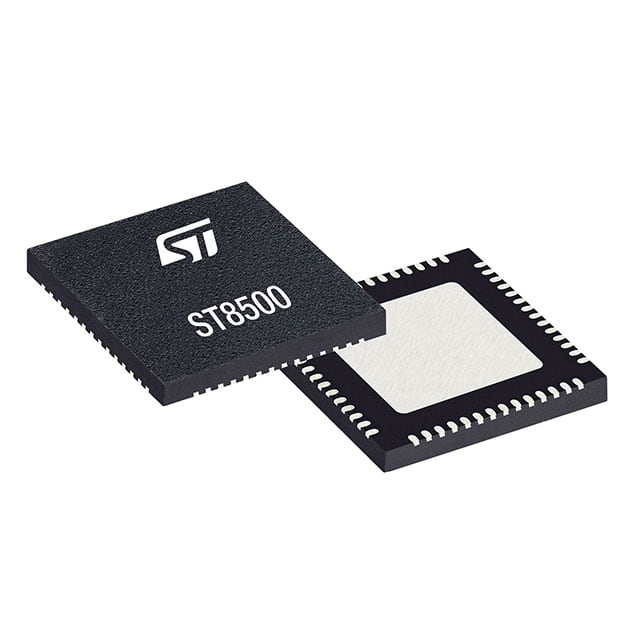
STMicroelectronics ST8500TR
- Part No.:
- ST8500TR
- Manufacturer:
- STMicroelectronics
- Category:
- Telecom
- Package:
- 56-VFQFN Exposed Pad
- Datasheet:
-
 ST8500TR.pdf
- Description:
- IC TELECOM INTERFACE 56QFN
- Quantity:
- Payment:

- Shipping:

Inventory:2,171
Please send an inquiry. Send us your inquiry, and we will respond immediately.
Product details
Overview
ST8500TR from STMicroelectronics is a programmable power line communication (PLC) System-on-Chip integrating a differential analog front-end (PGA, ADC, DAC, zero-crossing comparator), a 400 MHz real-time engine for PHY/MAC processing, and an ARM® Cortex®-M4F core running at 200 MHz with 256 kB SRAM, supporting CENELEC/FCC/ARIB-compliant smart metering and grid communications.
For engineers reviewing the ST8500TR datasheet, ST8500TR pinout, ST8500TR application, or ST8500TR equivalent, this page delivers verified technical context, QFN56 package details, PLC signal bandwidth up to 500 kHz, cryptographic acceleration (AES-128/192/256), and low-power mode support - all critical for protocol stack implementation and regulatory-compliant hardware design.
Technical Context
The ST8500TR implements a dual-core architecture: a dedicated real-time engine (RTE) handles time-critical PLC functions including modulation/demodulation, FEC (Viterbi, Reed-Solomon), and digital filter chain configuration up to 500 kHz bandwidth; the ARM Cortex-M4F core manages upper-layer protocols, peripheral control, and secure boot via OTP and AES engines.
Its analog front-end supports differential PLC coupling with automatic gain control, 500 kHz signal bandwidth, zero-crossing detection synchronized to mains AC, and integrated thermal/current sensing for line driver protection - enabling robust operation in noisy grid environments without external signal conditioning.
Key Specifications
| Parameter | Value and Actual Design Meaning |
|---|---|
| PLC Bandwidth | DC to 500 kHz - enables compliance with CENELEC A/B/C, FCC Part 15, and ARIB STD-T108 standards. |
| Real-Time Engine Clock | Up to 400 MHz - provides deterministic latency for PHY layer processing of G3-PLC® and PRIME protocols. |
| Cortex-M4F Core Speed | 200 MHz - supports concurrent protocol stack execution, crypto operations, and host interface management. |
| Embedded Memory | 256 kB SRAM (code/data), 96 kB SRAM (data only), 8 kB shared RAM - sufficient for full G3-PLC stack + application firmware. |
| Cryptographic Acceleration | AES-128/192/256 + TRNG/PRNG - enables secure key exchange and payload encryption per IEC 62056-21 and DLMS/COSEM. |
| Power Supply | 3.3 V (I/O/analog), 2.5 V (internal analog regulator), 1.1 V (digital) - separates noise-sensitive analog paths from digital switching domains. |
| Operating Temperature | –40 °C to +105 °C - qualified for outdoor smart meter and distribution automation deployments. |
| Package | QFN56 (7 × 7 × 1 mm) - surface-mount compatible with industrial PCB assembly and thermal pad for line-driver heat dissipation. |
Pinout & Package
ST8500TR is housed in a 56-pin QFN package (7 mm × 7 mm × 1 mm) with exposed thermal pad. Pin functions are defined across three GPIO ports (GPIO00–GPIO03), dual USARTs, SPI0–SPI2, I²C, JTAG/SW debug, PLC analog I/O (RX+/−, TX+/−, ZC_IN), and power/ground terminals.
| Pin/Terminal | Circuit Role | Design Meaning |
|---|---|---|
| RX_P / RX_N | Differential PLC receiver input | Accepts ±2.5 V differential signal; connects directly to line coupling network for high-sensitivity reception. |
| TX_P / TX_N | Differential PLC transmitter output | Drives line via external line driver; supports up to 500 kHz pre-filtered baseband signal. |
| ZC_IN | Mains zero-crossing detection input | Accepts bipolar AC signal; triggers timestamp capture in GPT0 for synchronized PLC frame alignment. |
| VDDA / VSSA | Analog supply and ground | 3.3 V supply with dedicated 2.5 V internal LDO - isolates sensitive AFE from digital noise. |
| VDDD / VSSD | Digital supply and ground | 1.1 V supply powers Cortex-M4F and RTE logic - optimized for low dynamic power at 200–400 MHz. |
| SWCLK / SWDIO | Serial Wire Debug interface | Enables non-intrusive firmware debugging and flash programming without JTAG header footprint. |
Key Features
| Feature | Design Value |
|---|---|
| Programmable PLC Modem SoC | Single-chip solution replacing discrete PHY+MCU+crypto ICs - reduces BOM count and PCB area in meter designs. |
| Dual-Core Architecture | RTE handles real-time PLC signal processing; Cortex-M4F runs upper-layer protocols - eliminates timing conflicts and OS dependency. |
| Integrated Analog Front-End | PGA with AGC, 12-bit ADC, DAC with pre-driver - eliminates external op-amps, filters, and level-shifting components. |
| Secure Boot & Key Storage | Bootloader ROM + OTP memory with dedicated secure key areas - prevents firmware tampering and enables field-upgrade authentication. |
| Multi-Standard Compliance Support | Configurable DFE and RTE firmware for G3-PLC®, PRIME, IEEE 1901.2 - avoids hardware redesign when migrating between regional PLC standards. |
Applications
| Smart Electricity Meter | Gas/Water Smart Meter |
|---|---|
|
Use Scenario: Two-way communication between utility head-end and residential meter over existing AC wiring. IC Role / Device Role / Timing Role: Primary PLC modem SoC handling physical layer modulation, MAC scheduling, and DLMS/COSEM protocol stack execution. Use Value: Enables firmware-upgradable, standards-compliant metering without external MCU or crypto co-processor - reducing certification effort and bill-of-materials cost. |
Use Scenario: Battery-powered endpoint transmitting consumption data via PLC repeaters in multi-dwelling units. IC Role / Device Role / Timing Role: Low-power PLC transceiver with Doze/Slow modes and zero-crossing synchronized transmission windows. Use Value: Extends battery life by >3× versus discrete solutions through integrated power gating and event-driven wake-up from ZC_IN. |
| Grid Automation Node | Streetlight Control Unit |
|
Use Scenario: Transformer monitoring unit collecting voltage, current, and harmonic data across MV/LV boundaries. IC Role / Device Role / Timing Role: High-reliability PLC node with thermal/current sense feedback for line driver protection and adaptive TX power control. Use Value: Maintains link integrity under varying grid impedance and noise conditions using real-time AFE calibration and RTE-based channel estimation. |
Use Scenario: Outdoor lighting controller receiving dimming commands and reporting fault status over street-level power lines. IC Role / Device Role / Timing Role: Secure PLC edge node executing authenticated command parsing and AES-encrypted status reporting. Use Value: Meets IEC 62351-8 security requirements via on-chip TRNG, AES engine, and OTP-stored device keys - eliminating external secure element. |
Equivalent & Alternatives
The following parts are listed as comparable options for similar PLC modem SoC applications.
| Alternative Part | Technical Difference | Application Difference | Selection Advice |
|---|---|---|---|
| MAX2992 | Dedicated G3-PLC PHY only; no embedded MCU or crypto engine - requires external host processor and security IC. | Limited to G3-PLC deployments; lacks PRIME or custom protocol flexibility. | Choose when G3-PLC-only functionality suffices and host MCU already exists in design. |
| AR7400 | ARM Cortex-A5-based PLC SoC; higher power, larger package (BGA169); targets gateway-class nodes, not endpoint meters. | Designed for concentrator/gateway roles with Ethernet backhaul - unsuitable for space-constrained meters. | Choose only for substation-level aggregation where Linux OS and multi-interface support are required. |
Compared with MAX2992 and AR7400, the ST8500TR uniquely integrates real-time PLC processing, full protocol stack execution, and hardware crypto in a compact QFN56 package - making it the only single-chip solution qualified for endpoint metering across CENELEC, FCC, and ARIB regions.
Availability
ST8500TR is available at Aetrix Electronics and suitable for smart metering, grid automation, and IoT energy management systems requiring stable component supply, long lifecycle support, and regulatory-compliant PLC performance.
Supply support for ST8500TR includes scheduled delivery planning, volume procurement assistance, BOM continuity management, traceable sourcing, and lifecycle availability coordination for OEM customers, industrial embedded developers, connected-device designers, and electronics production programs.
Manufacturer
STMicroelectronics is a global semiconductor leader headquartered in Geneva, Switzerland, designing and manufacturing microcontrollers, analog ICs, power management, and sensor solutions for industrial, automotive, and smart infrastructure markets.
The ST8500TR belongs to ST's Power Line Communication SoC product line, engineered specifically for secure, standards-compliant, and field-upgradable smart grid endpoints - emphasizing integration, low-power operation, and cryptographic resilience.
FAQ
What is the maximum supported PLC signal bandwidth of the ST8500TR?
The ST8500TR supports a PLC signal bandwidth from DC to 500 kHz, as confirmed in the official datasheet (DocID031029 Rev 3, Section 2.1). This range enables full compliance with CENELEC EN 50065 (3–148.5 kHz), FCC Part 15 (10–490 kHz), and ARIB STD-T108 (2–500 kHz) regulations - covering all major narrowband PLC standards including G3-PLC® and PRIME.
Does the ST8500TR include hardware cryptographic acceleration?
Yes, the ST8500TR integrates a dedicated AES engine supporting 128-, 192-, and 256-bit key lengths, plus a true random number generator (TRNG) and pseudo-random number generator (PRNG). These are documented in Sections 2.2.13 and 2.2.14 of the datasheet and are used for secure boot, key derivation, and DLMS/COSEM payload encryption - eliminating need for external crypto ICs.
What debug interfaces does the ST8500TR support?
The ST8500TR supports Serial Wire Debug (SWD) and JTAG via the SWJ-DP interface (Section 2.2.3), with dedicated SWCLK and SWDIO pins. It does not require separate JTAG headers - SWD provides full non-intrusive debugging, flash programming, and real-time trace capability using standard ARM-compliant tools like ST-LINK and Keil µVision.
Is the ST8500TR pin-compatible with earlier ST PLC modems like the ST7580?
No, the ST8500TR is not pin-compatible with the ST7580. It uses a 56-pin QFN package with different pin assignments, power domain partitioning (1.1 V digital, 2.5 V analog LDO), and integrated peripherals (e.g., dual USARTs, three SPIs, I²C). Migration requires PCB redesign and firmware adaptation due to architectural differences in the RTE/Cortex-M4F dual-core system.
ST8500TR Specifications
- Product attributes
- Attribute value
- Manufacturer:
- STMicroelectronics
- Series:
- -
- Package/Case:
- 56-VFQFN Exposed Pad
- Packaging:
- Tape & Reel (TR)
- Product Status:
- Active
- Function:
- Power Line Communication Modem (PLC)
- Interface:
- I2C, SPI, UART/USART
- Number of Circuits:
- 1
- Voltage - Supply:
- 2.3V ~ 2.75V, 3V ~ 3.6V
- Current - Supply:
- -
- Power (Watts):
- -
- Operating Temperature:
- -40°C ~ 105°C
- Grade:
- -
- Qualification:
- -
- Mounting Type:
- Surface Mount
- Supplier Device Package:
- 56-QFN (7x7)
ST8500TR FAQ
1.How can I place an order for ST8500TR through Aetrix?
Please submit a Request for Quotation (RFQ) for ST8500TR on Aetrix. Our sales agent will provide a competitive quotation and guide you through the order confirmation once you accept the terms.
2.Are the price and stock information for ST8500TR reliable?
The price and inventory of ST8500TR are updated periodically and may fluctuate due to market conditions. Stock and pricing data are typically refreshed every 24 hours. Quotation validity for ST8500TR is usually 5 days.
3.What payment methods are accepted for ST8500TR?
We accept Wire Transfer, PayPal, Credit Card, Western Union, MoneyGram, and Escrow for ST8500TR transactions.
Note: Certain payment methods may incur a processing fee.
4.How is shipping managed for ST8500TR?
ST8500TR orders can be shipped via leading logistics carriers, including DHL, UPS, FedEx, TNT, or Registered Mail.
Once your ST8500TR order is processed, you will receive an email with the shipment details and tracking number.
Note: Tracking information may take up to 24 hours to appear. Express delivery typically takes 3–5 business days.
5.How can I obtain technical support or documentation for ST8500TR?
For technical support, including ST8500TR datasheets, pinout diagrams, or application guidance, please contact our engineering support team. They can provide detailed documentation and assistance for your ST8500TR requirements.
6.How does Aetrix verify that ST8500TR is sourced from the original manufacturer or authorized distributors?
All ST8500TR products on Aetrix are procured from qualified distributors and authorized channels. Our dedicated quality assurance team conducts strict verification, including traceability checks and, if necessary, third-party testing. This ensures that ST8500TR meets industry standards.
7.What is the process for return or replacement of ST8500TR?
All ST8500TR units undergo pre-shipment inspection (PSI). If there is an issue with ST8500TR, returns or replacements are accepted under the following conditions:
1.Quantity discrepancies, incorrect items, or visible external defects (such as breakage or corrosion), acknowledged by Aetrix.
2.The issue is reported within 90 days of delivery.
3.The ST8500TR part is unused and in its original packaging.
Return procedure for ST8500TR:
1.Submit a request within 90 days.
2.Obtain a Return Material Authorization (RMA) from Aetrix.
ST8500TR Tags

-
LMC567CMX/NOPB
Texas Instruments
-
LM567CMX/NOPB
Texas Instruments
-
LM567CM/NOPB
Texas Instruments
-
VSC8531XMW-02
Microchip Technology
-
VSC8531XMW-05
Microchip Technology

-
GPY115C0VI
MaxLinear, Inc.
-
SI32185-A-FMR
Skyworks Solutions Inc.
-
VSC8541XMV-05
Microchip Technology
-
SI32178-B-FM1R
Skyworks Solutions Inc.
-
GPY215C0VI
MaxLinear, Inc.
-
CPC7514ZTR
Littelfuse Inc.
-
VSC8502XML-03
Microchip Technology
Tech Hub
Schmitt triggers use separate rising and falling thresholds to stabilize slow or noisy signals. This guide covers hysteresis, 74HC14 and 74HCT14 selection, comparator calculations, RC oscillators and p…
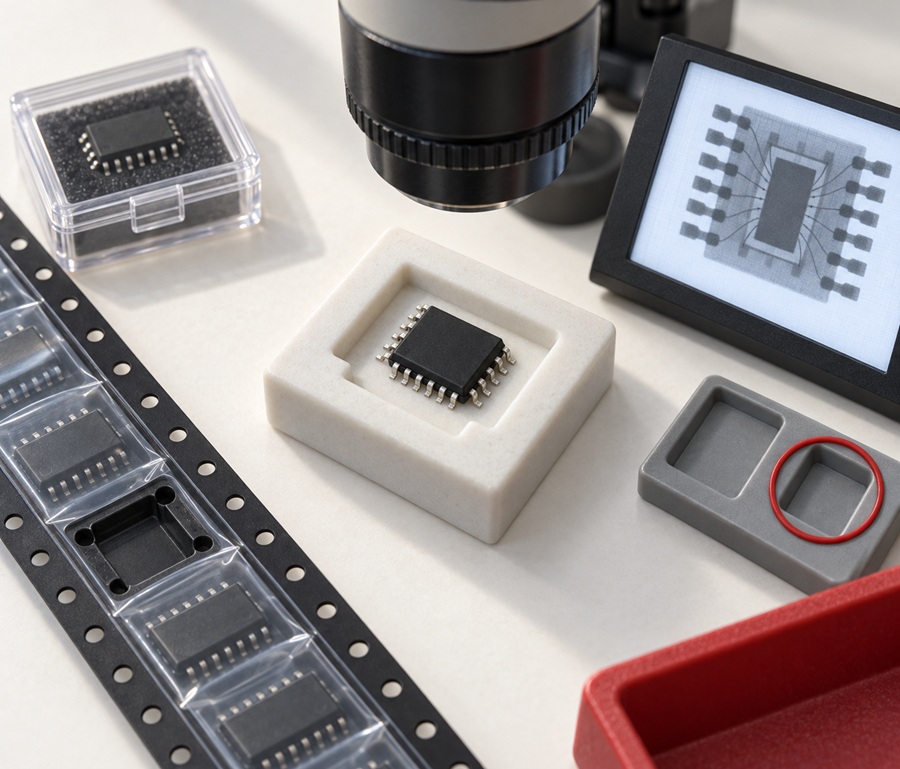
Counterfeit components can hide behind convincing markings and passing basic function tests. This engineering reference covers source traceability, external inspection, X-ray, XRF, electrical testing, …

A practical engineering and sourcing framework covering lifecycle verification, lifetime-buy calculations, replacement qualification, supplier checks and counterfeit-risk controls.

TTL and CMOS logic families differ in thresholds, loading, output drive, power and timing. This engineering guide compares 74HC and 74HCT, calculates noise margins and checks 3.3 V/5 V compatibility.

A practical engineering guide to 3.3V and 5V logic compatibility, input thresholds, resistor dividers, translator ICs, MOSFET level shifting, I2C pull-ups, timing limits and power-sequencing risks.

The 74HC595 uses push-pull logic outputs, while the TPIC6B595 uses 50 V open-drain DMOS sinks for higher-power loads. This guide compares timing, current limits, 3.3 V interfacing, load wiring, thermal…

The 74HC595 converts serial data into eight stable parallel outputs. This guide covers pin functions, shift and storage timing, OE and MR behavior, drive-current limits, cascading, voltage compatibilit…

A technical comparison of level-sensitive latches and edge-triggered flip-flops, covering timing windows, setup and hold limits, master–slave operation, time borrowing, race-through, HDL inference and…

A D latch stores one bit while Enable controls when data can pass. This reference covers gate-level operation, truth tables, transparency, setup and hold timing, LE versus OE, common ICs and practical …

An SR latch stores one bit through cross-coupled feedback. This engineering reference covers NOR and NAND implementations, truth tables, forbidden-state recovery, gated operation, switch debouncing, fa…


