
 My Inquiry
 My Account


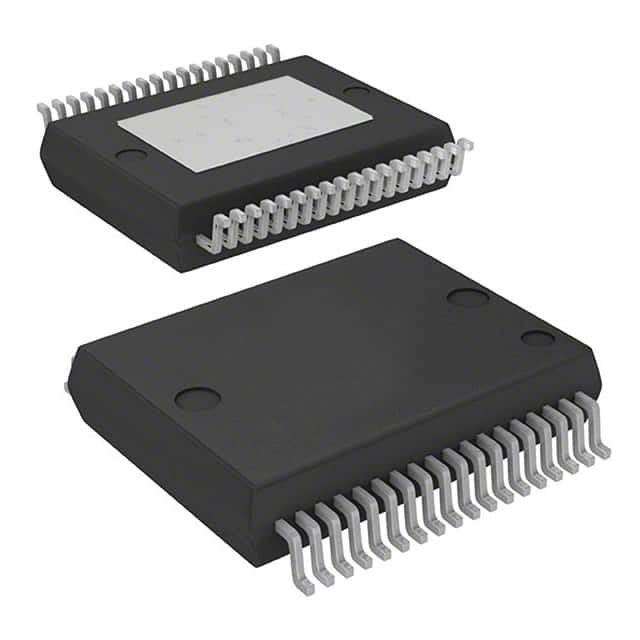
STMicroelectronics STA333ML13TR
- Part No.:
- STA333ML13TR
- Manufacturer:
- STMicroelectronics
- Category:
- Audio Special Purpose
- Package:
- 36-PowerBFSOP (0.295", 7.50mm Width)
- Datasheet:
-
 STA333ML13TR.pdf
- Description:
- IC FULLY INTEG PROC POWERSSO-36
- Quantity:
- Payment:

- Shipping:

Inventory:1,692
Please send an inquiry. Send us your inquiry, and we will respond immediately.
Product details
Overview
STA333ML13TR from STMicroelectronics is a 2-channel microless digital audio system-on-chip integrating 24-bit DDX® Class-D amplification and embedded digital signal processing. It delivers 2 × 20 W into 8 Ω at 18 V, features 100-dB SNR, 96 kHz internal processing, and operates without external microcontroller control. Used in compact audio terminals like wireless speaker cradles and LCD audio systems.
For engineers reviewing the STA333ML13TR datasheet, STA333ML13TR pinout, STA333ML13TR application, or STA333ML13TR equivalent, key selection criteria include its filterless BTL capability, I²S interface compatibility, thermal/short-circuit protection architecture, and gain/oversampling configuration via hardware pins.
Technical Context
The STA333ML13TR implements a ternary 24-bit DDX® modulator with 384 kHz PWM carrier frequency and 96 kHz internal sample rate, enabling high-fidelity audio reconstruction without external DSP. Its dual half-bridge power stage uses matched P/N-channel DMOS with Rds(on) ≤ 250 mΩ and integrated dead-time control (5–20 ns).
Protection logic includes autonomous thermal shutdown (140–150 °C), short-circuit current limiting (2.7–5.0 A), undervoltage lockout (3.5–4.3 V), and fault signaling via open-drain INT_LINE. Configuration is pin-driven: ONSEL selects 256×fs or 384×fs PLL clock ratio; GAIN sets output level to 0 dBFs or 24 dBFs.
Key Specifications
| Parameter | Value and Actual Design Meaning |
|---|---|
| Output Power | 2 × 20 W into 8 Ω @ 18 V - enables full-range stereo playback in space-constrained speakers without heatsink dependency |
| SNR / Dynamic Range | 100 dB A-weighted - supports 16-bit+ audio fidelity with minimal noise floor interference in consumer audio |
| THD+N | 0.05% @ 1 W, 1 kHz - preserves harmonic integrity for voice and music reproduction without audible distortion |
| Efficiency | ≥90% peak - reduces thermal load and extends battery life in portable cradles and wireless speakers |
| Supply Range | 4.5–20 V - accommodates wide-input DC adapters and automotive-grade power rails without regulation overhead |
| Input Interface | I²S with selectable left-justified format - ensures plug-and-play compatibility with SoCs, DACs, and media processors |
| Protection | Embedded thermal, overcurrent, short-circuit, and UVLO - eliminates need for external monitoring circuitry in cost-sensitive designs |
Pinout & Package
STA333ML13TR uses PowerSSO-36 EPD (exposed pad down) package: 36-pin thermally enhanced surface-mount housing with integrated ground plane connection via exposed copper pad (EP). Designed for high-power dissipation in compact PCB layouts.
| Pin/Terminal | Circuit Role | Design Meaning |
|---|---|---|
| OUT1A / OUT1B / OUT2A / OUT2B | Power half-bridge outputs | Drive speaker loads in BTL configuration; each pair forms one channel's push-pull stage |
| VCC1 / VCC2 / VDD_DIG / VDD_PLL | Independent power domains | Separate supplies for analog power stage (VCC), digital core (VDD_DIG), and PLL (VDD_PLL) minimize noise coupling |
| SDI / BICKI / LRCKI | I²S serial audio inputs | Accept standard 24-bit stereo data streams; FMT pin selects I²S or left-justified protocol |
| PWDN / ONSEL / GAIN / RESET | Hardware configuration & control | Set operating mode (power-down), PLL ratio (256×/384×fs), gain (0/24 dBFs), and cold reset without firmware |
| INT_LINE | Fault interrupt output | Open-drain signal asserts low on thermal overload, short-circuit, or UVLO - enables system-level fault logging |
| GND_SUB / GND1 / GND2 / GND_REG / GND_DIG / GND_PLL / EP | Ground domains | Dedicated substrate, power, analog reference, digital, and PLL grounds reduce crosstalk and improve PSRR |
Key Features
| Feature | Design Value |
|---|---|
| Microless operation | Eliminates external MCU requirement - reduces BOM count and firmware development for cradle/speaker applications |
| Filterless BTL mode | Enables direct speaker connection without LC output filters - cuts component cost and board area by ~30% vs. filtered Class-D |
| Automatic zero-detect mute | Mutes channel after 2048 consecutive zero samples - prevents pop/click during silence or stream interruption |
| Fade-in/out on power/fault | Smooth volume ramping during startup, shutdown, or recovery - avoids transient artifacts in user-facing audio systems |
| Embedded thermal protection | 140–150 °C shutdown with 18–22 °C hysteresis - sustains safe operation under sustained 2×20 W load without external sensors |
Applications
| Wireless Speaker Cradle | LCD Audio System |
|---|---|
|
Use Scenario: Docking station for smartphones/tablets delivering amplified stereo audio to external speakers. IC Role / Device Role / Timing Role: Standalone audio endpoint - receives I²S from host SoC, processes and amplifies signal, drives speakers directly. Use Value: Microless architecture eliminates MCU cost and firmware validation; filterless BTL reduces bill-of-materials and EMI filtering complexity. |
Use Scenario: Integrated audio subsystem in flat-panel displays providing HDMI/ARC-compatible sound output. IC Role / Device Role / Timing Role: Digital-to-analog conversion and power amplification block - accepts I²S from display controller, outputs to built-in speakers. Use Value: 100 dB SNR ensures clean audio reproduction alongside video; wide 4.5–20 V supply range matches display power rail flexibility. |
| Digital Speaker Module | DVD/Blu-ray Player Audio Stage |
|
Use Scenario: Compact self-contained speaker with Bluetooth receiver and Class-D amplifier in single enclosure. IC Role / Device Role / Timing Role: Final-stage audio processor and amplifier - decodes digital stream, applies volume/gain, drives speaker load. Use Value: Hardware-configurable gain (0/24 dBFs) and oversampling (256×/384×fs) simplify tuning across product variants without firmware changes. |
Use Scenario: Audio output section of optical disc players supporting multi-channel PCM and legacy stereo formats. IC Role / Device Role / Timing Role: Stereo DAC + amplifier subsystem - converts decoded I²S from AV processor, delivers high-efficiency analog output. Use Value: 96 kHz internal processing preserves high-resolution audio detail; embedded short-circuit protection guards against speaker wiring faults. |
Equivalent & Alternatives
The following parts are listed as comparable options for similar 2-channel digital Class-D amplifier applications.
| Alternative Part | Technical Difference | Application Difference | Selection Advice |
|---|---|---|---|
| TAS5756M from Texas Instruments | Higher integration: includes 4-channel support, integrated DSP, and HD-Audio compliance; requires external MCU for configuration. | Suitable for premium AV receivers needing multi-format decoding and parametric EQ, not microless cost-sensitive cradles. | Select when advanced audio processing (bass management, room correction) is required and MCU presence is acceptable. |
| MAX98357A from Maxim Integrated | Single-channel, I²S-input Class-D with 3.2 W output; no thermal/short-circuit protection; smaller QFN-16 package. | Targeted at ultra-compact mono speakers or earbud docks where power and protection are secondary to size. | Choose only for <10 W mono applications with tight space constraints and simplified protection requirements. |
Compared with TAS5756M and MAX98357A, STA333ML13TR uniquely balances microless operation, 2×20 W output, and full protection set - making it optimal for mid-power stereo audio endpoints where BOM reduction and reliability are primary design goals.
Availability
STA333ML13TR is available at Aetrix Electronics and suitable for LCD audio systems, wireless speaker cradles, and digital speaker modules requiring stable component supply, long-lifecycle availability, and production-ready qualification.
Supply support for STA333ML13TR includes scheduled delivery planning, volume procurement assistance, BOM continuity management, traceable sourcing, and lifecycle availability coordination for OEM customers, industrial embedded developers, connected-device designers, and electronics production programs.
Manufacturer
STMicroelectronics is a global semiconductor leader headquartered in Geneva, specializing in analog, power, and microcontroller technologies for industrial, automotive, and consumer markets.
The STA333ML belongs to ST's Sound Terminal® family - engineered to deliver full digital audio streaming with integrated processing and Class-D amplification for cost-effective, low-power audio endpoints.
FAQ
What is the minimum recommended PCB layout practice for thermal management?
Use a double-layer PCB with two 3 × 3 cm² copper ground areas connected to the exposed pad (EP) via ≥16 thermal vias. This achieves 24 °C/W junction-to-ambient thermal resistance in natural convection, enabling full 2×20 W output without forced cooling. Avoid isolating the EP pad or using insufficient via count, which raises junction temperature beyond 150 °C.
Can STA333ML13TR operate in filterless mode with 4 Ω speakers?
No - the datasheet specifies filterless operation only for 8 Ω loads. Driving 4 Ω speakers in filterless mode increases EMI and risk of instability due to higher current slew rates and parasitic resonance. For 4 Ω, use the recommended LC filter configuration per Figure 11 to maintain EMC compliance and output stability.
How does the automatic invalid input detect mute function work?
The IC monitors I²S data validity continuously. If LRCKI or BICKI signals stop toggling, or if SDI contains invalid framing (e.g., missing word clocks or corrupted bit alignment), the device mutes both channels within 100 ms and asserts INT_LINE low. Recovery occurs automatically once valid I²S synchronization resumes.
Is the 24-bit DDX® modulator compatible with 16-bit I²S input sources?
Yes - the DDX® engine accepts 16-, 20-, or 24-bit I²S data. Internally, it up-samples all inputs to 96 kHz/24-bit resolution before modulation. No external bit-depth conversion is needed; the device preserves LSB significance and applies dithering to prevent truncation artifacts in 16-bit streams.
STA333ML13TR Specifications
- Product attributes
- Attribute value
- Manufacturer:
- STMicroelectronics
- Series:
- Sound Terminal™
- Package/Case:
- 36-PowerBFSOP (0.295", 7.50mm Width)
- Packaging:
- Tape & Reel (TR)
- Product Status:
- Active
- Function:
- Fully Integrated Processor
- Applications:
- Pre-Amplifier
- Number of Channels:
- 2
- Interface:
- I2S
- Voltage - Supply:
- 4.5V ~ 20V
- Operating Temperature:
- 0°C ~ 70°C (TA)
- Specifications:
- Direct Digital Amplification
- Mounting Type:
- Surface Mount
- Grade:
- -
STA333ML13TR FAQ
1.How can I place an order for STA333ML13TR through Aetrix?
Please submit a Request for Quotation (RFQ) for STA333ML13TR on Aetrix. Our sales agent will provide a competitive quotation and guide you through the order confirmation once you accept the terms.
2.Are the price and stock information for STA333ML13TR reliable?
The price and inventory of STA333ML13TR are updated periodically and may fluctuate due to market conditions. Stock and pricing data are typically refreshed every 24 hours. Quotation validity for STA333ML13TR is usually 5 days.
3.What payment methods are accepted for STA333ML13TR?
We accept Wire Transfer, PayPal, Credit Card, Western Union, MoneyGram, and Escrow for STA333ML13TR transactions.
Note: Certain payment methods may incur a processing fee.
4.How is shipping managed for STA333ML13TR?
STA333ML13TR orders can be shipped via leading logistics carriers, including DHL, UPS, FedEx, TNT, or Registered Mail.
Once your STA333ML13TR order is processed, you will receive an email with the shipment details and tracking number.
Note: Tracking information may take up to 24 hours to appear. Express delivery typically takes 3–5 business days.
5.How can I obtain technical support or documentation for STA333ML13TR?
For technical support, including STA333ML13TR datasheets, pinout diagrams, or application guidance, please contact our engineering support team. They can provide detailed documentation and assistance for your STA333ML13TR requirements.
6.How does Aetrix verify that STA333ML13TR is sourced from the original manufacturer or authorized distributors?
All STA333ML13TR products on Aetrix are procured from qualified distributors and authorized channels. Our dedicated quality assurance team conducts strict verification, including traceability checks and, if necessary, third-party testing. This ensures that STA333ML13TR meets industry standards.
7.What is the process for return or replacement of STA333ML13TR?
All STA333ML13TR units undergo pre-shipment inspection (PSI). If there is an issue with STA333ML13TR, returns or replacements are accepted under the following conditions:
1.Quantity discrepancies, incorrect items, or visible external defects (such as breakage or corrosion), acknowledged by Aetrix.
2.The issue is reported within 90 days of delivery.
3.The STA333ML13TR part is unused and in its original packaging.
Return procedure for STA333ML13TR:
1.Submit a request within 90 days.
2.Obtain a Return Material Authorization (RMA) from Aetrix.
STA333ML13TR Tags
-
SA571DR2G
onsemi
-
ADAU7002ACBZ-R7
Analog Devices Inc.

-
DRV135UA/2K5
Texas Instruments
-
DRV134UA/1K
Texas Instruments
-
DRV134PA
Texas Instruments
-
DRV134UA
Texas Instruments
-
DRV135UA
Texas Instruments
-
SA572DR2G
onsemi
-
PGA2311U/1K
Texas Instruments
-
SI8244BB-D-IS1R
Skyworks Solutions Inc.

-
CS8416K-CZZR
Cirrus Logic Inc.
-
SRC4392IPFBR
Texas Instruments
Tech Hub

A practical engineering guide to 3.3V and 5V logic compatibility, input thresholds, resistor dividers, translator ICs, MOSFET level shifting, I2C pull-ups, timing limits and power-sequencing risks.

The 74HC595 uses push-pull logic outputs, while the TPIC6B595 uses 50 V open-drain DMOS sinks for higher-power loads. This guide compares timing, current limits, 3.3 V interfacing, load wiring, thermal…

The 74HC595 converts serial data into eight stable parallel outputs. This guide covers pin functions, shift and storage timing, OE and MR behavior, drive-current limits, cascading, voltage compatibilit…

A technical comparison of level-sensitive latches and edge-triggered flip-flops, covering timing windows, setup and hold limits, master–slave operation, time borrowing, race-through, HDL inference and…

A D latch stores one bit while Enable controls when data can pass. This reference covers gate-level operation, truth tables, transparency, setup and hold timing, LE versus OE, common ICs and practical …

An SR latch stores one bit through cross-coupled feedback. This engineering reference covers NOR and NAND implementations, truth tables, forbidden-state recovery, gated operation, switch debouncing, fa…

Latch circuits retain one bit through feedback. This technical reference covers SR and D latches, truth tables, transparency, timing limits, latch-versus-flip-flop behavior, applications and common log…

An engineering guide to LED driver operation, constant-current and constant-voltage outputs, linear and switching topologies, dimming, IC selection, calculations, replacement compatibility, and fault c…

Operational amplifier guide covering op amp basics, feedback, ideal vs real op amps, common configurations, buffer circuits, offset, bias current, gain-bandwidth, slew rate, rail-to-rail limits and sel…

Jumper cables guide covering safe connection order, red and black clamp placement, final ground connection, cable gauge, length, clamp quality, copper vs CCA cables, jump starter comparison and battery…


