
 My Inquiry
 My Account


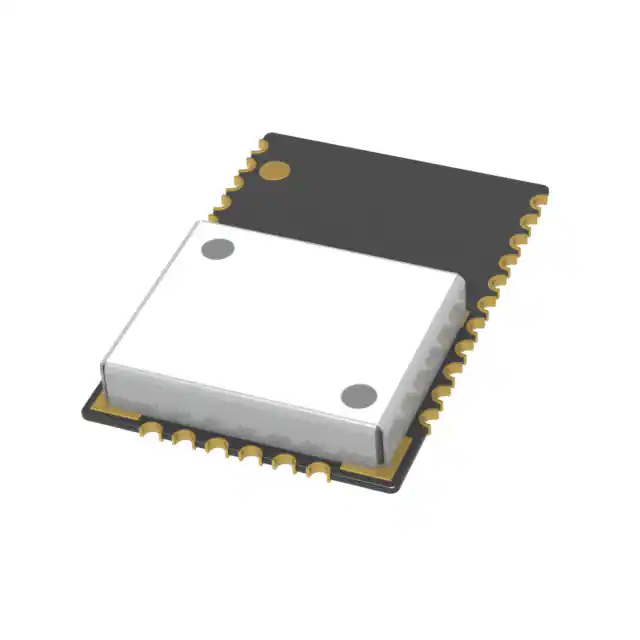
STMicroelectronics STA8089FGB

- Part No.:
- STA8089FGB
- Manufacturer:
- STMicroelectronics
- Category:
- RF Receivers
- Package:
- 56-VFQFN Exposed Pad
- Datasheet:
-
 STA8089FGB.pdf
- Description:
- RF RX GNSS 1.561/1.575GHZ 56QFPN
- Quantity:
- Payment:

- Shipping:

Inventory:3,579
Please send an inquiry. Send us your inquiry, and we will respond immediately.
Product details
Overview
STA8089FGB from STMicroelectronics is a fully integrated, single-die GNSS receiver IC supporting GPS, Galileo, GLONASS, BeiDou, and QZSS with 48 tracking + 2 fast acquisition channels, -162 dBm indoor tracking sensitivity, <1 s hot-start TTFF, and embedded 196 MHz ARM946 MCU with 256 KB SRAM and 16 Mbit in-package SQI Flash - deployed in automotive telematics, asset trackers, and precision timing modules.
For engineers reviewing the STA8089FGB datasheet, STA8089FGB pinout, STA8089FGB application, or STA8089FGB equivalent, key selection considerations include multi-constellation RF front-end architecture, dual CAN interface support, RTC/backup power domain operation, and pin-to-pin compatibility with STA8088FG for legacy design migration.
Technical Context
The STA8089FGB integrates a dedicated G3BB+ baseband processor handling simultaneous signal acquisition and tracking across five GNSS constellations using a shared RF chain with configurable IF downconversion (4.092 MHz for GPS/Galileo, 8.57 MHz for GLONASS, 10.23 MHz for BeiDou), plus embedded ST-DRAW dead reckoning firmware capability in the FGBD variant.
Its subsystem architecture couples a high-performance ARM946E-S core (196 MHz) with tightly coupled memory (16 KB I-TCM / 128 KB D-TCM), dual CAN 2.0B controllers, USB 2.0 full-speed PHY, three UARTs, one I²C master, one SSP (SPI-compatible), 10-bit dual-channel ADC, and RTC with backup domain powered by VINB (1.6–4.3 V).
Key Specifications
| Parameter | Value and Actual Design Meaning |
|---|---|
| GNSS Constellations | GPS, Galileo, GLONASS, BeiDou, QZSS - enables global positioning resilience in urban canyons and partial sky view. |
| Tracking Channels | 48 parallel channels - supports concurrent satellite signal processing across all constellations for high-accuracy PVT solutions. |
| Indoor Sensitivity | -162 dBm (tracking mode) - allows reliable position lock indoors or under dense foliage without external LNA. |
| TTFF (Cold Start) | ≤30 s - achieved via embedded flash-stored ephemeris and assisted GNSS data handling in firmware. |
| MCU Core | ARM946E-S @ up to 196 MHz - delivers real-time navigation computation, protocol stack execution, and host interface management. |
| Embedded Memory | 256 KB SRAM + 16 Mbit SQI Flash - eliminates need for external memory; stores firmware, almanac, and user application code. |
| Operating Temp | -40°C to +85°C - qualified for automotive cabin and industrial outdoor deployment without derating. |
| Supply Voltages | VINL = 1.8 V ±5%, VDD = 1.0–1.32 V, VCC_RF = 1.2 V ±10%, VddIO = 1.8 V ±5% or 3.3 V ±10% - supports flexible power architecture with internal LDOs. |
Pinout & Package
STA8089FGB is housed in a VFQFPN56 package (7 mm × 7 mm × 1.0 mm, 0.4 mm pitch) with exposed thermal pad. Pin functions are validated per STMicroelectronics DS10716 Rev 9 (pp. 8–13), including dedicated RF, power, communication, and backup-domain terminals.
| Pin/Terminal | Circuit Role | Design Meaning |
|---|---|---|
| VCC_RF / VCC_PLL / VCC_CHAIN | Analog RF supply rails | Independent 1.2 V supplies isolate noise-sensitive RF sections from digital domains. |
| VINL1 / VINL2 / VINB | Main & backup LDO inputs | VINL1 powers LDO1 (1.1 V core); VINB (1.6–4.3 V) sustains RTC and backup RAM during main power loss. |
| RTC_XTI / RTC_XTO | 32.768 kHz crystal interface | Enables autonomous timekeeping and low-power wake-up timing independent of GNSS lock. |
| CAN0_RX / CAN0_TX / CAN1_RX / CAN1_TX | CAN 2.0B physical layer I/O | Dual isolated CAN interfaces support vehicle bus integration and redundancy-critical telemetry. |
| USB_DP / USB_DM | Integrated USB 2.0 FS PHY | Full-speed (12 Mbps) USB interface with on-chip transceiver eliminates external PHY component. |
| SPI_DI / SPI_DO / SPI_CLK / SPI_CSN | Quad-SPI Flash interface | Direct connection to embedded 16 Mbit SQI Flash; also supports boot-from-Flash and firmware updates. |
| ADC_IN1 / ADC_IN2 | Analog sensor inputs | 10-bit SAR ADC channels (0–1.4 V range) for battery voltage monitoring or external sensor interfacing. |
| STDBYn / STDBY_OUT / WAKEUP | Power management control | Hardware-controlled low-power standby with programmable wake sources (RTC, CAN, GPIO, USB). |
Key Features
| Feature | Design Value |
|---|---|
| Multi-constellation GNSS engine | Simultaneous GPS/Galileo/GLONASS/BeiDou/QZSS tracking - improves positional accuracy and availability in obstructed environments. |
| Embedded ST-DRAW firmware support | Dead reckoning capability (FGBD variant only) - maintains position estimate during GNSS signal outages using inertial and vehicle dynamics data. |
| Dual CAN 2.0B controllers | Independent CAN buses with message filtering and FIFO buffering - enables robust automotive network integration and diagnostics. |
| In-package 16 Mbit SQI Flash | Eliminates external memory footprint and reduces BOM cost; supports secure firmware storage and field updates. |
| Backup power domain with RTC | Retains time, configuration, and last-known position during main power loss - critical for rapid cold-start recovery. |
| Flexible I/O voltage support | VddIO_R1 (1.8 V or 3.3 V) and VddIO_R2 (3.3 V) allow direct interfacing with mixed-voltage peripherals without level shifters. |
Applications
| Automotive Telematics | Fleet Tracking Unit |
|---|---|
|
Use Scenario: Real-time vehicle location reporting, geofence alerts, and driver behavior analytics in connected cars and commercial fleets. IC Role / Device Role / Timing Role: Primary GNSS positioning engine with CAN bus integration for vehicle bus data correlation and USB-based firmware updates. Use Value: Sub-3-meter CEP accuracy under urban canopy, <30 s cold-start TTFF, and seamless failover to ST-DRAW during tunneling. |
Use Scenario: Battery-powered asset trackers mounted on trailers, containers, or heavy equipment operating across international borders. IC Role / Device Role / Timing Role: Standalone positioning node with ultra-low-power standby (VINB-backed RTC), dual CAN for sensor fusion, and embedded Flash for offline logging. Use Value: -162 dBm sensitivity enables indoor warehouse positioning; 10-year battery life achievable via intelligent wake scheduling. |
| Maritime Navigation Terminal | Survey-Grade Timing Module |
|
Use Scenario: Compact marine chartplotters requiring multi-constellation support, NMEA 0183 output, and interference-resistant RF performance near radar systems. IC Role / Device Role / Timing Role: High-integrity GNSS receiver with dual CAN for AIS integration and USB for PC-based configuration and data export. Use Value: Resilient tracking across GPS/Galileo/BeiDou ensures continuous fix even if one constellation experiences regional degradation. |
Use Scenario: Precision time synchronization unit for telecom base stations, where stable 1PPS output and holdover accuracy are mission-critical. IC Role / Device Role / Timing Role: RTC-backed timing source with 32.768 kHz crystal oscillator, low-jitter 1PPS generation, and temperature-compensated holdover. Use Value: Integrated RTC with VINB backup provides >72-hour holdover stability; 1PPS jitter <100 ns RMS enables IEEE 1588 compliance. |
Equivalent & Alternatives
The following parts are listed as comparable options for similar GNSS receiver applications.
| Alternative Part | Technical Difference | Application Difference | Selection Advice |
|---|---|---|---|
| u-blox UBX-M8030 | 48-channel GPS/Galileo/GLONASS/BeiDou; no embedded MCU or Flash; requires external host processor and memory. | Lacks integrated ARM946 and 16 Mbit Flash - suitable for host-driven architectures but increases system complexity and BOM count. | Select when leveraging existing host CPU and requiring maximum flexibility in firmware customization. |
| Qualcomm Snapdragon GNSS Platform (e.g., WCN3680) | Integrated into SoC with cellular modem; GNSS functionality shares resources with LTE/Wi-Fi; no standalone GNSS mode. | Not a drop-in replacement - designed for mobile handsets, not embedded telematics; lacks CAN, RTC backup, and industrial temp rating. | Choose only for smartphone-class designs where GNSS is secondary to connectivity and power efficiency dominates. |
Compared with u-blox UBX-M8030 and Qualcomm's SoC-integrated GNSS, STA8089FGB delivers self-contained positioning with deterministic real-time performance, dual CAN for automotive bus coupling, and VINB-backed RTC for guaranteed time continuity - making it optimal for safety-aware, resource-constrained embedded systems.
Availability
STA8089FGB is available at Aetrix Electronics and suitable for automotive telematics, fleet tracking units, maritime navigation terminals, and survey-grade timing modules requiring stable component supply, long-term lifecycle support, and production-ready qualification.
Supply support for STA8089FGB includes scheduled delivery planning, volume procurement assistance, BOM continuity management, traceable sourcing, and lifecycle availability coordination for OEM customers, industrial embedded developers, connected-device designers, and electronics production programs.
Manufacturer
STMicroelectronics is a global semiconductor leader headquartered in Geneva, Switzerland, specializing in microcontrollers, sensors, power management, and automotive-grade ICs with ISO/TS 16949-certified manufacturing.
STA8089FGB belongs to the Teseo III family - a product line engineered specifically for high-accuracy, multi-constellation GNSS positioning in automotive, industrial, and professional navigation applications with emphasis on integration, low power, and functional safety readiness.
FAQ
Does STA8089FGB support dead reckoning firmware?
STA8089FGB itself does not include ST-DRAW dead reckoning firmware; that capability is exclusive to the STA8089FGBD variant. The FGB part shares identical hardware and pinout but ships with standard GNSS-only firmware. Firmware upgrade to ST-DRAW requires reprogramming via JTAG or USB and validation against ST's TESEO-DRAW license terms.
What is the role of VINB and how is it used in low-power operation?
VINB (1.6–4.3 V) powers the backup domain, sustaining RTC operation, backup RAM contents, and wake-up logic during main power loss. When VINL is removed, the device enters standby with STDBY_OUT asserted low; VINB maintains timekeeping and enables wake events via CAN, RTC alarm, or GPIO - enabling sub-1 µA retention current and rapid resumption.
Can STA8089FGB operate without an external crystal?
No - STA8089FGB requires a 32.768 kHz crystal connected to RTC_XTI/RTC_XTO for RTC functionality and a 26 MHz or 38.4 MHz reference oscillator (via XTAL_IN/XTAL_OUT) for RF synthesizer and baseband clocking. The device lacks internal RC oscillators capable of meeting GNSS timing stability requirements.
Is the embedded 16 Mbit Flash accessible for user application storage?
Yes - the in-package SQI Flash is fully accessible via the SPI interface (SPI_DI/SPI_DO/SPI_CLK/SPI_CSN) and mapped into the ARM946's address space. It supports XIP (execute-in-place), firmware updates, NVM parameter storage, and logging buffers - all managed through ST's Teseo SDK and HAL drivers without external memory controllers.
STA8089FGB Specifications
- Product attributes
- Attribute value
- Manufacturer:
- STMicroelectronics
- Series:
- -
- Package/Case:
- 56-VFQFN Exposed Pad
- Packaging:
- Tray
- Product Status:
- Active
- Frequency:
- 1.561GHz, 1.575GHz, 1.601GHz
- Sensitivity:
- -162dBm
- Data Rate (Max):
- 12Mbps
- Modulation or Protocol:
- BeiDou, Galileo, GLONASS, GNSS, GPS
- Applications:
- General Purpose
- Current - Receiving:
- -
- Data Interface:
- I2C, SPI, UART
- Memory Size:
- 256kB SRAM, 512kB ROM
- Antenna Connector:
- PCB, Surface Mount
- Features:
- -
- Voltage - Supply:
- 1.08V ~ 1.32V
- Operating Temperature:
- -40°C ~ 85°C (TA)
- Grade:
- -
- Qualification:
- -
- Mounting Type:
- Surface Mount
- Supplier Device Package:
- 56-VFQFPN (7x7)
STA8089FGB FAQ
1.How can I place an order for STA8089FGB through Aetrix?
Please submit a Request for Quotation (RFQ) for STA8089FGB on Aetrix. Our sales agent will provide a competitive quotation and guide you through the order confirmation once you accept the terms.
2.Are the price and stock information for STA8089FGB reliable?
The price and inventory of STA8089FGB are updated periodically and may fluctuate due to market conditions. Stock and pricing data are typically refreshed every 24 hours. Quotation validity for STA8089FGB is usually 5 days.
3.What payment methods are accepted for STA8089FGB?
We accept Wire Transfer, PayPal, Credit Card, Western Union, MoneyGram, and Escrow for STA8089FGB transactions.
Note: Certain payment methods may incur a processing fee.
4.How is shipping managed for STA8089FGB?
STA8089FGB orders can be shipped via leading logistics carriers, including DHL, UPS, FedEx, TNT, or Registered Mail.
Once your STA8089FGB order is processed, you will receive an email with the shipment details and tracking number.
Note: Tracking information may take up to 24 hours to appear. Express delivery typically takes 3–5 business days.
5.How can I obtain technical support or documentation for STA8089FGB?
For technical support, including STA8089FGB datasheets, pinout diagrams, or application guidance, please contact our engineering support team. They can provide detailed documentation and assistance for your STA8089FGB requirements.
6.How does Aetrix verify that STA8089FGB is sourced from the original manufacturer or authorized distributors?
All STA8089FGB products on Aetrix are procured from qualified distributors and authorized channels. Our dedicated quality assurance team conducts strict verification, including traceability checks and, if necessary, third-party testing. This ensures that STA8089FGB meets industry standards.
7.What is the process for return or replacement of STA8089FGB?
All STA8089FGB units undergo pre-shipment inspection (PSI). If there is an issue with STA8089FGB, returns or replacements are accepted under the following conditions:
1.Quantity discrepancies, incorrect items, or visible external defects (such as breakage or corrosion), acknowledged by Aetrix.
2.The issue is reported within 90 days of delivery.
3.The STA8089FGB part is unused and in its original packaging.
Return procedure for STA8089FGB:
1.Submit a request within 90 days.
2.Obtain a Return Material Authorization (RMA) from Aetrix.
STA8089FGB Tags
-
MICRF220AYQS-TR
Microchip Technology
-
SX1239IMLTRT
Semtech Corporation
-
SI4356-B1A-FMR
Silicon Labs

-
SI4362-C2A-GMR
Silicon Labs

-
MAX1473EUI+T
Analog Devices Inc./Maxim Integrated

-
CMX992Q3
CML Micro

-
CMX994AQ4
CML Micro

-
MAX2112ETI+
Analog Devices Inc./Maxim Integrated
-
MAX2112ETI+T
Analog Devices Inc./Maxim Integrated
-
TESEO-LIV3R
STMicroelectronics
-
M20048-1
Antenova
-
CMX994EQ4
CML Micro
Tech Hub

Operational amplifier guide covering op amp basics, feedback, ideal vs real op amps, common configurations, buffer circuits, offset, bias current, gain-bandwidth, slew rate, rail-to-rail limits and sel…

Jumper cables guide covering safe connection order, red and black clamp placement, final ground connection, cable gauge, length, clamp quality, copper vs CCA cables, jump starter comparison and battery…

LDO regulator guide covering low dropout voltage, power dissipation, thermal design, PSRR, output noise, capacitor stability, adjustable LDO circuits, LDO vs buck converter and datasheet selection chec…

Conditional Access Module guide covering CAM meaning, CI/CI+ interface, smart card authorization, DVB security workflow, TV and set-top box compatibility, internal electronics, ESD protection, connecto…

Guide to electronic component obsolescence covering EOL risk, PCN/PDN notices, last-time buy planning, replacement options, form-fit-function validation, counterfeit risk and BOM lifecycle management.

18650 battery guide covering lithium-ion cell basics, 3.6V/3.7V voltage, 4.2V charging, mAh and Wh capacity, protected cells, chargers, BMS, series-parallel packs, holders, welding and sourcing checks.…

Hall effect sensor guide covering working principle, linear and digital sensors, Arduino circuits, current sensing, speed detection, automotive applications, A3144 examples, signal filtering and datash…

Product Change Notification guide for electronic components, covering PCN meaning, PCN vs PDN/EOL, common change types, risk levels, form-fit-function review, engineering validation, BOM control, LTB/L…

A practical guide to blend door actuators, covering HVAC function, symptoms, location, AC and heater issues, reset and calibration, replacement cost, electrical diagnosis, compatibility checks, and rep…

Engineering guide to Raspberry Pi alternatives, covering chip-level differences, Orange Pi, ROCK, Jetson, Banana Pi, NanoPi, Compute Module, Pico, GPIO, camera, HAT compatibility, and replacement risks…


