
 My Inquiry
 My Account


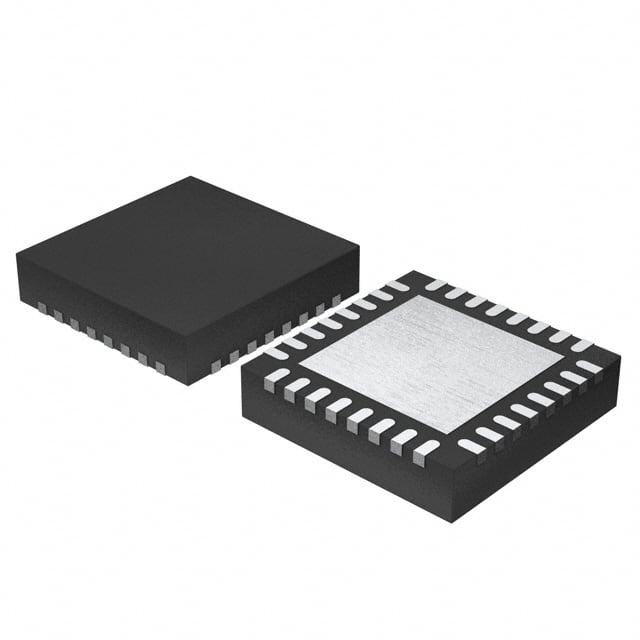
STMicroelectronics STEF12H60MPUR
- Part No.:
- STEF12H60MPUR
- Manufacturer:
- STMicroelectronics
- Category:
- Current Regulation/Management
- Package:
- 32-VFQFN Exposed Pad
- Datasheet:
-
 STEF12H60MPUR.pdf
- Description:
- IC ELECTRONIC FUSE 32QFN
- Quantity:
- Payment:

- Shipping:

Inventory:17,426
Please send an inquiry. Send us your inquiry, and we will respond immediately.
Product details
Overview
STEF12H60MPUR from STMicroelectronics is a 60 A integrated electronic fuse (eFuse) for 12 V DC power rails, featuring an internal 0.85 mΩ N-channel Power MOSFET, programmable current limit via CLREF pin (0.2–1.4 V), adjustable soft-start (10–100 ms), and precise current monitoring (±3% accuracy at 10–60 A). It operates across –40°C to +125°C and is used in server main eFuse protection.
For engineers reviewing the STEF12H60MPUR datasheet, STEF12H60MPUR pinout, STEF12H60MPUR application, or STEF12H60MPUR equivalent, this device delivers accurate overcurrent response (100 µs), thermal fault detection (130–150°C shutdown), dual-mode fault management (latch-off or auto-retry), parallel operation support, and integrated diagnostics including gate-drain short detection and self-test during startup.
Technical Context
The STEF12H60MPUR implements a closed-loop current-limiting architecture using a replica-MOSFET current sense circuit (ACS = 10 µA/A) and a voltage-comparator-based CLREF threshold interface. Its soft-start control uses a constant-current-charged external capacitor (ISS = 5.2 µA typical) to generate monotonic VOUT ramp-up, with foldback current limiting active below 40% VIN and stepped limits up to 80% VIN.
Thermal protection integrates a calibrated on-die temperature sensor (450 mV at 25°C, 10 mV/°C coefficient) feeding a comparator with 130–150°C shutdown threshold. Fault status is reported via open-drain GOK (gate-OK) and D_OC (overcurrent) outputs, both 5 V compliant, with 1 µs D_OC response time and 250 µs shutdown timer after current limit activation.
Key Specifications
| Parameter | Value and Actual Design Meaning |
|---|---|
| Continuous Current | 60 A - maximum sustained load current without derating under recommended conditions (TJ ≤ 125°C, RθJA = 26°C/W) |
| RDS(on) | 0.85 mΩ typ. - low conduction loss enabling <100 mV drop at 60 A, critical for high-efficiency 12 V rail protection |
| Input Voltage Range | 5–18 V - supports wide 12 V system tolerance, including cold-crank and transient overvoltage conditions |
| Current Monitor Accuracy | ±3% (10–60 A) - enables reliable real-time load current reporting to host controller via IMON pin |
| Soft-Start Time | 10–100 ms - externally programmable via CSS capacitor to limit inrush into large output capacitance (e.g., ≥47 µF) |
| Overcurrent Response | 100 µs - time from VCS > VCLREF to initiation of current limiting, ensuring fast fault containment |
| Thermal Shutdown Threshold | 130–150°C - precise junction temperature detection with hysteresis prevents nuisance tripping during transient thermal loads |
| Package | QFN32-5 × 5 mm - exposed-pad thermally enhanced package with RθJB = 5.4°C/W for PCB-level heat dissipation |
Pinout & Package
STEF12H60MPUR is housed in a thermally optimized QFN32 (5 mm × 5 mm, 0.5 mm pitch) package with an exposed thermal pad connected internally to VIN. The package supports high-current routing via eight VIN and eight VOUT pins, and includes dedicated analog sensing (IMON, VTEMP, CS, CLREF), control (ON/PD, SS), and status (GOK, D_OC) terminals.
| Pin/Terminal | Circuit Role | Design Meaning |
|---|---|---|
| VIN (Pins 9–16, Exposed Pad) | Power input connection | Direct connection to internal MOSFET drain; all pins must be shorted on PCB to minimize impedance and thermal resistance |
| VOUT (Pins 25–32) | Power output connection | Source node of internal MOSFET; all pins must be shorted to distribute 60 A load current and reduce IR drop |
| ON/PD (Pin 4) | Enable/disable & output discharge control | Three-state logic input: >1.4 V enables, <1.2 V disables, 0.8–1.2 V activates 0.72 kΩ VOUT-to-GND pull-down for safe discharge |
| CLREF (Pin 24) | Current limit reference input | Accepts 0.2–1.4 V external voltage to set ILIM; clamped at 1.65 V max to prevent overcurrent misconfiguration |
| IMON (Pin 22) | Current monitor output | Generates voltage proportional to IOUT (10 µA/A) across external RMON, filtered by optional CMON for ADC interfacing |
| VTEMP (Pin 18) | Digital temperature sensor output | Provides 450 mV @ 25°C ±10 mV/°C linear output; bypassed with 0.1 µF to GND for noise immunity |
| GOK (Pin 5) | Gate-OK status flag | Open-drain output pulled low during uncommanded shutdown (thermal, overcurrent, startup failure); requires external pull-up |
| D_OC (Pin 3) | Overcurrent detection flag | Open-drain output pulled low when sensed current exceeds VCLREF × 0.85; 1 µs response ensures rapid system alerting |
Key Features
| Feature | Design Value |
|---|---|
| Integrated 0.85 mΩ MOSFET | Eliminates external FET selection and layout complexity while delivering <100 mW conduction loss at 60 A |
| Programmable current limit (0.2–1.4 V) | Enables dynamic ILIM adjustment via DAC or microcontroller GPIO, supporting adaptive system power management |
| Startup foldback current limiting | Reduces current limit to 130–170 mV reference during initial VOUT ramp-up, preventing false trips into capacitive loads |
| Parallel operation with current balancing | Supports N devices sharing load equally during startup and steady state via synchronized soft-start and gate drive timing |
| Internal MOSFET self-diagnostic | Detects gate-drain shorts (VDG_SH = 3.1 V), drain-source shorts (VDS_TH = 90% VIN), and gate faults before enabling output |
| Accurate thermal monitoring (±2°C) | On-die sensor with 10 mV/°C slope enables predictive thermal throttling and lifetime derating in server PSU designs |
Applications
| Server Main eFuse | Hot-Swap Board Protection |
|---|---|
|
Use Scenario: Primary overcurrent protection for 12 V backplane power distribution in rack-mounted servers. IC Role / Device Role / Timing Role: High-current eFuse providing fault isolation, current limiting, and thermal shutdown for CPU/GPU VRMs and memory modules. Use Value: Enables hot-plug capability with 100 µs overcurrent response and latch-off behavior to prevent cascading failures during board insertion. |
Use Scenario: Power sequencing and fault containment for modular PCIe or OCP mezzanine cards inserted into live chassis. IC Role / Device Role / Timing Role: Electronic fuse managing inrush current during card insertion and detecting short circuits before system bus corruption. Use Value: Soft-start (10–100 ms) controls dI/dt into card bulk capacitance; GOK/D_OC flags feed BMC for automated fault logging and recovery. |
| Industrial 12 V Rail Protection | High-Power Telecom Shelf |
|
Use Scenario: Overload and short-circuit protection for 12 V auxiliary rails powering PLC I/O modules, motor drivers, and sensors. IC Role / Device Role / Timing Role: Solid-state replacement for mechanical fuses, offering resettable operation, current telemetry, and thermal margin tracking. Use Value: ±3% current monitoring accuracy enables predictive maintenance; -40°C to +125°C rating supports uncooled industrial enclosures. |
Use Scenario: Redundant 12 V power path protection in carrier-grade telecom shelves with N+1 power supplies. IC Role / Device Role / Timing Role: Parallel-configurable eFuse ensuring balanced current sharing and coordinated fault response across multiple power inputs. Use Value: Parallel operation feature maintains <5% current imbalance between units during startup and steady state, improving system MTBF. |
Equivalent & Alternatives
The following parts are listed as comparable options for similar electronic fuse applications.
| Alternative Part | Technical Difference | Application Difference | Selection Advice |
|---|---|---|---|
| TPS25982LMLR (Texas Instruments) | 60 A rated, but uses external MOSFET; no integrated temperature sensor; 2.5 V–18 V input; 1.2 µs OC response | Requires external FET layout and thermal design; lacks on-die thermal telemetry and self-diagnostics | Preferred when discrete FET optimization or multi-rail coordination (via I²C) is required; not drop-in compatible |
| RTQ2131BGQW (Richtek) | 50 A rated; integrated 1.2 mΩ FET; 4.5–18 V input; no soft-start programming; fixed 120 ms startup | Lower current rating and fixed timing limit suitability for lower-power edge servers or storage enclosures | Selected where cost sensitivity outweighs programmability needs; lacks parallel operation and startup foldback |
Compared with TPS25982LMLR and RTQ2131BGQW, STEF12H60MPUR uniquely combines integrated 0.85 mΩ FET, programmable soft-start, startup foldback, parallel current balancing, and full self-diagnostics-making it optimal for high-reliability, high-current 12 V infrastructure where layout simplicity and fault visibility are critical.
Availability
STEF12H60MPUR is available at Aetrix Electronics and suitable for server main eFuse, hot-swap board protection, and high-power industrial 12 V rail protection requiring stable component supply, long-term lifecycle assurance, and traceable sourcing.
Supply support for STEF12H60MPUR includes scheduled delivery planning, volume procurement assistance, BOM continuity management, traceable sourcing, and lifecycle availability coordination for OEM customers, industrial embedded developers, connected-device designers, and electronics production programs.
Manufacturer
STMicroelectronics is a global semiconductor leader headquartered in Geneva, Switzerland, specializing in power management, automotive ICs, and industrial microcontrollers with over 45 years of analog/mixed-signal design heritage.
The STEF12H60MPUR belongs to ST's eFuse portfolio designed specifically for high-current, high-reliability DC power rail protection in datacenter, telecom, and industrial systems-emphasizing integration, diagnostics, and thermal robustness over discrete alternatives.
FAQ
What is the difference between STEF12H60MPUR and STEF12H60MAPUR?
STEF12H60MPUR is the latch-off version: after thermal or overcurrent shutdown, it remains off until power cycle or VDD UVLO reset. STEF12H60MAPUR is the auto-retry variant with 1 s fixed restart delay after fault clearance. Both share identical pinout, electrical specs, and package; only fault recovery behavior differs. Selection depends on system-level fault policy-latch-off for safety-critical isolation, auto-retry for high-availability redundancy.
How is current limit set and verified in-circuit?
Current limit is set by applying a voltage (0.2–1.4 V) to CLREF; the resulting ILIM = VCLREF / (RCS × 10 µA/A). For example, 1.0 V with 2.2 kΩ RCS yields ~45.5 A. Verification is done by measuring IMON voltage across RMON: VIMON = IOUT × RMON × 10 µA/A. At 60 A and RMON = 100 Ω, expect 60 mV ±1.8 mV (±3%).
Can STEF12H60MPUR operate with 5 V input?
Yes-STEF12H60MPUR supports 5–18 V input per datasheet Table 4. However, at 5 V, the 0.85 mΩ RDS(on) causes only ~51 mV drop at 60 A, preserving regulation margin. Critical constraints include: VINF must be ≥5.5 V (via LDO), so external RC filter from VIN to VINF must ensure ≥5.5 V at VINF even at 5 V VIN-requiring careful LDO bias design or auxiliary supply.
What layout practices minimize thermal resistance?
To achieve RθJA = 26°C/W, use ≥4 thermal vias (0.3 mm diameter, 0.6 mm pitch) under the exposed pad, connect to inner-layer copper pour ≥100 mm², and avoid solder mask over thermal pads. Route all eight VIN and eight VOUT pins with ≥0.5 mm trace width and 2 oz copper. Keep IMON, VTEMP, and CLREF traces short and away from switching nodes to preserve analog accuracy.
STEF12H60MPUR Specifications
- Product attributes
- Attribute value
- Manufacturer:
- STMicroelectronics
- Series:
- -
- Package/Case:
- 32-VFQFN Exposed Pad
- Packaging:
- Tape & Reel (TR)
- Product Status:
- Active
- Function:
- Electronic Fuse
- Sensing Method:
- -
- Accuracy:
- -
- Voltage - Input:
- 8V ~ 15V
- Current - Output:
- 60A
- Operating Temperature:
- -40°C ~ 125°C
- Grade:
- -
- Qualification:
- -
- Mounting Type:
- Surface Mount
- Supplier Device Package:
- 32-QFN (5x5)
STEF12H60MPUR FAQ
1.How can I place an order for STEF12H60MPUR through Aetrix?
Please submit a Request for Quotation (RFQ) for STEF12H60MPUR on Aetrix. Our sales agent will provide a competitive quotation and guide you through the order confirmation once you accept the terms.
2.Are the price and stock information for STEF12H60MPUR reliable?
The price and inventory of STEF12H60MPUR are updated periodically and may fluctuate due to market conditions. Stock and pricing data are typically refreshed every 24 hours. Quotation validity for STEF12H60MPUR is usually 5 days.
3.What payment methods are accepted for STEF12H60MPUR?
We accept Wire Transfer, PayPal, Credit Card, Western Union, MoneyGram, and Escrow for STEF12H60MPUR transactions.
Note: Certain payment methods may incur a processing fee.
4.How is shipping managed for STEF12H60MPUR?
STEF12H60MPUR orders can be shipped via leading logistics carriers, including DHL, UPS, FedEx, TNT, or Registered Mail.
Once your STEF12H60MPUR order is processed, you will receive an email with the shipment details and tracking number.
Note: Tracking information may take up to 24 hours to appear. Express delivery typically takes 3–5 business days.
5.How can I obtain technical support or documentation for STEF12H60MPUR?
For technical support, including STEF12H60MPUR datasheets, pinout diagrams, or application guidance, please contact our engineering support team. They can provide detailed documentation and assistance for your STEF12H60MPUR requirements.
6.How does Aetrix verify that STEF12H60MPUR is sourced from the original manufacturer or authorized distributors?
All STEF12H60MPUR products on Aetrix are procured from qualified distributors and authorized channels. Our dedicated quality assurance team conducts strict verification, including traceability checks and, if necessary, third-party testing. This ensures that STEF12H60MPUR meets industry standards.
7.What is the process for return or replacement of STEF12H60MPUR?
All STEF12H60MPUR units undergo pre-shipment inspection (PSI). If there is an issue with STEF12H60MPUR, returns or replacements are accepted under the following conditions:
1.Quantity discrepancies, incorrect items, or visible external defects (such as breakage or corrosion), acknowledged by Aetrix.
2.The issue is reported within 90 days of delivery.
3.The STEF12H60MPUR part is unused and in its original packaging.
Return procedure for STEF12H60MPUR:
1.Submit a request within 90 days.
2.Obtain a Return Material Authorization (RMA) from Aetrix.
STEF12H60MPUR Tags
.jpg)
-
PSSI2021SAY,115
Nexperia USA Inc.
-
BCR401RE6327HTSA1
Infineon Technologies
-
INA199B2DCKR
Texas Instruments
-
INA199A1DCKR
Texas Instruments
-
INA199B1DCKR
Texas Instruments
-
NSI45015WT1G
onsemi
-
NSI45020T1G
onsemi
-
NSI45030AT1G
onsemi
-
NSI45025AT1G
onsemi
-
NSI45020AT1G
onsemi
-
NSI50010YT1G
onsemi
-
LM334Z/NOPB
Texas Instruments
Tech Hub

A practical engineering and sourcing framework covering lifecycle verification, lifetime-buy calculations, replacement qualification, supplier checks and counterfeit-risk controls.

TTL and CMOS logic families differ in thresholds, loading, output drive, power and timing. This engineering guide compares 74HC and 74HCT, calculates noise margins and checks 3.3 V/5 V compatibility.

A practical engineering guide to 3.3V and 5V logic compatibility, input thresholds, resistor dividers, translator ICs, MOSFET level shifting, I2C pull-ups, timing limits and power-sequencing risks.

The 74HC595 uses push-pull logic outputs, while the TPIC6B595 uses 50 V open-drain DMOS sinks for higher-power loads. This guide compares timing, current limits, 3.3 V interfacing, load wiring, thermal…

The 74HC595 converts serial data into eight stable parallel outputs. This guide covers pin functions, shift and storage timing, OE and MR behavior, drive-current limits, cascading, voltage compatibilit…

A technical comparison of level-sensitive latches and edge-triggered flip-flops, covering timing windows, setup and hold limits, master–slave operation, time borrowing, race-through, HDL inference and…

A D latch stores one bit while Enable controls when data can pass. This reference covers gate-level operation, truth tables, transparency, setup and hold timing, LE versus OE, common ICs and practical …

An SR latch stores one bit through cross-coupled feedback. This engineering reference covers NOR and NAND implementations, truth tables, forbidden-state recovery, gated operation, switch debouncing, fa…

Latch circuits retain one bit through feedback. This technical reference covers SR and D latches, truth tables, transparency, timing limits, latch-versus-flip-flop behavior, applications and common log…

An engineering guide to LED driver operation, constant-current and constant-voltage outputs, linear and switching topologies, dimming, IC selection, calculations, replacement compatibility, and fault c…


