
 My Inquiry
 My Account


STMicroelectronics STEVAL-CCA028V1
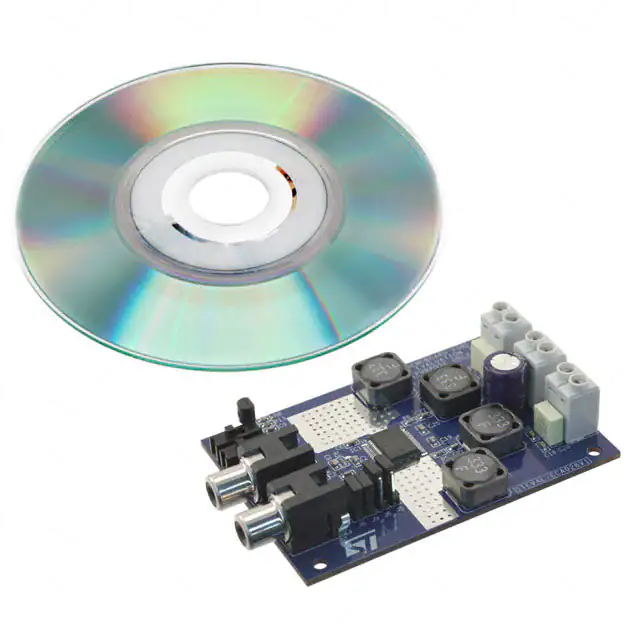
- Part No.:
- STEVAL-CCA028V1
- Manufacturer:
- STMicroelectronics
- Category:
- Audio Amplifier Evaluation Boards
- Package:
- Datasheet:
-
 STEVAL-CCA028V1.pdf
- Description:
- EVAL BOARD FOR TDA7491P
- Quantity:
- Payment:

- Shipping:

Inventory:1,762
Please send an inquiry. Send us your inquiry, and we will respond immediately.
Product details
Overview
STEVAL-CCA028V1 from STMicroelectronics is a 10 W + 10 W dual-channel Class-D audio amplifier demonstration board based on the TDA7491P IC, operating from a single 5–18 V supply, delivering 9.5 W per channel into 8 Ω at 12 V with 10% THD, and featuring filterless operation, differential inputs, and integrated thermal/short-circuit protection.
For engineers reviewing the STEVAL-CCA028V1 datasheet, STEVAL-CCA028V1 pinout, STEVAL-CCA028V1 application, or STEVAL-CCA028V1 equivalent, this board enables rapid validation of gain configuration (20/26/30/32 dB), standby/mute control, external clock synchronization, and heatsink-free operation in compact audio systems.
Technical Context
The board implements the TDA7491P in BTL (Bridge-Tied Load) topology, supporting both single-ended and differential analog inputs via configurable jumpers. It uses no output LC filters-relying on spread-spectrum modulation and optimized layout for EMI compliance.
Power delivery includes dedicated PVCC/PVCCA/PVCCB rails, separate power grounds (PGNDA/PGNDB), and diagnostic pins (DIAG, SVR) for fault reporting. Synchronization input (SYNCLK) allows multi-board timing alignment without jitter accumulation.
Key Specifications
| Parameter | Value and Actual Design Meaning |
|---|---|
| Output Power | 10 W + 10 W continuous into 6 Ω @ 11 V, 10% THD - enables full-range stereo playback in compact enclosures without forced cooling. |
| Supply Voltage Range | 5–18 V single supply - supports battery-powered (e.g., 2S–4S Li-ion) and adapter-fed audio systems without rail splitting. |
| Efficiency | η = 90% - reduces thermal load on PCB and eliminates need for heatsinks in ≤10 W/channel designs. |
| Gain Settings | 20 dB / 26 dB / 30 dB / 32 dB (fixed, jumper-selectable) - matches varied line-level or DAC output amplitudes without external op-amps. |
| Input Configuration | Differential or single-ended via hardware jumpers - suppresses common-mode noise in noisy environments (e.g., automotive infotainment). |
| Protection Features | Thermal shutdown, short-circuit detection, and mute-controlled soft-start - prevents speaker damage and pop-noise during power sequencing. |
Availability
STEVAL-CCA028V1 is available at Aetrix Electronics and suitable for audio evaluation, consumer speaker prototyping, and industrial human-machine interface (HMI) sound systems requiring stable component supply and documented reference design validation.
Supply support for STEVAL-CCA028V1 includes scheduled delivery planning, volume procurement assistance, BOM continuity management, traceable sourcing, and lifecycle availability coordination for OEM customers, industrial embedded developers, connected-device designers, and electronics production programs.
Manufacturer
STMicroelectronics is a global semiconductor leader headquartered in Geneva, designing and manufacturing microcontrollers, power ICs, analog chips, and MEMS sensors for industrial, automotive, and consumer applications.
The STEVAL-CCA028V1 belongs to ST's Audio Demonstration Board product line, engineered to accelerate adoption of high-efficiency Class-D amplifiers in space-constrained, thermally sensitive audio subsystems.
FAQ
What input signal types does STEVAL-CCA028V1 accept?
The board accepts either differential or single-ended analog audio inputs, selected via onboard jumpers (JP1–JP4). Differential mode uses INPA/INNA and INPB/INNB pairs for noise rejection; single-ended mode routes signals through INPA and INPB only, with referenced ground paths defined by SGND and SUB_GND.
Does STEVAL-CCA028V1 require an external LC filter?
No. The TDA7491P IC on this board uses filterless modulation architecture, eliminating external output chokes and capacitors. EMI is managed through spread-spectrum switching and optimized PCB layout - verified per EN55032 Class B limits in the original ST reference design.
How is gain configured on this demonstration board?
Gain is set using two 2-position DIP switches (SW1 and SW2), selecting among four fixed values: 20 dB, 26 dB, 30 dB, or 32 dB. Switch positions directly configure internal resistor networks inside the TDA7491P - no firmware or external components are needed for gain adjustment.
Can STEVAL-CCA028V1 be synchronized with other Class-D boards?
Yes. The SYNCLK input (Pin 25 of U1) accepts an external 200–500 kHz clock signal to align switching frequencies across multiple boards, reducing beat frequencies and inter-board EMI coupling - critical for multi-channel active speaker arrays and distributed audio systems.
STEVAL-CCA028V1 Specifications
- Product attributes
- Attribute value
- Manufacturer:
- STMicroelectronics
- Series:
- -
- Packaging:
- Bulk
- Product Status:
- Active
- Amplifier Type:
- Class D
- Output Type:
- 2-Channel (Stereo)
- Max Output Power x Channels @ Load:
- 10W x 2 @ 6Ohm
- Voltage - Supply:
- 5V ~ 18V
- Utilized IC / Part:
- TDA7491P
- Contents:
- Board(s)
STEVAL-CCA028V1 FAQ
1.How can I place an order for STEVAL-CCA028V1 through Aetrix?
Please submit a Request for Quotation (RFQ) for STEVAL-CCA028V1 on Aetrix. Our sales agent will provide a competitive quotation and guide you through the order confirmation once you accept the terms.
2.Are the price and stock information for STEVAL-CCA028V1 reliable?
The price and inventory of STEVAL-CCA028V1 are updated periodically and may fluctuate due to market conditions. Stock and pricing data are typically refreshed every 24 hours. Quotation validity for STEVAL-CCA028V1 is usually 5 days.
3.What payment methods are accepted for STEVAL-CCA028V1?
We accept Wire Transfer, PayPal, Credit Card, Western Union, MoneyGram, and Escrow for STEVAL-CCA028V1 transactions.
Note: Certain payment methods may incur a processing fee.
4.How is shipping managed for STEVAL-CCA028V1?
STEVAL-CCA028V1 orders can be shipped via leading logistics carriers, including DHL, UPS, FedEx, TNT, or Registered Mail.
Once your STEVAL-CCA028V1 order is processed, you will receive an email with the shipment details and tracking number.
Note: Tracking information may take up to 24 hours to appear. Express delivery typically takes 3–5 business days.
5.How can I obtain technical support or documentation for STEVAL-CCA028V1?
For technical support, including STEVAL-CCA028V1 datasheets, pinout diagrams, or application guidance, please contact our engineering support team. They can provide detailed documentation and assistance for your STEVAL-CCA028V1 requirements.
6.How does Aetrix verify that STEVAL-CCA028V1 is sourced from the original manufacturer or authorized distributors?
All STEVAL-CCA028V1 products on Aetrix are procured from qualified distributors and authorized channels. Our dedicated quality assurance team conducts strict verification, including traceability checks and, if necessary, third-party testing. This ensures that STEVAL-CCA028V1 meets industry standards.
7.What is the process for return or replacement of STEVAL-CCA028V1?
All STEVAL-CCA028V1 units undergo pre-shipment inspection (PSI). If there is an issue with STEVAL-CCA028V1, returns or replacements are accepted under the following conditions:
1.Quantity discrepancies, incorrect items, or visible external defects (such as breakage or corrosion), acknowledged by Aetrix.
2.The issue is reported within 90 days of delivery.
3.The STEVAL-CCA028V1 part is unused and in its original packaging.
Return procedure for STEVAL-CCA028V1:
1.Submit a request within 90 days.
2.Obtain a Return Material Authorization (RMA) from Aetrix.
STEVAL-CCA028V1 Tags

-
2130
Adafruit Industries LLC
-
3006
Adafruit Industries LLC
-
XPCB-12BT
Soberton Inc.
-
AMP2X15
PUI Audio, Inc.
-
EPC9192KIT
EPC
-
987
Adafruit Industries LLC
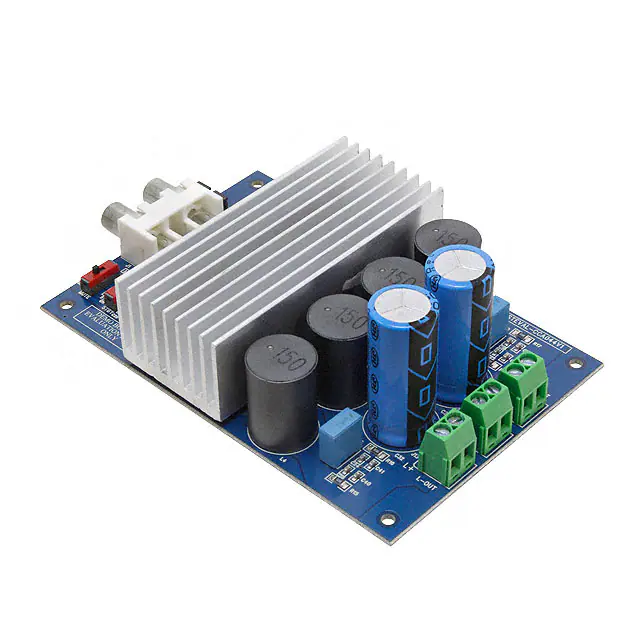
-
STEVAL-CCA044V1
STMicroelectronics
-
93105
MISCO
-
93103
MISCO
-
1752
Adafruit Industries LLC
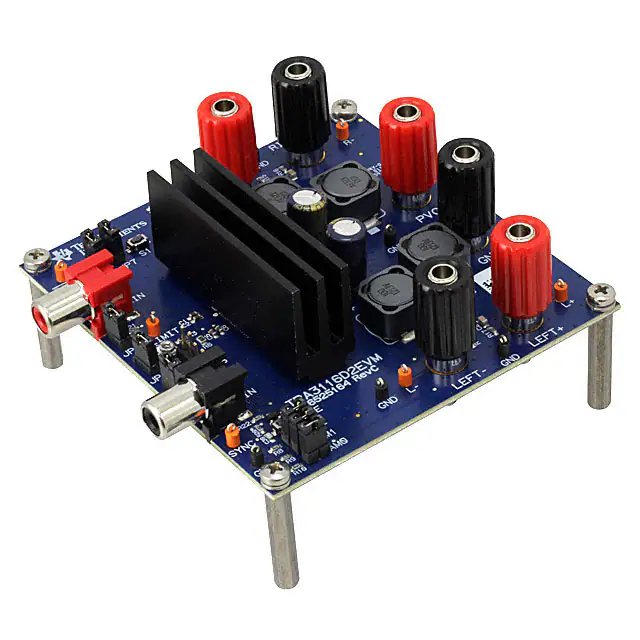
-
TPA3116D2EVM
Texas Instruments
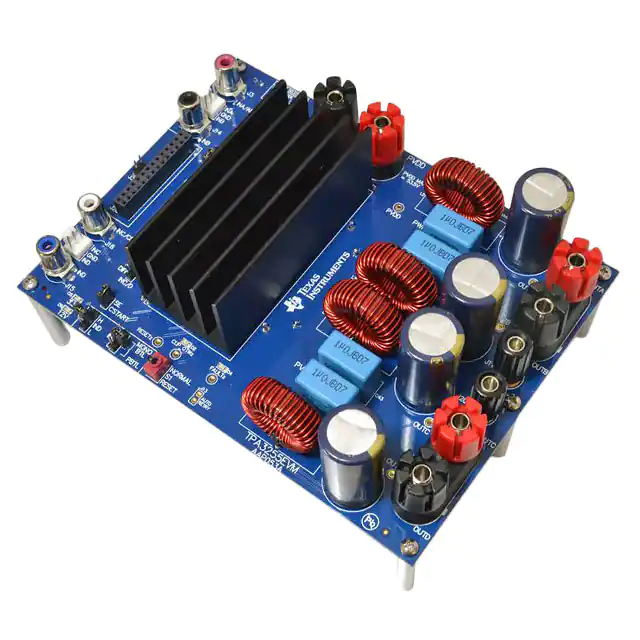
-
TPA3255EVM
Texas Instruments
Tech Hub

A practical engineering and sourcing framework covering lifecycle verification, lifetime-buy calculations, replacement qualification, supplier checks and counterfeit-risk controls.

TTL and CMOS logic families differ in thresholds, loading, output drive, power and timing. This engineering guide compares 74HC and 74HCT, calculates noise margins and checks 3.3 V/5 V compatibility.

A practical engineering guide to 3.3V and 5V logic compatibility, input thresholds, resistor dividers, translator ICs, MOSFET level shifting, I2C pull-ups, timing limits and power-sequencing risks.

The 74HC595 uses push-pull logic outputs, while the TPIC6B595 uses 50 V open-drain DMOS sinks for higher-power loads. This guide compares timing, current limits, 3.3 V interfacing, load wiring, thermal…

The 74HC595 converts serial data into eight stable parallel outputs. This guide covers pin functions, shift and storage timing, OE and MR behavior, drive-current limits, cascading, voltage compatibilit…

A technical comparison of level-sensitive latches and edge-triggered flip-flops, covering timing windows, setup and hold limits, master–slave operation, time borrowing, race-through, HDL inference and…

A D latch stores one bit while Enable controls when data can pass. This reference covers gate-level operation, truth tables, transparency, setup and hold timing, LE versus OE, common ICs and practical …

An SR latch stores one bit through cross-coupled feedback. This engineering reference covers NOR and NAND implementations, truth tables, forbidden-state recovery, gated operation, switch debouncing, fa…

Latch circuits retain one bit through feedback. This technical reference covers SR and D latches, truth tables, transparency, timing limits, latch-versus-flip-flop behavior, applications and common log…

An engineering guide to LED driver operation, constant-current and constant-voltage outputs, linear and switching topologies, dimming, IC selection, calculations, replacement compatibility, and fault c…


