
 My Inquiry
 My Account


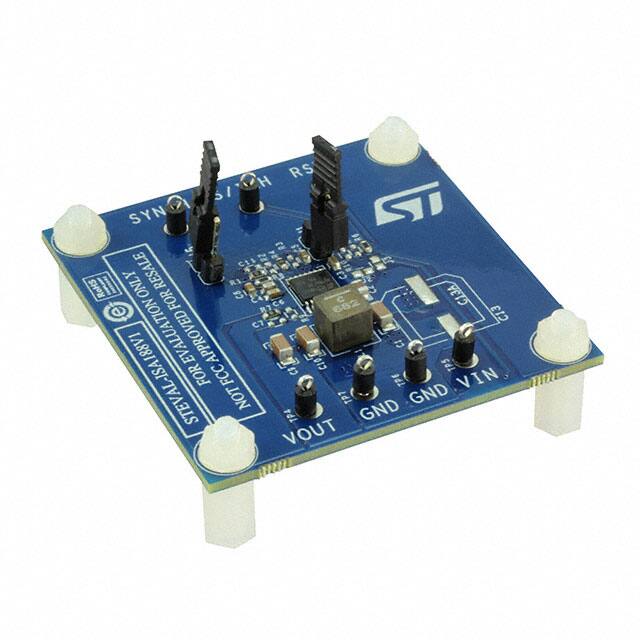
STMicroelectronics STEVAL-ISA188V1
- Part No.:
- STEVAL-ISA188V1
- Manufacturer:
- STMicroelectronics
- Package:
- Datasheet:
-
 STEVAL-ISA188V1.pdf
- Description:
- EVAL BOARD FOR A6986F3V3
- Quantity:
- Payment:

- Shipping:

Inventory:1,930
Please send an inquiry. Send us your inquiry, and we will respond immediately.
Product details
Overview
STEVAL-ISA188V1 from STMicroelectronics is an evaluation board for the A6986F3V3 3.3 V, 1.5 A synchronous step-down switching regulator, designed for automotive battery-powered systems with 4–38 V input range, AEC-Q100 qualification, and cold-crank tolerance. It supports low-consumption mode (30 μA IQ at 12 V), programmable switching frequency (250 kHz–2 MHz), and embedded output voltage supervisor.
For engineers reviewing the STEVAL-ISA188V1 datasheet, STEVAL-ISA188V1 schematic, STEVAL-ISA188V1 application notes, or STEVAL-ISA188V1 board layout, this page provides verified functional context, configuration flexibility (LCM/LNM, soft-start, synchronization), and design-ready evaluation capabilities for automotive power supply validation.
Technical Context
The board implements the A6986F3V3 IC in peak current mode architecture with integrated high-side (RDS(on) = 180 mΩ) and low-side (RDS(on) = 150 mΩ) MOSFETs, enabling 100% duty cycle operation critical for cold-crank events. It features dual operating modes-low-consumption mode (LCM) for body electronics standby efficiency and low-noise mode (LNM) for forced PWM in infotainment systems.
Hardware-configurable features include adjustable ISKIP current, synchronization input (SYNCH pin), adjustable soft-start via SS/INH, and output voltage sequencing support. Protection functions-overvoltage, thermal shutdown, internal current limiting, and embedded supervisor-ensure robustness in automotive environments per AEC-Q100 Grade 1 requirements.
Key Specifications
| Parameter | Value and Actual Design Meaning |
|---|---|
| Input Voltage Range | 4 V to 38 V - supports full automotive battery range including cold crank (down to 3 V with 100% duty cycle) |
| Output Voltage | Fixed 3.3 V - factory-configured for direct compatibility with MCU/SOC core logic rails |
| Max Output Current | 1.5 A DC - sustained delivery under thermal limits with onboard 6.8 µH and 4.7 µH inductors |
| Quiescent Current (LCM) | 30 µA at VIN = 12 V - enables >90% efficiency at light loads typical of parked-car body modules |
| Switching Frequency | 250 kHz to 2 MHz - programmable via resistor; default 500 kHz balances EMI and passive size |
| Protection Features | Overvoltage, thermal shutdown, internal current limiting - hardware-enforced safeguards without external circuitry |
| AEC-Q100 Qualification | Grade 1 (−40 °C to +125 °C ambient) - validated for engine bay and cabin-mounted automotive ECUs |
Availability
STEVAL-ISA188V1 is available at Aetrix Electronics and suitable for automotive body control modules, infotainment power supplies, ADAS domain controllers, and telematics gateway designs requiring stable component supply and production-ready evaluation capability.
Supply support for STEVAL-ISA188V1 includes scheduled delivery planning, volume procurement assistance, BOM continuity management, traceable sourcing, and lifecycle availability coordination for OEM customers, industrial embedded developers, connected-device designers, and electronics production programs.
Manufacturer
STMicroelectronics is a global semiconductor leader headquartered in Geneva, Switzerland, specializing in automotive, industrial, and power management solutions with broad analog, digital, and mixed-signal portfolio coverage.
The STEVAL-ISA188V1 belongs to ST's automotive-grade evaluation board series targeting DC-DC converter validation; it was developed to accelerate design-in of A6986F3V3 in safety-critical and energy-efficient vehicle subsystems.
FAQ
What is the default switching frequency and how is it set?
The default switching frequency is 500 kHz, configured by a 75 kΩ resistor (R8) between FSW and GND per the A6986F3V3 datasheet. Frequency can be adjusted from 250 kHz to 2 MHz by changing this resistor value, enabling optimization for EMI compliance or passive component size reduction.
Does the board support synchronization to an external clock?
Yes - the SYNCH pin (U1 Pin 4) accepts an external clock signal (250 kHz–2 MHz) to synchronize switching, reducing beat frequencies in multi-rail systems. The board includes test point TP3 for signal injection and routing compatible with standard automotive clock sources.
How is low-consumption mode (LCM) enabled or disabled?
LCM is enabled by default via jumper configuration and internal register setting. It is activated automatically below ~100 mA load and disables pulse-skipping only when LNM is not selected. Mode selection is controlled by the ISKIP current threshold and cannot be toggled dynamically during operation without reconfiguration.
Can the output voltage be modified to 5 V or other values?
No - the board is factory-configured for fixed 3.3 V output using the A6986F3V3 variant with internal feedback divider. To evaluate other voltages, users must select a different A6986 variant (e.g., A6986F50 for 5 V) and replace U1 with corresponding part; the PCB layout does not support external resistor-based adjustment.
STEVAL-ISA188V1 Specifications
- Product attributes
- Attribute value
- Manufacturer:
- STMicroelectronics
- Series:
- -
- Packaging:
- Bulk
- Product Status:
- Active
- Main Purpose:
- DC/DC, Step Down
- Outputs and Type:
- 1 Non-Isolated Output
- Voltage - Output:
- -
- Current - Output:
- 3.3V
- Voltage - Input:
- 1.5A
- Regulator Topology:
- 4V ~ 38V
- Frequency - Switching:
- Buck
- Contents:
- 500kHz
- Utilized IC / Part:
- Board(s)
- Power - Output:
- A6986F3V3
STEVAL-ISA188V1 FAQ
1.How can I place an order for STEVAL-ISA188V1 through Aetrix?
Please submit a Request for Quotation (RFQ) for STEVAL-ISA188V1 on Aetrix. Our sales agent will provide a competitive quotation and guide you through the order confirmation once you accept the terms.
2.Are the price and stock information for STEVAL-ISA188V1 reliable?
The price and inventory of STEVAL-ISA188V1 are updated periodically and may fluctuate due to market conditions. Stock and pricing data are typically refreshed every 24 hours. Quotation validity for STEVAL-ISA188V1 is usually 5 days.
3.What payment methods are accepted for STEVAL-ISA188V1?
We accept Wire Transfer, PayPal, Credit Card, Western Union, MoneyGram, and Escrow for STEVAL-ISA188V1 transactions.
Note: Certain payment methods may incur a processing fee.
4.How is shipping managed for STEVAL-ISA188V1?
STEVAL-ISA188V1 orders can be shipped via leading logistics carriers, including DHL, UPS, FedEx, TNT, or Registered Mail.
Once your STEVAL-ISA188V1 order is processed, you will receive an email with the shipment details and tracking number.
Note: Tracking information may take up to 24 hours to appear. Express delivery typically takes 3–5 business days.
5.How can I obtain technical support or documentation for STEVAL-ISA188V1?
For technical support, including STEVAL-ISA188V1 datasheets, pinout diagrams, or application guidance, please contact our engineering support team. They can provide detailed documentation and assistance for your STEVAL-ISA188V1 requirements.
6.How does Aetrix verify that STEVAL-ISA188V1 is sourced from the original manufacturer or authorized distributors?
All STEVAL-ISA188V1 products on Aetrix are procured from qualified distributors and authorized channels. Our dedicated quality assurance team conducts strict verification, including traceability checks and, if necessary, third-party testing. This ensures that STEVAL-ISA188V1 meets industry standards.
7.What is the process for return or replacement of STEVAL-ISA188V1?
All STEVAL-ISA188V1 units undergo pre-shipment inspection (PSI). If there is an issue with STEVAL-ISA188V1, returns or replacements are accepted under the following conditions:
1.Quantity discrepancies, incorrect items, or visible external defects (such as breakage or corrosion), acknowledged by Aetrix.
2.The issue is reported within 90 days of delivery.
3.The STEVAL-ISA188V1 part is unused and in its original packaging.
Return procedure for STEVAL-ISA188V1:
1.Submit a request within 90 days.
2.Obtain a Return Material Authorization (RMA) from Aetrix.
STEVAL-ISA188V1 Tags
-
DFR0571
DFRobot
-
DFR0379
DFRobot
-
DFR0205
DFRobot
-
1385
Adafruit Industries LLC
-
COM-15208
SparkFun Electronics
-
1944
Adafruit Industries LLC
-
2465
Adafruit Industries LLC
-
DC2468A
Analog Devices Inc.
-
DC2841A
Analog Devices Inc.

-
TPS552892EVM-111
Texas Instruments
-
TPS55289EVM-093
Texas Instruments
-
EPC9158
EPC
Tech Hub

A practical engineering and sourcing framework covering lifecycle verification, lifetime-buy calculations, replacement qualification, supplier checks and counterfeit-risk controls.

TTL and CMOS logic families differ in thresholds, loading, output drive, power and timing. This engineering guide compares 74HC and 74HCT, calculates noise margins and checks 3.3 V/5 V compatibility.

A practical engineering guide to 3.3V and 5V logic compatibility, input thresholds, resistor dividers, translator ICs, MOSFET level shifting, I2C pull-ups, timing limits and power-sequencing risks.

The 74HC595 uses push-pull logic outputs, while the TPIC6B595 uses 50 V open-drain DMOS sinks for higher-power loads. This guide compares timing, current limits, 3.3 V interfacing, load wiring, thermal…

The 74HC595 converts serial data into eight stable parallel outputs. This guide covers pin functions, shift and storage timing, OE and MR behavior, drive-current limits, cascading, voltage compatibilit…

A technical comparison of level-sensitive latches and edge-triggered flip-flops, covering timing windows, setup and hold limits, master–slave operation, time borrowing, race-through, HDL inference and…

A D latch stores one bit while Enable controls when data can pass. This reference covers gate-level operation, truth tables, transparency, setup and hold timing, LE versus OE, common ICs and practical …

An SR latch stores one bit through cross-coupled feedback. This engineering reference covers NOR and NAND implementations, truth tables, forbidden-state recovery, gated operation, switch debouncing, fa…

Latch circuits retain one bit through feedback. This technical reference covers SR and D latches, truth tables, transparency, timing limits, latch-versus-flip-flop behavior, applications and common log…

An engineering guide to LED driver operation, constant-current and constant-voltage outputs, linear and switching topologies, dimming, IC selection, calculations, replacement compatibility, and fault c…


