
 My Inquiry
 My Account


STMicroelectronics STEVAL-ISA191V1
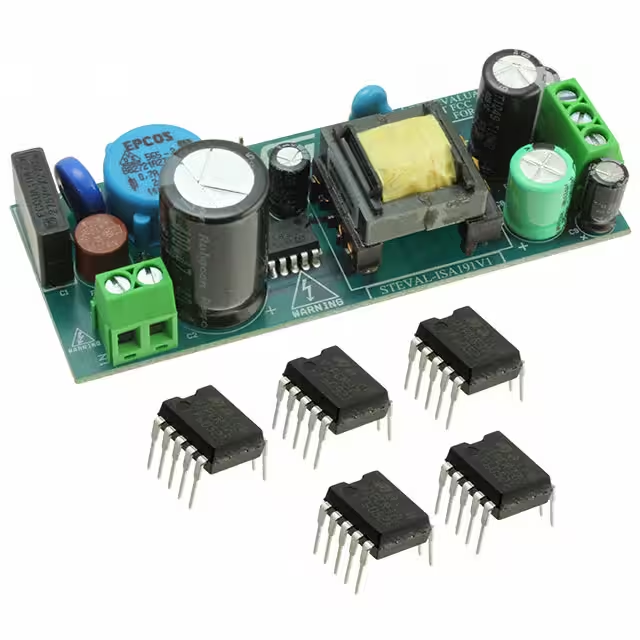
- Part No.:
- STEVAL-ISA191V1
- Manufacturer:
- STMicroelectronics
- Package:
- Datasheet:
-
 STEVAL-ISA191V1.pdf
- Description:
- EVAL BOARD FOR VIPER37
- Quantity:
- Payment:

- Shipping:

Inventory:1,448
Please send an inquiry. Send us your inquiry, and we will respond immediately.
Product details
Overview
STEVAL-ISA191V1 from STMicroelectronics is an evaluation board implementing a 15 W isolated dual-output flyback converter using the VIPer37LE high-voltage PWM controller, delivering 5 V / 1.2 A and 12 V / 0.75 A from universal AC input (85–265 VAC, 50–60 Hz), with <40 mW no-load consumption and >75% average efficiency.
For engineers reviewing the STEVAL-ISA191V1 datasheet, STEVAL-ISA191V1 schematic, STEVAL-ISA191V1 application, or STEVAL-ISA191V1 equivalent, this board serves as a validated reference design for compact, low-standby-power AC/DC power supplies targeting industrial control interfaces, IoT edge node power rails, and dual-rail embedded systems requiring EMI-compliant Class-B operation.
Technical Context
The board implements a primary-side regulated, transformer-isolated flyback topology with fixed 60 kHz switching frequency and frequency jittering to reduce EMI peaks. It uses burst-mode operation under light/no load to achieve <40 mW standby consumption at 230 VAC.
VIPer37LE integrates an 800 V avalanche-rated MOSFET and current-mode PWM controller with comprehensive protection: overvoltage, overload, output short-circuit, secondary winding short, hard saturation, and brown-out detection - enabling robust single-chip AC/DC conversion without optocoupler feedback compensation.
Key Specifications
| Parameter | Value and Actual Design Meaning |
|---|---|
| Topology | Isolated dual-output flyback with primary-side regulation |
| Input Range | 85–265 VAC, 50–60 Hz - supports global mains without manual selection |
| Output 1 | 5 V / 1.2 A - powers logic, microcontrollers, and USB peripherals |
| Output 2 | 12 V / 0.75 A - drives relays, sensors, or analog front-ends |
| Standby Power | <40 mW at 230 VAC - meets stringent energy-efficiency standards |
| EMI Compliance | EN55022 Class B - validated for commercial/industrial environments |
| Efficiency | >75% average across load range - reduces thermal stress and improves reliability |
Availability
STEVAL-ISA191V1 is available at Aetrix Electronics and suitable for industrial control interfaces, IoT edge node power rails, and dual-rail embedded systems requiring stable component supply, rapid prototyping validation, and EMI-compliant AC/DC conversion.
Supply support for STEVAL-ISA191V1 includes scheduled delivery planning, volume procurement assistance, BOM continuity management, traceable sourcing, and lifecycle availability coordination for OEM customers, industrial embedded developers, connected-device designers, and electronics production programs.
Manufacturer
STMicroelectronics is a global semiconductor leader designing and manufacturing microcontrollers, power ICs, sensors, and analog/mixed-signal devices for automotive, industrial, and consumer applications.
This board belongs to ST's STEVAL evaluation platform family, engineered to accelerate development of certified, production-ready AC/DC power supplies using VIPerPlus off-line converters in cost-sensitive, space-constrained designs.
FAQ
What is the purpose of the STEVAL-ISA191V1 evaluation board?
The STEVAL-ISA191V1 is a fully assembled, tested reference design for a 15 W dual-output isolated flyback converter. It demonstrates the VIPer37LE's capability to deliver tightly regulated 5 V and 12 V outputs from universal AC input with minimal external components, low standby power, and Class-B EMI compliance - intended for rapid power architecture validation and schematic review.
Does this board require an optocoupler for feedback regulation?
No. The STEVAL-ISA191V1 uses primary-side regulation via the VIPer37LE's internal sensing and control loop, eliminating the need for an optocoupler or secondary-side TL431 shunt regulator. Feedback is derived from auxiliary winding voltage and internal reference, simplifying layout and improving long-term reliability.
Can the output voltages be adjusted without hardware modification?
No. Output voltages are fixed by transformer turns ratio and feedback resistor network (R13/R14 for 5 V; R16/R17 for 12 V). Adjusting either output requires changing those resistors and verifying regulation stability and cross-regulation performance - not supported out-of-box.
What safety certifications does this board support?
The board meets EN55022 Class B conducted and radiated EMI limits and incorporates reinforced isolation per IEC 60747-5-2 (creepage/clearance ≥8 mm between primary and secondary). It is not pre-certified to UL/IEC 62368-1, but its layout and component selection align with requirements for end-equipment certification when integrated into properly designed enclosures.
STEVAL-ISA191V1 Specifications
- Product attributes
- Attribute value
- Manufacturer:
- STMicroelectronics
- Series:
- VIPer™ plus
- Packaging:
- Bulk
- Product Status:
- Active
- Main Purpose:
- AC/DC, Primary Side
- Outputs and Type:
- 2 Isolated Outputs
- Voltage - Output:
- -
- Current - Output:
- 5V, 12V
- Voltage - Input:
- 1.2A, 750mA
- Regulator Topology:
- 85 ~ 265 VAC
- Frequency - Switching:
- Flyback
- Contents:
- 60kHz
- Utilized IC / Part:
- Board(s)
- Power - Output:
- VIPer37
STEVAL-ISA191V1 FAQ
1.How can I place an order for STEVAL-ISA191V1 through Aetrix?
Please submit a Request for Quotation (RFQ) for STEVAL-ISA191V1 on Aetrix. Our sales agent will provide a competitive quotation and guide you through the order confirmation once you accept the terms.
2.Are the price and stock information for STEVAL-ISA191V1 reliable?
The price and inventory of STEVAL-ISA191V1 are updated periodically and may fluctuate due to market conditions. Stock and pricing data are typically refreshed every 24 hours. Quotation validity for STEVAL-ISA191V1 is usually 5 days.
3.What payment methods are accepted for STEVAL-ISA191V1?
We accept Wire Transfer, PayPal, Credit Card, Western Union, MoneyGram, and Escrow for STEVAL-ISA191V1 transactions.
Note: Certain payment methods may incur a processing fee.
4.How is shipping managed for STEVAL-ISA191V1?
STEVAL-ISA191V1 orders can be shipped via leading logistics carriers, including DHL, UPS, FedEx, TNT, or Registered Mail.
Once your STEVAL-ISA191V1 order is processed, you will receive an email with the shipment details and tracking number.
Note: Tracking information may take up to 24 hours to appear. Express delivery typically takes 3–5 business days.
5.How can I obtain technical support or documentation for STEVAL-ISA191V1?
For technical support, including STEVAL-ISA191V1 datasheets, pinout diagrams, or application guidance, please contact our engineering support team. They can provide detailed documentation and assistance for your STEVAL-ISA191V1 requirements.
6.How does Aetrix verify that STEVAL-ISA191V1 is sourced from the original manufacturer or authorized distributors?
All STEVAL-ISA191V1 products on Aetrix are procured from qualified distributors and authorized channels. Our dedicated quality assurance team conducts strict verification, including traceability checks and, if necessary, third-party testing. This ensures that STEVAL-ISA191V1 meets industry standards.
7.What is the process for return or replacement of STEVAL-ISA191V1?
All STEVAL-ISA191V1 units undergo pre-shipment inspection (PSI). If there is an issue with STEVAL-ISA191V1, returns or replacements are accepted under the following conditions:
1.Quantity discrepancies, incorrect items, or visible external defects (such as breakage or corrosion), acknowledged by Aetrix.
2.The issue is reported within 90 days of delivery.
3.The STEVAL-ISA191V1 part is unused and in its original packaging.
Return procedure for STEVAL-ISA191V1:
1.Submit a request within 90 days.
2.Obtain a Return Material Authorization (RMA) from Aetrix.
STEVAL-ISA191V1 Tags
-
DFR0571
DFRobot
-
DFR0379
DFRobot
-
DFR0205
DFRobot
-
1385
Adafruit Industries LLC
-
COM-15208
SparkFun Electronics
-
1944
Adafruit Industries LLC
-
2465
Adafruit Industries LLC
-
DC2468A
Analog Devices Inc.
-
DC2841A
Analog Devices Inc.

-
TPS552892EVM-111
Texas Instruments
-
TPS55289EVM-093
Texas Instruments
-
EPC9158
EPC
Tech Hub

A practical engineering and sourcing framework covering lifecycle verification, lifetime-buy calculations, replacement qualification, supplier checks and counterfeit-risk controls.

TTL and CMOS logic families differ in thresholds, loading, output drive, power and timing. This engineering guide compares 74HC and 74HCT, calculates noise margins and checks 3.3 V/5 V compatibility.

A practical engineering guide to 3.3V and 5V logic compatibility, input thresholds, resistor dividers, translator ICs, MOSFET level shifting, I2C pull-ups, timing limits and power-sequencing risks.

The 74HC595 uses push-pull logic outputs, while the TPIC6B595 uses 50 V open-drain DMOS sinks for higher-power loads. This guide compares timing, current limits, 3.3 V interfacing, load wiring, thermal…

The 74HC595 converts serial data into eight stable parallel outputs. This guide covers pin functions, shift and storage timing, OE and MR behavior, drive-current limits, cascading, voltage compatibilit…

A technical comparison of level-sensitive latches and edge-triggered flip-flops, covering timing windows, setup and hold limits, master–slave operation, time borrowing, race-through, HDL inference and…

A D latch stores one bit while Enable controls when data can pass. This reference covers gate-level operation, truth tables, transparency, setup and hold timing, LE versus OE, common ICs and practical …

An SR latch stores one bit through cross-coupled feedback. This engineering reference covers NOR and NAND implementations, truth tables, forbidden-state recovery, gated operation, switch debouncing, fa…

Latch circuits retain one bit through feedback. This technical reference covers SR and D latches, truth tables, transparency, timing limits, latch-versus-flip-flop behavior, applications and common log…

An engineering guide to LED driver operation, constant-current and constant-voltage outputs, linear and switching topologies, dimming, IC selection, calculations, replacement compatibility, and fault c…


