
 My Inquiry
 My Account


STMicroelectronics STEVAL-MIC005V1
- Part No.:
- STEVAL-MIC005V1
- Manufacturer:
- STMicroelectronics
- Category:
- Expansion Boards, Daughter Cards
- Package:
- Datasheet:
-
 STEVAL-MIC005V1.pdf
- Description:
- COUPON BOARD MP23DB02MM
- Quantity:
- Payment:

- Shipping:

Inventory:1,421
Please send an inquiry. Send us your inquiry, and we will respond immediately.
Product details
Overview
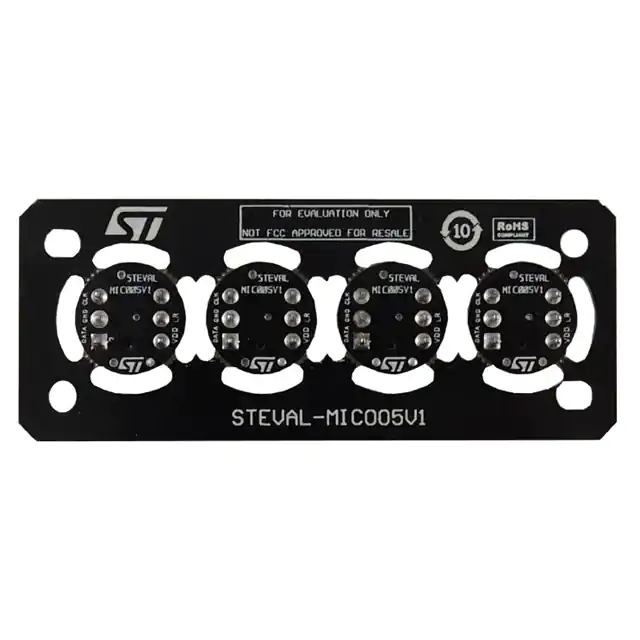
STEVAL-MIC005V1 from STMicroelectronics is a microphone coupon daughterboard featuring four MP23DB02MM bottom-port digital MEMS microphones, supporting PDM single-bit output, 122 dBSPL acoustic overload point, and multi-performance mode operation with identical -26 dBFs ±1 dB sensitivity across modes. It interfaces directly with X-NUCLEO-CCA02M2 for STM32 Nucleo evaluation.
For engineers reviewing the STEVAL-MIC005V1 datasheet, STEVAL-MIC005V1 pinout, STEVAL-MIC005V1 application, or STEVAL-MIC005V1 equivalent, key selection factors include PDM interface compatibility, dual-mode SNR (64 dB low-power), supply voltage range (1.6–3.6 V), acoustic overload margin, and modular coupon-based physical layout for individual microphone validation.
Technical Context
The board implements four independent MP23DB02MM microphones, each with dedicated PDM data output (DOUT), clock input (CLK), left/right channel select (L/R), power (VDD), and ground (GND) terminals. All microphones share identical electrical characteristics and operate synchronously under common clock control.
Each microphone supports two configurable performance modes-low-power and high-performance-with identical sensitivity (-26 dBFs ±1 dB) but differing SNR (64 dB in low-power mode) and current consumption. The coupon design enables mechanical detachment of individual microphone PCBs for isolated acoustic testing.
Key Specifications
| Parameter | Value and Actual Design Meaning |
|---|---|
| Microphone Count | 4 independent MP23DB02MM devices on one board, enabling multi-channel audio capture or spatial acoustic analysis. |
| Output Interface | PDM single-bit serial output per microphone - requires external decimation filter or MCU with PDM-to-PCM hardware support. |
| Supply Voltage | 1.6 V to 3.6 V - compatible with standard I/O domains of STM32 Nucleo and other 1.8 V / 3.3 V embedded platforms. |
| Acoustic Overload Point | 122 dBSPL - supports loud-environment recording without clipping, e.g., industrial noise monitoring or voice assistant far-field use. |
| SNR (Low Power Mode) | 64 dB - defines minimum detectable signal level above quantization and thermal noise floor in battery-constrained applications. |
| Sensitivity | -26 dBFs ±1 dB - consistent across both operating modes, simplifying firmware calibration and gain staging in multi-mic arrays. |
Availability
STEVAL-MIC005V1 is available at Aetrix Electronics and suitable for microphone array prototyping, STM32-based voice interface development, and MEMS acoustic sensor validation requiring stable component supply and modular test flexibility.
Supply support for STEVAL-MIC005V1 includes scheduled delivery planning, volume procurement assistance, BOM continuity management, traceable sourcing, and lifecycle availability coordination for OEM customers, industrial embedded developers, connected-device designers, and electronics production programs.
Manufacturer
STMicroelectronics is a global semiconductor leader headquartered in Geneva, Switzerland, designing and manufacturing analog, MEMS, power, microcontroller, and sensor solutions for industrial, automotive, and consumer markets.
The STEVAL-MIC005V1 belongs to ST's evaluation board portfolio for digital MEMS microphones, developed specifically to accelerate PDM-based audio subsystem validation and multi-microphone system integration with STM32 ecosystem hardware.
FAQ
Is STEVAL-MIC005V1 compatible with STM32CubeMX audio configuration tools?
Yes - STEVAL-MIC005V1 connects directly to X-NUCLEO-CCA02M2, which is fully supported by STM32CubeMX for PDM microphone initialization, clock configuration, and DMA-based audio streaming setup. The board's fixed PDM timing aligns with STM32 HAL_PDM drivers for automatic register mapping.
Can individual microphones be used independently after detaching the coupons?
Yes - each coupon contains a complete MP23DB02MM circuit with bypass capacitors (1 µF + 100 nF), VDD, GND, CLK, L/R, and DOUT pins routed to a 6-pin header (J1). Detached coupons retain full electrical functionality and can be interfaced with custom carriers or test fixtures.
What is the maximum recommended PDM clock frequency for STEVAL-MIC005V1?
The MP23DB02MM microphones on STEVAL-MIC005V1 support PDM clock frequencies up to 3.072 MHz. At this rate, the board delivers 16-bit equivalent PCM audio at 48 kHz after decimation - matching standard audio sampling requirements for voice and environmental sound capture.
Does STEVAL-MIC005V1 support time-of-arrival (TOA) measurements for beamforming?
Yes - all four microphones share synchronous clocking and exhibit matched group delay (<100 ns inter-channel skew), enabling precise phase-coherent sampling required for real-time TOA estimation and digital beamforming algorithms in embedded voice processing applications.
STEVAL-MIC005V1 Specifications
- Product attributes
- Attribute value
- Manufacturer:
- STMicroelectronics
- Series:
- -
- Packaging:
- Bulk
- Product Status:
- Active
- Platform:
- -
- Type:
- Audio
- Function:
- Microphone
- Utilized IC / Part:
- MP23DB02MM
- Contents:
- Board(s)
STEVAL-MIC005V1 FAQ
1.How can I place an order for STEVAL-MIC005V1 through Aetrix?
Please submit a Request for Quotation (RFQ) for STEVAL-MIC005V1 on Aetrix. Our sales agent will provide a competitive quotation and guide you through the order confirmation once you accept the terms.
2.Are the price and stock information for STEVAL-MIC005V1 reliable?
The price and inventory of STEVAL-MIC005V1 are updated periodically and may fluctuate due to market conditions. Stock and pricing data are typically refreshed every 24 hours. Quotation validity for STEVAL-MIC005V1 is usually 5 days.
3.What payment methods are accepted for STEVAL-MIC005V1?
We accept Wire Transfer, PayPal, Credit Card, Western Union, MoneyGram, and Escrow for STEVAL-MIC005V1 transactions.
Note: Certain payment methods may incur a processing fee.
4.How is shipping managed for STEVAL-MIC005V1?
STEVAL-MIC005V1 orders can be shipped via leading logistics carriers, including DHL, UPS, FedEx, TNT, or Registered Mail.
Once your STEVAL-MIC005V1 order is processed, you will receive an email with the shipment details and tracking number.
Note: Tracking information may take up to 24 hours to appear. Express delivery typically takes 3–5 business days.
5.How can I obtain technical support or documentation for STEVAL-MIC005V1?
For technical support, including STEVAL-MIC005V1 datasheets, pinout diagrams, or application guidance, please contact our engineering support team. They can provide detailed documentation and assistance for your STEVAL-MIC005V1 requirements.
6.How does Aetrix verify that STEVAL-MIC005V1 is sourced from the original manufacturer or authorized distributors?
All STEVAL-MIC005V1 products on Aetrix are procured from qualified distributors and authorized channels. Our dedicated quality assurance team conducts strict verification, including traceability checks and, if necessary, third-party testing. This ensures that STEVAL-MIC005V1 meets industry standards.
7.What is the process for return or replacement of STEVAL-MIC005V1?
All STEVAL-MIC005V1 units undergo pre-shipment inspection (PSI). If there is an issue with STEVAL-MIC005V1, returns or replacements are accepted under the following conditions:
1.Quantity discrepancies, incorrect items, or visible external defects (such as breakage or corrosion), acknowledged by Aetrix.
2.The issue is reported within 90 days of delivery.
3.The STEVAL-MIC005V1 part is unused and in its original packaging.
Return procedure for STEVAL-MIC005V1:
1.Submit a request within 90 days.
2.Obtain a Return Material Authorization (RMA) from Aetrix.
STEVAL-MIC005V1 Tags
-
2809
Adafruit Industries LLC
-
BOB-19626
SparkFun Electronics
-
DFR0299
DFRobot
-
5346
Adafruit Industries LLC
-
4538
Adafruit Industries LLC

-
4471
Adafruit Industries LLC
-
1980
Adafruit Industries LLC
-
4470
Adafruit Industries LLC
-
U035-B
M5Stack Technology Co., Ltd.
-
SEN0137
DFRobot
-
3191
Adafruit Industries LLC
-
4756
Adafruit Industries LLC
Tech Hub
Counterfeit components can hide behind convincing markings and passing basic function tests. This engineering reference covers source traceability, external inspection, X-ray, XRF, electrical testing, …

A practical engineering and sourcing framework covering lifecycle verification, lifetime-buy calculations, replacement qualification, supplier checks and counterfeit-risk controls.

TTL and CMOS logic families differ in thresholds, loading, output drive, power and timing. This engineering guide compares 74HC and 74HCT, calculates noise margins and checks 3.3 V/5 V compatibility.

A practical engineering guide to 3.3V and 5V logic compatibility, input thresholds, resistor dividers, translator ICs, MOSFET level shifting, I2C pull-ups, timing limits and power-sequencing risks.

The 74HC595 uses push-pull logic outputs, while the TPIC6B595 uses 50 V open-drain DMOS sinks for higher-power loads. This guide compares timing, current limits, 3.3 V interfacing, load wiring, thermal…

The 74HC595 converts serial data into eight stable parallel outputs. This guide covers pin functions, shift and storage timing, OE and MR behavior, drive-current limits, cascading, voltage compatibilit…

A technical comparison of level-sensitive latches and edge-triggered flip-flops, covering timing windows, setup and hold limits, master–slave operation, time borrowing, race-through, HDL inference and…

A D latch stores one bit while Enable controls when data can pass. This reference covers gate-level operation, truth tables, transparency, setup and hold timing, LE versus OE, common ICs and practical …

An SR latch stores one bit through cross-coupled feedback. This engineering reference covers NOR and NAND implementations, truth tables, forbidden-state recovery, gated operation, switch debouncing, fa…

Latch circuits retain one bit through feedback. This technical reference covers SR and D latches, truth tables, transparency, timing limits, latch-versus-flip-flop behavior, applications and common log…


