
 My Inquiry
 My Account


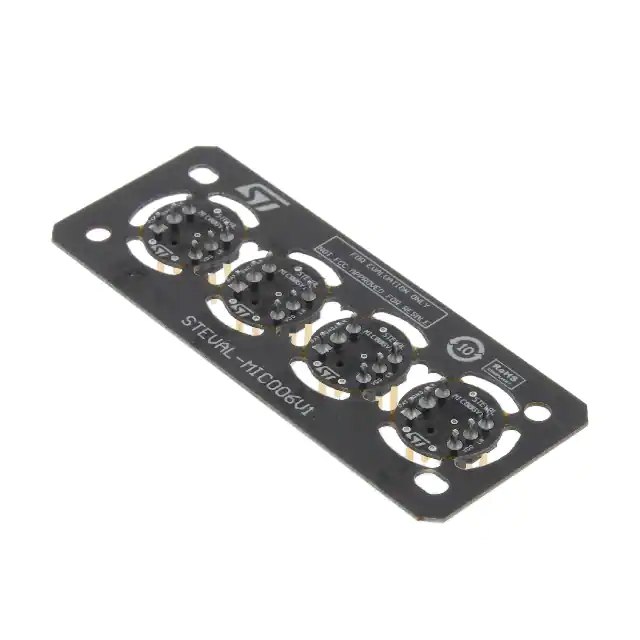
STMicroelectronics STEVAL-MIC006V1
- Part No.:
- STEVAL-MIC006V1
- Manufacturer:
- STMicroelectronics
- Category:
- Expansion Boards, Daughter Cards
- Package:
- Datasheet:
-
 STEVAL-MIC006V1.pdf
- Description:
- COUPON BOARD MP23DB01HP
- Quantity:
- Payment:

- Shipping:

Inventory:2,409
Please send an inquiry. Send us your inquiry, and we will respond immediately.
Product details
Overview
STEVAL-MIC006V1 from STMicroelectronics is a microphone coupon daughterboard featuring four MP23DB01HP bottom-port digital MEMS microphones, supporting PDM single-bit output, multi-performance mode (Low Power/High Performance), 135 dBSPL acoustic overload point, and operation from 1.6–3.6 V supply. It is designed for rapid evaluation and comparative testing of ST's MEMS microphones when paired with the X-NUCLEO-CCA02M2 expansion board.
For engineers reviewing the STEVAL-MIC006V1 datasheet, STEVAL-MIC006V1 pinout, STEVAL-MIC006V1 application, or STEVAL-MIC006V1 equivalent, key selection considerations include PDM interface compatibility, dual-mode SNR/sensitivity trade-offs (65 dB SNR / −41 dBFs in Performance mode; −24 dBFs in Low Power mode), acoustic overload margin, and mechanical decoupling via detachable microphone PCBs.
Technical Context
The board implements four independent MP23DB01HP transducers, each with configurable performance mode selected via external biasing-no I²C or control bus required. Each microphone outputs synchronous PDM data referenced to a shared CLK input and uses L/R pin to define channel assignment (left/right stereo framing).
Power delivery is per-microphone: VDD1/VDD2/VDD3/VDD4 pins accept 1.6–3.6 V with local 1 µF + 100 nF decoupling. The board lacks on-board voltage regulation or level translation, requiring host-supplied clean, stable PDM-compatible supply and clock signals.
Key Specifications
| Parameter | Value and Actual Design Meaning |
|---|---|
| Microphone Count | 4 independent MP23DB01HP devices, each on detachable coupon PCB |
| Output Interface | PDM (Pulse Density Modulation), single-bit, synchronous with external CLK |
| Supply Voltage Range | 1.6 V to 3.6 V per microphone-enables direct interfacing with 1.8 V or 3.3 V host MCU I/O domains |
| Acoustic Overload Point | 135 dBSPL-supports high-SPL environments like industrial monitoring or loudspeaker feedback detection |
| SNR (Performance Mode) | 65 dB-enables high-fidelity voice capture in noise-sensitive applications such as far-field ASR |
| Sensitivity (LP Mode) | −24 dBFs ±1 dB-optimized for ultra-low-power always-on wake-word detection with reduced dynamic range |
Availability
STEVAL-MIC006V1 is available at Aetrix Electronics and suitable for microphone evaluation, audio algorithm development, and embedded voice interface prototyping requiring stable component supply and traceable ST reference hardware.
Supply support for STEVAL-MIC006V1 includes scheduled delivery planning, volume procurement assistance, BOM continuity management, traceable sourcing, and lifecycle availability coordination for OEM customers, industrial embedded developers, connected-device designers, and electronics production programs.
Manufacturer
STMicroelectronics is a global semiconductor leader headquartered in Geneva, Switzerland, specializing in microcontrollers, sensors, power ICs, and analog/mixed-signal solutions for industrial, automotive, and consumer markets.
This board belongs to ST's X-NUCLEO ecosystem of Arduino-form-factor expansion boards, designed specifically to accelerate sensor and audio subsystem validation for STM32-based embedded development.
FAQ
Is STEVAL-MIC006V1 compatible with STM32 Nucleo boards other than X-NUCLEO-CCA02M2?
Yes-STEVAL-MIC006V1 uses standard 6-pin PDM headers (CLK, DATA, L/R, VDD, GND) and is mechanically and electrically compatible with any host board providing 1.6–3.6 V PDM-capable I/O, including STM32 Nucleo-64/144 boards with appropriate firmware configuration. No dedicated driver is required beyond standard PDM peripheral initialization.
Can the four microphones operate in different performance modes simultaneously?
No-performance mode (Low Power or High Performance) is set globally per microphone via its VDD pin voltage level and external bias network, as defined in the MP23DB01HP datasheet. All four microphones on STEVAL-MIC006V1 share identical supply routing and thus operate in the same mode unless modified externally.
What is the purpose of the detachable microphone coupons?
The four individual PCB coupons allow physical separation of microphones to eliminate mechanical crosstalk, enable spatial array configuration (e.g., linear or tetrahedral layouts), and support independent sensitivity calibration or failure isolation during lab testing without affecting other channels.
Does STEVAL-MIC006V1 include anti-aliasing or decimation filtering?
No-the board provides raw PDM bitstreams only. Digital decimation and filtering must be implemented in the host processor (e.g., using STM32 DFSDM peripheral or external FPGA/DSP). ST provides reference firmware and HAL drivers for DFSDM-based PDM-to-PCM conversion in the X-CUBE-AUDIO package.
STEVAL-MIC006V1 Specifications
- Product attributes
- Attribute value
- Manufacturer:
- STMicroelectronics
- Series:
- -
- Packaging:
- Bulk
- Product Status:
- Active
- Platform:
- -
- Type:
- Audio
- Function:
- Microphone
- Utilized IC / Part:
- MP23DB01HP
- Contents:
- Board(s)
STEVAL-MIC006V1 FAQ
1.How can I place an order for STEVAL-MIC006V1 through Aetrix?
Please submit a Request for Quotation (RFQ) for STEVAL-MIC006V1 on Aetrix. Our sales agent will provide a competitive quotation and guide you through the order confirmation once you accept the terms.
2.Are the price and stock information for STEVAL-MIC006V1 reliable?
The price and inventory of STEVAL-MIC006V1 are updated periodically and may fluctuate due to market conditions. Stock and pricing data are typically refreshed every 24 hours. Quotation validity for STEVAL-MIC006V1 is usually 5 days.
3.What payment methods are accepted for STEVAL-MIC006V1?
We accept Wire Transfer, PayPal, Credit Card, Western Union, MoneyGram, and Escrow for STEVAL-MIC006V1 transactions.
Note: Certain payment methods may incur a processing fee.
4.How is shipping managed for STEVAL-MIC006V1?
STEVAL-MIC006V1 orders can be shipped via leading logistics carriers, including DHL, UPS, FedEx, TNT, or Registered Mail.
Once your STEVAL-MIC006V1 order is processed, you will receive an email with the shipment details and tracking number.
Note: Tracking information may take up to 24 hours to appear. Express delivery typically takes 3–5 business days.
5.How can I obtain technical support or documentation for STEVAL-MIC006V1?
For technical support, including STEVAL-MIC006V1 datasheets, pinout diagrams, or application guidance, please contact our engineering support team. They can provide detailed documentation and assistance for your STEVAL-MIC006V1 requirements.
6.How does Aetrix verify that STEVAL-MIC006V1 is sourced from the original manufacturer or authorized distributors?
All STEVAL-MIC006V1 products on Aetrix are procured from qualified distributors and authorized channels. Our dedicated quality assurance team conducts strict verification, including traceability checks and, if necessary, third-party testing. This ensures that STEVAL-MIC006V1 meets industry standards.
7.What is the process for return or replacement of STEVAL-MIC006V1?
All STEVAL-MIC006V1 units undergo pre-shipment inspection (PSI). If there is an issue with STEVAL-MIC006V1, returns or replacements are accepted under the following conditions:
1.Quantity discrepancies, incorrect items, or visible external defects (such as breakage or corrosion), acknowledged by Aetrix.
2.The issue is reported within 90 days of delivery.
3.The STEVAL-MIC006V1 part is unused and in its original packaging.
Return procedure for STEVAL-MIC006V1:
1.Submit a request within 90 days.
2.Obtain a Return Material Authorization (RMA) from Aetrix.
STEVAL-MIC006V1 Tags
-
2809
Adafruit Industries LLC
-
BOB-19626
SparkFun Electronics
-
DFR0299
DFRobot
-
5346
Adafruit Industries LLC
-
4538
Adafruit Industries LLC

-
4471
Adafruit Industries LLC
-
1980
Adafruit Industries LLC
-
4470
Adafruit Industries LLC
-
U035-B
M5Stack Technology Co., Ltd.
-
SEN0137
DFRobot
-
3191
Adafruit Industries LLC
-
4756
Adafruit Industries LLC
Tech Hub

A practical engineering and sourcing framework covering lifecycle verification, lifetime-buy calculations, replacement qualification, supplier checks and counterfeit-risk controls.

TTL and CMOS logic families differ in thresholds, loading, output drive, power and timing. This engineering guide compares 74HC and 74HCT, calculates noise margins and checks 3.3 V/5 V compatibility.

A practical engineering guide to 3.3V and 5V logic compatibility, input thresholds, resistor dividers, translator ICs, MOSFET level shifting, I2C pull-ups, timing limits and power-sequencing risks.

The 74HC595 uses push-pull logic outputs, while the TPIC6B595 uses 50 V open-drain DMOS sinks for higher-power loads. This guide compares timing, current limits, 3.3 V interfacing, load wiring, thermal…

The 74HC595 converts serial data into eight stable parallel outputs. This guide covers pin functions, shift and storage timing, OE and MR behavior, drive-current limits, cascading, voltage compatibilit…

A technical comparison of level-sensitive latches and edge-triggered flip-flops, covering timing windows, setup and hold limits, master–slave operation, time borrowing, race-through, HDL inference and…

A D latch stores one bit while Enable controls when data can pass. This reference covers gate-level operation, truth tables, transparency, setup and hold timing, LE versus OE, common ICs and practical …

An SR latch stores one bit through cross-coupled feedback. This engineering reference covers NOR and NAND implementations, truth tables, forbidden-state recovery, gated operation, switch debouncing, fa…

Latch circuits retain one bit through feedback. This technical reference covers SR and D latches, truth tables, transparency, timing limits, latch-versus-flip-flop behavior, applications and common log…

An engineering guide to LED driver operation, constant-current and constant-voltage outputs, linear and switching topologies, dimming, IC selection, calculations, replacement compatibility, and fault c…


