
 My Inquiry
 My Account


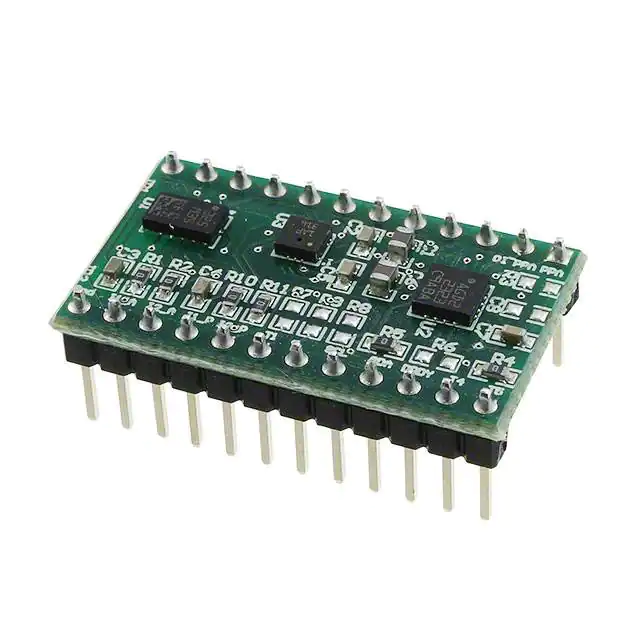
STMicroelectronics STEVAL-MKI124V1
- Part No.:
- STEVAL-MKI124V1
- Manufacturer:
- STMicroelectronics
- Category:
- Expansion Boards, Daughter Cards
- Package:
- Datasheet:
-
 STEVAL-MKI124V1.pdf
- Description:
- DIL24 L3GD20 LPS331AP LSM303DLHC
- Quantity:
- Payment:

- Shipping:

Inventory:4,620
Please send an inquiry. Send us your inquiry, and we will respond immediately.
Product details
Overview
STEVAL-MKI124V1 from STMicroelectronics is an adapter evaluation board supporting simultaneous interface and prototyping of three MEMS sensors - L3GD20 (3-axis gyroscope), LSM303DLHC (3-axis accelerometer + 3-axis magnetometer), and LPS331AP (digital barometric pressure sensor) - via a standard DIL24 socket. It includes on-board decoupling capacitors, pull-up resistors, and full pin access for I²C communication, interrupt signaling, and power domains.
For engineers reviewing the STEVAL-MKI124V1 datasheet, STEVAL-MKI124V1 pinout, STEVAL-MKI124V1 application, or STEVAL-MKI124V1 equivalent, this board enables rapid validation of 10-axis sensor fusion in motion-tracking, orientation-aware embedded systems, and environmental sensing applications without custom PCB design.
Technical Context
The board implements direct pin mapping from all three ICs to a single 24-pin DIL header, preserving native I²C addressability and interrupt routing (INT1/INT2 per device). Each sensor's VDD and Vdd_IO rails are independently routed with dedicated 10 µF and 100 nF decoupling.
It is mechanically and electrically designed for plug-in compatibility with the STEVAL-MKI109V2 motherboard, which provides USB-to-I²C bridging via an STM32F103 microcontroller and supports Unico GUI-based configuration and real-time data streaming.
Key Specifications
| Parameter | Value and Actual Design Meaning |
|---|---|
| DIL Socket Type | Standard 24-pin dual in-line, enabling direct insertion into breadboards or carrier sockets without soldering. |
| Sensor Integration | L3GD20 (±245/500/2000 dps gyro), LSM303DLHC (±2/4/8 g accel + ±1.3/1.9/2.5/4.0/4.7/5.6/8.1 gauss mag), LPS331AP (260–1260 hPa barometer). |
| Interface Protocol | Unified I²C bus (shared SDA/SCL lines) with individual CS and INT pins for each sensor; no SPI support. |
| Power Supply Support | Dual-rail: VDD (2.2–3.6 V for L3GD20/LPS331AP) and Vdd_IO (1.71–3.6 V for LSM303DLHC logic level translation). |
| On-board Components | 10 µF + 100 nF VDD decoupling per sensor, 4.7 µF/0.22 µF LPS331AP PLLFILT network, 10 kΩ pull-ups on SDA/SCL, zero-ohm jumpers for signal routing flexibility. |
| RoHS Compliance | Fully RoHS-compliant construction, suitable for commercial and industrial prototyping environments. |
Availability
STEVAL-MKI124V1 is available at Aetrix Electronics and suitable for motion-sensing reference designs, sensor fusion algorithm development, and industrial IoT edge node prototyping requiring stable component supply and quick-turn evaluation capability.
Supply support for STEVAL-MKI124V1 includes scheduled delivery planning, volume procurement assistance, BOM continuity management, traceable sourcing, and lifecycle availability coordination for OEM customers, industrial embedded developers, connected-device designers, and electronics production programs.
Manufacturer
STMicroelectronics is a global semiconductor leader headquartered in Geneva, designing and manufacturing microcontrollers, sensors, power ICs, and analog/mixed-signal devices for industrial, automotive, and consumer markets.
This board belongs to ST's STEVAL (ST Evaluation) series - purpose-built adapter and demonstration platforms that simplify integration of ST's MEMS and sensor products into customer systems using standardized mechanical and electrical interfaces.
FAQ
Does STEVAL-MKI124V1 support SPI communication with the onboard sensors?
No. The board routes only I²C signals (SDA/SCL) and interrupt lines for all three sensors. The L3GD20 and LSM303DLHC support SPI in their native IC form, but STEVAL-MKI124V1 does not expose SPI pins - it is strictly an I²C-optimized adapter. No CS or SDO/SDI traces are brought out to the DIL24 header beyond what's required for I²C addressing.
Can STEVAL-MKI124V1 be used without the STEVAL-MKI109V2 motherboard?
Yes. The DIL24 footprint allows direct connection to any host system providing 3.3 V power, I²C pull-ups, and compatible logic levels. However, standalone use requires external firmware to manage multi-device I²C arbitration, register mapping, and interrupt handling - unlike the STEVAL-MKI109V2, which includes preloaded STM32 firmware and Unico GUI support.
What is the function of the "Res" pins labeled on U2 (L3GD20) and U3 (LPS331AP)?
Those are reserved pins per the respective IC datasheets: L3GD20 pins 9–12 and LPS331AP pins 9–13 are marked "Res" (Reserved) and must be left unconnected. They have no internal connection or defined function and are not tied to ground or VDD on the board - confirmed by schematic inspection and ST's official documentation.
Are the LSM303DLHC magnetometer and accelerometer on separate I²C addresses?
Yes. The LSM303DLHC integrates both functions but exposes them on two distinct I²C addresses: 0x1E (default) for the magnetometer and 0x18 (default) for the accelerometer. STEVAL-MKI124V1 preserves this separation, allowing independent initialization and readout without address conflict or internal arbitration.
STEVAL-MKI124V1 Specifications
- Product attributes
- Attribute value
- Manufacturer:
- STMicroelectronics
- Series:
- MEMS
- Packaging:
- Bulk
- Product Status:
- Obsolete
- Platform:
- Professional MEMS Tool
- Type:
- Sensor
- Function:
- Accelerometer, Gyroscope, Pressure, Magnetometer
- Utilized IC / Part:
- L3GD20, LPS331AP, LSM303DLHC
- Contents:
- Board(s)
STEVAL-MKI124V1 FAQ
1.How can I place an order for STEVAL-MKI124V1 through Aetrix?
Please submit a Request for Quotation (RFQ) for STEVAL-MKI124V1 on Aetrix. Our sales agent will provide a competitive quotation and guide you through the order confirmation once you accept the terms.
2.Are the price and stock information for STEVAL-MKI124V1 reliable?
The price and inventory of STEVAL-MKI124V1 are updated periodically and may fluctuate due to market conditions. Stock and pricing data are typically refreshed every 24 hours. Quotation validity for STEVAL-MKI124V1 is usually 5 days.
3.What payment methods are accepted for STEVAL-MKI124V1?
We accept Wire Transfer, PayPal, Credit Card, Western Union, MoneyGram, and Escrow for STEVAL-MKI124V1 transactions.
Note: Certain payment methods may incur a processing fee.
4.How is shipping managed for STEVAL-MKI124V1?
STEVAL-MKI124V1 orders can be shipped via leading logistics carriers, including DHL, UPS, FedEx, TNT, or Registered Mail.
Once your STEVAL-MKI124V1 order is processed, you will receive an email with the shipment details and tracking number.
Note: Tracking information may take up to 24 hours to appear. Express delivery typically takes 3–5 business days.
5.How can I obtain technical support or documentation for STEVAL-MKI124V1?
For technical support, including STEVAL-MKI124V1 datasheets, pinout diagrams, or application guidance, please contact our engineering support team. They can provide detailed documentation and assistance for your STEVAL-MKI124V1 requirements.
6.How does Aetrix verify that STEVAL-MKI124V1 is sourced from the original manufacturer or authorized distributors?
All STEVAL-MKI124V1 products on Aetrix are procured from qualified distributors and authorized channels. Our dedicated quality assurance team conducts strict verification, including traceability checks and, if necessary, third-party testing. This ensures that STEVAL-MKI124V1 meets industry standards.
7.What is the process for return or replacement of STEVAL-MKI124V1?
All STEVAL-MKI124V1 units undergo pre-shipment inspection (PSI). If there is an issue with STEVAL-MKI124V1, returns or replacements are accepted under the following conditions:
1.Quantity discrepancies, incorrect items, or visible external defects (such as breakage or corrosion), acknowledged by Aetrix.
2.The issue is reported within 90 days of delivery.
3.The STEVAL-MKI124V1 part is unused and in its original packaging.
Return procedure for STEVAL-MKI124V1:
1.Submit a request within 90 days.
2.Obtain a Return Material Authorization (RMA) from Aetrix.
STEVAL-MKI124V1 Tags
-
2809
Adafruit Industries LLC
-
BOB-19626
SparkFun Electronics
-
DFR0299
DFRobot
-
5346
Adafruit Industries LLC
-
4538
Adafruit Industries LLC

-
4471
Adafruit Industries LLC
-
1980
Adafruit Industries LLC
-
4470
Adafruit Industries LLC
-
U035-B
M5Stack Technology Co., Ltd.
-
SEN0137
DFRobot
-
3191
Adafruit Industries LLC
-
4756
Adafruit Industries LLC
Tech Hub
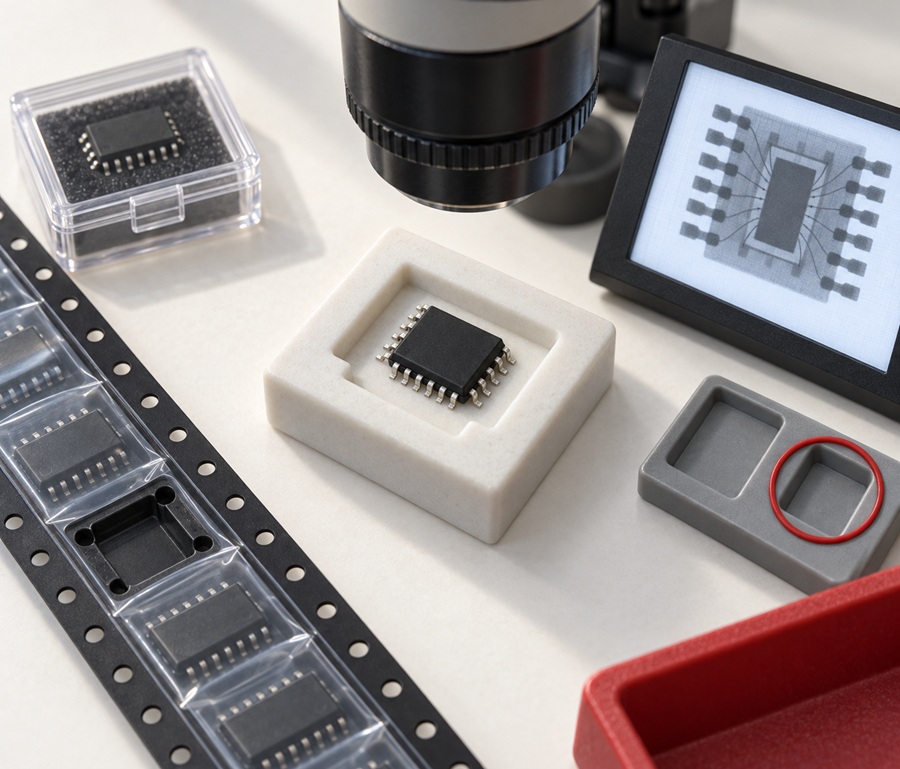
Counterfeit components can hide behind convincing markings and passing basic function tests. This engineering reference covers source traceability, external inspection, X-ray, XRF, electrical testing, …

A practical engineering and sourcing framework covering lifecycle verification, lifetime-buy calculations, replacement qualification, supplier checks and counterfeit-risk controls.

TTL and CMOS logic families differ in thresholds, loading, output drive, power and timing. This engineering guide compares 74HC and 74HCT, calculates noise margins and checks 3.3 V/5 V compatibility.

A practical engineering guide to 3.3V and 5V logic compatibility, input thresholds, resistor dividers, translator ICs, MOSFET level shifting, I2C pull-ups, timing limits and power-sequencing risks.

The 74HC595 uses push-pull logic outputs, while the TPIC6B595 uses 50 V open-drain DMOS sinks for higher-power loads. This guide compares timing, current limits, 3.3 V interfacing, load wiring, thermal…

The 74HC595 converts serial data into eight stable parallel outputs. This guide covers pin functions, shift and storage timing, OE and MR behavior, drive-current limits, cascading, voltage compatibilit…

A technical comparison of level-sensitive latches and edge-triggered flip-flops, covering timing windows, setup and hold limits, master–slave operation, time borrowing, race-through, HDL inference and…

A D latch stores one bit while Enable controls when data can pass. This reference covers gate-level operation, truth tables, transparency, setup and hold timing, LE versus OE, common ICs and practical …

An SR latch stores one bit through cross-coupled feedback. This engineering reference covers NOR and NAND implementations, truth tables, forbidden-state recovery, gated operation, switch debouncing, fa…

Latch circuits retain one bit through feedback. This technical reference covers SR and D latches, truth tables, transparency, timing limits, latch-versus-flip-flop behavior, applications and common log…


