
 My Inquiry
 My Account


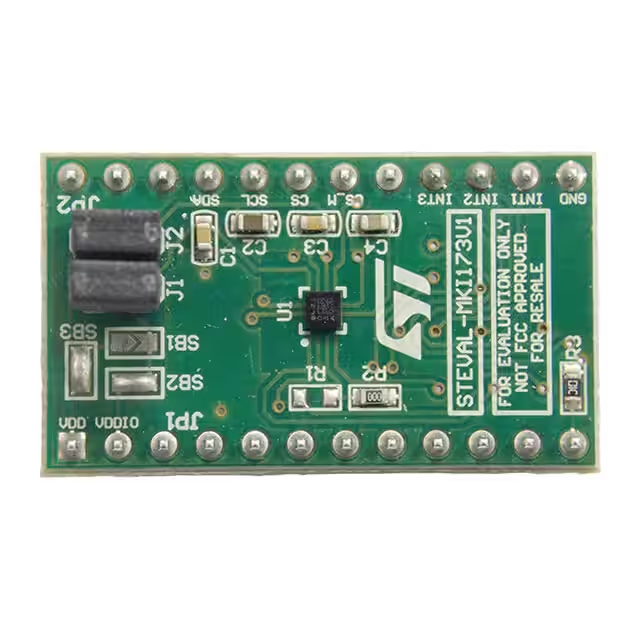
STMicroelectronics STEVAL-MKI173V1
- Part No.:
- STEVAL-MKI173V1
- Manufacturer:
- STMicroelectronics
- Category:
- Expansion Boards, Daughter Cards
- Package:
- Datasheet:
-
 STEVAL-MKI173V1.pdf
- Description:
- DIL24 ADAPTER BOARD LSM303AH
- Quantity:
- Payment:

- Shipping:

Inventory:1,443
Please send an inquiry. Send us your inquiry, and we will respond immediately.
Product details
Overview
STEVAL-MKI173V1 from STMicroelectronics is a DIL24 socket adapter board designed to evaluate the LSM303AH 3-axis accelerometer and 3-axis magnetometer MEMS sensor. It provides full pin access, on-board decoupling (10 µF + 220 nF + 2×100 nF), and 1.8 V logic-level translation for SCL/SDA/INT/CS signals. The board plugs directly into standard DIL24 sockets and is fully compatible with the STEVAL-MKI109V3 motherboard for PC-based sensor evaluation using Unico GUI.
For engineers reviewing the STEVAL-MKI173V1 datasheet, STEVAL-MKI173V1 pinout, STEVAL-MKI173V1 application, or STEVAL-MKI173V1 equivalent, this adapter enables rapid prototyping of motion-sensing systems requiring dual-voltage domain interfacing (VDD = 2.16–3.6 V, VDDIO = 1.71–1.89 V), interrupt-driven sensor data acquisition, and plug-and-play integration with ST's 32-bit sensor evaluation ecosystem.
Technical Context
The STEVAL-MKI173V1 implements level-shifting circuitry using discrete resistors and dedicated 1.8 V supply routing to isolate the LSM303AH's I²C interface (SCL/SDA) and interrupt outputs (INT1/INT2) from host motherboard voltage domains. It routes all 12 primary LSM303AH pins-including DRDY_MAG, CS, RES (GND), and dual-VDD rails-to a standard 24-pin DIL footprint.
Board-level design includes four solder bridges (SB2–SB5, SB7–SB10) for configurable signal routing and voltage domain selection, plus dual decoupling networks: one for core VDD (10 µF + 220 nF) and another for VDDIO (2×100 nF). No microcontroller or firmware is onboard-the board functions purely as a passive, ready-to-use interface adapter.
Key Specifications
| Parameter | Value and Actual Design Meaning |
|---|---|
| DIL Socket Type | Standard 24-pin dual in-line, enabling direct insertion into breadboards or carrier sockets without soldering. |
| Supported Sensor | LSM303AH only-pinout and power routing are fixed to this specific MEMS device's 12-pin functional interface. |
| VDD Supply Range | 2.16 V to 3.6 V-powers accelerometer/magnetometer core; decoupled with 10 µF + 220 nF ceramic capacitors. |
| VDDIO Supply Range | 1.71 V to 1.89 V-powers I²C and interrupt logic; decoupled with two 100 nF ceramics for noise immunity. |
| I²C Level Translation | Passive resistor-based translation between host (e.g., STEVAL-MKI109V3) and LSM303AH, supporting 1.8 V logic signaling. |
| Interrupt Outputs | Dedicated INT1_XL and INT2_XL pins routed to DIL24 pins 11 and 12, with 1.8 V level-shifted versions available via solder bridges. |
Availability
STEVAL-MKI173V1 is available at Aetrix Electronics and suitable for MEMS sensor evaluation, industrial motion prototype development, and educational embedded systems labs requiring stable component supply and standardized DIL24 interoperability.
Supply support for STEVAL-MKI173V1 includes scheduled delivery planning, volume procurement assistance, BOM continuity management, traceable sourcing, and lifecycle availability coordination for OEM customers, industrial embedded developers, connected-device designers, and electronics production programs.
Manufacturer
STMicroelectronics is a global semiconductor leader headquartered in Geneva, Switzerland, specializing in MEMS sensors, microcontrollers, power management, and automotive ICs.
This adapter belongs to ST's STEVAL sensor evaluation platform family, engineered to accelerate time-to-prototype for motion-sensing applications by eliminating custom PCB design for basic sensor interfacing.
FAQ
Does STEVAL-MKI173V1 include an embedded microcontroller?
No. The board contains no microcontroller, memory, or firmware. It is a passive hardware adapter that routes and level-shifts LSM303AH signals to a DIL24 socket. Host processing and communication are handled externally-typically by the STEVAL-MKI109V3 motherboard or user-designed host system.
Can STEVAL-MKI173V1 be used with sensors other than LSM303AH?
No. Its layout, pin mapping, decoupling network, and voltage domain configuration are exclusively designed for the LSM303AH. Pin assignments (e.g., DRDY_MAG on pin 7, RES tied to GND on pin 3) and power rail segmentation match only this device's datasheet requirements.
What is the role of solder bridges SB2–SB5 and SB7–SB10?
These eight 0 Ω solder bridges configure signal routing and voltage domain selection: SB2/SB3 enable VDDIO_1V8 for INT1/INT2; SB4/SB5 route SCL/SDA to 1.8 V logic; SB7/SB10 select alternate CS/INT paths; SB8/SB9 control DRDY_MAG output domain. They allow hardware customization without redesign.
Is USB connectivity or GUI software included with STEVAL-MKI173V1?
No. The board itself has no USB interface or software. It requires connection to a compatible host (e.g., STEVAL-MKI109V3) to enable USB communication and Unico GUI operation. ST provides the Unico GUI separately as a free download for Windows-based sensor evaluation.
STEVAL-MKI173V1 Specifications
- Product attributes
- Attribute value
- Manufacturer:
- STMicroelectronics
- Series:
- -
- Packaging:
- Bulk
- Product Status:
- Active
- Platform:
- Professional MEMS Tool
- Type:
- Sensor
- Function:
- Accelerometer, Magnetometer
- Utilized IC / Part:
- LSM303AH
- Contents:
- Board(s)
STEVAL-MKI173V1 FAQ
1.How can I place an order for STEVAL-MKI173V1 through Aetrix?
Please submit a Request for Quotation (RFQ) for STEVAL-MKI173V1 on Aetrix. Our sales agent will provide a competitive quotation and guide you through the order confirmation once you accept the terms.
2.Are the price and stock information for STEVAL-MKI173V1 reliable?
The price and inventory of STEVAL-MKI173V1 are updated periodically and may fluctuate due to market conditions. Stock and pricing data are typically refreshed every 24 hours. Quotation validity for STEVAL-MKI173V1 is usually 5 days.
3.What payment methods are accepted for STEVAL-MKI173V1?
We accept Wire Transfer, PayPal, Credit Card, Western Union, MoneyGram, and Escrow for STEVAL-MKI173V1 transactions.
Note: Certain payment methods may incur a processing fee.
4.How is shipping managed for STEVAL-MKI173V1?
STEVAL-MKI173V1 orders can be shipped via leading logistics carriers, including DHL, UPS, FedEx, TNT, or Registered Mail.
Once your STEVAL-MKI173V1 order is processed, you will receive an email with the shipment details and tracking number.
Note: Tracking information may take up to 24 hours to appear. Express delivery typically takes 3–5 business days.
5.How can I obtain technical support or documentation for STEVAL-MKI173V1?
For technical support, including STEVAL-MKI173V1 datasheets, pinout diagrams, or application guidance, please contact our engineering support team. They can provide detailed documentation and assistance for your STEVAL-MKI173V1 requirements.
6.How does Aetrix verify that STEVAL-MKI173V1 is sourced from the original manufacturer or authorized distributors?
All STEVAL-MKI173V1 products on Aetrix are procured from qualified distributors and authorized channels. Our dedicated quality assurance team conducts strict verification, including traceability checks and, if necessary, third-party testing. This ensures that STEVAL-MKI173V1 meets industry standards.
7.What is the process for return or replacement of STEVAL-MKI173V1?
All STEVAL-MKI173V1 units undergo pre-shipment inspection (PSI). If there is an issue with STEVAL-MKI173V1, returns or replacements are accepted under the following conditions:
1.Quantity discrepancies, incorrect items, or visible external defects (such as breakage or corrosion), acknowledged by Aetrix.
2.The issue is reported within 90 days of delivery.
3.The STEVAL-MKI173V1 part is unused and in its original packaging.
Return procedure for STEVAL-MKI173V1:
1.Submit a request within 90 days.
2.Obtain a Return Material Authorization (RMA) from Aetrix.
STEVAL-MKI173V1 Tags
-
2809
Adafruit Industries LLC
-
BOB-19626
SparkFun Electronics
-
DFR0299
DFRobot
-
5346
Adafruit Industries LLC
-
4538
Adafruit Industries LLC

-
4471
Adafruit Industries LLC
-
1980
Adafruit Industries LLC
-
4470
Adafruit Industries LLC
-
U035-B
M5Stack Technology Co., Ltd.
-
SEN0137
DFRobot
-
3191
Adafruit Industries LLC
-
4756
Adafruit Industries LLC
Tech Hub

Operational amplifier guide covering op amp basics, feedback, ideal vs real op amps, common configurations, buffer circuits, offset, bias current, gain-bandwidth, slew rate, rail-to-rail limits and sel…

Jumper cables guide covering safe connection order, red and black clamp placement, final ground connection, cable gauge, length, clamp quality, copper vs CCA cables, jump starter comparison and battery…

LDO regulator guide covering low dropout voltage, power dissipation, thermal design, PSRR, output noise, capacitor stability, adjustable LDO circuits, LDO vs buck converter and datasheet selection chec…

Conditional Access Module guide covering CAM meaning, CI/CI+ interface, smart card authorization, DVB security workflow, TV and set-top box compatibility, internal electronics, ESD protection, connecto…

Guide to electronic component obsolescence covering EOL risk, PCN/PDN notices, last-time buy planning, replacement options, form-fit-function validation, counterfeit risk and BOM lifecycle management.

18650 battery guide covering lithium-ion cell basics, 3.6V/3.7V voltage, 4.2V charging, mAh and Wh capacity, protected cells, chargers, BMS, series-parallel packs, holders, welding and sourcing checks.…

Hall effect sensor guide covering working principle, linear and digital sensors, Arduino circuits, current sensing, speed detection, automotive applications, A3144 examples, signal filtering and datash…

Product Change Notification guide for electronic components, covering PCN meaning, PCN vs PDN/EOL, common change types, risk levels, form-fit-function review, engineering validation, BOM control, LTB/L…

A practical guide to blend door actuators, covering HVAC function, symptoms, location, AC and heater issues, reset and calibration, replacement cost, electrical diagnosis, compatibility checks, and rep…

Engineering guide to Raspberry Pi alternatives, covering chip-level differences, Orange Pi, ROCK, Jetson, Banana Pi, NanoPi, Compute Module, Pico, GPIO, camera, HAT compatibility, and replacement risks…


