
 My Inquiry
 My Account


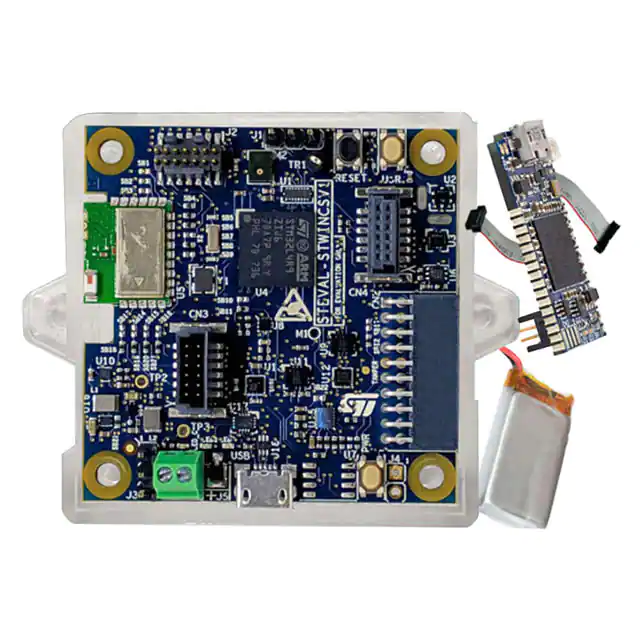
STMicroelectronics STEVAL-STWINKT1
- Part No.:
- STEVAL-STWINKT1
- Manufacturer:
- STMicroelectronics
- Category:
- Sensor Evaluation Boards
- Package:
- Datasheet:
-
 STEVAL-STWINKT1.pdf
- Description:
- STWIN SENSORTILE WIRELESS INDUST
- Quantity:
- Payment:

- Shipping:

Inventory:1,178
Please send an inquiry. Send us your inquiry, and we will respond immediately.
Product details
Overview
STEVAL-STWINKT1 from STMicroelectronics is a wireless industrial IoT development kit and reference design built around the STM32L4R9ZIJ6 ultra-low-power ARM Cortex-M4F MCU (120 MHz, 2048 KB Flash), integrating nine industrial-grade sensors-including IIS3DWB vibration sensor (6 kHz bandwidth), ISM330DHCX 6-axis IMU with machine learning core, LPS22HH pressure, HTS221 humidity/temperature, and dual MEMS microphones (IMP34DT05 digital + MP23ABS1 analog)-for condition monitoring and predictive maintenance in rotating machinery.
For engineers reviewing the STEVAL-STWINKT1 datasheet, STEVAL-STWINKT1 pinout, STEVAL-STWINKT1 application, or STEVAL-STWINKT1 equivalent, this kit supports BLE 4.2 (onboard SPBTLE-1S), RS485 (STR485LV), USB OTG, MicroSD logging, and optional Wi-Fi via STEVAL-STWINWFV1 expansion-enabling distributed edge analytics, ultrasound detection, and secure firmware updates with STSAFE-A110 footprint.
Technical Context
The STEVAL-STWINKT1 implements a decentralized sensing architecture where the STM32L4R9ZIJ6 executes real-time vibration analysis using DFSDM for microphone data and dedicated motion processing engines in the ISM330DHCX (finite state machine + machine learning core). Sensor fusion across 9 DoF (accelerometer, gyroscope, magnetometer) and wideband acoustic capture (up to ~40 kHz via MP23ABS1 analog mic + TS922 opamp) enables high-fidelity mechanical fault signature extraction.
Power management includes STBC02 Li-ion charger, ST1PS01EJR buck converter (2.7 V @ 7 A), and LDK130 LDO (3.3 V @ 150 mA), supporting autonomous operation on 480 mAh Li-Po battery. Connectivity layers are hardware-isolated: BLE uses SPI interface (DIO0–DIO14 pins), RS485 employs STR485LV transceiver with DE/RE control, and USB OTG uses USBLC6-2P6 ESD protection.
Key Specifications
| Parameter | Value and Actual Design Meaning |
|---|---|
| Core MCU | STM32L4R9ZIJ6: ARM Cortex-M4F @ 120 MHz, 2048 KB Flash, 640 KB RAM, FPU, DFSDM, SAI, USB OTG FS |
| Vibration Sensing | IIS3DWB: ±2 g / ±4 g / ±8 g range, 6 kHz bandwidth, 90 µg/√Hz noise density, digital I²C/SPI output |
| Inertial Sensing | ISM330DHCX: ±2/±4/±8/±16 g accel + ±125/±250/±500/±1000/±2000 dps gyro, embedded FSM & ML core |
| Acoustic Sensing | IMP34DT05 (digital): -26 dBFS sensitivity, 64 dBA SNR; MP23ABS1 (analog): 69 dB SNR, 10 Hz–70 kHz response |
| Environmental Sensors | LPS22HH (±2 hPa abs pressure), HTS221 (±3.5% RH, ±0.5°C temp), STTS751 (±1°C local temp), IIS2MDC (±50 Gauss mag) |
| Wireless Interface | Onboard SPBTLE-1S: BLE 4.2 compliant, 0 dBm TX, -93 dBm RX sensitivity, SPI-controlled, integrated antenna |
| Expansion Interfaces | STMOD+ (20-pin), 40-pin flex, 12-pin male (connectivity), 12-pin female (sensing), all with defined signal mapping per DB3969 |
Availability
STEVAL-STWINKT1 is available at Aetrix Electronics and suitable for predictive maintenance systems, industrial vibration analyzers, and wireless condition monitoring gateways requiring stable component supply, long-term firmware support, and validated sensor fusion firmware stacks.
Supply support for STEVAL-STWINKT1 includes scheduled delivery planning, volume procurement assistance, BOM continuity management, traceable sourcing, and lifecycle availability coordination for OEM customers, industrial embedded developers, connected-device designers, and electronics production programs.
Manufacturer
STMicroelectronics is a global semiconductor leader headquartered in Geneva, Switzerland, designing and manufacturing silicon solutions for automotive, industrial, power, and IoT applications with emphasis on energy efficiency and system-level integration.
This kit belongs to ST's STWIN (SensorTile Wireless Industrial Node) product line, engineered specifically for edge-based industrial IoT-emphasizing ultra-low-power multi-sensor synchronization, on-node AI inference, and robust wired/wireless connectivity for harsh factory environments.
FAQ
What firmware and software tools are included with STEVAL-STWINKT1?
The kit ships with STSW-STWINKT01 firmware package containing pre-validated drivers for all onboard sensors, FreeRTOS-based edge analytics examples (vibration FFT, anomaly detection), BLE GATT services for sensor streaming, and cloud dashboard integration templates. ST's Unicleo-GUI and X-CUBE-MEMS1 software expansions provide GUI-based configuration and real-time sensor data visualization.
Does STEVAL-STWINKT1 support Wi-Fi out of the box?
No-Wi-Fi is not onboard. It requires the STEVAL-STWINWFV1 expansion board, which plugs into the 40-pin flex connector and integrates an ESP32-WROOM-32 module. The core board provides UART and power routing to the expansion, and firmware support for Wi-Fi is included in STSW-STWINKT01 v2.0+ with AT command handling and TLS-secured MQTT transport.
Can the STSAFE-A110 secure element be soldered and used on this board?
Yes-the board includes a footprint and routed I²C lines (I2C3_SCL/SDA) for STSAFE-A110, though the IC is not mounted by default. Once installed, it enables ECDSA signature verification for firmware updates, secure boot authentication, and cryptographic key storage compliant with Common Criteria EAL4+, supporting brand protection and anti-cloning in certified industrial deployments.
What is the maximum sampling rate achievable for synchronized multi-sensor acquisition?
Using the STM32L4R9's DFSDM peripheral with oversampling and the ISM330DHCX's ODR-configurable FIFO, synchronized 9-DoF motion data can be acquired at up to 6.66 kHz (accel + gyro), while the IIS3DWB supports 6.4 kHz vibration sampling. Combined with IMP34DT05 (16–48 kHz PCM) and MP23ABS1 (via SAI + TS922 amplifier), true simultaneous capture across acoustic and inertial domains is supported at 48 kHz with hardware-triggered alignment.
STEVAL-STWINKT1 Specifications
- Product attributes
- Attribute value
- Manufacturer:
- STMicroelectronics
- Series:
- -
- Packaging:
- Bulk
- Product Status:
- Obsolete
- Sensor Type:
- Accelerometer, Gyroscope, Magnetometer, Pressure, Temperature
- Sensing Range:
- -
- Interface:
- RF
- Sensitivity:
- -
- Voltage - Supply:
- -
- Embedded:
- Yes, MCU, 32-Bit
- Contents:
- Board(s), Accessories
- Utilized IC / Part:
- IIS3DWB, ISM330DHCX, STM32L4R9
STEVAL-STWINKT1 FAQ
1.How can I place an order for STEVAL-STWINKT1 through Aetrix?
Please submit a Request for Quotation (RFQ) for STEVAL-STWINKT1 on Aetrix. Our sales agent will provide a competitive quotation and guide you through the order confirmation once you accept the terms.
2.Are the price and stock information for STEVAL-STWINKT1 reliable?
The price and inventory of STEVAL-STWINKT1 are updated periodically and may fluctuate due to market conditions. Stock and pricing data are typically refreshed every 24 hours. Quotation validity for STEVAL-STWINKT1 is usually 5 days.
3.What payment methods are accepted for STEVAL-STWINKT1?
We accept Wire Transfer, PayPal, Credit Card, Western Union, MoneyGram, and Escrow for STEVAL-STWINKT1 transactions.
Note: Certain payment methods may incur a processing fee.
4.How is shipping managed for STEVAL-STWINKT1?
STEVAL-STWINKT1 orders can be shipped via leading logistics carriers, including DHL, UPS, FedEx, TNT, or Registered Mail.
Once your STEVAL-STWINKT1 order is processed, you will receive an email with the shipment details and tracking number.
Note: Tracking information may take up to 24 hours to appear. Express delivery typically takes 3–5 business days.
5.How can I obtain technical support or documentation for STEVAL-STWINKT1?
For technical support, including STEVAL-STWINKT1 datasheets, pinout diagrams, or application guidance, please contact our engineering support team. They can provide detailed documentation and assistance for your STEVAL-STWINKT1 requirements.
6.How does Aetrix verify that STEVAL-STWINKT1 is sourced from the original manufacturer or authorized distributors?
All STEVAL-STWINKT1 products on Aetrix are procured from qualified distributors and authorized channels. Our dedicated quality assurance team conducts strict verification, including traceability checks and, if necessary, third-party testing. This ensures that STEVAL-STWINKT1 meets industry standards.
7.What is the process for return or replacement of STEVAL-STWINKT1?
All STEVAL-STWINKT1 units undergo pre-shipment inspection (PSI). If there is an issue with STEVAL-STWINKT1, returns or replacements are accepted under the following conditions:
1.Quantity discrepancies, incorrect items, or visible external defects (such as breakage or corrosion), acknowledged by Aetrix.
2.The issue is reported within 90 days of delivery.
3.The STEVAL-STWINKT1 part is unused and in its original packaging.
Return procedure for STEVAL-STWINKT1:
1.Submit a request within 90 days.
2.Obtain a Return Material Authorization (RMA) from Aetrix.
STEVAL-STWINKT1 Tags
-
1782
Adafruit Industries LLC
-
SEN0142
DFRobot

-
2857
Adafruit Industries LLC
-
3316
Adafruit Industries LLC
-
2652
Adafruit Industries LLC
-
3317
Adafruit Industries LLC
-
163
Adafruit Industries LLC
-
SEN-09269
SparkFun Electronics
-
3709
Adafruit Industries LLC
-
1018
Adafruit Industries LLC
-
VL53L5CX-SATEL
STMicroelectronics
-
3387
Adafruit Industries LLC
Tech Hub

A practical engineering guide to 3.3V and 5V logic compatibility, input thresholds, resistor dividers, translator ICs, MOSFET level shifting, I2C pull-ups, timing limits and power-sequencing risks.

The 74HC595 uses push-pull logic outputs, while the TPIC6B595 uses 50 V open-drain DMOS sinks for higher-power loads. This guide compares timing, current limits, 3.3 V interfacing, load wiring, thermal…

The 74HC595 converts serial data into eight stable parallel outputs. This guide covers pin functions, shift and storage timing, OE and MR behavior, drive-current limits, cascading, voltage compatibilit…

A technical comparison of level-sensitive latches and edge-triggered flip-flops, covering timing windows, setup and hold limits, master–slave operation, time borrowing, race-through, HDL inference and…

A D latch stores one bit while Enable controls when data can pass. This reference covers gate-level operation, truth tables, transparency, setup and hold timing, LE versus OE, common ICs and practical …

An SR latch stores one bit through cross-coupled feedback. This engineering reference covers NOR and NAND implementations, truth tables, forbidden-state recovery, gated operation, switch debouncing, fa…

Latch circuits retain one bit through feedback. This technical reference covers SR and D latches, truth tables, transparency, timing limits, latch-versus-flip-flop behavior, applications and common log…

An engineering guide to LED driver operation, constant-current and constant-voltage outputs, linear and switching topologies, dimming, IC selection, calculations, replacement compatibility, and fault c…

Operational amplifier guide covering op amp basics, feedback, ideal vs real op amps, common configurations, buffer circuits, offset, bias current, gain-bandwidth, slew rate, rail-to-rail limits and sel…

Jumper cables guide covering safe connection order, red and black clamp placement, final ground connection, cable gauge, length, clamp quality, copper vs CCA cables, jump starter comparison and battery…


