
 My Inquiry
 My Account


STMicroelectronics STM32F722IET7
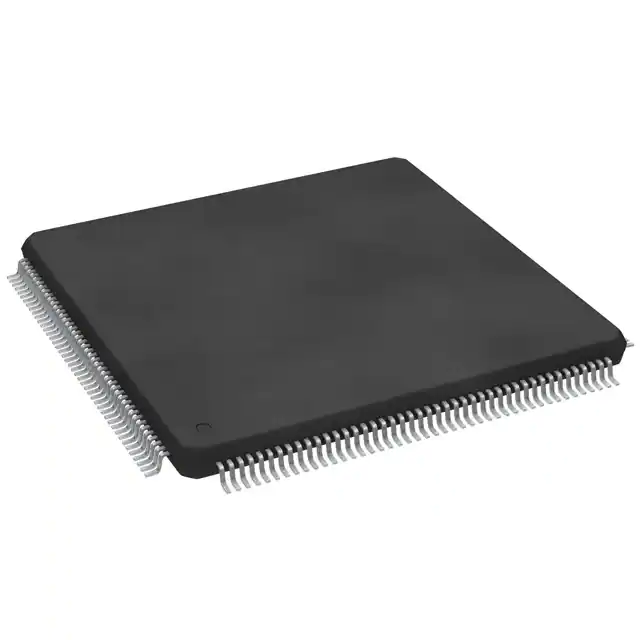
- Part No.:
- STM32F722IET7
- Manufacturer:
- STMicroelectronics
- Category:
- Microcontrollers
- Package:
- 176-LQFP
- Datasheet:
-
 STM32F722IET7.pdf
- Description:
- IC MCU 32BIT 512KB FLASH 176LQFP
- Quantity:
- Payment:

- Shipping:

Inventory:1,730
Please send an inquiry. Send us your inquiry, and we will respond immediately.
Product details
Overview
STM32F722IET7 from STMicroelectronics is a high-performance Arm® Cortex®-M7 32-bit microcontroller with FPU, delivering 462 DMIPS at 216 MHz, featuring 512 KB Flash, 256+16+4 KB SRAM (including TCM and backup RAM), USB OTG HS/FS, three 12-bit ADCs (2.4 MSPS), two 12-bit DACs, and up to 21 communication interfaces - deployed in industrial HMI, motor control gateways, and embedded audio processing systems.
For engineers reviewing the STM32F722IET7 datasheet, STM32F722IET7 pinout, STM32F722IET7 application, or STM32F722IET7 equivalent, key selection considerations include its dual-mode Quad-SPI interface, ART Accelerator-enabled zero-wait-state Flash execution, 140 GPIOs (138 5 V-tolerant), and integrated USB HS PHY with dedicated DMA - critical for real-time deterministic control and high-bandwidth peripheral bridging.
Technical Context
The STM32F722IET7 implements an adaptive real-time accelerator (ART) with 8 KB instruction and 8 KB data L1 caches, enabling deterministic 0-wait-state execution from Flash or external memory. Its Cortex-M7 core includes MPU, DSP instructions, and a 216 MHz max frequency, supported by dual PLLs (main + audio PLLI2S/PLLSAI) for independent clock domain management across USB, audio, and system buses.
It integrates a flexible external memory controller (FMC) supporting NOR/NAND/SDRAM, dual SAIs for stereo I²S/TDM audio, and bxCAN 2.0B for industrial fieldbus connectivity. The device supports triple-interleaved ADC mode (7.2 MSPS aggregate) and low-power timers operational in Stop mode - essential for synchronized sensor acquisition and energy-constrained edge nodes.
Key Specifications
| Parameter | Value and Actual Design Meaning |
|---|---|
| Core | Arm Cortex-M7 with FPU, 462 DMIPS @ 216 MHz - enables real-time signal processing and multitasking without external coprocessor. |
| Flash Memory | 512 KB with PCROP and read/write protection - supports secure firmware updates and IP protection in certified industrial devices. |
| SRAM | 256 KB data TCM + 16 KB instruction TCM + 4 KB backup SRAM - isolates time-critical code/data and retains state during low-power modes. |
| ADC | 3× 12-bit, 2.4 MSPS each; 7.2 MSPS in triple interleaved mode - captures fast transients in motor current sensing or power quality monitoring. |
| USB Interface | OTG HS/FS with on-chip HS PHY and dedicated DMA - eliminates external PHY need and reduces latency for host/device switching in portable test equipment. |
| Timers | Up to 18 timers including 2× 32-bit and 13× 16-bit, all running at 216 MHz - provides precise PWM generation, encoder counting, and time-stamped event capture. |
| I/O Count | 140 GPIOs, 138 5 V-tolerant - simplifies level-shifting in mixed-voltage industrial backplanes and legacy bus interfacing. |
Pinout & Package
LQFP64 (10 × 10 mm) package with exposed thermal pad; 64-pin quad flat configuration optimized for compact industrial control modules and cost-sensitive HMI designs.
| Pin/Terminal | Circuit Role | Design Meaning |
|---|---|---|
| VDD, VSS | Power supply and ground | 1.7–3.6 V main supply; separate analog/digital domains ensure noise isolation for ADC/DAC operation. |
| PA0–PA15, PB0–PB15, etc. | General-purpose I/O | Configurable as GPIO, AF, or analog; 138 pins support 5 V tolerance - direct interfacing with TTL/CMOS logic without level shifters. |
| PC13–PC15 | RTC oscillator inputs | Support external 32.768 kHz crystal for subsecond RTC accuracy and calendar functions in battery-backed applications. |
| PA11/PA12 | USB FS DP/DM | Dedicated full-speed USB transceiver pins with internal pull-ups - enables plug-and-play HID or CDC device functionality. |
| PA11/PA12 (alt) | CAN RX/TX | Remappable to bxCAN 2.0B interface - allows shared pin usage between USB and CAN in space-constrained layouts. |
| VCAP1/VCAP2 | Internal regulator decoupling | Require 2.2 µF ceramic capacitors per pin - critical for stable core voltage regulation at 216 MHz operation. |
Key Features
| Feature | Design Value |
|---|---|
| ART Accelerator + L1 cache | Enables zero-wait-state execution from Flash memory - eliminates instruction fetch stalls and improves real-time ISR response predictability. |
| Dual-mode Quad-SPI | Supports XIP (execute-in-place) from external flash or PSRAM - extends code space beyond 512 KB while maintaining deterministic timing. |
| Flexible Memory Controller (FMC) | Drives NOR/NAND/SDRAM with configurable timing - enables local display frame buffer (e.g., RGB TFT) or external program storage in HMI systems. |
| True Random Number Generator (RNG) | FIPS-compliant entropy source - satisfies cryptographic key generation requirements for secure boot and TLS stack integration. |
| 96-bit unique ID | Factory-programmed serial number - used for device binding, license enforcement, and secure over-the-air firmware authentication. |
Applications
| Industrial Motor Control Gateway | Embedded Audio Processing Node |
|---|---|
Use Scenario: Central gateway aggregating CAN-based servo drives, analog current/voltage sensors, and Ethernet/IP uplink in packaging machinery. IC Role / Device Role / Timing Role: Real-time master controller executing field-oriented control (FOC) loops, synchronizing ADC sampling with PWM triggers, and managing CAN message scheduling. Use Value: Triple-interleaved ADC (7.2 MSPS) captures simultaneous phase currents; 216 MHz core handles dual FOC + EtherNet/IP stack without jitter. | Use Scenario: Standalone audio mixer with analog mic inputs, digital SPDIF output, and USB audio class (UAC2) streaming to PC. IC Role / Device Role / Timing Role: Audio subsystem controller managing SAI/I²S routing, sample rate conversion, and USB audio endpoint buffering. Use Value: Dual SAIs support concurrent input (mic array) and output (SPDIF + USB) streams; audio PLLs lock to external 11.2896 MHz clock for ±10 ppm jitter compliance. |
| Human-Machine Interface (HMI) Terminal | Secure IoT Edge Sensor Hub |
Use Scenario: 7-inch resistive touchscreen terminal with local graphics rendering, SD card logging, and RS-485 Modbus RTU connectivity. IC Role / Device Role / Timing Role: Application processor driving TFT LCD via FSMC, managing touch interrupt latency, and handling protocol translation. Use Value: FMC-driven parallel RGB interface achieves 60 Hz refresh; 140 GPIOs route touch, backlight, and multiple UART/RS-485 transceivers. | Use Scenario: Battery-powered environmental monitor collecting temperature, humidity, and CO₂ via I²C sensors, transmitting encrypted data via LoRaWAN. IC Role / Device Role / Timing Role: Secure sensor fusion node performing calibration, AES-128 encryption, and ultra-low-power wake-on-event sequencing. Use Value: Backup SRAM retains calibrated coefficients during deep sleep; RNG seeds crypto keys; VBAT mode sustains RTC and 32×32-bit registers for 10+ years on coin cell. |
Equivalent & Alternatives
The following parts are listed as comparable options for similar high-performance MCU applications.
| Alternative Part | Technical Difference | Application Difference | Selection Advice |
|---|---|---|---|
| STM32F767ZIT6 | 1 MB Flash, 512 KB SRAM, Ethernet MAC, no USB HS PHY - requires external PHY for HS operation. | Better suited for Ethernet-connected gateway applications where network throughput outweighs USB bandwidth needs. | Select when 10/100 Ethernet is mandatory and USB HS is secondary; verify PCB layout for RMII and external PHY placement. |
| STM32H743VIT6 | Cortex-M7 @ 480 MHz, dual-core option (M7+M4), 2 MB Flash, enhanced security (PKA, HASH, AES), no USB HS PHY on LQFP100 variant. | Targeted at safety-critical or high-security applications requiring ASIL-B compliance or secure boot with hardware root-of-trust. | Choose for next-gen designs needing higher compute headroom, dual-core isolation, or certified cryptographic acceleration - not drop-in compatible. |
Compared with STM32F767ZIT6 and STM32H743VIT6, the STM32F722IET7 offers optimal balance of USB HS integration, compact LQFP64 footprint, and sufficient memory for mid-tier industrial controllers - avoiding overdesign while retaining ART-accelerated Flash performance and 5 V-tolerant I/O flexibility.
Availability
STM32F722IET7 is available at Aetrix Electronics and suitable for industrial motor control gateways, embedded audio processing nodes, and human-machine interface terminals requiring stable component supply across multi-year production cycles.
Supply support for STM32F722IET7 includes scheduled delivery planning, volume procurement assistance, BOM continuity management, traceable sourcing, and lifecycle availability coordination for OEM customers, industrial embedded developers, connected-device designers, and electronics production programs.
Manufacturer
STMicroelectronics is a global semiconductor leader headquartered in Geneva, specializing in microcontrollers, power management, and sensor technologies for industrial, automotive, and consumer markets.
The STM32F7 series targets high-end embedded applications demanding real-time determinism, rich connectivity, and advanced analog integration - designed specifically for industrial automation, medical instrumentation, and premium HMI platforms.
FAQ
What is the maximum operating frequency and how is it achieved?
The STM32F722IET7 achieves 216 MHz maximum CPU frequency using its internal voltage regulator and high-speed external crystal (4–26 MHz) fed into the main PLL. The ART Accelerator with 8 KB instruction cache enables zero-wait-state execution from Flash, eliminating pipeline stalls and ensuring deterministic timing at full speed.
Does this MCU support USB High-Speed device mode without external components?
Yes - the STM32F722IET7 integrates a full-speed USB PHY and a high-speed USB PHY on-die, allowing native USB 2.0 HS device/host/OTG operation without external transceivers. It also includes dedicated DMA channels to offload USB data transfers from the CPU, preserving real-time responsiveness.
How many ADC channels can be simultaneously sampled at full rate?
Three independent 12-bit ADCs support up to 24 total channels. In triple interleaved mode, they achieve 7.2 MSPS aggregate sampling (2.4 MSPS per ADC), with hardware synchronization ensuring simultaneous start and correlated timing - critical for three-phase motor current measurement.
What low-power modes retain RTC and backup SRAM functionality?
In Standby mode, the STM32F722IET7 retains RTC operation, 32×32-bit backup registers, and 4 KB of backup SRAM powered by VBAT. This enables calendar tracking, wake-on-alarm, and state preservation for up to 10 years on a CR2032 coin cell - verified per datasheet Section 3.17 and Table 32.
STM32F722IET7 Specifications
- Product attributes
- Attribute value
- Manufacturer:
- STMicroelectronics
- Package/Case:
- 176-LQFP
- Series:
- STM32F7
- Packaging:
- Tray
- Product Status:
- Active
- Programmable:
- Not Verified
- Core Processor:
- ARM® Cortex®-M7
- Core Size:
- 32-Bit Single-Core
- Speed:
- 216MHz
- Connectivity:
- CANbus, EBI/EMI, I2C, IrDA, LINbus, MMC/SD, QSPI, SAI, SPI, UART/USART, USB
- Peripherals:
- Brown-out Detect/Reset, DMA, I2S, POR, PWM, WDT
- Number of I/O:
- 140
- Program Memory Size:
- 512KB (512K x 8)
- Program Memory Type:
- FLASH
- EEPROM Size:
- -
- RAM Size:
- 256K x 8
- Voltage - Supply (Vcc/Vdd):
- 1.7V ~ 3.6V
- Data Converters:
- A/D 24x12b; D/A 2x12b
- Oscillator Type:
- Internal
- Operating Temperature:
- -40°C ~ 105°C (TA)
- Grade:
- -
- Qualification:
- -
- Mounting Type:
- Surface Mount
- Supplier Device Package:
STM32F722IET7 FAQ
1.How can I place an order for STM32F722IET7 through Aetrix?
Please submit a Request for Quotation (RFQ) for STM32F722IET7 on Aetrix. Our sales agent will provide a competitive quotation and guide you through the order confirmation once you accept the terms.
2.Are the price and stock information for STM32F722IET7 reliable?
The price and inventory of STM32F722IET7 are updated periodically and may fluctuate due to market conditions. Stock and pricing data are typically refreshed every 24 hours. Quotation validity for STM32F722IET7 is usually 5 days.
3.What payment methods are accepted for STM32F722IET7?
We accept Wire Transfer, PayPal, Credit Card, Western Union, MoneyGram, and Escrow for STM32F722IET7 transactions.
Note: Certain payment methods may incur a processing fee.
4.How is shipping managed for STM32F722IET7?
STM32F722IET7 orders can be shipped via leading logistics carriers, including DHL, UPS, FedEx, TNT, or Registered Mail.
Once your STM32F722IET7 order is processed, you will receive an email with the shipment details and tracking number.
Note: Tracking information may take up to 24 hours to appear. Express delivery typically takes 3–5 business days.
5.How can I obtain technical support or documentation for STM32F722IET7?
For technical support, including STM32F722IET7 datasheets, pinout diagrams, or application guidance, please contact our engineering support team. They can provide detailed documentation and assistance for your STM32F722IET7 requirements.
6.How does Aetrix verify that STM32F722IET7 is sourced from the original manufacturer or authorized distributors?
All STM32F722IET7 products on Aetrix are procured from qualified distributors and authorized channels. Our dedicated quality assurance team conducts strict verification, including traceability checks and, if necessary, third-party testing. This ensures that STM32F722IET7 meets industry standards.
7.What is the process for return or replacement of STM32F722IET7?
All STM32F722IET7 units undergo pre-shipment inspection (PSI). If there is an issue with STM32F722IET7, returns or replacements are accepted under the following conditions:
1.Quantity discrepancies, incorrect items, or visible external defects (such as breakage or corrosion), acknowledged by Aetrix.
2.The issue is reported within 90 days of delivery.
3.The STM32F722IET7 part is unused and in its original packaging.
Return procedure for STM32F722IET7:
1.Submit a request within 90 days.
2.Obtain a Return Material Authorization (RMA) from Aetrix.
STM32F722IET7 Tags

-
ATTINY4-TSHR
Microchip Technology
-
ATTINY10-TSHR
Microchip Technology
-
ATTINY10-TS8R
Microchip Technology

-
ATTINY202-SSNR
Microchip Technology
-
ATTINY202-SSFR
Microchip Technology
-
ATTINY402-SSNR
Microchip Technology

-
PIC16F15213T-I/MF
Microchip Technology
-
PIC16F15213-E/MF
Microchip Technology

-
PIC10F200T-I/OT
Microchip Technology
-
ATTINY412-SSNR
Microchip Technology
-
PIC10F202T-I/OT
Microchip Technology

-
ATTINY404-SSNR
Microchip Technology
Tech Hub

A practical engineering guide to 3.3V and 5V logic compatibility, input thresholds, resistor dividers, translator ICs, MOSFET level shifting, I2C pull-ups, timing limits and power-sequencing risks.

The 74HC595 uses push-pull logic outputs, while the TPIC6B595 uses 50 V open-drain DMOS sinks for higher-power loads. This guide compares timing, current limits, 3.3 V interfacing, load wiring, thermal…

The 74HC595 converts serial data into eight stable parallel outputs. This guide covers pin functions, shift and storage timing, OE and MR behavior, drive-current limits, cascading, voltage compatibilit…

A technical comparison of level-sensitive latches and edge-triggered flip-flops, covering timing windows, setup and hold limits, master–slave operation, time borrowing, race-through, HDL inference and…

A D latch stores one bit while Enable controls when data can pass. This reference covers gate-level operation, truth tables, transparency, setup and hold timing, LE versus OE, common ICs and practical …

An SR latch stores one bit through cross-coupled feedback. This engineering reference covers NOR and NAND implementations, truth tables, forbidden-state recovery, gated operation, switch debouncing, fa…

Latch circuits retain one bit through feedback. This technical reference covers SR and D latches, truth tables, transparency, timing limits, latch-versus-flip-flop behavior, applications and common log…

An engineering guide to LED driver operation, constant-current and constant-voltage outputs, linear and switching topologies, dimming, IC selection, calculations, replacement compatibility, and fault c…

Operational amplifier guide covering op amp basics, feedback, ideal vs real op amps, common configurations, buffer circuits, offset, bias current, gain-bandwidth, slew rate, rail-to-rail limits and sel…

Jumper cables guide covering safe connection order, red and black clamp placement, final ground connection, cable gauge, length, clamp quality, copper vs CCA cables, jump starter comparison and battery…


