
 My Inquiry
 My Account


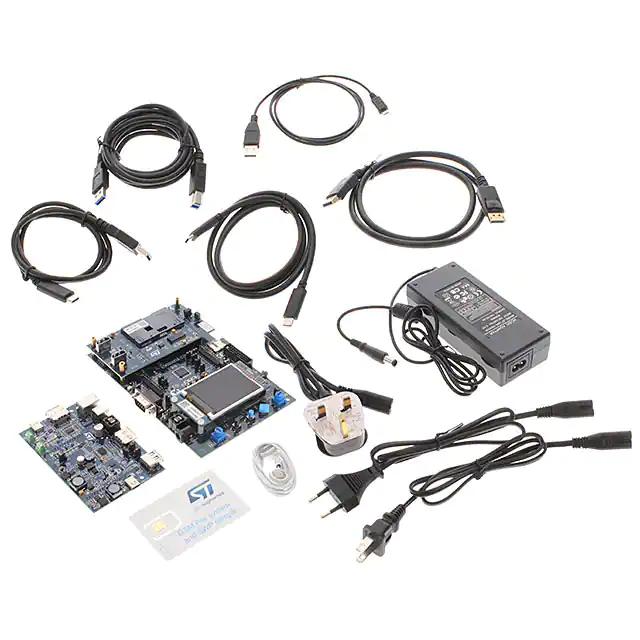
STMicroelectronics STM32G081B-EVAL
- Part No.:
- STM32G081B-EVAL
- Manufacturer:
- STMicroelectronics
- Category:
- Embedded MCU, DSP Evaluation Boards
- Package:
- Datasheet:
-
 STM32G081B-EVAL.pdf
- Description:
- STM32G081 EVAL BRD
- Quantity:
- Payment:

- Shipping:

Inventory:3,796
Please send an inquiry. Send us your inquiry, and we will respond immediately.
Product details
Overview
STM32G081B-EVAL from STMicroelectronics is a full-featured evaluation board for the STM32G081RBT6 Arm® Cortex®-M0+ microcontroller (128 KB Flash, 32 KB SRAM, LQFP64), featuring dual USB-C ports with Power Delivery (up to 45 W DRP on Port 1), RS-232/RS-485 interfaces, stereo audio jack with microphone ADC, microSD™ slot, and on-board ST-LINK/V2-1 debugger supporting mass storage, VCP, and SWD.
For engineers reviewing the STM32G081B-EVAL datasheet, STM32G081B-EVAL pinout, STM32G081B-EVAL application, or STM32G081B-EVAL equivalent, this board supports rapid prototyping of USB-C PD systems, motor control, industrial HMI, and multi-interface embedded applications with validated hardware abstraction layers in STM32Cube.
Technical Context
The board implements a modular architecture: a mainboard hosting the STM32G081RBT6 MCU with configurable 1.65–3.6 V supply, RTC with backup battery, 12-bit ADC, two 12-bit DACs, and five USARTs; plus interchangeable daughterboards - one for legacy peripherals (IrDA, LDR, temperature sensor, HDMI CEC, smart card) and one for USB-C/DP/USB PD (dual Type-C ports, DisplayPort alternate mode, VCONN, 19 V PD input).
ST-LINK/V2-1 is integrated as an in-circuit debugger/programmer with USB re-enumeration (mass storage, virtual COM port, debug port), enabling seamless firmware development across Keil®, IAR™, and GCC-based IDEs on Windows®, Linux®, and macOS®.
Key Specifications
| Parameter | Value and Actual Design Meaning |
|---|---|
| MCU Core | Arm® Cortex®-M0+, 64 MHz max, enabling real-time USB PD policy engine and low-power peripheral management |
| On-board MCU | STM32G081RBT6 (LQFP64, 128 KB Flash, 32 KB SRAM) - direct target for application code deployment |
| USB-C Capability | Port 1: DRP with USB PD 3.0 (up to 45 W); Port 2: Sink-only - supports full USB Type-C r1.2 compliance and alternate mode negotiation |
| Debug Interface | Integrated ST-LINK/V2-1 with SWD, virtual COM port, and mass storage - no external tool required for flashing or serial logging |
| Expansion Support | Dual daughterboard connectors (legacy peripheral & USB-C/PD), plus extension headers for custom wiring or carrier boards |
| Power Options | 5 V DC jack, ST-LINK USB bus power, or 19 V input via USB PD daughterboard - enables system-level power architecture validation |
Availability
STM32G081B-EVAL is available at Aetrix Electronics and suitable for USB-C power delivery system validation, industrial HMI development, and multi-protocol interface prototyping requiring stable component supply, long-term design-in support, and traceable sourcing.
Supply support for STM32G081B-EVAL includes scheduled delivery planning, volume procurement assistance, BOM continuity management, traceable sourcing, and lifecycle availability coordination for OEM customers, industrial embedded developers, connected-device designers, and electronics production programs.
Manufacturer
STMicroelectronics is a global semiconductor leader headquartered in Geneva, Switzerland, designing and manufacturing microcontrollers, analog ICs, power devices, and sensors for industrial, automotive, and consumer applications.
The STM32G0 series targets cost-sensitive, low-power, high-integration applications - delivering USB-C PD readiness, enhanced security features, and streamlined development via STM32Cube ecosystem.
FAQ
Does STM32G081B-EVAL support USB Power Delivery sink and source modes simultaneously?
Yes - USB-C Port 1 operates as a dual-role port (DRP) compliant with USB PD 3.0, capable of sourcing up to 45 W or sinking power dynamically based on policy engine execution on the STM32G081RBT6. Port 2 is sink-only. Firmware examples in STM32Cube demonstrate real-time role swapping and voltage/current negotiation.
Can the legacy peripheral daughterboard be used independently of the USB-C daughterboard?
Yes - both daughterboards connect via dedicated edge connectors to the mainboard and are electrically isolated. The legacy board (IrDA, LDR, temperature sensor, HDMI CEC, smart card) functions fully without the USB-C board installed, and vice versa. Each uses separate power domains and GPIO mappings.
What software tools are officially supported for firmware development on STM32G081B-EVAL?
ST officially supports Keil® MDK-ARM, IAR™ EWARM, and GCC-based IDEs (including STM32CubeIDE). All are validated with the board's ST-LINK/V2-1 interface and STM32CubeG0 HAL/LL libraries. Preloaded demonstration firmware runs standalone and source code is available on www.st.com.
Is the ST-LINK/V2-1 on STM32G081B-EVAL field-upgradable?
Yes - the embedded ST-LINK/V2-1 firmware can be updated via USB using ST's official STSW-LINK007 utility. This enables compatibility with newer STM32 devices and debugging features without hardware modification, and supports mass storage drag-and-drop programming and virtual COM port logging out-of-the-box.
STM32G081B-EVAL Specifications
- Product attributes
- Attribute value
- Manufacturer:
- STMicroelectronics
- Series:
- STM32G0
- Packaging:
- Bulk
- Product Status:
- Active
- Type:
- MCU 32-Bit
- Core Processor:
- ARM® Cortex®-M0+
- Platform:
- -
- Utilized IC / Part:
- STM32G081
- Mounting Type:
- Fixed
- Contents:
- Board(s)
STM32G081B-EVAL FAQ
1.How can I place an order for STM32G081B-EVAL through Aetrix?
Please submit a Request for Quotation (RFQ) for STM32G081B-EVAL on Aetrix. Our sales agent will provide a competitive quotation and guide you through the order confirmation once you accept the terms.
2.Are the price and stock information for STM32G081B-EVAL reliable?
The price and inventory of STM32G081B-EVAL are updated periodically and may fluctuate due to market conditions. Stock and pricing data are typically refreshed every 24 hours. Quotation validity for STM32G081B-EVAL is usually 5 days.
3.What payment methods are accepted for STM32G081B-EVAL?
We accept Wire Transfer, PayPal, Credit Card, Western Union, MoneyGram, and Escrow for STM32G081B-EVAL transactions.
Note: Certain payment methods may incur a processing fee.
4.How is shipping managed for STM32G081B-EVAL?
STM32G081B-EVAL orders can be shipped via leading logistics carriers, including DHL, UPS, FedEx, TNT, or Registered Mail.
Once your STM32G081B-EVAL order is processed, you will receive an email with the shipment details and tracking number.
Note: Tracking information may take up to 24 hours to appear. Express delivery typically takes 3–5 business days.
5.How can I obtain technical support or documentation for STM32G081B-EVAL?
For technical support, including STM32G081B-EVAL datasheets, pinout diagrams, or application guidance, please contact our engineering support team. They can provide detailed documentation and assistance for your STM32G081B-EVAL requirements.
6.How does Aetrix verify that STM32G081B-EVAL is sourced from the original manufacturer or authorized distributors?
All STM32G081B-EVAL products on Aetrix are procured from qualified distributors and authorized channels. Our dedicated quality assurance team conducts strict verification, including traceability checks and, if necessary, third-party testing. This ensures that STM32G081B-EVAL meets industry standards.
7.What is the process for return or replacement of STM32G081B-EVAL?
All STM32G081B-EVAL units undergo pre-shipment inspection (PSI). If there is an issue with STM32G081B-EVAL, returns or replacements are accepted under the following conditions:
1.Quantity discrepancies, incorrect items, or visible external defects (such as breakage or corrosion), acknowledged by Aetrix.
2.The issue is reported within 90 days of delivery.
3.The STM32G081B-EVAL part is unused and in its original packaging.
Return procedure for STM32G081B-EVAL:
1.Submit a request within 90 days.
2.Obtain a Return Material Authorization (RMA) from Aetrix.
STM32G081B-EVAL Tags
-
SC0915
Raspberry Pi
-
102010428
Seeed Technology Co., Ltd
-
SC0917
Raspberry Pi

-
SC1631
Raspberry Pi
-
102010328
Seeed Technology Co., Ltd
-
102010388
Seeed Technology Co., Ltd
-
4600
Adafruit Industries LLC
-
102010268
Seeed Technology Co., Ltd
-
C124
M5Stack Technology Co., Ltd.
-
3500
Adafruit Industries LLC
-
5302
Adafruit Industries LLC
-
DFR0282
DFRobot
Tech Hub

A practical engineering and sourcing framework covering lifecycle verification, lifetime-buy calculations, replacement qualification, supplier checks and counterfeit-risk controls.

TTL and CMOS logic families differ in thresholds, loading, output drive, power and timing. This engineering guide compares 74HC and 74HCT, calculates noise margins and checks 3.3 V/5 V compatibility.

A practical engineering guide to 3.3V and 5V logic compatibility, input thresholds, resistor dividers, translator ICs, MOSFET level shifting, I2C pull-ups, timing limits and power-sequencing risks.

The 74HC595 uses push-pull logic outputs, while the TPIC6B595 uses 50 V open-drain DMOS sinks for higher-power loads. This guide compares timing, current limits, 3.3 V interfacing, load wiring, thermal…

The 74HC595 converts serial data into eight stable parallel outputs. This guide covers pin functions, shift and storage timing, OE and MR behavior, drive-current limits, cascading, voltage compatibilit…

A technical comparison of level-sensitive latches and edge-triggered flip-flops, covering timing windows, setup and hold limits, master–slave operation, time borrowing, race-through, HDL inference and…

A D latch stores one bit while Enable controls when data can pass. This reference covers gate-level operation, truth tables, transparency, setup and hold timing, LE versus OE, common ICs and practical …

An SR latch stores one bit through cross-coupled feedback. This engineering reference covers NOR and NAND implementations, truth tables, forbidden-state recovery, gated operation, switch debouncing, fa…

Latch circuits retain one bit through feedback. This technical reference covers SR and D latches, truth tables, transparency, timing limits, latch-versus-flip-flop behavior, applications and common log…

An engineering guide to LED driver operation, constant-current and constant-voltage outputs, linear and switching topologies, dimming, IC selection, calculations, replacement compatibility, and fault c…


