
 My Inquiry
 My Account


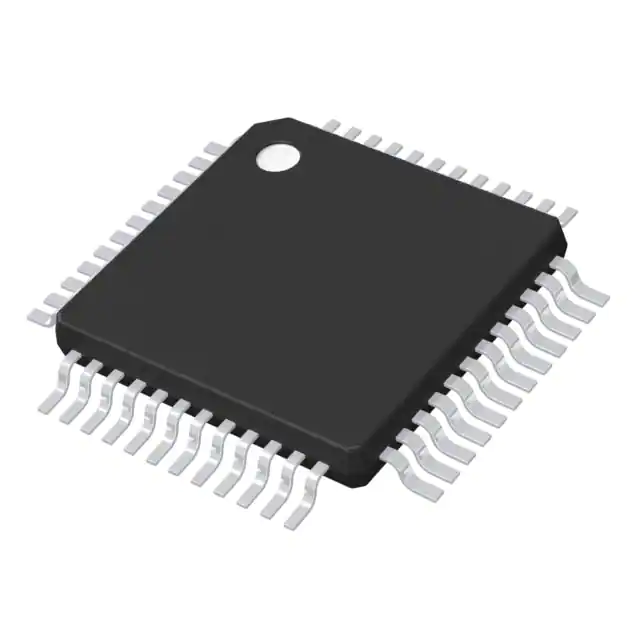
STMicroelectronics STM32L010C6T6
- Part No.:
- STM32L010C6T6
- Manufacturer:
- STMicroelectronics
- Category:
- Microcontrollers
- Package:
- 48-LQFP
- Datasheet:
-
 STM32L010C6T6.pdf
- Description:
- IC MCU 32BIT 32KB FLASH 48LQFP
- Quantity:
- Payment:

- Shipping:

Inventory:22,025
Please send an inquiry. Send us your inquiry, and we will respond immediately.
Product details
Overview
STM32L010C6T6 from STMicroelectronics is an ultra-low-power 32-bit Arm® Cortex®-M0+ microcontroller in LQFP48 package, featuring 32 KB Flash, 8 KB SRAM, 256-byte EEPROM, 12-bit ADC (1.14 Msps), and integrated low-power timers including RTC and ultra-low-power LPTIM. It operates from 1.8–3.6 V and supports gas metering, sensor nodes, and battery-powered user interfaces.
For engineers reviewing the STM32L010C6T6 datasheet, STM32L010C6T6 pinout, STM32L010C6T6 application, or STM32L010C6T6 equivalent, key selection criteria include standby current (0.23 µA), 5 µs Flash wakeup time, 31 5-V-tolerant I/Os, and dual UART support (USART + LPUART) for energy-constrained embedded designs.
Technical Context
The STM32L010C6T6 implements a hierarchical low-power architecture with seven operational modes (Run, Sleep, Low-power Run/Sleep, Stop, Standby), where Stop mode retains RTC and 8 KB RAM at 0.6 µA and Standby draws just 0.23 µA with two wakeup pins. Its clock system integrates five sources: HSE (0–32 MHz), LSE (32.768 kHz), HSI16 (±1% factory-trimmed), LSI (37 kHz), and MSI (65 kHz–4.2 MHz), all selectable via RCC registers.
Core peripherals include a 7-channel DMA controller servicing ADC, SPI, I²C, USART, and timers; a 12-bit ADC with up to 10 channels and operation down to 1.8 V; and three general-purpose timers (two 16-bit, one ultra-low-power), plus SysTick, RTC, and dual watchdogs (IWDG/WWDG). The interconnect matrix enables flexible peripheral-to-memory routing without CPU intervention.
Key Specifications
| Parameter | Value and Actual Design Meaning |
|---|---|
| CPU Core | Arm Cortex-M0+, 32-bit, up to 32 MHz - delivers 0.95 DMIPS/MHz for deterministic real-time control in resource-constrained firmware. |
| Memory | 32 KB Flash (sector-protected), 8 KB SRAM, 256 B EEPROM - enables field-upgradable firmware, data logging, and parameter retention without external storage. |
| Power Consumption | 0.23 µA Standby (2 wakeup pins), 0.6 µA Stop + RTC + 8 KB RAM - extends battery life to years in intermittent-sensing applications like smart meters. |
| ADC | 12-bit, 1.14 Msps, 10-channel, functional down to 1.8 V - supports high-resolution analog sensing (e.g., pressure, temperature) directly from single-cell Li-ion or coin-cell supplies. |
| I/O Capability | 38 fast I/Os (31 5-V-tolerant), configurable as GPIO, EXTI, or 13 alternate functions - simplifies interface to legacy 5 V logic, sensors, and displays without level shifters. |
| Communication | 1× USART, 1× LPUART, 1× SPI (16 Mbit/s), 1× I²C (SMBus/PMBus) - provides robust serial connectivity for sensor fusion, wireless module control, and power-aware host communication. |
| Timers | 7 timers: 2× 16-bit GP (4/2 channels), 1× 16-bit ultra-low-power, SysTick, RTC, IWDG, WWDG - enables precise timing, pulse generation, calendar functions, and fail-safe monitoring in safety-critical edge nodes. |
Pinout & Package
LQFP48 (7 × 7 mm, 0.5 mm pitch), ECOPACK2-compliant surface-mount package with exposed thermal pad - optimized for compact PCB layouts and thermal reliability in sealed industrial enclosures.
| Pin/Terminal | Circuit Role | Design Meaning |
|---|---|---|
| VDD | Power supply (digital) | Primary 1.8–3.6 V input; decoupling required per datasheet layout guidelines to maintain low-noise core operation. |
| VSS | Digital ground | Reference return path for digital I/O and core logic; must be connected to solid ground plane for EMI suppression. |
| NRST | Active-low reset input | Asynchronous reset pin with internal pull-up; accepts 1.65–5.5 V logic; requires external RC filter per Figure 21 for noise immunity. |
| PA0–PA15 | General-purpose I/O bank A | 31 total 5-V-tolerant I/Os across PA/PB/PC; support EXTI, analog input (ADC_IN0–IN9), and multiple AF functions (e.g., USART_TX/RX, SPI_SCK/MOSI). |
| PC13–PC15 | Low-power oscillator pins | Connect 32.768 kHz crystal for RTC calibration; PC14/PC15 require load capacitors (12.5 pF typical) per Figure 16. |
| BOOT0 | Boot mode selection | High at reset enables system memory bootloader (USART/SPI); tied low for normal Flash execution - critical for production programming flow. |
Key Features
| Feature | Design Value |
|---|---|
| Ultra-low-power BOR | 5 selectable brownout thresholds (1.6–2.5 V) - ensures reliable reset during battery voltage sag without external supervisor IC. |
| Pre-programmed bootloader | Factory-loaded USART/SPI bootloader - enables in-system firmware updates without debugger, reducing BOM and field service cost. |
| Serial wire debug (SW-DP) | 2-pin debug interface (SWDIO/SWCLK) - supports full JTAG-like debugging with minimal PCB footprint and no dedicated TRST/nRST pins. |
| 96-bit unique ID | Factory-programmed device serial number - enables secure device authentication, license binding, and anti-cloning in IoT endpoints. |
| CRC calculation unit | Hardware-accelerated CRC-32 - offloads checksum computation from CPU during firmware OTA updates or data packet validation. |
Applications
| Smart Utility Metering | Wearable Health Sensors |
|---|---|
Use Scenario: Battery-powered gas/water meter with hourly pressure/flow sampling and LoRaWAN transmission. IC Role / Device Role / Timing Role: Main controller executing metering algorithm, managing RTC-triggered ADC conversions, and coordinating LPUART-to-LoRa module handoff. Use Value: 0.23 µA Standby and 5 µs wakeup enable >10-year battery life while maintaining sub-second response to tamper events. |
Use Scenario: Optical heart-rate monitor using photodiode array and ambient light cancellation. IC Role / Device Role / Timing Role: Analog front-end controller acquiring synchronized ADC samples, applying FIR filtering in RAM, and transmitting processed BPM over BLE UART. Use Value: 12-bit ADC operating at 1.8 V allows direct connection to low-voltage analog sensors, eliminating level-shifting components and board space. |
| Industrial Wireless Sensor Node | Low-Power User Interface |
Use Scenario: Temperature/humidity node in factory HVAC duct with Zigbee mesh reporting every 5 minutes. IC Role / Device Role / Timing Role: System orchestrator entering Stop mode between readings, waking on RTC alarm, reading Si7021 via I²C, and transmitting via UART to radio module. Use Value: 0.6 µA Stop + RTC + 8 KB RAM retention preserves context and calibration data across sleep cycles without capacitor backup. |
Use Scenario: Keypad + LED status panel for access control system powered by AA batteries. IC Role / Device Role / Timing Role: Input scanner detecting keypresses via GPIO interrupts, driving common-anode LEDs via timer PWM, and managing button debouncing in firmware. Use Value: 31 5-V-tolerant I/Os interface directly to mechanical switches and standard LEDs, avoiding external buffer ICs and reducing bill-of-materials count. |
Equivalent & Alternatives
The following parts are listed as comparable options for similar ultra-low-power MCU applications.
| Alternative Part | Technical Difference | Application Difference | Selection Advice |
|---|---|---|---|
| STM32L011K4T6 | 20-pin TSSOP, 16 KB Flash, no EEPROM, 1x USART only - smaller footprint but reduced memory and peripheral count. | Suitable for simpler sensor nodes with minimal firmware and no data logging requirement. | Select when board space is critical and EEPROM-based parameter storage is unnecessary. |
| EFM32ZG108F16 | Silicon Labs ARM Cortex-M0+, 16 KB Flash, 8 KB RAM, 0.18 µA Deep Sleep - lower standby current but lacks LPUART and has no factory bootloader. | Better for extreme battery life in infrequent-wakeup applications where UART is handled externally. | Choose when lowest possible standby dominates over integrated communication and field upgrade capability. |
Compared with STM32L010C6T6, STM32L011K4T6 trades memory and peripherals for compactness, while EFM32ZG108F16 achieves deeper sleep at the cost of integrated bootloader and LPUART-making STM32L010C6T6 optimal for balanced feature-rich, battery-operated edge controllers.
Availability
STM32L010C6T6 is available at Aetrix Electronics and suitable for smart utility metering, wearable health sensors, industrial wireless sensor nodes, and low-power user interfaces requiring stable component supply across multi-year production cycles.
Supply support for STM32L010C6T6 includes scheduled delivery planning, volume procurement assistance, BOM continuity management, traceable sourcing, and lifecycle availability coordination for OEM customers, industrial embedded developers, connected-device designers, and electronics production programs.
Manufacturer
STMicroelectronics is a global semiconductor leader headquartered in Geneva, Switzerland, designing and manufacturing microcontrollers, power management ICs, sensors, and automotive semiconductors since 1987.
The STM32L0 value line targets cost-sensitive, ultra-low-power applications such as smart meters, wearables, and battery-operated industrial sensors-emphasizing energy efficiency, integration, and ease of certification.
FAQ
What is the minimum supply voltage for ADC operation on STM32L010C6T6?
The 12-bit ADC remains fully functional down to 1.8 V supply voltage, enabling direct interfacing with single-cell lithium or alkaline batteries without boost regulation. This is verified in Section 6.3.15 of DS12324 Rev 3, where ADC accuracy specs (INL/DNL, offset/gain error) are guaranteed across the full 1.8–3.6 V range.
Does STM32L010C6T6 support hardware encryption or secure boot?
No, the STM32L010C6T6 does not integrate hardware cryptographic accelerators (AES, PKA) or secure boot ROM. It relies on software-based security (e.g., AES-CTR in Flash) and external secure elements for key storage. Secure variants like STM32L5xxx or STM32U5xxx provide TrustZone and hardware crypto engines.
Can the internal 16 MHz RC oscillator (HSI16) be used as the system clock without calibration?
Yes, HSI16 is factory-trimmed to ±1% accuracy at 25 °C and 3.3 V, making it usable as the main system clock without runtime calibration. For higher precision (e.g., USB or audio timing), an external crystal (HSE) or calibrated LSE for RTC is recommended per Section 3.5 and Table 36.
How many I/O pins support external interrupt (EXTI) capability?
All 38 GPIOs support external interrupt capability via the EXTI controller, with 29 lines mapped to individual pins and 9 shared across groups (e.g., PA0–PG0 share EXTI0). Pin-specific EXTI mapping is defined in Table 11 (Alternate Functions) and Section 4 (Pin Descriptions) of DS12324 Rev 3.
STM32L010C6T6 Specifications
- Product attributes
- Attribute value
- Manufacturer:
- STMicroelectronics
- Package/Case:
- 48-LQFP
- Series:
- STM32L0
- Packaging:
- Tray
- Product Status:
- Active
- Programmable:
- Not Verified
- Core Processor:
- ARM® Cortex®-M0+
- Core Size:
- 32-Bit Single-Core
- Speed:
- 32MHz
- Connectivity:
- I2C, IrDA, SPI, UART/USART
- Peripherals:
- Brown-out Detect/Reset, DMA, POR, PWM, WDT
- Number of I/O:
- 38
- Program Memory Size:
- 32KB (32K x 8)
- Program Memory Type:
- FLASH
- EEPROM Size:
- 256 x 8
- RAM Size:
- 8K x 8
- Voltage - Supply (Vcc/Vdd):
- 1.8V ~ 3.6V
- Data Converters:
- A/D 10x12b
- Oscillator Type:
- Internal
- Operating Temperature:
- -40°C ~ 85°C (TA)
- Grade:
- -
- Qualification:
- -
- Mounting Type:
- Surface Mount
- Supplier Device Package:
STM32L010C6T6 FAQ
1.How can I place an order for STM32L010C6T6 through Aetrix?
Please submit a Request for Quotation (RFQ) for STM32L010C6T6 on Aetrix. Our sales agent will provide a competitive quotation and guide you through the order confirmation once you accept the terms.
2.Are the price and stock information for STM32L010C6T6 reliable?
The price and inventory of STM32L010C6T6 are updated periodically and may fluctuate due to market conditions. Stock and pricing data are typically refreshed every 24 hours. Quotation validity for STM32L010C6T6 is usually 5 days.
3.What payment methods are accepted for STM32L010C6T6?
We accept Wire Transfer, PayPal, Credit Card, Western Union, MoneyGram, and Escrow for STM32L010C6T6 transactions.
Note: Certain payment methods may incur a processing fee.
4.How is shipping managed for STM32L010C6T6?
STM32L010C6T6 orders can be shipped via leading logistics carriers, including DHL, UPS, FedEx, TNT, or Registered Mail.
Once your STM32L010C6T6 order is processed, you will receive an email with the shipment details and tracking number.
Note: Tracking information may take up to 24 hours to appear. Express delivery typically takes 3–5 business days.
5.How can I obtain technical support or documentation for STM32L010C6T6?
For technical support, including STM32L010C6T6 datasheets, pinout diagrams, or application guidance, please contact our engineering support team. They can provide detailed documentation and assistance for your STM32L010C6T6 requirements.
6.How does Aetrix verify that STM32L010C6T6 is sourced from the original manufacturer or authorized distributors?
All STM32L010C6T6 products on Aetrix are procured from qualified distributors and authorized channels. Our dedicated quality assurance team conducts strict verification, including traceability checks and, if necessary, third-party testing. This ensures that STM32L010C6T6 meets industry standards.
7.What is the process for return or replacement of STM32L010C6T6?
All STM32L010C6T6 units undergo pre-shipment inspection (PSI). If there is an issue with STM32L010C6T6, returns or replacements are accepted under the following conditions:
1.Quantity discrepancies, incorrect items, or visible external defects (such as breakage or corrosion), acknowledged by Aetrix.
2.The issue is reported within 90 days of delivery.
3.The STM32L010C6T6 part is unused and in its original packaging.
Return procedure for STM32L010C6T6:
1.Submit a request within 90 days.
2.Obtain a Return Material Authorization (RMA) from Aetrix.
STM32L010C6T6 Tags

-
ATTINY4-TSHR
Microchip Technology
-
ATTINY10-TSHR
Microchip Technology
-
ATTINY10-TS8R
Microchip Technology

-
ATTINY202-SSNR
Microchip Technology
-
ATTINY202-SSFR
Microchip Technology
-
ATTINY402-SSNR
Microchip Technology

-
PIC16F15213T-I/MF
Microchip Technology
-
PIC16F15213-E/MF
Microchip Technology

-
PIC10F200T-I/OT
Microchip Technology
-
ATTINY412-SSNR
Microchip Technology
-
PIC10F202T-I/OT
Microchip Technology

-
ATTINY404-SSNR
Microchip Technology
Tech Hub

A practical engineering and sourcing framework covering lifecycle verification, lifetime-buy calculations, replacement qualification, supplier checks and counterfeit-risk controls.

TTL and CMOS logic families differ in thresholds, loading, output drive, power and timing. This engineering guide compares 74HC and 74HCT, calculates noise margins and checks 3.3 V/5 V compatibility.

A practical engineering guide to 3.3V and 5V logic compatibility, input thresholds, resistor dividers, translator ICs, MOSFET level shifting, I2C pull-ups, timing limits and power-sequencing risks.

The 74HC595 uses push-pull logic outputs, while the TPIC6B595 uses 50 V open-drain DMOS sinks for higher-power loads. This guide compares timing, current limits, 3.3 V interfacing, load wiring, thermal…

The 74HC595 converts serial data into eight stable parallel outputs. This guide covers pin functions, shift and storage timing, OE and MR behavior, drive-current limits, cascading, voltage compatibilit…

A technical comparison of level-sensitive latches and edge-triggered flip-flops, covering timing windows, setup and hold limits, master–slave operation, time borrowing, race-through, HDL inference and…

A D latch stores one bit while Enable controls when data can pass. This reference covers gate-level operation, truth tables, transparency, setup and hold timing, LE versus OE, common ICs and practical …

An SR latch stores one bit through cross-coupled feedback. This engineering reference covers NOR and NAND implementations, truth tables, forbidden-state recovery, gated operation, switch debouncing, fa…

Latch circuits retain one bit through feedback. This technical reference covers SR and D latches, truth tables, transparency, timing limits, latch-versus-flip-flop behavior, applications and common log…

An engineering guide to LED driver operation, constant-current and constant-voltage outputs, linear and switching topologies, dimming, IC selection, calculations, replacement compatibility, and fault c…


