
 My Inquiry
 My Account


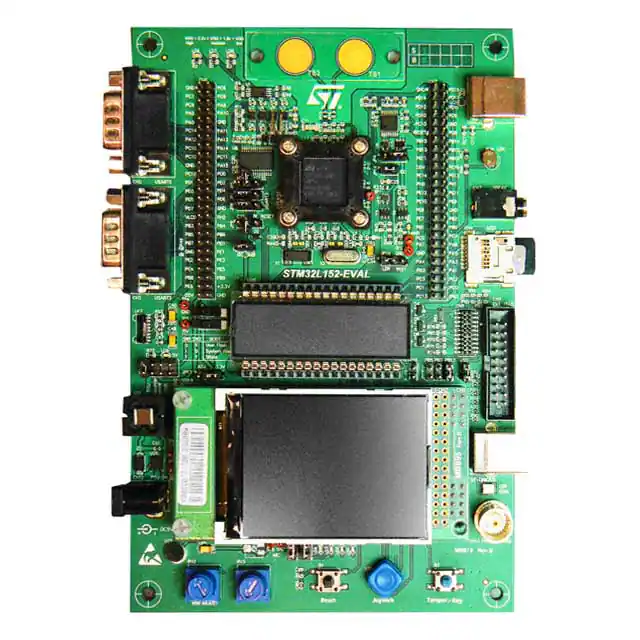
STMicroelectronics STM32L152-EVAL
- Part No.:
- STM32L152-EVAL
- Manufacturer:
- STMicroelectronics
- Category:
- Embedded MCU, DSP Evaluation Boards
- Package:
- Datasheet:
-
 STM32L152-EVAL.pdf
- Description:
- STM32L152 EVAL BRD
- Quantity:
- Payment:

- Shipping:

Inventory:3,641
Please send an inquiry. Send us your inquiry, and we will respond immediately.
Product details
Overview
STM32L152-EVAL from STMicroelectronics is an obsolete evaluation board built around the STM32L152VBT6 ARM Cortex-M3 microcontroller, featuring 128 KB Flash, 12-bit ADC/DAC, USB FS, LCD controller, touch sensing, and dual SPI/I²C/USART interfaces. It integrates a 240×320 TFT LCD, MicroSD card slot, audio codec, temperature sensor, RS-232, IrDA, JTAG/trace debug via embedded ST-LINK/V2, and power measurement circuitry for ultra-low-power development.
For engineers reviewing the STM32L152-EVAL datasheet, STM32L152-EVAL pinout, STM32L152-EVAL application, or STM32L152-EVAL equivalent, this board supports rapid prototyping of battery-powered IoT sensors, portable medical monitors, smart metering UIs, and energy-harvesting human-interface devices with validated low-power peripheral integration and real-world signal chain validation.
Technical Context
The board implements full hardware validation of the STM32L152VBT6's integrated peripherals: its 12-bit ADC samples analog inputs from LDR and potentiometer; the 12-bit DAC drives the onboard speaker; the LCD controller directly manages the 32-segment glass and 240×320 TFT via dedicated SPI interface; and the embedded ST-LINK/V2 provides seamless SWD/JTAG debugging without external tools.
Power architecture supports four independent 5 V sources (power jack, ST-LINK/V2 USB, user USB, daughterboard), MCU voltage selection between 1.65–3.6 V or fixed 3.3 V, and real-time current measurement to characterize sleep/wake current profiles-enabling accurate ultra-low-power design verification per STM32L1 series specifications.
Key Specifications
| Parameter | Value and Actual Design Meaning |
|---|---|
| Core MCU | STM32L152VBT6: ARM Cortex-M3 @ 32 MHz, 128 KB Flash, 16 KB SRAM |
| LCD Interface | Dedicated LCD controller driving both 32×4 segment glass and 240×320 SPI TFT display |
| Analog Peripherals | 12-bit ADC (16 ch), 12-bit DAC (2 ch), temperature sensor, LDR, potentiometer |
| Communication | 2× SPI (TFT + MicroSD), 2× I²C (temp sensor), 3× USART (RS-232, IrDA, ST-LINK) |
| Debug & Programming | Embedded ST-LINK/V2 supporting SWD/JTAG, trace, and virtual COM port |
| Power Options | Four 5 V inputs; MCU supply selectable 1.65–3.6 V or fixed 3.3 V; on-board current measurement |
Availability
STM32L152-EVAL is available at Aetrix Electronics and suitable for ultra-low-power embedded development, portable HMI validation, battery-operated sensor node prototyping, and educational ARM Cortex-M3 curriculum requiring stable component supply despite its obsolete status.
Supply support for STM32L152-EVAL includes scheduled delivery planning, volume procurement assistance, BOM continuity management, traceable sourcing, and lifecycle availability coordination for OEM customers, industrial embedded developers, connected-device designers, and electronics production programs.
Manufacturer
STMicroelectronics is a global semiconductor leader headquartered in Geneva, designing and manufacturing microcontrollers, analog ICs, power management, MEMS, and discrete components for industrial, automotive, and consumer applications.
This evaluation board belongs to ST's STM32L1-series ecosystem, engineered specifically to demonstrate and accelerate development of sub-100 µA/MHz ultra-low-power applications in energy-constrained environments such as wearables and remote sensors.
FAQ
Is STM32L152-EVAL still in production?
No. STMicroelectronics officially obsoleted STM32L152-EVAL in January 2013 and replaced it with STM32L152D-EVAL. Aetrix Electronics maintains limited legacy stock for design continuity and migration support but does not offer new production builds or long-term supply guarantees.
What is the replacement board and how does it differ?
The designated replacement is STM32L152D-EVAL. It retains the same STM32L152VBT6 MCU and core peripherals but features updated layout, improved power measurement resolution, revised daughterboard connector pinout, and enhanced ESD protection on USB and I/O lines per ST's 2013 revision notes.
Can I use STM32L152-EVAL firmware on STM32L152D-EVAL?
Yes-firmware is binary-compatible because both boards use identical STM32L152VBT6 silicon and memory map. However, minor driver adjustments may be needed for the revised MicroSD card detection circuit and updated ST-LINK/V2 firmware version included on the D-EVAL variant.
Does Aetrix provide migration support from STM32L152-EVAL to newer platforms?
Yes. Aetrix offers technical consultation, schematic review, and BSP adaptation services for migrating to STM32L152D-EVAL or modern successors like STM32L4/L5 series. Support includes pin compatibility analysis, power profile revalidation, and HAL/LL library alignment guidance.
STM32L152-EVAL Specifications
- Product attributes
- Attribute value
- Manufacturer:
- STMicroelectronics
- Series:
- STM32L1
- Packaging:
- Box
- Product Status:
- Obsolete
- Type:
- MCU 32-Bit
- Core Processor:
- ARM® Cortex®-M3
- Platform:
- -
- Utilized IC / Part:
- STM32L152
- Mounting Type:
- Fixed
- Contents:
- Board(s), LCD
STM32L152-EVAL FAQ
1.How can I place an order for STM32L152-EVAL through Aetrix?
Please submit a Request for Quotation (RFQ) for STM32L152-EVAL on Aetrix. Our sales agent will provide a competitive quotation and guide you through the order confirmation once you accept the terms.
2.Are the price and stock information for STM32L152-EVAL reliable?
The price and inventory of STM32L152-EVAL are updated periodically and may fluctuate due to market conditions. Stock and pricing data are typically refreshed every 24 hours. Quotation validity for STM32L152-EVAL is usually 5 days.
3.What payment methods are accepted for STM32L152-EVAL?
We accept Wire Transfer, PayPal, Credit Card, Western Union, MoneyGram, and Escrow for STM32L152-EVAL transactions.
Note: Certain payment methods may incur a processing fee.
4.How is shipping managed for STM32L152-EVAL?
STM32L152-EVAL orders can be shipped via leading logistics carriers, including DHL, UPS, FedEx, TNT, or Registered Mail.
Once your STM32L152-EVAL order is processed, you will receive an email with the shipment details and tracking number.
Note: Tracking information may take up to 24 hours to appear. Express delivery typically takes 3–5 business days.
5.How can I obtain technical support or documentation for STM32L152-EVAL?
For technical support, including STM32L152-EVAL datasheets, pinout diagrams, or application guidance, please contact our engineering support team. They can provide detailed documentation and assistance for your STM32L152-EVAL requirements.
6.How does Aetrix verify that STM32L152-EVAL is sourced from the original manufacturer or authorized distributors?
All STM32L152-EVAL products on Aetrix are procured from qualified distributors and authorized channels. Our dedicated quality assurance team conducts strict verification, including traceability checks and, if necessary, third-party testing. This ensures that STM32L152-EVAL meets industry standards.
7.What is the process for return or replacement of STM32L152-EVAL?
All STM32L152-EVAL units undergo pre-shipment inspection (PSI). If there is an issue with STM32L152-EVAL, returns or replacements are accepted under the following conditions:
1.Quantity discrepancies, incorrect items, or visible external defects (such as breakage or corrosion), acknowledged by Aetrix.
2.The issue is reported within 90 days of delivery.
3.The STM32L152-EVAL part is unused and in its original packaging.
Return procedure for STM32L152-EVAL:
1.Submit a request within 90 days.
2.Obtain a Return Material Authorization (RMA) from Aetrix.
STM32L152-EVAL Tags
-
SC0915
Raspberry Pi
-
102010428
Seeed Technology Co., Ltd
-
SC0917
Raspberry Pi

-
SC1631
Raspberry Pi
-
102010328
Seeed Technology Co., Ltd
-
102010388
Seeed Technology Co., Ltd
-
4600
Adafruit Industries LLC
-
102010268
Seeed Technology Co., Ltd
-
C124
M5Stack Technology Co., Ltd.
-
3500
Adafruit Industries LLC
-
5302
Adafruit Industries LLC
-
DFR0282
DFRobot
Tech Hub

A practical engineering and sourcing framework covering lifecycle verification, lifetime-buy calculations, replacement qualification, supplier checks and counterfeit-risk controls.

TTL and CMOS logic families differ in thresholds, loading, output drive, power and timing. This engineering guide compares 74HC and 74HCT, calculates noise margins and checks 3.3 V/5 V compatibility.

A practical engineering guide to 3.3V and 5V logic compatibility, input thresholds, resistor dividers, translator ICs, MOSFET level shifting, I2C pull-ups, timing limits and power-sequencing risks.

The 74HC595 uses push-pull logic outputs, while the TPIC6B595 uses 50 V open-drain DMOS sinks for higher-power loads. This guide compares timing, current limits, 3.3 V interfacing, load wiring, thermal…

The 74HC595 converts serial data into eight stable parallel outputs. This guide covers pin functions, shift and storage timing, OE and MR behavior, drive-current limits, cascading, voltage compatibilit…

A technical comparison of level-sensitive latches and edge-triggered flip-flops, covering timing windows, setup and hold limits, master–slave operation, time borrowing, race-through, HDL inference and…

A D latch stores one bit while Enable controls when data can pass. This reference covers gate-level operation, truth tables, transparency, setup and hold timing, LE versus OE, common ICs and practical …

An SR latch stores one bit through cross-coupled feedback. This engineering reference covers NOR and NAND implementations, truth tables, forbidden-state recovery, gated operation, switch debouncing, fa…

Latch circuits retain one bit through feedback. This technical reference covers SR and D latches, truth tables, transparency, timing limits, latch-versus-flip-flop behavior, applications and common log…

An engineering guide to LED driver operation, constant-current and constant-voltage outputs, linear and switching topologies, dimming, IC selection, calculations, replacement compatibility, and fault c…


