
 My Inquiry
 My Account


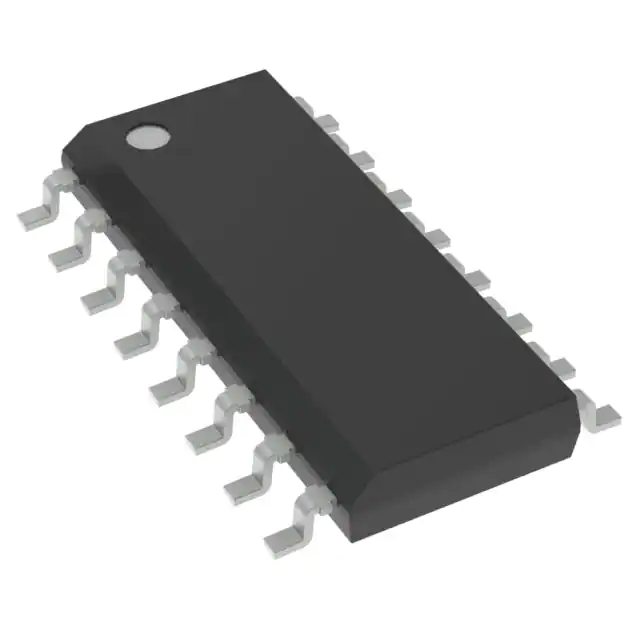
STMicroelectronics STP08CDC596MTR
- Part No.:
- STP08CDC596MTR
- Manufacturer:
- STMicroelectronics
- Category:
- LED Drivers
- Package:
- 16-SOIC (0.154", 3.90mm Width)
- Datasheet:
-
 STP08CDC596MTR.pdf
- Description:
- IC LED DRIVER LINEAR 120MA 16SO
- Quantity:
- Payment:

- Shipping:

Inventory:3,553
Please send an inquiry. Send us your inquiry, and we will respond immediately.
Product details
Overview
STP08CDC596MTR from STMicroelectronics is an 8-bit constant-current LED sink driver with integrated open/short and short-to-rail fault detection, designed for serial-in/parallel-out LED panel control. It delivers 20–120 mA per channel via external REXT, supports 25 MHz clocking, operates from 3.3 V or 5 V logic, and features 16 V output voltage capability for driving multiple LEDs in series - deployed in traffic signage where real-time LED health monitoring is critical.
For engineers reviewing the STP08CDC596MTR datasheet, STP08CDC596MTR pinout, STP08CDC596MTR application, or STP08CDC596MTR equivalent, key selection criteria include its fault-detection protocol timing (5-clock entry sequence), ±3% current matching between channels, SO-16 package thermal resistance (125 °C/W), and compatibility with microcontroller-driven serial cascades requiring SDO feedback of error status bits.
Technical Context
The device integrates an 8-bit shift register feeding an 8-bit D-type storage latch, followed by eight matched regulated current sinks. Its detection mode uses a deterministic 5-clock handshake on OE/DM2 and LE/DM1 to enter error-sampling state without footprint change versus legacy drivers.
Detection evaluates each output for open circuit, short-to-GND, or short-to-VLED by comparing sensed current (IO vs IO,DEC) and output voltage (VO ≥ 2.4 V indicates short-to-rail). All status bits are returned serially via SDO within ≤2 µs per channel after OE activation.
Key Specifications
| Parameter | Value and Actual Design Meaning |
|---|---|
| Output current range | 20–120 mA per channel, set by single REXT (e.g., 910 Ω → 20.9 mA typ) |
| Current accuracy | ±3% between channels, ±10% across ICs - enables uniform LED brightness without per-channel trimming |
| Max output voltage | 16 V - supports up to 5 standard red LEDs (2.1 V each) in series per channel |
| Clock frequency | 25 MHz - sustains >200 kSPS update rate for 8-bit data, enabling high-refresh-rate displays |
| Fault detection latency | ≤2 µs per channel - allows rapid identification of failed LEDs before thermal runaway or system alarm escalation |
| Logic supply voltage | 3.3 V or 5 V compatible - interfaces directly with modern MCU GPIO without level-shifting |
| Propagation delay | tPHL1 = 30–60 ns (CLK→OUT) - ensures tight timing margin in high-speed cascaded configurations |
Pinout & Package
STP08CDC596MTR is supplied in SO-16 (Small Outline Integrated Circuit, 150 mil width) with gull-wing leads and JEDEC-standard pinout. The package has 1.27 mm pitch, 10.0 mm × 3.9 mm body, and 1.75 mm height; thermal resistance RthJA = 125 °C/W.
| Pin/Terminal | Circuit Role | Design Meaning |
|---|---|---|
| 1 GND | Ground reference | Common return for all current sinks and logic inputs; must be low-impedance path to minimize noise coupling into analog current paths |
| 2 SDI | Serial data input | Accepts 8-bit LED on/off pattern; sampled on CLK rising edge; compatible with SPI-mode MCU outputs |
| 3 CLK | Shift clock input | Drives internal shift register; 25 MHz max - defines maximum data throughput and display refresh bandwidth |
| 4 LE/DM1 | Latch enable / Detection mode 1 | Transfers shift register contents to output latches in normal mode; participates in 5-clock detection entry sequence |
| 5–12 OUT0–OUT7 | Constant-current sink outputs | Each drives cathode of one LED string; 16 V compliance enables series strings; current set by REXT |
| 13 OE/DM2 | Output enable / Detection mode 2 | Active-low output control; second signal in detection handshake; must remain low ≥2 clocks in normal operation |
| 14 SDO | Serial data output | Feedbacks 8-bit status word during detection mode; bit order matches OUT0–OUT7; changes on CLK falling edge |
| 15 R-EXT | Current programming terminal | Connects external resistor to set all 8 output currents identically; 360 Ω → ~51.5 mA typ |
| 16 VDD | Logic supply | Powers internal logic and shift register; decoupling capacitor required near pin to suppress switching noise |
Key Features
| Feature | Design Value |
|---|---|
| Integrated fault detection | Identifies open, short-to-GND, and short-to-VLED per channel without extra pins or PCB area - eliminates need for external sense resistors or comparators |
| Single-resistor current tuning | One external REXT sets identical current across all 8 channels - simplifies BOM, reduces calibration effort, and ensures consistent LED luminance |
| 25 MHz serial interface | Enables full 8-bit updates every 320 ns - supports high-resolution, high-frame-rate LED matrices without data bottlenecks |
| 16 V output compliance | Allows up to five 2.1 V LEDs in series per channel - reduces interconnect count and improves power efficiency over parallel topologies |
| SO-16 footprint compatibility | Mechanically and electrically pin-compatible with legacy 8-bit LED drivers (e.g., STP16CPC26) - enables drop-in upgrade with enhanced diagnostics |
Applications
| Traffic Signage Panels | Industrial Status Displays |
|---|---|
|
Use Scenario: Outdoor LED message signs for highway variable speed limits and lane control. IC Role / Device Role / Timing Role: Constant-current sink driver with real-time open-circuit detection per LED segment to prevent partial sign failure from escalating into safety-critical visibility loss. Use Value: Enables automated nightly self-test reporting via SDO feedback - reducing manual inspection frequency and eliminating undetected pixel failures during peak traffic hours. |
Use Scenario: Factory floor machine status boards showing operational state (RUN/STOP/ALERT) using high-brightness LEDs. IC Role / Device Role / Timing Role: Serial-controlled LED driver with short-to-rail detection to identify wiring faults caused by mechanical abrasion or connector vibration in harsh industrial environments. Use Value: Prevents false "green light" indications due to shorted LED lines - ensuring accurate machine state representation and avoiding production line misinterpretation. |
| Retail Digital Menu Boards | Public Transit Information Displays |
|
Use Scenario: Indoor full-color menu boards using RGB LED modules with individual current control per color channel. IC Role / Device Role / Timing Role: Eight-channel sink driver managing monochrome segments (e.g., white text on black background); REXT tuned for 40 mA to balance brightness and thermal load. Use Value: Maintains consistent text legibility across 10,000+ hour lifetime by compensating for LED forward-voltage drift via stable current regulation - no brightness grading required. |
Use Scenario: Platform-level passenger information displays showing train arrival times and service disruptions. IC Role / Device Role / Timing Role: Fault-aware LED driver detecting short-to-GND events caused by condensation ingress in outdoor-rated enclosures. Use Value: Triggers immediate controller alert upon first detected short - allowing predictive maintenance before complete display blackout occurs during rush-hour service. |
Equivalent & Alternatives
The following parts are listed as comparable options for similar LED sink driver applications.
| Alternative Part | Technical Difference | Application Difference | Selection Advice |
|---|---|---|---|
| TLC59283DBQR | No integrated fault detection; requires external sensing circuitry; 15–100 mA range; 20 MHz max clock | Suitable only where diagnostic coverage is handled at system level (e.g., MCU ADC monitoring) | Select when cost sensitivity outweighs need for autonomous fault reporting and board space is constrained for external components |
| MAX7219CWG+ | Includes built-in BCD decode, scan limit, and intensity control; 20 mA max per segment; no short-to-rail detection | Optimized for 7-segment numeric displays, not general-purpose LED matrix control | Choose for alphanumeric displays with minimal MCU overhead, but avoid for high-current or fault-critical LED arrays |
Compared with TLC59283DBQR and MAX7219CWG+, STP08CDC596MTR uniquely combines per-channel fault diagnosis, 120 mA drive strength, and SO-16 pin compatibility - making it the only option that preserves legacy layout while adding field-serviceable LED health monitoring without firmware or hardware redesign.
Availability
STP08CDC596MTR is available at Aetrix Electronics and suitable for traffic signage, industrial HMI panels, and public transit displays requiring stable component supply, long-term manufacturability, and automotive-grade temperature resilience (−40°C to +125°C).
Supply support for STP08CDC596MTR includes scheduled delivery planning, volume procurement assistance, BOM continuity management, traceable sourcing, and lifecycle availability coordination for OEM customers, industrial embedded developers, connected-device designers, and electronics production programs.
Manufacturer
STMicroelectronics is a global semiconductor leader headquartered in Geneva, Switzerland, designing and manufacturing silicon solutions for automotive, industrial, and consumer markets since 1987.
The STP08CDC596 belongs to ST's LED driver product line, engineered specifically for high-reliability outdoor and industrial visual signaling systems where LED failure detection must occur autonomously, in real time, and without increasing PCB complexity.
FAQ
What is the minimum REXT value supported, and what current does it produce?
The datasheet specifies REXT = 360 Ω yields 46–56.5 mA per channel (typ. 51.5 mA) at VO = 0.7 V. Using lower values risks exceeding absolute max output current (120 mA) or violating thermal limits in SO-16. No tested performance data exists below 360 Ω; ST recommends staying within 360–910 Ω for guaranteed operation.
How does the detection mode interact with cascaded STP08CDC596 devices?
In cascade, SDO of upstream device connects to SDI of downstream. During detection, only the first device in chain enters error mode; others remain in transparent pass-through. To detect faults across all devices, the host MCU must execute separate 5-clock sequences per device, daisy-chaining SDO feedback sequentially - confirmed in Section 9.1 timing diagrams.
Can STP08CDC596MTR drive RGB LEDs with independent current control per color?
No. All 8 channels share one REXT, so red, green, and blue LEDs - which have different forward voltages and optimal currents - cannot be independently optimized. For RGB, use per-channel drivers like STP16CP05 or discrete current sources; STP08CDC596MTR is intended for monochrome or segmented white-light applications.
Is the SO-16 package RoHS-compliant and lead-free?
Yes. Per Section 11 of the datasheet, STP08CDC596MTR uses ECOPACK® packaging with lead-free second-level interconnects, compliant with JEDEC JESD97 and EU RoHS Directive 2011/65/EU. The inner box label and package marking indicate "ECOPACK" and lead-free status.
STP08CDC596MTR Specifications
- Product attributes
- Attribute value
- Manufacturer:
- STMicroelectronics
- Series:
- -
- Package/Case:
- 16-SOIC (0.154", 3.90mm Width)
- Packaging:
- Tape & Reel (TR)
- Product Status:
- Obsolete
- Type:
- Linear
- Topology:
- Shift Register
- Internal Switch(s):
- Yes
- Number of Outputs:
- 8
- Voltage - Supply (Min):
- 3.3V
- Voltage - Supply (Max):
- 5.5V
- Voltage - Output:
- 16V
- Current - Output / Channel:
- 120mA
- Frequency:
- 25MHz
- Dimming:
- -
- Applications:
- Signage
- Operating Temperature:
- -40°C ~ 125°C (TA)
- Grade:
- -
- Qualification:
- -
- Mounting Type:
- Surface Mount
- Supplier Device Package:
- 16-SO
STP08CDC596MTR FAQ
1.How can I place an order for STP08CDC596MTR through Aetrix?
Please submit a Request for Quotation (RFQ) for STP08CDC596MTR on Aetrix. Our sales agent will provide a competitive quotation and guide you through the order confirmation once you accept the terms.
2.Are the price and stock information for STP08CDC596MTR reliable?
The price and inventory of STP08CDC596MTR are updated periodically and may fluctuate due to market conditions. Stock and pricing data are typically refreshed every 24 hours. Quotation validity for STP08CDC596MTR is usually 5 days.
3.What payment methods are accepted for STP08CDC596MTR?
We accept Wire Transfer, PayPal, Credit Card, Western Union, MoneyGram, and Escrow for STP08CDC596MTR transactions.
Note: Certain payment methods may incur a processing fee.
4.How is shipping managed for STP08CDC596MTR?
STP08CDC596MTR orders can be shipped via leading logistics carriers, including DHL, UPS, FedEx, TNT, or Registered Mail.
Once your STP08CDC596MTR order is processed, you will receive an email with the shipment details and tracking number.
Note: Tracking information may take up to 24 hours to appear. Express delivery typically takes 3–5 business days.
5.How can I obtain technical support or documentation for STP08CDC596MTR?
For technical support, including STP08CDC596MTR datasheets, pinout diagrams, or application guidance, please contact our engineering support team. They can provide detailed documentation and assistance for your STP08CDC596MTR requirements.
6.How does Aetrix verify that STP08CDC596MTR is sourced from the original manufacturer or authorized distributors?
All STP08CDC596MTR products on Aetrix are procured from qualified distributors and authorized channels. Our dedicated quality assurance team conducts strict verification, including traceability checks and, if necessary, third-party testing. This ensures that STP08CDC596MTR meets industry standards.
7.What is the process for return or replacement of STP08CDC596MTR?
All STP08CDC596MTR units undergo pre-shipment inspection (PSI). If there is an issue with STP08CDC596MTR, returns or replacements are accepted under the following conditions:
1.Quantity discrepancies, incorrect items, or visible external defects (such as breakage or corrosion), acknowledged by Aetrix.
2.The issue is reported within 90 days of delivery.
3.The STP08CDC596MTR part is unused and in its original packaging.
Return procedure for STP08CDC596MTR:
1.Submit a request within 90 days.
2.Obtain a Return Material Authorization (RMA) from Aetrix.
STP08CDC596MTR Tags
-
BCR402RE6327HTSA1
Infineon Technologies

-
BCR430UXTSA2
Infineon Technologies
-
BCR420UE6433HTMA1
Infineon Technologies
-
BCR420UE6327HTSA1
Infineon Technologies
-
BCR421UE6327HTSA1
Infineon Technologies
-
LYT1604D-TL
Power Integrations

-
HV9910CLG-G
Microchip Technology

-
CL2N8-G
Microchip Technology
-
BCR420UW6-7
Diodes Incorporated
-
BCR421UW6-7
Diodes Incorporated
-
BCR420UFD-7
Diodes Incorporated
-
BCR421UFD-7
Diodes Incorporated
Tech Hub

A practical engineering and sourcing framework covering lifecycle verification, lifetime-buy calculations, replacement qualification, supplier checks and counterfeit-risk controls.

TTL and CMOS logic families differ in thresholds, loading, output drive, power and timing. This engineering guide compares 74HC and 74HCT, calculates noise margins and checks 3.3 V/5 V compatibility.

A practical engineering guide to 3.3V and 5V logic compatibility, input thresholds, resistor dividers, translator ICs, MOSFET level shifting, I2C pull-ups, timing limits and power-sequencing risks.

The 74HC595 uses push-pull logic outputs, while the TPIC6B595 uses 50 V open-drain DMOS sinks for higher-power loads. This guide compares timing, current limits, 3.3 V interfacing, load wiring, thermal…

The 74HC595 converts serial data into eight stable parallel outputs. This guide covers pin functions, shift and storage timing, OE and MR behavior, drive-current limits, cascading, voltage compatibilit…

A technical comparison of level-sensitive latches and edge-triggered flip-flops, covering timing windows, setup and hold limits, master–slave operation, time borrowing, race-through, HDL inference and…

A D latch stores one bit while Enable controls when data can pass. This reference covers gate-level operation, truth tables, transparency, setup and hold timing, LE versus OE, common ICs and practical …

An SR latch stores one bit through cross-coupled feedback. This engineering reference covers NOR and NAND implementations, truth tables, forbidden-state recovery, gated operation, switch debouncing, fa…

Latch circuits retain one bit through feedback. This technical reference covers SR and D latches, truth tables, transparency, timing limits, latch-versus-flip-flop behavior, applications and common log…

An engineering guide to LED driver operation, constant-current and constant-voltage outputs, linear and switching topologies, dimming, IC selection, calculations, replacement compatibility, and fault c…


