
 My Inquiry
 My Account


STMicroelectronics STP16DP05TTR
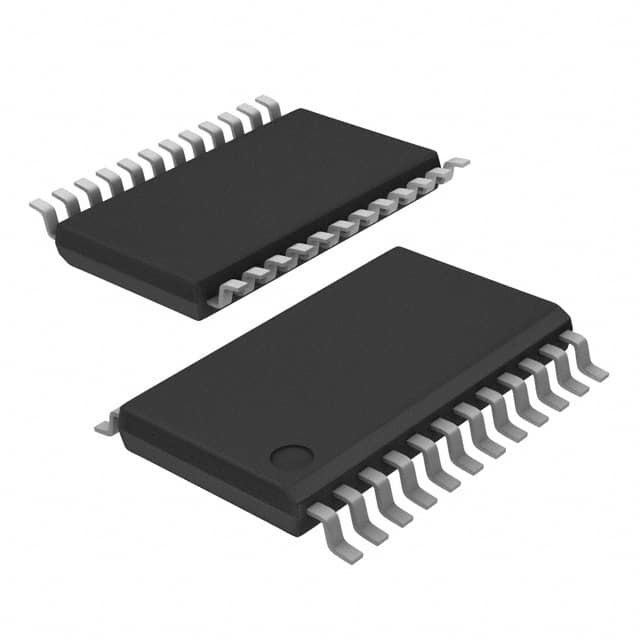
- Part No.:
- STP16DP05TTR
- Manufacturer:
- STMicroelectronics
- Category:
- LED Drivers
- Package:
- 24-TSSOP (0.173", 4.40mm Width)
- Datasheet:
-
 STP16DP05TTR.pdf
- Description:
- IC LED DRVR LINEAR 100MA 24TSSOP
- Quantity:
- Payment:

- Shipping:

Inventory:6,910
Please send an inquiry. Send us your inquiry, and we will respond immediately.
Product details
Overview
STP16DP05TTR from STMicroelectronics is a 16-bit constant-current LED sink driver IC designed for serially controlled LED panel displays. It delivers precise 5–100 mA per channel via external REXT, integrates open/short LED fault detection on all 16 outputs, and operates from 3.0–5.5 V supply with 30 MHz clock support. Its TSSOP24 exposed-pad package enables thermal management in high-density signage and industrial HMI applications.
For engineers reviewing the STP16DP05TTR datasheet, STP16DP05TTR pinout, STP16DP05TTR application, or STP16DP05TTR equivalent, key selection criteria include output current adjustability (via REXT), dual-mode pin functionality (DM1/DM2 for latch/detection), error detection reporting via SDO, and compatibility with 3.3 V microcontrollers without level shifting.
Technical Context
The STP16DP05TTR implements a 16-bit serial-in/parallel-out shift register feeding a D-type storage register, driving sixteen matched current-regulated sinks. Its detection mode uses time-multiplexed logic on LE/DM1 and OE/DM2 pins to identify open, short-to-GND, or short-to-VO faults without additional pins.
Output current accuracy is ±1.5% between channels and ±5% across devices at 20–100 mA; dropout voltage remains ≤20 V, enabling up to 6–7 white LEDs in series per channel. Thermal resistance is 37.5 °C/W when the exposed pad is soldered to PCB ground plane.
Key Specifications
| Parameter | Value and Actual Design Meaning |
|---|---|
| Output channels | 16 independent constant-current sinks, each programmable 5–100 mA via REXT |
| Supply voltage | 3.0–5.5 V - supports direct interface with 3.3 V and 5 V microcontrollers |
| Max clock frequency | 30 MHz - enables fast refresh rates for dynamic LED displays |
| Fault detection | Per-channel open, short-to-GND, and short-to-VO detection reported serially via SDO |
| Current accuracy | ±1.5% between outputs, ±5% across devices - ensures uniform LED brightness |
| Thermal resistance | 37.5 °C/W (junction-to-ambient, TSSOP24 exposed pad) - requires PCB thermal pad for rated performance |
| ESD protection | 2.5 kV HBM, 200 V MM - meets industrial handling requirements |
Pinout & Package
STP16DP05TTR is housed in a 24-pin TSSOP package with exposed thermal pad (ECOPACK® compliant). The exposed pad must be electrically connected to PCB ground for optimal thermal performance and reliability.
| Pin/Terminal | Circuit Role | Design Meaning |
|---|---|---|
| 1 GND | Ground reference | Common return for power and logic; connects to exposed pad |
| 2 SDI | Serial data input | Accepts 3.3 V–compatible CMOS-level data stream for shift register loading |
| 3 CLK | Master clock input | Edge-triggered clock up to 30 MHz; controls data shift timing |
| 4 LE/DM1 | Latch enable / Detection Mode 1 | Level-sensitive control: high = load shift register to outputs; dual-function entry trigger for fault detection |
| 5–20 OUT0–OUT15 | Constant-current sink outputs | Each drives LED cathodes with regulated current; supports 20 V max output swing |
| 21 OE/DM2 | Output enable / Detection Mode 2 | Active-low output control; dual-function entry/exit trigger for fault detection sequence |
| 22 SDO | Serial data output | Shifts out fault status bits (16-bit) during detection mode; compatible with daisy-chain topology |
| 23 R-EXT | Current-setting resistor input | Connects external resistor to set full-scale output current (e.g., 970 Ω → 20 mA) |
| 24 VDD | Positive supply | 3.0–5.5 V input; powers logic and output stages; decoupling required near pin |
Key Features
| Feature | Design Value |
|---|---|
| Adjustable output current | Set precisely from 5–100 mA per channel using single external resistor - eliminates per-channel trimming |
| Integrated fault detection | Detects open, short-to-GND, and short-to-VO on all 16 outputs without extra components or pins |
| Backward compatibility | Pin- and function-compatible with STP16C/L596 - enables drop-in upgrade in legacy LED display designs |
| High-speed serial interface | 30 MHz clock tolerance supports >2.4 Mbps data throughput - suitable for high-refresh-rate signage |
| Thermally enhanced packaging | TSSOP24 with exposed pad reduces thermal resistance by 2.5× vs standard TSSOP - sustains full 100 mA/channel operation |
Applications
| LED Video Wall Modules | Industrial HMI Displays |
|---|---|
|
Use Scenario: High-density indoor LED video walls requiring uniform brightness and real-time fault monitoring across thousands of LEDs. IC Role / Device Role / Timing Role: Sink driver controlling individual LED pixels; serial cascade configuration enables compact controller-to-panel wiring. Use Value: ±1.5% channel-to-channel current matching ensures pixel-level luminance consistency; open/short detection prevents localized black spots or overcurrent damage. |
Use Scenario: Factory-floor operator panels with segmented LED indicators, status lights, and warning arrays operating in wide temperature ranges. IC Role / Device Role / Timing Role: Constant-current sink for discrete indicator LEDs; OE/DM2 pin enables software-initiated self-test during boot-up or maintenance cycles. Use Value: -40°C to +125°C operating range and integrated thermal shutdown protect against ambient heat buildup; detection mode verifies LED integrity before system activation. |
| Automotive Dashboard Lighting | Architectural LED Strips |
|
Use Scenario: Instrument cluster backlighting and customizable ambient lighting where ESD robustness and supply flexibility are critical. IC Role / Device Role / Timing Role: Low-voltage (3.3 V) LED driver interfacing directly with automotive MCU GPIOs; R-EXT allows dimming calibration per vehicle variant. Use Value: 2.5 kV HBM ESD rating withstands assembly handling; 3.0–5.5 V supply range accommodates battery voltage fluctuations without external regulators. |
Use Scenario: Long-run architectural LED strips used in retail and hospitality environments requiring reliable fault isolation and thermal resilience. IC Role / Device Role / Timing Role: Distributed current sink for multi-segment strip control; exposed pad mounting dissipates heat across aluminum extrusion substrates. Use Value: 20 V output capability supports 6–7-series white LEDs per channel; detection mode identifies failed segments remotely via SDO feedback to central controller. |
Equivalent & Alternatives
The following parts are listed as comparable options for similar LED sink driver applications.
| Alternative Part | Technical Difference | Application Difference | Selection Advice |
|---|---|---|---|
| TLC59283RTJR | 16-bit sink driver with 3–20 mA fixed-range current; no open/short detection; 25 MHz max clock | Lacks fault reporting; suited for cost-sensitive static signage where diagnostics are handled externally | Select when detection is unnecessary and BOM cost reduction outweighs diagnostic capability |
| MAX7219CWG+ | 8-bit driver with internal current regulation; includes SPI interface, scan control, and brightness DAC; no per-output fault detection | Integrated display controller simplifies firmware but limits per-channel current tuning and fault granularity | Select for matrix-based alphanumeric displays needing built-in decoding, not discrete LED string control |
Compared with TLC59283RTJR and MAX7219CWG+, the STP16DP05TTR uniquely combines per-output fault detection, wide 5–100 mA current adjustability, and 30 MHz serial throughput - making it optimal for high-reliability, serviceable LED systems where failure localization and brightness precision are design-critical.
Availability
STP16DP05TTR is available at Aetrix Electronics and suitable for LED video walls, industrial HMIs, automotive dashboard lighting, and architectural LED strips requiring stable component supply, long-term lifecycle support, and RoHS-compliant packaging.
Supply support for STP16DP05TTR includes scheduled delivery planning, volume procurement assistance, BOM continuity management, traceable sourcing, and lifecycle availability coordination for OEM customers, industrial embedded developers, connected-device designers, and electronics production programs.
Manufacturer
STMicroelectronics is a global semiconductor leader headquartered in Geneva, Switzerland, specializing in power management, analog, MEMS, and microcontroller technologies for industrial, automotive, and consumer markets.
The STP16DP05TTR belongs to ST's LED driver portfolio, engineered specifically for high-channel-count, fault-aware LED display systems demanding precision current regulation and embedded diagnostics in space-constrained packages.
FAQ
What is the minimum supply voltage required for STP16DP05TTR to operate at full 100 mA output current?
The STP16DP05TTR requires a minimum VDD of 3.0 V for logic operation, but achieving 100 mA per channel demands sufficient headroom between VDD and the LED string forward voltage plus dropout. At 100 mA, typical dropout is ~1.3 V (per Figure 12), so VDD must exceed the sum of LED VF + 1.3 V. For a 3.2 V white LED, VDD ≥ 4.5 V is recommended to sustain full current across temperature and process variation.
How does the STP16DP05TTR report open-circuit faults during detection mode?
During detection mode, the device drives each output with test current and samples voltage/current response. An open circuit is flagged when detected current IODEC falls below 50% of the programmed output current (IO). This result bit is loaded into the shift register and shifted out via SDO - a '0' on SDO indicates open, '1' indicates no fault, matching the 16-bit data order of OUT0 to OUT15.
Can STP16DP05TTR be used in parallel to drive higher-current LEDs?
No - the STP16DP05TTR is not designed for paralleling outputs. Each channel is a dedicated current sink with independent regulation; paralleling would cause mismatched current sharing due to ±1.5% channel-to-channel tolerance and thermal drift. For higher per-LED current, use external MOSFETs driven by STP16DP05TTR's logic-level outputs, or select a driver with higher per-channel rating like STP16CP05.
Is the exposed thermal pad on the TSSOP24 package electrically connected internally?
Yes - the exposed pad on the STP16DP05TTR's TSSOP24 package is internally connected to GND. ST's datasheet explicitly states it must be "electrically connected to a metal land electrically isolated or connected to ground." Soldering it to a PCB ground plane provides both thermal conduction and electrical grounding, reducing thermal resistance to 37.5 °C/W and improving noise immunity.
STP16DP05TTR Specifications
- Product attributes
- Attribute value
- Manufacturer:
- STMicroelectronics
- Series:
- -
- Package/Case:
- 24-TSSOP (0.173", 4.40mm Width)
- Packaging:
- Tape & Reel (TR)
- Product Status:
- Active
- Type:
- Linear
- Topology:
- Shift Register
- Internal Switch(s):
- Yes
- Number of Outputs:
- 16
- Voltage - Supply (Min):
- 3V
- Voltage - Supply (Max):
- 5.5V
- Voltage - Output:
- 20V
- Current - Output / Channel:
- 100mA
- Frequency:
- 30MHz
- Dimming:
- -
- Applications:
- -
- Operating Temperature:
- -40°C ~ 125°C (TA)
- Grade:
- -
- Qualification:
- -
- Mounting Type:
- Surface Mount
- Supplier Device Package:
- 24-TSSOP
STP16DP05TTR FAQ
1.How can I place an order for STP16DP05TTR through Aetrix?
Please submit a Request for Quotation (RFQ) for STP16DP05TTR on Aetrix. Our sales agent will provide a competitive quotation and guide you through the order confirmation once you accept the terms.
2.Are the price and stock information for STP16DP05TTR reliable?
The price and inventory of STP16DP05TTR are updated periodically and may fluctuate due to market conditions. Stock and pricing data are typically refreshed every 24 hours. Quotation validity for STP16DP05TTR is usually 5 days.
3.What payment methods are accepted for STP16DP05TTR?
We accept Wire Transfer, PayPal, Credit Card, Western Union, MoneyGram, and Escrow for STP16DP05TTR transactions.
Note: Certain payment methods may incur a processing fee.
4.How is shipping managed for STP16DP05TTR?
STP16DP05TTR orders can be shipped via leading logistics carriers, including DHL, UPS, FedEx, TNT, or Registered Mail.
Once your STP16DP05TTR order is processed, you will receive an email with the shipment details and tracking number.
Note: Tracking information may take up to 24 hours to appear. Express delivery typically takes 3–5 business days.
5.How can I obtain technical support or documentation for STP16DP05TTR?
For technical support, including STP16DP05TTR datasheets, pinout diagrams, or application guidance, please contact our engineering support team. They can provide detailed documentation and assistance for your STP16DP05TTR requirements.
6.How does Aetrix verify that STP16DP05TTR is sourced from the original manufacturer or authorized distributors?
All STP16DP05TTR products on Aetrix are procured from qualified distributors and authorized channels. Our dedicated quality assurance team conducts strict verification, including traceability checks and, if necessary, third-party testing. This ensures that STP16DP05TTR meets industry standards.
7.What is the process for return or replacement of STP16DP05TTR?
All STP16DP05TTR units undergo pre-shipment inspection (PSI). If there is an issue with STP16DP05TTR, returns or replacements are accepted under the following conditions:
1.Quantity discrepancies, incorrect items, or visible external defects (such as breakage or corrosion), acknowledged by Aetrix.
2.The issue is reported within 90 days of delivery.
3.The STP16DP05TTR part is unused and in its original packaging.
Return procedure for STP16DP05TTR:
1.Submit a request within 90 days.
2.Obtain a Return Material Authorization (RMA) from Aetrix.
STP16DP05TTR Tags
-
BCR402RE6327HTSA1
Infineon Technologies

-
BCR430UXTSA2
Infineon Technologies
-
BCR420UE6433HTMA1
Infineon Technologies
-
BCR420UE6327HTSA1
Infineon Technologies
-
BCR421UE6327HTSA1
Infineon Technologies
-
LYT1604D-TL
Power Integrations

-
HV9910CLG-G
Microchip Technology
-
CL2N8-G
Microchip Technology
-
BCR420UW6-7
Diodes Incorporated
-
BCR421UW6-7
Diodes Incorporated
-
BCR420UFD-7
Diodes Incorporated
-
BCR421UFD-7
Diodes Incorporated
Tech Hub

A practical engineering and sourcing framework covering lifecycle verification, lifetime-buy calculations, replacement qualification, supplier checks and counterfeit-risk controls.

TTL and CMOS logic families differ in thresholds, loading, output drive, power and timing. This engineering guide compares 74HC and 74HCT, calculates noise margins and checks 3.3 V/5 V compatibility.

A practical engineering guide to 3.3V and 5V logic compatibility, input thresholds, resistor dividers, translator ICs, MOSFET level shifting, I2C pull-ups, timing limits and power-sequencing risks.

The 74HC595 uses push-pull logic outputs, while the TPIC6B595 uses 50 V open-drain DMOS sinks for higher-power loads. This guide compares timing, current limits, 3.3 V interfacing, load wiring, thermal…

The 74HC595 converts serial data into eight stable parallel outputs. This guide covers pin functions, shift and storage timing, OE and MR behavior, drive-current limits, cascading, voltage compatibilit…

A technical comparison of level-sensitive latches and edge-triggered flip-flops, covering timing windows, setup and hold limits, master–slave operation, time borrowing, race-through, HDL inference and…

A D latch stores one bit while Enable controls when data can pass. This reference covers gate-level operation, truth tables, transparency, setup and hold timing, LE versus OE, common ICs and practical …

An SR latch stores one bit through cross-coupled feedback. This engineering reference covers NOR and NAND implementations, truth tables, forbidden-state recovery, gated operation, switch debouncing, fa…

Latch circuits retain one bit through feedback. This technical reference covers SR and D latches, truth tables, transparency, timing limits, latch-versus-flip-flop behavior, applications and common log…

An engineering guide to LED driver operation, constant-current and constant-voltage outputs, linear and switching topologies, dimming, IC selection, calculations, replacement compatibility, and fault c…


