
 My Inquiry
 My Account


Microchip Technology SY87700ALHG-TR
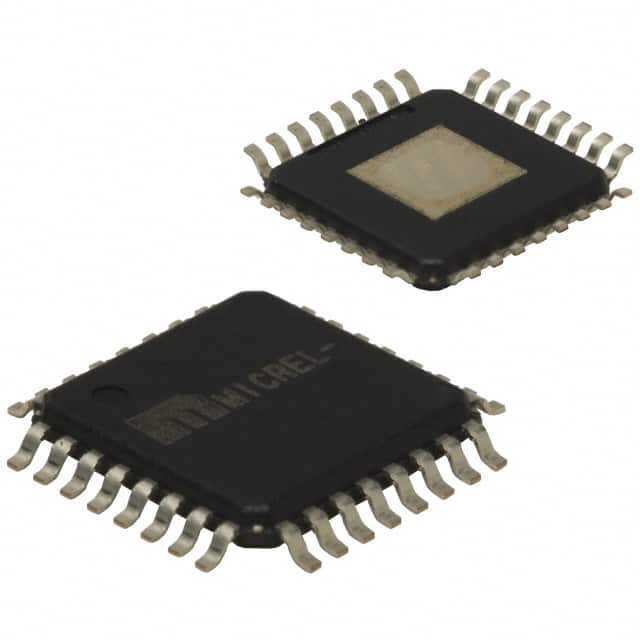
- Part No.:
- SY87700ALHG-TR
- Manufacturer:
- Microchip Technology
- Category:
- Application Specific Clock/Timing
- Package:
- 32-TQFP Exposed Pad
- Datasheet:
-
 SY87700ALHG-TR.pdf
- Description:
- IC CLK DATA REC SDH 208MBPS
- Quantity:
- Payment:

- Shipping:

Inventory:535
Please send an inquiry. Send us your inquiry, and we will respond immediately.
Product details
Overview
SY87700ALHG-TR from Micrel is a low-power, 3.3V AnyRate® clock and data recovery (CDR) IC supporting NRZ data rates from 32Mbps to 208Mbps. It performs full clock recovery and data retiming via dual on-chip PLLs-one for clock generation and one for clock recovery-and includes link fault detection. It is designed for SONET/SDH/ATM OC-1/OC-3 systems requiring precise jitter-tolerant timing alignment.
For engineers reviewing the SY87700ALHG-TR datasheet, SY87700ALHG-TR pinout, SY87700ALHG-TR application, or SY87700ALHG-TR equivalent, key selection criteria include its differential PECL I/O interface, industrial temperature range (–40°C to +85°C), dual-loop PLL architecture, 30% lower power versus SY87700V, and Pb-free 32-pin EPAD-TQFP (H32-1) packaging.
Technical Context
The SY87700ALHG-TR implements two independent PLLs: a receiver PLL synchronizes its VCO directly to incoming NRZ data (32–208Mbps), while a frequency-synthesis PLL generates output clocks using REFCLK as reference. Frequency selection is controlled by three TTL FREQSEL inputs, enabling eight discrete VCO center frequency ranges (e.g., 125–208MHz at 6× multiplication).
It supports differential PECL (ECL 100k) serial I/O with built-in line receivers, eliminating external buffering. Link fault detection monitors RDIN integrity and forces LFIN HIGH only when CD is HIGH and recovered clock deviation remains within ±1000ppm of REFCLK-derived frequency-ensuring robust lock status indication under signal loss or drift.
Key Specifications
| Parameter | Value and Actual Design Meaning |
|---|---|
| Data Rate Range | 32Mbps to 208Mbps NRZ - supports OC-1 (51.84Mbps) and OC-3 (155.52Mbps) SONET line rates. |
| Supply Voltage | 3.15V to 3.45V - single 3.3V rail with tight tolerance ensures stable PLL operation across industrial temp range. |
| Power Consumption | 120mA to 160mA - 30% lower than SY87700V, reducing thermal load in dense telecom line cards. |
| VCO Center Frequency | 750MHz to 1250MHz - programmable via FREQSEL pins and REFCLK × byte-rate multiplication. |
| Acquisition Lock Time | 15µs - enables rapid re-lock after transient signal interruptions in burst-mode links. |
| Output Skew | ±200ps - guarantees tight timing alignment between RCLK/TCLK and RDOUT for eye-center sampling. |
| Operating Temperature | –40°C to +85°C - qualified for industrial-grade telecom infrastructure deployment. |
Pinout & Package
SY87700ALHG-TR is packaged in a 32-pin EPAD-TQFP (H32-1) with exposed thermal pad soldered to PCB ground for enhanced thermal dissipation (θJA = 20.7°C/W at 500lfpm airflow). Pin functions are validated per Micrel's August 2009 datasheet (M9999-082009-D).
| Pin/Terminal | Circuit Role | Design Meaning |
|---|---|---|
| RDINP / RDINN | Differential serial data input | PECL inputs accept raw NRZ stream; internal line receiver eliminates need for external amplification or level-shifting. |
| REFCLK | TTL reference clock input | Provides training frequency for receiver PLL during loss-of-signal; determines VCO center frequency via divide ratio. |
| CD | Carrier detect control | Enables/disables CDR function: HIGH enables normal recovery; LOW forces RDOUT/LFIN LOW and locks PLL to REFCLK. |
| FREQSEL1–3 | TTL frequency select inputs | Select one of eight VCO frequency bands (e.g., 125–208Mbps at 6×); define operating range without external components. |
| CLKSEL | TTL clock source selector | Chooses between recovered clock (RCLK) or synthesized clock (TCLK) on differential outputs - critical for loopback or test modes. |
| LFIN | TTL link fault indicator | Asynchronous active-HIGH output signals PLL lock status; asserts only when RDIN is within ±1000ppm of expected rate. |
| RCLKP/RCLKN | Differential recovered clock output | ECL 100k outputs aligned to data eye center; used to sample RDOUT with minimal setup/hold violation risk. |
| RDOUTP/RDOUTN | Differential recovered data output | Retimed NRZ data synchronized to RCLK rising edge; meets SONET jitter compliance requirements. |
| PLLRP/PLLRN | Receiver PLL loop filter | External RC network (e.g., 350Ω + 1.0µF X7R) sets PLL bandwidth for optimal jitter tracking and transition density tolerance. |
| VCC / VCCA / VCCO | Power supply terminals | All three supplies must be tied to same 3.3V rail; separate analog/digital domains reduce noise coupling into sensitive PLL circuitry. |
Key Features
| Feature | Design Value |
|---|---|
| Dual independent PLL architecture | Separate clock recovery and clock synthesis loops prevent interference and enable flexible clock sourcing for transmit/receive paths. |
| Integrated PECL line receiver | Eliminates need for external high-speed buffer ICs, reducing BOM count and board area in 3.3V telecom designs. |
| Link fault detection with automatic REFCLK fallback | Ensures continuous clock output even during signal loss, maintaining system timing stability without software intervention. |
| Programmable frequency selection (8 ranges) | Allows single hardware design to support multiple data rates (e.g., OC-1 and OC-3) via simple strap options - no firmware update required. |
| Pb-free 32-pin EPAD-TQFP package | Thermally enhanced footprint with exposed pad improves heat transfer; recommended over SOIC for new designs per Micrel guidance. |
Applications
| SONET OC-1/OC-3 Line Interface | Fast Ethernet Physical Layer |
|---|---|
Use Scenario: Recovering embedded clock and retiming data from optical line cards operating at 51.84Mbps or 155.52Mbps. IC Role / Device Role / Timing Role: Clock and data recovery (CDR) IC performing phase-aligned sampling of NRZ data using dual-loop PLL architecture. Use Value: Meets GR-253 SONET jitter transfer and jitter tolerance specs with <15µs lock time and ±200ps clock skew. |
Use Scenario: Retiming 100BASE-FX fiber signals in enterprise switches or media converters. IC Role / Device Role / Timing Role: High-speed serial retimer converting unclocked fiber data into synchronous parallel-ready streams. Use Value: Supports 125MHz clock generation (100Mbps data rate) with ECL 100k outputs compatible with standard LVPECL receivers. |
| SMPTE 259M Video Transport | Proprietary High-Speed Serial Links |
Use Scenario: Recovering timing from uncompressed SD-SDI video streams at 270Mbps (within extended 208Mbps spec with margin). IC Role / Device Role / Timing Role: CDR providing jitter-clean clock for video serializer/deserializer clock domain crossing. Use Value: Maintains <±1000ppm frequency lock tolerance and 45–55% duty cycle output - critical for pixel-clock accuracy in broadcast gear. |
Use Scenario: Interfacing custom ASICs or FPGAs requiring deterministic clock/data alignment up to 208Mbps. IC Role / Device Role / Timing Role: Standalone retiming engine decoupling transmitter and receiver clock domains in proprietary backplane links. Use Value: Enables plug-and-play integration via TTL-configurable FREQSEL/CLKSEL pins and differential PECL I/O without external level translators. |
Equivalent & Alternatives
The following parts are listed as comparable options for similar clock and data recovery applications.
| Alternative Part | Technical Difference | Application Difference | Selection Advice |
|---|---|---|---|
| SY87701AL | Supports wider data rate range (28–1300Mbps); higher VCO frequencies (up to 2.6GHz); requires different loop filter tuning. | Targeted at OC-12/OC-48 and Gigabit Ethernet; not drop-in compatible due to extended frequency range and pinout differences. | Select SY87701AL only when >208Mbps operation is required; SY87700ALHG-TR remains optimal for OC-3 and sub-200Mbps legacy systems. |
| ICS87200AMLF | Single PLL architecture; supports 10–1000Mbps; uses LVDS I/O instead of PECL; lacks integrated line receiver. | Designed for general-purpose CDR in industrial automation; requires external AC-coupling and level-shifting for PECL interfaces. | Choose ICS87200AMLF for cost-sensitive, multi-protocol designs where external buffering is acceptable; SY87700ALHG-TR delivers superior integration for telecom-specific PECL environments. |
Compared with SY87701AL and ICS87200AMLF, the SY87700ALHG-TR provides optimized balance of integration (built-in PECL receiver), power efficiency (30% lower than SY87700V), and SONET-specific jitter performance - making it the preferred choice for OC-1/OC-3 line interface cards where reliability and minimal external components are critical.
Availability
SY87700ALHG-TR is available at Aetrix Electronics and suitable for SONET/SDH line interface cards, Fast Ethernet media converters, SMPTE 259M video transport systems, and proprietary high-speed serial links requiring stable component supply and long-term lifecycle support.
Supply support for SY87700ALHG-TR includes scheduled delivery planning, volume procurement assistance, BOM continuity management, traceable sourcing, and lifecycle availability coordination for OEM customers, industrial embedded developers, connected-device designers, and electronics production programs.
Manufacturer
Micrel, Inc. was a U.S.-based semiconductor company specializing in high-performance analog, RF, and timing solutions before its acquisition by Microchip Technology in 2015. Its timing products emphasized low-jitter, high-integration CDR and clock generation for telecom infrastructure.
The SY87700ALHG-TR belongs to Micrel's AnyRate® CDR product line, engineered specifically for SONET/SDH/ATM systems requiring flexible, low-power clock recovery across multiple data rates without changing hardware or layout.
FAQ
What is the maximum supported data rate for SY87700ALHG-TR?
The SY87700ALHG-TR supports NRZ data rates from 32Mbps up to 208Mbps. This range covers SONET OC-1 (51.84Mbps) and OC-3 (155.52Mbps) standards, with margin for implementation tolerances. The upper limit is defined by VCO center frequency (750–1250MHz) and loop filter bandwidth constraints documented in the August 2009 datasheet.
Does SY87700ALHG-TR require external loop filter components?
Yes, SY87700ALHG-TR requires external passive components on PLLRP/PLLRN (receiver PLL) and PLLSP/PLLSN (synthesis PLL) pins. Recommended values include 350Ω + 1.0µF (X7R) for the receiver loop and 680Ω + 1.0µF for the synthesizer loop. These set PLL bandwidth and jitter transfer characteristics per application requirements.
Is SY87700ALHG-TR pin-compatible with SY87700ALZG?
No, SY87700ALHG-TR (32-pin EPAD-TQFP, H32-1) is not pin-compatible with SY87700ALZG (28-pin SOIC, Z28-1). Pin counts, layouts, and thermal pad configuration differ significantly. Micrel explicitly states the 28-pin SOIC is "NOT recommended for new designs," confirming H32-1 as the intended platform for SY87700ALHG-TR.
What does the CD (Carrier Detect) pin do on SY87700ALHG-TR?
The CD pin on SY87700ALHG-TR controls receiver PLL operation: when HIGH, SY87700ALHG-TR performs normal clock recovery from RDIN; when LOW, it forces RDOUT and LFIN LOW and locks the receiver PLL to REFCLK. This enables graceful degradation during signal loss and supports carrier-sense protocols in optical modules.
Can SY87700ALHG-TR generate clocks independently of incoming data?
Yes, SY87700ALHG-TR can generate clocks independently using its frequency-synthesis PLL referenced to REFCLK. When CD is LOW or RDIN is absent, the receiver PLL falls back to REFCLK, and TCLK outputs reflect the synthesized frequency (determined by DIVSEL1/DIVSEL2 and REFCLK). This maintains clock continuity in loss-of-signal conditions.
SY87700ALHG-TR Specifications
- Product attributes
- Attribute value
- Manufacturer:
- Microchip Technology
- Series:
- AnyRate®
- Package/Case:
- 32-TQFP Exposed Pad
- Packaging:
- Tape & Reel (TR)
- Product Status:
- Active
- Programmable:
- Not Verified
- PLL:
- Yes
- Main Purpose:
- Ethernet, SONET/SDH, ATM applications
- Input:
- PECL, TTL
- Output:
- PECL
- Number of Circuits:
- 1
- Ratio - Input:Output:
- 3:3
- Differential - Input:Output:
- Yes/Yes
- Frequency - Max:
- 208Mbps
- Voltage - Supply:
- 3.15V ~ 3.45V
- Operating Temperature:
- -40°C ~ 85°C
- Mounting Type:
- Surface Mount
- Grade:
- -
- Qualification:
- -
- Supplier Device Package:
- 32-TQFP-EP (7x7)
SY87700ALHG-TR FAQ
1.How can I place an order for SY87700ALHG-TR through Aetrix?
Please submit a Request for Quotation (RFQ) for SY87700ALHG-TR on Aetrix. Our sales agent will provide a competitive quotation and guide you through the order confirmation once you accept the terms.
2.Are the price and stock information for SY87700ALHG-TR reliable?
The price and inventory of SY87700ALHG-TR are updated periodically and may fluctuate due to market conditions. Stock and pricing data are typically refreshed every 24 hours. Quotation validity for SY87700ALHG-TR is usually 5 days.
3.What payment methods are accepted for SY87700ALHG-TR?
We accept Wire Transfer, PayPal, Credit Card, Western Union, MoneyGram, and Escrow for SY87700ALHG-TR transactions.
Note: Certain payment methods may incur a processing fee.
4.How is shipping managed for SY87700ALHG-TR?
SY87700ALHG-TR orders can be shipped via leading logistics carriers, including DHL, UPS, FedEx, TNT, or Registered Mail.
Once your SY87700ALHG-TR order is processed, you will receive an email with the shipment details and tracking number.
Note: Tracking information may take up to 24 hours to appear. Express delivery typically takes 3–5 business days.
5.How can I obtain technical support or documentation for SY87700ALHG-TR?
For technical support, including SY87700ALHG-TR datasheets, pinout diagrams, or application guidance, please contact our engineering support team. They can provide detailed documentation and assistance for your SY87700ALHG-TR requirements.
6.How does Aetrix verify that SY87700ALHG-TR is sourced from the original manufacturer or authorized distributors?
All SY87700ALHG-TR products on Aetrix are procured from qualified distributors and authorized channels. Our dedicated quality assurance team conducts strict verification, including traceability checks and, if necessary, third-party testing. This ensures that SY87700ALHG-TR meets industry standards.
7.What is the process for return or replacement of SY87700ALHG-TR?
All SY87700ALHG-TR units undergo pre-shipment inspection (PSI). If there is an issue with SY87700ALHG-TR, returns or replacements are accepted under the following conditions:
1.Quantity discrepancies, incorrect items, or visible external defects (such as breakage or corrosion), acknowledged by Aetrix.
2.The issue is reported within 90 days of delivery.
3.The SY87700ALHG-TR part is unused and in its original packaging.
Return procedure for SY87700ALHG-TR:
1.Submit a request within 90 days.
2.Obtain a Return Material Authorization (RMA) from Aetrix.
SY87700ALHG-TR Tags
-
LMK00334RTVRQ1
Texas Instruments
.jpg)
-
DSC557-0344FI0T
Microchip Technology
-
9FGV0241AKILFT
Renesas

-
9DBL0452CKILFT
Renesas
-
DSC557-0344FL1T
Microchip Technology
-
RC19008AGND#KB0
Renesas
-
RC19008AGND#BB0
Renesas
-
9DB403DGILFT
Renesas
-
9DB233AGILFT
Renesas
-
9DB803DGILFT
Renesas
-
9FGL0851DKILFT
Renesas
-
AB-557-03-HCHC-F-L-C-T
Abracon LLC
Tech Hub

TTL and CMOS logic families differ in thresholds, loading, output drive, power and timing. This engineering guide compares 74HC and 74HCT, calculates noise margins and checks 3.3 V/5 V compatibility.

A practical engineering guide to 3.3V and 5V logic compatibility, input thresholds, resistor dividers, translator ICs, MOSFET level shifting, I2C pull-ups, timing limits and power-sequencing risks.

The 74HC595 uses push-pull logic outputs, while the TPIC6B595 uses 50 V open-drain DMOS sinks for higher-power loads. This guide compares timing, current limits, 3.3 V interfacing, load wiring, thermal…

The 74HC595 converts serial data into eight stable parallel outputs. This guide covers pin functions, shift and storage timing, OE and MR behavior, drive-current limits, cascading, voltage compatibilit…

A technical comparison of level-sensitive latches and edge-triggered flip-flops, covering timing windows, setup and hold limits, master–slave operation, time borrowing, race-through, HDL inference and…

A D latch stores one bit while Enable controls when data can pass. This reference covers gate-level operation, truth tables, transparency, setup and hold timing, LE versus OE, common ICs and practical …

An SR latch stores one bit through cross-coupled feedback. This engineering reference covers NOR and NAND implementations, truth tables, forbidden-state recovery, gated operation, switch debouncing, fa…

Latch circuits retain one bit through feedback. This technical reference covers SR and D latches, truth tables, transparency, timing limits, latch-versus-flip-flop behavior, applications and common log…

An engineering guide to LED driver operation, constant-current and constant-voltage outputs, linear and switching topologies, dimming, IC selection, calculations, replacement compatibility, and fault c…

Operational amplifier guide covering op amp basics, feedback, ideal vs real op amps, common configurations, buffer circuits, offset, bias current, gain-bandwidth, slew rate, rail-to-rail limits and sel…


