
 My Inquiry
 My Account


Toshiba Semiconductor and Storage TB62215AHQ,8
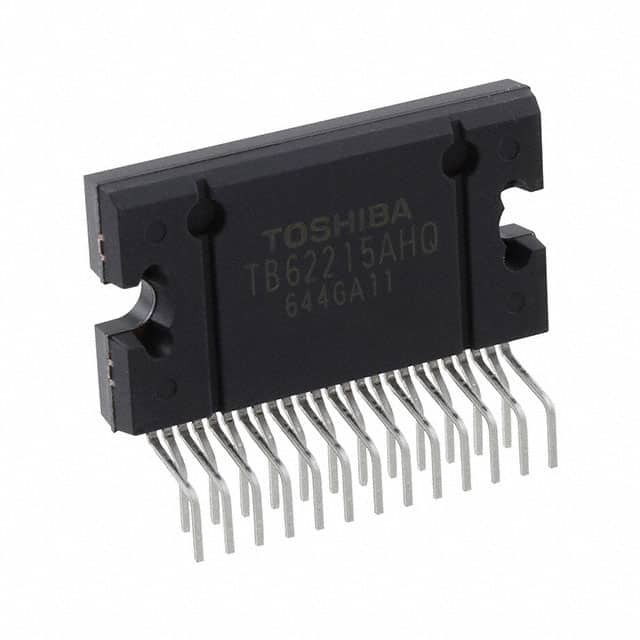
- Part No.:
- TB62215AHQ,8
- Manufacturer:
- Toshiba Semiconductor and Storage
- Category:
- Motor Drivers, Controllers
- Package:
- 25-SIP Formed Leads
- Datasheet:
-
 TB62215AHQ,8.pdf
- Description:
- IC MOTOR DRIVER BIPLR 25V 25HZIP
- Quantity:
- Payment:

- Shipping:

Inventory:1,332
Please send an inquiry. Send us your inquiry, and we will respond immediately.
Product details
Overview
TB62215AHQ from Toshiba is a clock-in controlled, two-phase bipolar stepping motor driver IC fabricated in BiCD process, delivering 40 V/3.0 A output capability with PWM chopper current control, full/half/quarter-step resolution, and integrated thermal shutdown (TSD), over-current shutdown (ISD), and power-on reset (POR) protection - used in precision motion control for industrial automation actuators, optical positioning stages, and medical infusion pump drives.
For engineers reviewing the TB62215AHQ datasheet, TB62215AHQ pinout, TB62215AHQ application, or TB62215AHQ equivalent, this page delivers verified technical context, HZIP25 package-specific pin functions, real-world step resolution behavior, current-sense resistor design implications, and validated alternative options for motor driver selection in thermally demanding embedded motion systems.
Technical Context
The TB62215AHQ implements a dedicated clock-input decoder with built-in oscillator (OSCM) for chopping frequency tuning via external RC network (fOSCM = 0.64–2.4 MHz, fchop = fOSCM/16), enabling precise current regulation across full/half/quarter-step modes. Its dual-channel predriver supports mixed-decay mode operation with charge/slow/fast timing states.
It integrates a 5.0 V internal VCC regulator, low on-resistance output stage (Ron(H+L) = 0.6 Ω typ.), and analog current sensing via RSA/RSB pins with VREF input (0–3.6 V) to set peak motor current (IOUT(max) = VREF × gain / RS, gain = 1/5.0 typ.). Thermal shutdown triggers at Tj = 140–170 °C; over-current detection activates at IOUT ≥ 3.0–5.0 A.
Key Specifications
| Parameter | Value and Actual Design Meaning |
|---|---|
| Output Voltage Rating | 40 V max - supports 24 V nominal motor supplies with margin for back-EMF spikes in inductive loads. |
| Continuous Output Current | 3.0 A max - absolute rating; derated to ≤2.1 A typical under 85°C ambient with HZIP25 thermal design. |
| Step Resolution Modes | Full / Half / Quarter - selected via DMODE1/DMODE2 logic inputs; quarter-step enables 4× microstepping granularity. |
| Chopping Frequency Range | 40–150 kHz - adjustable via OSCM pin; 100 kHz typical (fOSCM = 1.6 MHz) balances ripple reduction and gate loss. |
| Current Sense Accuracy | ±5% - ensures repeatable torque output across temperature and unit-to-unit variation when using matched RS resistors. |
| Thermal Shutdown Threshold | 140–170 °C - junction-based protection with hysteresis; recovery requires VM power cycle or DMODE standby entry. |
| Logic Input Compatibility | VIH = 2.0–5.5 V, VIL = 0–0.8 V - compatible with 3.3 V and 5 V microcontrollers without level shifting. |
Pinout & Package
HZIP25-P-1.00F package: 25-pin single-ended through-hole mount with integral heat sink tab (FIN), 7.6 g typical weight, designed for high-power dissipation (PD = 3.2 W at Ta = 25°C). Mount FIN directly to PCB ground plane for optimal thermal performance.
| Pin/Terminal | Circuit Role | Design Meaning |
|---|---|---|
| 1, 3–4, 8, 11, 13, 15, 23 | GND | Seven dedicated ground terminals - must be connected to a common low-impedance ground plane; critical for noise immunity and thermal conduction. |
| 10, 12, 14, 16 | OUTA+, OUTA−, OUTB−, OUTB+ | Four motor phase outputs - drive two-phase bipolar stepper windings; require symmetric trace routing and Kelvin sense layout for current accuracy. |
| 9, 17 | RSA, RSB | Current sense inputs - connect to low-side sense resistors (typ. 0.1–1 Ω); sensitive analog nodes requiring guard traces and local decoupling. |
| 5, 6, 7, 19, 22, 24, 25 | CLK, ENABLE, RESET, VM, VCC, VREF, OSCM | Digital control, power, and configuration pins - CLK accepts up to 100 kHz; VM supports 10–38 V; VREF sets peak current; OSCM sets chopper frequency. |
| 18, 20–21 | NC | No-connect pins - must remain unconnected; no routing or copper under these pads per Toshiba layout guidance. |
Key Features
| Feature | Design Value |
|---|---|
| PWM constant-current drive | Enables stable torque across speed range via real-time current regulation; eliminates current droop in inductive windings. |
| Built-in mixed-decay mode | Automatically blends slow/fast decay during current recirculation - reduces audible noise and improves step accuracy at low speeds. |
| Integrated error protection | TSD, ISD, and POR circuits autonomously disable outputs on fault - prevents latch-up and secondary damage during overload or thermal stress. |
| On-resistance <0.6 Ω (H+L) | Minimizes conduction loss and self-heating - critical for maintaining 3 A capability in HZIP25's 3.2 W thermal envelope. |
| External OSCM tuning | Allows chopper frequency optimization (40–150 kHz) for specific motor inductance and EMI requirements without changing IC. |
Applications
| Industrial CNC Positioning | Medical Infusion Pumps |
|---|---|
|
Use Scenario: Closed-loop linear actuator in multi-axis CNC tool changers requiring sub-micron repeatability and stall detection. IC Role / Device Role / Timing Role: Two-phase bipolar driver executing quarter-step microstepping with MO pin feedback for real-time angle monitoring and stall recovery. Use Value: Enables 4× finer position resolution vs. full-step; integrated ISD detects coil open/short faults before mechanical damage occurs. |
Use Scenario: Precise volumetric dosing in hospital-grade syringe pumps where flow rate stability and safety-critical fault response are mandatory. IC Role / Device Role / Timing Role: Motor controller managing bidirectional syringe plunger movement with ENABLE-controlled coast-to-stop and RESET-synchronized start. Use Value: TSD and POR ensure immediate shutdown on overheating or brownout - preventing overdose or underdose events during power anomalies. |
| Optical Lens Autofocus | Lab Automation Sample Handlers |
|
Use Scenario: High-speed focus adjustment in DSLR and machine vision lenses where acoustic noise and step vibration must be minimized. IC Role / Device Role / Timing Role: Low-noise stepper driver operating in half-step mode with mixed-decay control and 100 kHz chopper frequency. Use Value: Mixed-decay reduces motor winding ringing and audible whine; OSCM tuning allows EMI filtering without sacrificing responsiveness. |
Use Scenario: Robotic arm end-effector moving microtiter plates in high-throughput screening systems with strict duty-cycle and thermal constraints. IC Role / Device Role / Timing Role: Stepper interface receiving clock pulses from FPGA sequencer; CW/CCW and DMODE pins configured for programmable step resolution. Use Value: Full/half/quarter-step flexibility supports both coarse rapid moves and fine positioning - all within one compact HZIP25 footprint. |
Equivalent & Alternatives
The following parts are listed as comparable options for similar bipolar stepping motor driver applications.
| Alternative Part | Technical Difference | Application Difference | Selection Advice |
|---|---|---|---|
| STK672-440 | Higher voltage rating (50 V), but no integrated OSCM tuning or MO angle monitor; uses external oscillator. | Lacks quarter-step resolution and electric angle feedback - suitable only for full/half-step systems without stall detection. | Choose STK672-440 only if 50 V motor supply is required and MO feedback is unnecessary; verify external oscillator stability. |
| DRV8825 | Lower voltage (45 V) and current (2.2 A) ratings; microstepping up to 1/32-step; no integrated TSD/ISD - relies on external thermal management. | Supports finer microstepping but lacks autonomous fault protection - requires host MCU supervision for overtemperature/overcurrent. | Prefer DRV8825 for ultra-fine positioning where thermal headroom is ample and firmware can manage fault responses. |
Compared with STK672-440 and DRV8825, the TB62215AHQ uniquely combines HZIP25's 3.2 W thermal capacity, integrated quarter-step + MO feedback, and autonomous TSD/ISD - making it optimal for industrial motion systems where reliability under sustained load is non-negotiable.
Availability
TB62215AHQ is available at Aetrix Electronics and suitable for industrial CNC positioning, medical infusion pumps, optical autofocus mechanisms, and lab automation sample handlers requiring stable component supply with long-term manufacturability and thermal robustness.
Supply support for TB62215AHQ includes scheduled delivery planning, volume procurement assistance, BOM continuity management, traceable sourcing, and lifecycle availability coordination for OEM customers, industrial embedded developers, connected-device designers, and electronics production programs.
Manufacturer
Toshiba Electronic Devices & Storage Corporation designs high-reliability analog and power ICs for industrial, automotive, and consumer applications, with deep expertise in BiCD process technology and motor control integration.
The TB62215AHQ belongs to Toshiba's bipolar stepper driver product line, engineered specifically for thermally demanding motion control applications where integrated protection, precise current regulation, and package-level heat dissipation are essential design requirements.
FAQ
What is the maximum continuous motor current supported by the TB62215AHQ in its HZIP25 package?
The TB62215AHQ has an absolute maximum output current rating of 3.0 A, but its practical continuous current is thermally limited. In the HZIP25 package (PD = 3.2 W at Ta = 25°C), sustained operation above ~2.1 A requires aggressive heatsinking and airflow. Derating to 1.8 A is recommended for reliable 85°C ambient operation without forced cooling - confirmed by Toshiba's Operation Ranges table and thermal resistance modeling.
How does the OSCM pin configure chopper frequency in the TB62215AHQ?
The OSCM pin sets the internal oscillator frequency (fOSCM) via an external RC network: fOSCM ≈ 1/[0.56 × C × (R + 500)]. With typical values C = 270 pF and R = 3.6 kΩ, fOSCM = 1.6 MHz, yielding a chopper frequency fchop = fOSCM/16 = 100 kHz. This direct RC tuning allows designers to optimize trade-offs between current ripple (lower fchop) and switching loss (higher fchop) for their specific motor inductance.
Can the TB62215AHQ operate in quarter-step mode without external microcontroller intervention?
Yes - the TB62215AHQ implements native quarter-step resolution using only its DMODE1 and DMODE2 logic inputs. When both pins are driven high (H/H), the internal step resolution selector configures the driver for quarter-step operation, generating four electrical steps per full mechanical step. No external sequencing logic or firmware is needed; the CLK input advances position, and CW/CCW selects direction - all fully hardware-managed.
What is the function of the MO (Monitor Output) pin on the TB62215AHQ?
The MO pin on the TB62215AHQ outputs a digital signal synchronized to the motor's electrical angle - high during positive current half-cycles and low during negative ones. It provides real-time rotor position feedback without encoders, enabling stall detection (loss of MO toggling), phase alignment verification, and closed-loop correction in host systems. Its VOH/VOL specs (3.3–5.0 V / 0–0.5 V) ensure compatibility with standard logic interfaces.
Does the TB62215AHQ require external current-sense resistors, and how are they connected?
Yes - the TB62215AHQ requires two external low-value sense resistors (one per phase) connected between the RSA/RSB pins and GND. These resistors (typically 0.1–1 Ω) convert motor current into a voltage sensed by the IC's internal comparators. The peak current is calculated as IOUT(max) = VREF × (1/5.0) / RS; for example, with VREF = 3.0 V and RS = 0.51 Ω, IOUT = 1.18 A. Kelvin connections and ground-plane isolation are mandatory for accuracy.
TB62215AHQ,8 Specifications
- Product attributes
- Attribute value
- Manufacturer:
- Toshiba Semiconductor and Storage
- Series:
- -
- Package/Case:
- 25-SIP Formed Leads
- Packaging:
- Tube
- Product Status:
- Discontinued at Digi-Key
- Motor Type - Stepper:
- Bipolar
- Motor Type - AC, DC:
- -
- Function:
- Driver - Fully Integrated, Control and Power Stage
- Output Configuration:
- Half Bridge (4)
- Interface:
- Parallel
- Technology:
- Power MOSFET
- Step Resolution:
- 1, 1/2, 1/4
- Applications:
- General Purpose
- Current - Output:
- 3A
- Voltage - Supply:
- 4.75V ~ 5.25V
- Voltage - Load:
- 10V ~ 38V
- Operating Temperature:
- -20°C ~ 150°C (TJ)
- Grade:
- -
- Qualification:
- -
- Mounting Type:
- Through Hole
- Supplier Device Package:
- 25-HZIP
TB62215AHQ,8 FAQ
1.How can I place an order for TB62215AHQ,8 through Aetrix?
Please submit a Request for Quotation (RFQ) for TB62215AHQ,8 on Aetrix. Our sales agent will provide a competitive quotation and guide you through the order confirmation once you accept the terms.
2.Are the price and stock information for TB62215AHQ,8 reliable?
The price and inventory of TB62215AHQ,8 are updated periodically and may fluctuate due to market conditions. Stock and pricing data are typically refreshed every 24 hours. Quotation validity for TB62215AHQ,8 is usually 5 days.
3.What payment methods are accepted for TB62215AHQ,8?
We accept Wire Transfer, PayPal, Credit Card, Western Union, MoneyGram, and Escrow for TB62215AHQ,8 transactions.
Note: Certain payment methods may incur a processing fee.
4.How is shipping managed for TB62215AHQ,8?
TB62215AHQ,8 orders can be shipped via leading logistics carriers, including DHL, UPS, FedEx, TNT, or Registered Mail.
Once your TB62215AHQ,8 order is processed, you will receive an email with the shipment details and tracking number.
Note: Tracking information may take up to 24 hours to appear. Express delivery typically takes 3–5 business days.
5.How can I obtain technical support or documentation for TB62215AHQ,8?
For technical support, including TB62215AHQ,8 datasheets, pinout diagrams, or application guidance, please contact our engineering support team. They can provide detailed documentation and assistance for your TB62215AHQ,8 requirements.
6.How does Aetrix verify that TB62215AHQ,8 is sourced from the original manufacturer or authorized distributors?
All TB62215AHQ,8 products on Aetrix are procured from qualified distributors and authorized channels. Our dedicated quality assurance team conducts strict verification, including traceability checks and, if necessary, third-party testing. This ensures that TB62215AHQ,8 meets industry standards.
7.What is the process for return or replacement of TB62215AHQ,8?
All TB62215AHQ,8 units undergo pre-shipment inspection (PSI). If there is an issue with TB62215AHQ,8, returns or replacements are accepted under the following conditions:
1.Quantity discrepancies, incorrect items, or visible external defects (such as breakage or corrosion), acknowledged by Aetrix.
2.The issue is reported within 90 days of delivery.
3.The TB62215AHQ,8 part is unused and in its original packaging.
Return procedure for TB62215AHQ,8:
1.Submit a request within 90 days.
2.Obtain a Return Material Authorization (RMA) from Aetrix.
TB62215AHQ,8 Tags
-
DRV2603RUNR
Texas Instruments
-
DRV8837CDSGR
Texas Instruments
-
DRV8837DSGR
Texas Instruments
-
DRV8838DSGR
Texas Instruments
-
DRV8839DSSR
Texas Instruments
-
EMC2301-1-ACZL-TR
Microchip Technology
-
DRV8231ADSGR
Texas Instruments
-
EMC2302-2-AIZL-TR
Microchip Technology
-
DRV8800PWPR
Texas Instruments
-
DRV8835DSSR
Texas Instruments
-
EMC2303-1-KP-TR
Microchip Technology
-
DRV8876PWPR
Texas Instruments
Tech Hub
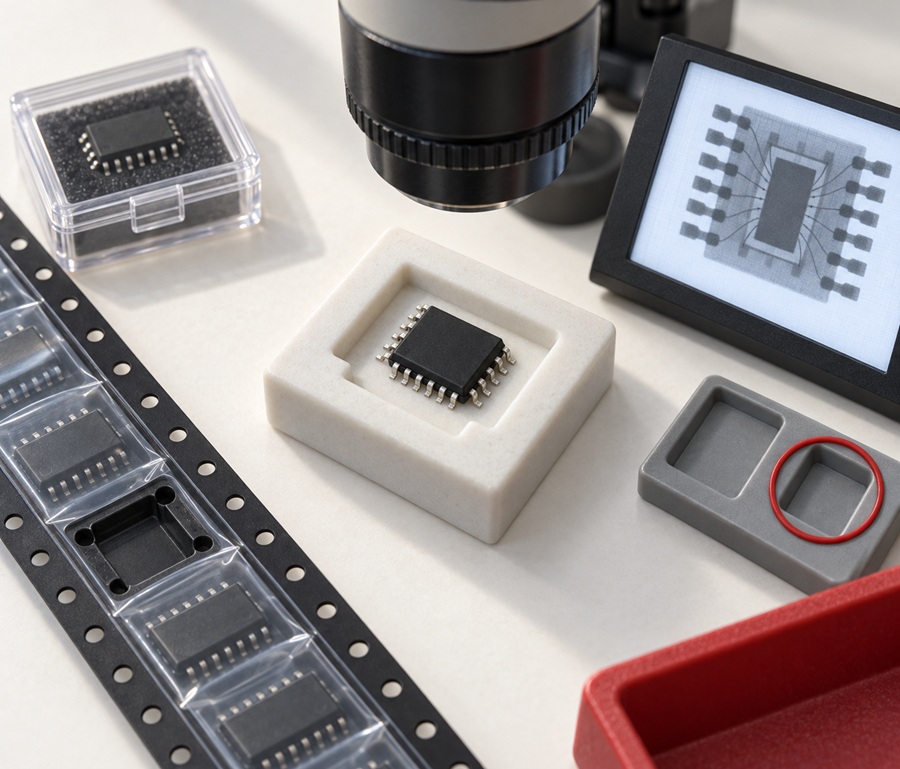
Counterfeit components can hide behind convincing markings and passing basic function tests. This engineering reference covers source traceability, external inspection, X-ray, XRF, electrical testing, …

A practical engineering and sourcing framework covering lifecycle verification, lifetime-buy calculations, replacement qualification, supplier checks and counterfeit-risk controls.

TTL and CMOS logic families differ in thresholds, loading, output drive, power and timing. This engineering guide compares 74HC and 74HCT, calculates noise margins and checks 3.3 V/5 V compatibility.

A practical engineering guide to 3.3V and 5V logic compatibility, input thresholds, resistor dividers, translator ICs, MOSFET level shifting, I2C pull-ups, timing limits and power-sequencing risks.

The 74HC595 uses push-pull logic outputs, while the TPIC6B595 uses 50 V open-drain DMOS sinks for higher-power loads. This guide compares timing, current limits, 3.3 V interfacing, load wiring, thermal…

The 74HC595 converts serial data into eight stable parallel outputs. This guide covers pin functions, shift and storage timing, OE and MR behavior, drive-current limits, cascading, voltage compatibilit…

A technical comparison of level-sensitive latches and edge-triggered flip-flops, covering timing windows, setup and hold limits, master–slave operation, time borrowing, race-through, HDL inference and…

A D latch stores one bit while Enable controls when data can pass. This reference covers gate-level operation, truth tables, transparency, setup and hold timing, LE versus OE, common ICs and practical …

An SR latch stores one bit through cross-coupled feedback. This engineering reference covers NOR and NAND implementations, truth tables, forbidden-state recovery, gated operation, switch debouncing, fa…

Latch circuits retain one bit through feedback. This technical reference covers SR and D latches, truth tables, transparency, timing limits, latch-versus-flip-flop behavior, applications and common log…


