
 My Inquiry
 My Account


Toshiba Semiconductor and Storage TB67S158FTG,EL
- Part No.:
- TB67S158FTG,EL
- Manufacturer:
- Toshiba Semiconductor and Storage
- Category:
- Motor Drivers, Controllers
- Package:
- 48-WFQFN Exposed Pad
- Datasheet:
-
 TB67S158FTG,EL.pdf
- Description:
- IC MOTOR DRIVER UNIPOLAR 48WQFN
- Quantity:
- Payment:

- Shipping:

Inventory:1,656
Please send an inquiry. Send us your inquiry, and we will respond immediately.
Product details
Overview
TB67S158FTG from Toshiba is a constant-voltage-control DMOS stepper motor driver IC capable of driving up to two 2-phase unipolar stepping motors simultaneously. It features dual interface modes (full parallel and serial/parallel), 80 V output voltage rating, 1.5 A maximum output current per phase, and integrated thermal shutdown (TSD), overcurrent detection (ISD), and VM power-on reset (POR). It is used in precision motion control systems such as industrial automation actuators and optical positioning stages.
For engineers reviewing the TB67S158FTG datasheet, TB67S158FTG pinout, TB67S158FTG application, or TB67S158FTG equivalent, key selection considerations include its BiCD-process low RDS(on) (0.5 Ω typ.), dual-mode interface flexibility, built-in VCC regulator enabling single-supply operation, and open-drain ALERT/ERR/ALM fault signaling for system-level diagnostics.
Technical Context
The TB67S158FTG implements a dual-channel architecture with four independent half-bridge outputs per motor (A/B/C/D phases), supporting both full-parallel direct transistor-array-style control and serial/parallel conversion via an 8-bit shift + storage register. Its internal VCC regulator allows operation from a single VM supply (10–60 V), eliminating need for external logic rail.
Protection is implemented through three independent circuits: ISD triggers at ≥3.0 A (typ.) per channel with 2.0 μs blanking time; TSD activates at junction temperature ≥160 °C (typ.) with automatic recovery upon cooling; and VMR monitors VM supply, asserting POR when VM drops below 8.0 V (typ.). All protections assert open-drain ERR or ALM signals.
Key Specifications
| Parameter | Value and Actual Design Meaning |
|---|---|
| Output Voltage Rating | 80 V max - supports high-back-EMF motors and wide input supply range (VM = 10–60 V typical) |
| Max Output Current | 1.5 A per phase - enables driving mid-torque unipolar stepper motors without external current limiting |
| RDS(on) | 0.5 Ω (typ.) - reduces conduction loss and heat generation at rated current |
| Interface Modes | Full parallel (MODE=L) or serial/parallel (MODE=H) - offers flexible control wiring and reduced MCU GPIO count |
| Thermal Shutdown Threshold | 160 °C (typ.) - protects die during overload or poor heatsinking; recovers automatically after cooldown |
| Logic Supply | Internal VCC regulator - eliminates need for separate 5 V rail; powered only by VM |
| Fault Signaling | Open-drain ERR (TSD/ISD) and ALM (TSD-only) - enables system-level fault monitoring with pull-up to 3.3/5 V |
Pinout & Package
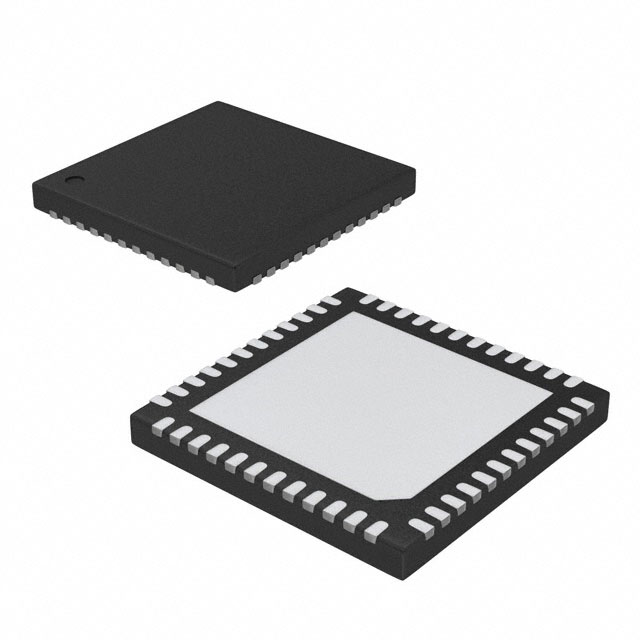
Packaged in a thermally enhanced P-WQFN48-0707-0.50-003 (7 mm × 7 mm, 0.5 mm pitch) with exposed thermal pad requiring PCB GND connection at all four corners and center pad.
| Pin/Terminal | Circuit Role | Design Meaning |
|---|---|---|
| IN_A1–IN_D2 (pins 2–6, 8–10) | Parallel mode input controls | Direct ON/OFF control of individual half-bridges in Mode1; function as DATA/CLK/CLR/LATCH in Mode2 |
| OUT_A+–OUT_D− (pins 14–17, 20–23, 38–47) | Motor output terminals | Dual H-bridge outputs per motor (A/B and C/D); each phase has dedicated + and − pins with duplicated bonding |
| VCOM_AB / VCOM_CD (pins 24, 37) | Phase common connections | Internal connection points for unipolar motor center taps (A/B and C/D pairs); must be wired externally per motor |
| PGND_AB / PGND_CD (pins 18–19, 42–43) | Power ground return paths | Low-inductance GND returns for respective motor pairs; must be routed separately from LGND to minimize noise coupling |
| LGND (pins 25, 35) | Logic ground reference | Reference for all digital inputs and internal regulator; must connect to system logic GND, isolated from PGND |
| VM (pin 30) | Main motor power supply | Input for 10–60 V motor rail; powers both output DMOS and internal VCC regulator |
| MODE (pin 26) | Interface mode selector | L = Full parallel; H = Serial/parallel; must be hard-wired (not toggled dynamically during operation) |
| ERR (pin 34) | Open-drain fault indicator | Asserts low on TSD or ISD activation; requires external 10 kΩ pull-up to 3.3/5 V for system monitoring |
Key Features
| Feature | Design Value |
|---|---|
| Dual 2-phase unipolar motor control | One TB67S158FTG replaces two discrete drivers, reducing BOM count and PCB area in multi-axis systems |
| BiCD process DMOS output stage | Enables 80 V/1.5 A capability with 0.5 Ω RDS(on), minimizing I²R losses and thermal stress |
| Single-supply operation | Internal VCC regulator derives logic power from VM, eliminating need for auxiliary 5 V supply |
| Integrated protection suite | TSD (160 °C), ISD (3.0 A typ.), and VMR/POR ensure robustness against overload, short-circuit, and brownout |
| Configurable interface modes | Full parallel mode simplifies firmware; serial mode reduces MCU pin count and supports daisy-chaining |
Applications
| Industrial CNC Actuators | Optical Positioning Stages |
|---|---|
Use Scenario: Precise open-loop positioning of linear slides and rotary tables in compact CNC routers and engravers. IC Role / Device Role / Timing Role: Dual-motor driver controlling two independent unipolar stepper axes with synchronized excitation timing. Use Value: Eliminates need for two separate drivers; 0.5 Ω RDS(on) sustains 1.5 A continuous current without external heatsink under typical duty cycles. | Use Scenario: Sub-micron alignment of lenses, mirrors, and fiber couplers in automated optical test equipment. IC Role / Device Role / Timing Role: Constant-voltage stepper driver executing 1-2-phase excitation sequences for smooth microstepping-compatible motion. Use Value: Built-in TSD and ISD prevent damage during stall or mechanical jam; ERR signal enables real-time fault logging in closed-loop feedback systems. |
| Medical Infusion Pumps | Automated Laboratory Analyzers |
Use Scenario: Controlled peristaltic or syringe actuation in portable infusion devices requiring silent, reliable fluid delivery. IC Role / Device Role / Timing Role: Unipolar stepper driver managing precise step-by-step plunger advancement with programmable acceleration profiles. Use Value: Single VM supply simplifies battery-powered design; ALM output provides early thermal warning before TSD shutdown, allowing graceful deceleration. | Use Scenario: Multi-axis sample handling and reagent dispensing in benchtop diagnostic analyzers with space-constrained PCB layouts. IC Role / Device Role / Timing Role: Serial-interface motor controller coordinating four motor channels (via two TB67S158FTG) using daisy-chained shift registers. Use Value: Serial mode reduces MCU GPIO usage by 75% vs. parallel; duplicated OUT pins (e.g., OUT_A+ on pins 14 & 15) improve current handling and layout routing flexibility. |
Equivalent & Alternatives
The following parts are listed as comparable options for similar stepper motor driver applications.
| Alternative Part | Technical Difference | Application Difference | Selection Advice |
|---|---|---|---|
| TB6600HG | Higher voltage (100 V) and current (4.5 A), but larger HTSSOP28 package; no serial interface; requires external logic supply | Better suited for high-torque industrial motors; lacks integrated VCC regulator and fault signaling granularity | Select when higher power and simpler parallel-only control are prioritized over board space and diagnostic capability |
| DRV8834 | Lower voltage (10.8 V max), microstepping support, smaller QFN16 package; uses external current sense resistors; no TSD/ISD hardware protection | Targeted at low-voltage, low-noise consumer applications; relies on MCU-based current regulation and thermal monitoring | Select for battery-powered portable devices where microstepping and ultra-compact size outweigh need for autonomous protection |
Compared with TB67S158FTG, TB6600HG delivers higher drive capability but sacrifices integration and diagnostics, while DRV8834 offers microstepping and footprint reduction at the cost of autonomous protection and voltage range-making TB67S158FTG optimal for mid-power, reliability-critical industrial motion control.
Availability
TB67S158FTG is available at Aetrix Electronics and suitable for industrial CNC actuators, optical positioning stages, medical infusion pumps, and automated laboratory analyzers requiring stable component supply, long-term lifecycle assurance, and traceable sourcing.
Supply support for TB67S158FTG includes scheduled delivery planning, volume procurement assistance, BOM continuity management, traceable sourcing, and lifecycle availability coordination for OEM customers, industrial embedded developers, connected-device designers, and electronics production programs.
Manufacturer
Toshiba Electronic Devices & Storage Corporation designs and manufactures high-reliability semiconductor solutions for automotive, industrial, and consumer applications, with leadership in power management and motor control ICs.
The TB67S158FTG belongs to Toshiba's Bi-CD Process DMOS stepper driver family, engineered specifically for compact, high-efficiency unipolar motor control in space- and reliability-constrained embedded systems.
FAQ
What interface modes does the TB67S158FTG support, and how is mode selection configured?
The TB67S158FTG supports two interface modes: full parallel (Mode1) and serial/parallel conversion (Mode2). Mode selection is controlled by the MODE pin (pin 26): logic low (≤0.8 V) selects full parallel mode, where IN_A1–IN_D2 directly control individual output transistors; logic high (≥2.0 V) selects serial mode, where pins repurpose as DATA, CLK, CLR, LATCH, etc. The MODE pin must be hard-wired and not dynamically switched during operation. Both modes retain identical output capabilities and protection features.
How does the TB67S158FTG handle thermal protection, and what happens when thermal shutdown activates?
When the TB67S158FTG junction temperature reaches ~160 °C (typ.), its thermal shutdown circuit (TSD) disables all output transistors and asserts the ERR pin low. The ALM pin also goes low if TSD is active in serial mode. Recovery occurs automatically once the die cools by ~30 °C below the threshold (i.e., to ~130 °C), provided VM remains applied or STBY is asserted. During TSD, the internal logic remains powered, allowing continued monitoring via ERR/ALM. The exposed thermal pad and proper PCB copper pour are essential for effective heat dissipation.
Can the TB67S158FTG drive two independent unipolar stepper motors simultaneously, and what are the wiring requirements?
Yes, the TB67S158FTG can drive two independent 2-phase unipolar stepper motors concurrently-one using phases A/B (VCOM_AB, OUT_A±, OUT_B±) and the other using C/D (VCOM_CD, OUT_C±, OUT_D±). Each motor requires its own center-tap connection to the respective VCOM pin. PGND_AB and PGND_CD must be routed separately to minimize crosstalk, while LGND connects to system logic ground. Motor windings connect between corresponding OUT+ and OUT− pins, with VCOM tied to VM via appropriate current-limiting or regulation per motor.
What is the purpose of the ERR and ALM pins, and how should they be interfaced with a host MCU?
ERR is an open-drain output that goes low during either thermal shutdown (TSD) or overcurrent detection (ISD); ALM is an open-drain output active only during TSD (available in serial mode). Both require external 3.3 V or 5 V pull-up resistors (typically 10 kΩ). The host MCU monitors these pins as active-low interrupt or status inputs. ERR provides consolidated fault indication, while ALM enables differentiated thermal alarm handling-e.g., initiating fan control or reducing motor load before full TSD shutdown. Neither pin drives high actively; they only sink current when asserted.
Does the TB67S158FTG require an external logic supply, and how is its internal regulator configured?
No, the TB67S158FTG does not require an external logic supply. It integrates a VCC regulator that derives 5 V logic power directly from the VM motor supply (10–60 V). This eliminates the need for a separate 5 V rail and simplifies system power architecture. The regulator operates across the full VM range and powers all internal logic, shift registers, and protection circuits. No external components are required-only proper decoupling (e.g., 10 μF ceramic + 100 nF near VM pin) is recommended per Toshiba's layout guidelines.
TB67S158FTG,EL Specifications
- Product attributes
- Attribute value
- Manufacturer:
- Toshiba Semiconductor and Storage
- Series:
- -
- Package/Case:
- 48-WFQFN Exposed Pad
- Packaging:
- Tape & Reel (TR)
- Product Status:
- Active
- Motor Type - Stepper:
- Unipolar
- Motor Type - AC, DC:
- -
- Function:
- Driver - Fully Integrated, Control and Power Stage
- Output Configuration:
- Half Bridge (8)
- Interface:
- Parallel
- Technology:
- DMOS
- Step Resolution:
- -
- Applications:
- General Purpose
- Current - Output:
- 1.5A
- Voltage - Supply:
- 4.75V ~ 5.25V
- Voltage - Load:
- 10V ~ 60V
- Operating Temperature:
- -20°C ~ 150°C (TJ)
- Grade:
- -
- Qualification:
- -
- Mounting Type:
- Surface Mount
- Supplier Device Package:
- 48-WQFN (7x7)
TB67S158FTG,EL FAQ
1.How can I place an order for TB67S158FTG,EL through Aetrix?
Please submit a Request for Quotation (RFQ) for TB67S158FTG,EL on Aetrix. Our sales agent will provide a competitive quotation and guide you through the order confirmation once you accept the terms.
2.Are the price and stock information for TB67S158FTG,EL reliable?
The price and inventory of TB67S158FTG,EL are updated periodically and may fluctuate due to market conditions. Stock and pricing data are typically refreshed every 24 hours. Quotation validity for TB67S158FTG,EL is usually 5 days.
3.What payment methods are accepted for TB67S158FTG,EL?
We accept Wire Transfer, PayPal, Credit Card, Western Union, MoneyGram, and Escrow for TB67S158FTG,EL transactions.
Note: Certain payment methods may incur a processing fee.
4.How is shipping managed for TB67S158FTG,EL?
TB67S158FTG,EL orders can be shipped via leading logistics carriers, including DHL, UPS, FedEx, TNT, or Registered Mail.
Once your TB67S158FTG,EL order is processed, you will receive an email with the shipment details and tracking number.
Note: Tracking information may take up to 24 hours to appear. Express delivery typically takes 3–5 business days.
5.How can I obtain technical support or documentation for TB67S158FTG,EL?
For technical support, including TB67S158FTG,EL datasheets, pinout diagrams, or application guidance, please contact our engineering support team. They can provide detailed documentation and assistance for your TB67S158FTG,EL requirements.
6.How does Aetrix verify that TB67S158FTG,EL is sourced from the original manufacturer or authorized distributors?
All TB67S158FTG,EL products on Aetrix are procured from qualified distributors and authorized channels. Our dedicated quality assurance team conducts strict verification, including traceability checks and, if necessary, third-party testing. This ensures that TB67S158FTG,EL meets industry standards.
7.What is the process for return or replacement of TB67S158FTG,EL?
All TB67S158FTG,EL units undergo pre-shipment inspection (PSI). If there is an issue with TB67S158FTG,EL, returns or replacements are accepted under the following conditions:
1.Quantity discrepancies, incorrect items, or visible external defects (such as breakage or corrosion), acknowledged by Aetrix.
2.The issue is reported within 90 days of delivery.
3.The TB67S158FTG,EL part is unused and in its original packaging.
Return procedure for TB67S158FTG,EL:
1.Submit a request within 90 days.
2.Obtain a Return Material Authorization (RMA) from Aetrix.
TB67S158FTG,EL Tags
-
DRV2603RUNR
Texas Instruments
-
DRV8837CDSGR
Texas Instruments
-
DRV8837DSGR
Texas Instruments
-
DRV8838DSGR
Texas Instruments
-
DRV8839DSSR
Texas Instruments
-
EMC2301-1-ACZL-TR
Microchip Technology
-
DRV8231ADSGR
Texas Instruments
-
EMC2302-2-AIZL-TR
Microchip Technology
-
DRV8800PWPR
Texas Instruments
-
DRV8835DSSR
Texas Instruments
-
EMC2303-1-KP-TR
Microchip Technology
-
DRV8876PWPR
Texas Instruments
Tech Hub

Counterfeit components can hide behind convincing markings and passing basic function tests. This engineering reference covers source traceability, external inspection, X-ray, XRF, electrical testing, …

A practical engineering and sourcing framework covering lifecycle verification, lifetime-buy calculations, replacement qualification, supplier checks and counterfeit-risk controls.

TTL and CMOS logic families differ in thresholds, loading, output drive, power and timing. This engineering guide compares 74HC and 74HCT, calculates noise margins and checks 3.3 V/5 V compatibility.

A practical engineering guide to 3.3V and 5V logic compatibility, input thresholds, resistor dividers, translator ICs, MOSFET level shifting, I2C pull-ups, timing limits and power-sequencing risks.

The 74HC595 uses push-pull logic outputs, while the TPIC6B595 uses 50 V open-drain DMOS sinks for higher-power loads. This guide compares timing, current limits, 3.3 V interfacing, load wiring, thermal…

The 74HC595 converts serial data into eight stable parallel outputs. This guide covers pin functions, shift and storage timing, OE and MR behavior, drive-current limits, cascading, voltage compatibilit…

A technical comparison of level-sensitive latches and edge-triggered flip-flops, covering timing windows, setup and hold limits, master–slave operation, time borrowing, race-through, HDL inference and…

A D latch stores one bit while Enable controls when data can pass. This reference covers gate-level operation, truth tables, transparency, setup and hold timing, LE versus OE, common ICs and practical …

An SR latch stores one bit through cross-coupled feedback. This engineering reference covers NOR and NAND implementations, truth tables, forbidden-state recovery, gated operation, switch debouncing, fa…

Latch circuits retain one bit through feedback. This technical reference covers SR and D latches, truth tables, transparency, timing limits, latch-versus-flip-flop behavior, applications and common log…


