
 My Inquiry
 My Account


Toshiba Semiconductor and Storage TCTH012BE,LF(CT

- Part No.:
- TCTH012BE,LF(CT
- Manufacturer:
- Toshiba Semiconductor and Storage
- Category:
- Supervisors
- Package:
- SOT-553
- Datasheet:
-
 TCTH012BE,LF(CT.pdf
- Description:
- CMOS LINEAR IC OVER TEMP DETECTI
- Quantity:
- Payment:

- Shipping:

Inventory:7,990
Please send an inquiry. Send us your inquiry, and we will respond immediately.
Product details
Overview
TCTH012BE,LF(CT from Toshiba Electronic Devices & Storage Corporation is a CMOS over-temperature detection IC that monitors external PTC thermistors and outputs an open-drain FLAG signal upon threshold exceedance. It delivers 1 μA (Typ.) constant-current drive to the PTC, consumes only 1.8 μA (Typ.) total supply current, and features latch functionality triggered by temperature rise - used in notebook PCs, industrial equipment, and home appliances for thermal safety shutdown.
For engineers reviewing the TCTH012BE,LF(CT) datasheet, TCTH012BE,LF(CT) pinout, TCTH012BE,LF(CT) application, or TCTH012BE,LF(CT) equivalent, this page provides verified functional identity, confirmed latch behavior with RESET release, open-drain output logic, ESV package dimensions, and real-world PTC thermistor interface constraints - all critical for thermal protection circuit design and BOM validation.
Technical Context
The TCTH012BE,LF(CT) implements a precision voltage comparator architecture sensing PTCO terminal voltage against a fixed 0.50 V (Typ.) detect threshold (VDET) with 0.1 V hysteresis. Its internal constant-current source (IPTCO = 1.00 μA ±8% at VDD = 3.3 V) establishes temperature setpoint via external PTC resistance selection.
It operates across -40 °C to +125 °C with supply voltage range 1.7–5.5 V, includes UVLO (1.5 V) and 20 μs operation mask time, and uses a dedicated RESET pin to release latched PTCGOOD output - distinguishing it from non-latch variants like TCTH011BE,LF(CT).
Key Specifications
| Parameter | Value and Actual Design Meaning |
|---|---|
| PTCO Output Current | 1.00 μA (Typ.), ±8% accuracy at 3.3 V - sets precise PTC-based temperature trip point |
| Detect Voltage (VDET) | 0.50 V (Typ.), 0.36–0.64 V range - defines voltage threshold triggering FLAG assertion |
| Hysteresis Voltage | 0.1 V - prevents oscillation during thermal transition near trip point |
| Total Supply Current | 1.8 μA (Typ.) - enables ultra-low-power thermal monitoring in battery-backed systems |
| Supply Voltage Range | 1.7–5.5 V - supports direct interface with 1.8 V, 3.3 V, and 5 V logic domains |
| Operating Temperature | -40 °C to +125 °C - qualified for industrial and mobile embedded thermal environments |
| Output Type | Open-drain PTCGOOD - requires external pull-up; compatible with mixed-voltage host systems |
| Latch Function | Enabled - holds FLAG low until RESET pin driven high or VDD cycled |
Pinout & Package
Package: ESV (SOT-553), 1.6 mm × 1.6 mm × 0.55 mm, weight 2.98 mg (Typ.).
| Pin/Terminal | Circuit Role | Design Meaning |
|---|---|---|
| VDD | Power supply input | Accepts 1.7–5.5 V; includes UVLO (1.5 V) for safe power-on reset |
| GND | Ground reference | Single ground pin; must connect to system GND per datasheet note |
| RESET | Latch release control | High-level input (>0.84 V) releases latched PTCGOOD; pulls down 0.04 μA when low |
| PTCGOOD | Open-drain FLAG output | Drives low on over-temperature; high-impedance otherwise - requires external pull-up |
| PTCO | Constant-current output | Sources 1 μA (Typ.) to series-connected PTC thermistor(s); max external voltage ≤1 V |
Key Features
| Feature | Design Value |
|---|---|
| Latch-enabled FLAG output | PTCGOOD remains asserted after over-temperature event until explicit RESET activation - ensures fault persistence in safety-critical monitoring |
| Open-drain PTCGOOD | Enables flexible voltage-level translation via external pull-up resistor - supports interfacing with 1.8 V, 3.3 V, or 5 V host logic |
| Ultra-low quiescent current | 1.8 μA (Typ.) total IDD - extends battery life in portable thermal sensors and always-on monitoring circuits |
| High-accuracy PTCO current | ±8% tolerance at 3.3 V - reduces PTC selection margin and improves temperature setpoint repeatability |
| ESV package footprint | 1.6 mm × 1.6 mm SOT-553 - enables compact placement near heat sources without PCB area penalty |
Applications
| Notebook PC Thermal Protection | Industrial Motor Drive Monitoring |
|---|---|
Use Scenario: Real-time CPU/GPU die temperature monitoring using surface-mounted PTC thermistor adjacent to processor package. IC Role / Device Role / Timing Role: Over-temperature detection IC asserting latched FLAG signal to system PMIC or microcontroller interrupt line upon thermal violation. Use Value: Prevents thermal runaway by enabling immediate throttling or forced shutdown - leverages 1.8 μA supply current to minimize impact on platform power budget. | Use Scenario: Detection of winding over-temperature in brushless DC motor drives using embedded PTC chain across stator windings. IC Role / Device Role / Timing Role: Latched thermal flag generator interfaced to motor control MCU via open-drain bus; RESET tied to system enable signal. Use Value: Ensures persistent fault indication even during transient voltage dips - eliminates need for continuous polling and improves system reliability under harsh EMI conditions. |
| Smart Home Appliance Safety | Medical Power Supply Thermal Guard |
Use Scenario: Over-temperature cutoff for induction cooktop power stage, with PTC mounted on IGBT heatsink. IC Role / Device Role / Timing Role: Standalone thermal watchdog providing hardware-level shutdown independent of main controller firmware. Use Value: Meets IEC 60335-1 Class II isolation requirements via galvanically isolated open-drain output - no software dependency for fail-safe response. | Use Scenario: Redundant thermal monitoring in Class II medical AC/DC power supplies, where PTC is placed on transformer core and rectifier diodes. IC Role / Device Role / Timing Role: Secondary thermal sensor feeding into safety monitor IC; latched output triggers crowbar circuit if primary thermal protection fails. Use Value: Supports dual-redundancy architectures with <100 μs response time (tDET1 = 17 μs) - satisfies IEC 62368-1 Annex G timing requirements for secondary protection. |
Equivalent & Alternatives
The following parts are listed as comparable options for similar over-temperature detection applications.
| Alternative Part | Technical Difference | Application Difference | Selection Advice |
|---|---|---|---|
| TCTH012AE,LF(CT) | Push-pull PTCGOOD output; no external pull-up required; identical PTCO current and latch function | Requires same VDD domain for FLAG output; less flexible for mixed-voltage systems | Select when driving single-rail logic directly and board space allows for simpler routing |
| MAX6505EUT+T | Open-drain output, but no latch function; 1.25 V fixed threshold; higher 5 μA supply current | Only suitable for auto-recovery thermal monitoring; cannot hold fault state without external circuitry | Choose only if latch behavior is unnecessary and lower cost outweighs missing safety persistence |
Compared with TCTH012BE,LF(CT), the TCTH012AE,LF(CT) simplifies interface design but sacrifices voltage-level flexibility, while the MAX6505EUT+T lacks latch capability entirely - making TCTH012BE,LF(CT) uniquely suited for safety-critical applications requiring guaranteed fault persistence without added components.
Availability
TCTH012BE,LF(CT) is available at Aetrix Electronics and suitable for notebook PC thermal management, industrial motor drive protection, smart home appliance safety cutoff, and medical power supply thermal guard applications requiring stable component supply and long-term lifecycle support.
Supply support for TCTH012BE,LF(CT) includes scheduled delivery planning, volume procurement assistance, BOM continuity management, traceable sourcing, and lifecycle availability coordination for OEM customers, industrial embedded developers, connected-device designers, and electronics production programs.
Manufacturer
Toshiba Electronic Devices & Storage Corporation designs and manufactures high-reliability analog and power semiconductors for industrial, automotive, and consumer applications.
The TCTH0xxxE series targets compact, ultra-low-power thermal safety monitoring - delivering latch-enabled over-temperature detection with minimal PCB footprint and sub-2 μA supply current for embedded systems where thermal integrity is mission-critical.
FAQ
What is the primary function of the TCTH012BE,LF(CT)?
The TCTH012BE,LF(CT) is a CMOS over-temperature detection IC that senses rising temperature via an external PTC thermistor and asserts a latched open-drain FLAG signal (PTCGOOD) when the thermistor's resistance crosses a voltage threshold determined by its 1.00 μA (Typ.) constant-current source. It is designed for fail-safe thermal shutdown in space-constrained, low-power systems.
Does the TCTH012BE,LF(CT) require an external pull-up resistor on PTCGOOD?
Yes, the TCTH012BE,LF(CT) features an open-drain PTCGOOD output and requires an external pull-up resistor to the desired logic rail (e.g., 1.8 V, 3.3 V, or 5 V). This configuration enables voltage-level translation and shared-bus operation - a key distinction from push-pull variants like TCTH012AE,LF(CT).
How does the latch function work in the TCTH012BE,LF(CT)?
The TCTH012BE,LF(CT) latches the PTCGOOD output low upon over-temperature detection and maintains that state until the RESET pin is driven high (≥0.84 V) or VDD is cycled. This ensures fault persistence across brief power interruptions or MCU resets - critical for safety compliance in industrial and medical applications.
What is the recommended PTC thermistor resistance range for use with the TCTH012BE,LF(CT)?
For a single PTC thermistor at 25 °C, Toshiba recommends 17.8 kΩ to 27 kΩ (α = 50, β = 10) or 9.1 kΩ to 27 kΩ (α = 100, β = 10), based on VDET = 0.50 V (Typ.) and IPTCO = 1.00 μA (Typ.). Exact values depend on target trip temperature and PTC resistance-vs.-temperature curve - refer to Section 10.3.1 of the TCTH0xxxE datasheet.
Can multiple PTC thermistors be connected to the TCTH012BE,LF(CT)?
Yes, up to ~30 PTC thermistors may be connected in series to the PTCO pin, provided they share identical 25 °C resistance values. The effective resistance window scales with quantity (N): for N = 10 and α = 180, use 4.7 kΩ–9.4 kΩ. Mismatched thermistors cause inaccurate trip points - design must account for combined resistance shift during simultaneous overheating.
TCTH012BE,LF(CT Specifications
- Product attributes
- Attribute value
- Manufacturer:
- Toshiba Semiconductor and Storage
- Series:
- TCTH0xxxE
- Package/Case:
- SOT-553
- Packaging:
- Tape & Reel (TR)
- Product Status:
- Active
- Programmable:
- -
- Type:
- Thermal
- Number of Voltages Monitored:
- 1
- Voltage - Threshold:
- 0.5V
- Output:
- Open Drain or Open Collector
- Reset:
- -
- Reset Timeout:
- 17µs Typical
- Operating Temperature:
- -40°C ~ 125°C (TJ)
- Grade:
- -
- Qualification:
- -
- Mounting Type:
- Surface Mount
- Supplier Device Package:
- ESV
TCTH012BE,LF(CT FAQ
1.How can I place an order for TCTH012BE,LF(CT through Aetrix?
Please submit a Request for Quotation (RFQ) for TCTH012BE,LF(CT on Aetrix. Our sales agent will provide a competitive quotation and guide you through the order confirmation once you accept the terms.
2.Are the price and stock information for TCTH012BE,LF(CT reliable?
The price and inventory of TCTH012BE,LF(CT are updated periodically and may fluctuate due to market conditions. Stock and pricing data are typically refreshed every 24 hours. Quotation validity for TCTH012BE,LF(CT is usually 5 days.
3.What payment methods are accepted for TCTH012BE,LF(CT?
We accept Wire Transfer, PayPal, Credit Card, Western Union, MoneyGram, and Escrow for TCTH012BE,LF(CT transactions.
Note: Certain payment methods may incur a processing fee.
4.How is shipping managed for TCTH012BE,LF(CT?
TCTH012BE,LF(CT orders can be shipped via leading logistics carriers, including DHL, UPS, FedEx, TNT, or Registered Mail.
Once your TCTH012BE,LF(CT order is processed, you will receive an email with the shipment details and tracking number.
Note: Tracking information may take up to 24 hours to appear. Express delivery typically takes 3–5 business days.
5.How can I obtain technical support or documentation for TCTH012BE,LF(CT?
For technical support, including TCTH012BE,LF(CT datasheets, pinout diagrams, or application guidance, please contact our engineering support team. They can provide detailed documentation and assistance for your TCTH012BE,LF(CT requirements.
6.How does Aetrix verify that TCTH012BE,LF(CT is sourced from the original manufacturer or authorized distributors?
All TCTH012BE,LF(CT products on Aetrix are procured from qualified distributors and authorized channels. Our dedicated quality assurance team conducts strict verification, including traceability checks and, if necessary, third-party testing. This ensures that TCTH012BE,LF(CT meets industry standards.
7.What is the process for return or replacement of TCTH012BE,LF(CT?
All TCTH012BE,LF(CT units undergo pre-shipment inspection (PSI). If there is an issue with TCTH012BE,LF(CT, returns or replacements are accepted under the following conditions:
1.Quantity discrepancies, incorrect items, or visible external defects (such as breakage or corrosion), acknowledged by Aetrix.
2.The issue is reported within 90 days of delivery.
3.The TCTH012BE,LF(CT part is unused and in its original packaging.
Return procedure for TCTH012BE,LF(CT:
1.Submit a request within 90 days.
2.Obtain a Return Material Authorization (RMA) from Aetrix.
TCTH012BE,LF(CT Tags
-
MIC826SYMT-TR
Microchip Technology
-
APX803S-31SA-7
Diodes Incorporated
-
APX803L20-29SA-7
Diodes Incorporated
-
TPS3828-33DBVR
Texas Instruments

-
V6340RSP3B+
EM Microelectronic
-
EM6325CXSP5B-2.9+
EM Microelectronic
-
MCP120T-300I/TT
Microchip Technology
-
MCP130T-315I/TT
Microchip Technology
-
MCP120T-475I/TT
Microchip Technology
-
MCP111T-300E/TT
Microchip Technology
-
MCP120T-315I/TT
Microchip Technology
-
MCP809T-315I/TT
Microchip Technology
Tech Hub
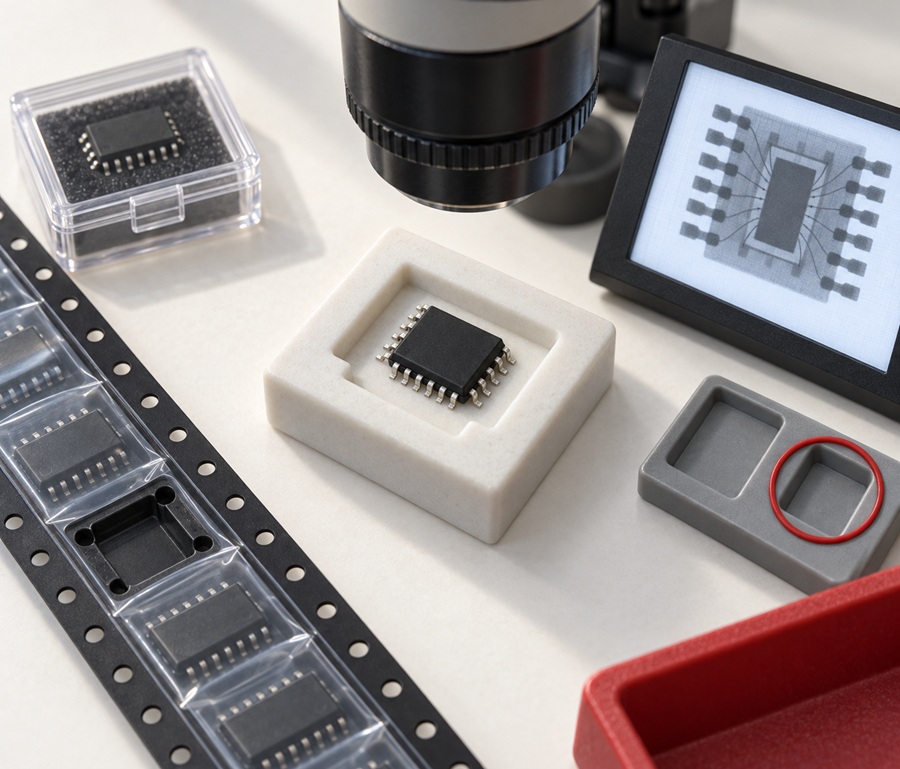
Counterfeit components can hide behind convincing markings and passing basic function tests. This engineering reference covers source traceability, external inspection, X-ray, XRF, electrical testing, …

A practical engineering and sourcing framework covering lifecycle verification, lifetime-buy calculations, replacement qualification, supplier checks and counterfeit-risk controls.

TTL and CMOS logic families differ in thresholds, loading, output drive, power and timing. This engineering guide compares 74HC and 74HCT, calculates noise margins and checks 3.3 V/5 V compatibility.

A practical engineering guide to 3.3V and 5V logic compatibility, input thresholds, resistor dividers, translator ICs, MOSFET level shifting, I2C pull-ups, timing limits and power-sequencing risks.

The 74HC595 uses push-pull logic outputs, while the TPIC6B595 uses 50 V open-drain DMOS sinks for higher-power loads. This guide compares timing, current limits, 3.3 V interfacing, load wiring, thermal…

The 74HC595 converts serial data into eight stable parallel outputs. This guide covers pin functions, shift and storage timing, OE and MR behavior, drive-current limits, cascading, voltage compatibilit…

A technical comparison of level-sensitive latches and edge-triggered flip-flops, covering timing windows, setup and hold limits, master–slave operation, time borrowing, race-through, HDL inference and…

A D latch stores one bit while Enable controls when data can pass. This reference covers gate-level operation, truth tables, transparency, setup and hold timing, LE versus OE, common ICs and practical …

An SR latch stores one bit through cross-coupled feedback. This engineering reference covers NOR and NAND implementations, truth tables, forbidden-state recovery, gated operation, switch debouncing, fa…

Latch circuits retain one bit through feedback. This technical reference covers SR and D latches, truth tables, transparency, timing limits, latch-versus-flip-flop behavior, applications and common log…


