
 My Inquiry
 My Account


STMicroelectronics TDA7705TR
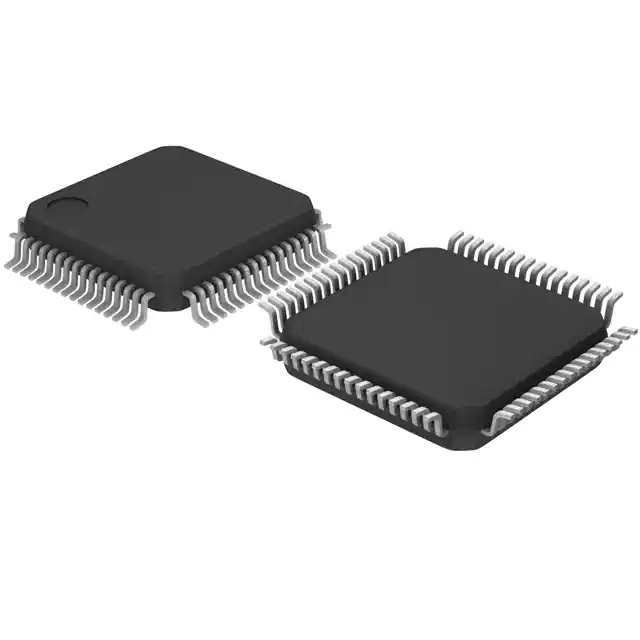
- Part No.:
- TDA7705TR
- Manufacturer:
- STMicroelectronics
- Category:
- RF Receivers
- Package:
- 64-LQFP
- Datasheet:
-
 TDA7705TR.pdf
- Description:
- RF RECEIVER AM/FM 64LQFP
- Quantity:
- Payment:

- Shipping:

Inventory:1,198
Please send an inquiry. Send us your inquiry, and we will respond immediately.
Product details
Overview
TDA7705TR from STMicroelectronics is a highly integrated AM/FM car radio tuner IC featuring fully integrated VCO, high-speed PLL (300 µs settling), digital IF signal processing, RDS demodulation with group synchronization, and stereo decoding with noiseblanker - all operating from a single 5 V supply in LQFP64 package for automotive infotainment systems.
For engineers reviewing the TDA7705TR datasheet, TDA7705TR pinout, TDA7705TR application, or TDA7705TR equivalent, key selection considerations include FM/AM image rejection performance, adaptive bandwidth control via DSP, I²C/SPI configurability, automatic self-alignment of preselection, and dual-input mixer support for tuned vs. fixed-bandpass front-ends.
Technical Context
The TDA7705TR implements a mixed-signal architecture with analog RF front-end (AM-LNA, FM/AM mixers, PIN diode drivers), integrated VCO covering FM (76–108 MHz), AM (LW/MW/SW), and WX bands, and a dedicated DSP engine performing digital down-conversion, dynamic channel selection filtering (DISS), soft mute, stereo blend, and RDS block synchronization - all synchronized to a 37.05 MHz crystal oscillator.
Its PLL achieves ≤300 µs frequency settling with 5 kHz (FM) or 500 Hz (AM) step resolution, while the IF ADC delivers IQ sampling for drift-free digital IF processing, and stereo DAC outputs support left/right audio with de-emphasis and high-cut control - enabling software-defined tuning and real-time weak-signal enhancement without external filters or alignment components.
Key Specifications
| Parameter | Value and Actual Design Meaning |
|---|---|
| Supply Voltage | Single 5 V rail powers RF, digital, PLL, VCO, IF ADC, and audio DAC sections - eliminates multi-rail design complexity. |
| FM Frequency Range | 76–108 MHz (EU/US/Japan/EastEU/Weatherband) - full global FM coverage with no external VCO tuning components. |
| AM Frequency Range | LW (150–285 kHz), MW (520–1710 kHz), SW (2.3–26.1 MHz) - supports worldwide AM broadcast bands including DRM-ready SW extension. |
| PLL Settling Time | ≤300 µs - enables rapid station seeking and reliable RDS group synchronization in automotive environments. |
| IF Architecture | Digital IQ IF processing with adaptive bandwidth control - replaces analog IF filters, eliminates drift, and allows software-tuned selectivity. |
| RDS Support | Full RDS demodulation with group and block synchronization - enables traffic announcement (TA), program service (PS), and alternative frequencies (AF) decoding. |
| Stereo Decoder | Integrated noiseblanker and stereo blend control - suppresses impulse noise and dynamically adjusts stereo/mono ratio based on signal quality. |
Pinout & Package
LQFP64 (10 × 10 × 1.4 mm) package with exposed thermal pad; 64-pin layout optimized for RF isolation (separate RF/digital/IF/PLL/VCO ground domains) and mixed-signal routing integrity.
| Pin/Terminal | Circuit Role | Design Meaning |
|---|---|---|
| 1 LF1 | PLL loop filter output | Drives external RC loop filter for PLL stability and phase margin control. |
| 3 DAC | FM tuning DAC output | 8-bit voltage-controlled tuning interface for VCO; auto-aligned during startup. |
| 6 FMMIX1in / 7 FMMIX2in | FM mixer differential inputs | Software-selectable inputs supporting tuned preselection or low-cost fixed-bandpass front-ends. |
| 16 LNAin / 19 LNAin2 | AM LNA inputs | Dual-stage AM LNA input with programmable gain (up to 26 dB) and IIP2/IIP3 optimization. |
| 53 DACoutL / 54 DACoutR | Stereo audio DAC outputs | Direct line-level left/right analog audio outputs with integrated de-emphasis and high-cut filtering. |
| 36 SDA/MOSI / 37 SCL/CLK | I²C/SPI bidirectional interface | Configurable serial bus (I²C or SPI) for register access, mode selection, and real-time parameter updates. |
Key Features
| Feature | Design Value |
|---|---|
| Fully integrated VCO | Covers FM, AM LW/MW/SW, and WX bands without external varactors or tuning coils - reduces BOM count and layout sensitivity. |
| Digital IF signal processing | Replaces analog IF filters with adaptive DSP-based channel selection - eliminates temperature drift and enables software-defined bandwidth (e.g., DISS). |
| Automatic self-alignment | Calibrates preselection and image rejection in-system at power-up - removes manual RF alignment and improves production yield. |
| High-performance stereodecoder | Includes noiseblanker and stereo blend logic - suppresses ignition noise and maintains intelligibility under weak-signal conditions. |
| RDS demodulation | Hardware-accelerated group/block sync - ensures robust PS, RT, and TA decoding even during multipath fading. |
Applications
| Automotive AM/FM Radio Receiver | Aftermarket Head Unit |
|---|---|
Use Scenario: Integrated infotainment system in OEM vehicles requiring EMI-robust, temperature-stable tuning across global broadcast bands. IC Role / Device Role / Timing Role: Primary tuner IC handling RF front-end, IF conversion, stereo decoding, RDS, and audio DAC - replaces discrete tuner + decoder + DAC subsystem. Use Value: Single-chip solution reduces PCB area by >40% versus discrete alternatives and eliminates manual alignment labor in manufacturing. | Use Scenario: Cost-sensitive aftermarket head unit supporting FM/AM/WX bands and RDS display (PS, RT, AF). IC Role / Device Role / Timing Role: Core tuner with I²C control and stereo DAC outputs - interfaces directly to microcontroller and speaker amplifiers. Use Value: Adaptive bandwidth control enables consistent audio quality across varying signal strengths without hardware changes. |
| DRM-Capable Shortwave Receiver | Weather Band Alert Radio |
Use Scenario: Portable or marine radio supporting Digital Radio Mondiale (DRM) on shortwave bands (SW 2.3–26.1 MHz). IC Role / Device Role / Timing Role: High-dynamic-range AM tuner with dual-input mixers and programmable AGC - optimized for weak-signal DRM IF capture. Use Value: Software-configurable IF bandwidth and noiseblanker improve DRM symbol recovery in noisy HF environments. | Use Scenario: Emergency weather alert receiver requiring fast WX band (162.4–162.55 MHz) acquisition and reliable audio output. IC Role / Device Role / Timing Role: FM tuner extended to WX band via same VCO/PLL architecture - uses FMMIX2in for dedicated WX preselection path. Use Value: Sub-300 µs PLL settling enables immediate WX channel lock upon alert trigger, minimizing latency in life-critical applications. |
Equivalent & Alternatives
The following parts are listed as comparable options for similar AM/FM tuner IC applications.
| Alternative Part | Technical Difference | Application Difference | Selection Advice |
|---|---|---|---|
| Si4790x Series (Skyworks) | Software-defined radio (SDR) architecture with wider frequency range (150 kHz–300 MHz); requires external crystal and more complex firmware stack. | Supports HD Radio and DAB+; lacks integrated stereo DAC and RDS hardware accelerator. | Preferred for multi-standard (HD/DAB+) designs where firmware flexibility outweighs analog integration. |
| MAX2112 (Maxim Integrated) | Analog IF architecture with external IF filters; no integrated DSP, RDS, or stereo decoder - requires companion baseband IC. | Lower integration demands separate audio DAC, RDS processor, and IF filter design - increases BOM and layout effort. | Used when legacy analog IF design reuse is prioritized over digital IF simplification. |
Compared with Si4790x and MAX2112, the TDA7705TR delivers higher integration (on-chip DAC, RDS, stereo decode), faster RDS acquisition (300 µs PLL), and zero-drift digital IF - reducing total system cost and development time for dedicated AM/FM car radios.
Availability
TDA7705TR is available at Aetrix Electronics and suitable for automotive infotainment systems, aftermarket head units, emergency weather radios, and DRM-capable shortwave receivers requiring stable component supply, long-lifecycle support, and AEC-Q100-aligned qualification evidence.
Supply support for TDA7705TR includes scheduled delivery planning, volume procurement assistance, BOM continuity management, traceable sourcing, and lifecycle availability coordination for OEM customers, industrial embedded developers, connected-device designers, and electronics production programs.
Manufacturer
STMicroelectronics is a global semiconductor leader specializing in automotive, industrial, and power management ICs, with broad analog/mixed-signal portfolio and ISO/TS 16949-certified manufacturing.
The TDA7705TR belongs to ST's Automotive Audio Tuner product line, designed specifically for cost-effective, high-reliability car radio systems requiring integrated RF-to-audio signal chain with minimal external components.
FAQ
What crystal frequency is required for the TDA7705TR?
The TDA7705TR requires a 37.05 MHz fundamental-mode crystal connected between OSCin (Pin 51) and OSCout (Pin 50). It also supports third-overtone 37.05 MHz crystals. No load capacitance adjustment is needed - internal oscillator circuitry is factory-trimmed for optimal start-up and stability across temperature.
Does the TDA7705TR support both I²C and SPI simultaneously?
No - the TDA7705TR supports either I²C or SPI, selected at power-up via the MODE pin (Pin 44) and boot configuration registers. Pin 36 functions as SDA (I²C) or MOSI (SPI); Pin 37 as SCL (I²C) or CLK (SPI). Simultaneous use is not supported, and bus mode must be fixed per application design.
How is AM image rejection achieved without external tracking filters?
The TDA7705TR achieves >55 dB AM image rejection using integrated image-rejection mixers with calibrated quadrature LO paths and automatic self-alignment of internal preselection stages. This eliminates need for external tracking filters or manual alignment, maintaining rejection across temperature and supply voltage variations.
Can the TDA7705TR drive headphones directly?
No - the DACoutL (Pin 53) and DACoutR (Pin 54) outputs are line-level (1.2 Vpp differential, 2 kΩ load impedance) and require external amplification. They are not designed for direct headphone driving due to insufficient current capability and lack of DC-blocking capacitors or volume control circuitry on-chip.
TDA7705TR Specifications
- Product attributes
- Attribute value
- Manufacturer:
- STMicroelectronics
- Series:
- -
- Package/Case:
- 64-LQFP
- Packaging:
- Tape & Reel (TR)
- Product Status:
- Active
- Frequency:
- -
- Sensitivity:
- -
- Data Rate (Max):
- -
- Modulation or Protocol:
- AM, FM
- Applications:
- Audio
- Current - Receiving:
- 220mA
- Data Interface:
- PCB, Surface Mount
- Memory Size:
- -
- Antenna Connector:
- PCB, Surface Mount
- Features:
- -
- Voltage - Supply:
- 4.75V ~ 5.25V
- Operating Temperature:
- -40°C ~ 85°C
- Grade:
- Automotive
- Qualification:
- AEC-Q100
- Mounting Type:
- Surface Mount
- Supplier Device Package:
- 64-LQFP (10x10)
TDA7705TR FAQ
1.How can I place an order for TDA7705TR through Aetrix?
Please submit a Request for Quotation (RFQ) for TDA7705TR on Aetrix. Our sales agent will provide a competitive quotation and guide you through the order confirmation once you accept the terms.
2.Are the price and stock information for TDA7705TR reliable?
The price and inventory of TDA7705TR are updated periodically and may fluctuate due to market conditions. Stock and pricing data are typically refreshed every 24 hours. Quotation validity for TDA7705TR is usually 5 days.
3.What payment methods are accepted for TDA7705TR?
We accept Wire Transfer, PayPal, Credit Card, Western Union, MoneyGram, and Escrow for TDA7705TR transactions.
Note: Certain payment methods may incur a processing fee.
4.How is shipping managed for TDA7705TR?
TDA7705TR orders can be shipped via leading logistics carriers, including DHL, UPS, FedEx, TNT, or Registered Mail.
Once your TDA7705TR order is processed, you will receive an email with the shipment details and tracking number.
Note: Tracking information may take up to 24 hours to appear. Express delivery typically takes 3–5 business days.
5.How can I obtain technical support or documentation for TDA7705TR?
For technical support, including TDA7705TR datasheets, pinout diagrams, or application guidance, please contact our engineering support team. They can provide detailed documentation and assistance for your TDA7705TR requirements.
6.How does Aetrix verify that TDA7705TR is sourced from the original manufacturer or authorized distributors?
All TDA7705TR products on Aetrix are procured from qualified distributors and authorized channels. Our dedicated quality assurance team conducts strict verification, including traceability checks and, if necessary, third-party testing. This ensures that TDA7705TR meets industry standards.
7.What is the process for return or replacement of TDA7705TR?
All TDA7705TR units undergo pre-shipment inspection (PSI). If there is an issue with TDA7705TR, returns or replacements are accepted under the following conditions:
1.Quantity discrepancies, incorrect items, or visible external defects (such as breakage or corrosion), acknowledged by Aetrix.
2.The issue is reported within 90 days of delivery.
3.The TDA7705TR part is unused and in its original packaging.
Return procedure for TDA7705TR:
1.Submit a request within 90 days.
2.Obtain a Return Material Authorization (RMA) from Aetrix.
TDA7705TR Tags
-
MICRF220AYQS-TR
Microchip Technology
-
SX1239IMLTRT
Semtech Corporation
-
SI4356-B1A-FMR
Silicon Labs

-
SI4362-C2A-GMR
Silicon Labs

-
MAX1473EUI+T
Analog Devices Inc./Maxim Integrated

-
CMX992Q3
CML Micro

-
CMX994AQ4
CML Micro

-
MAX2112ETI+
Analog Devices Inc./Maxim Integrated
-
MAX2112ETI+T
Analog Devices Inc./Maxim Integrated
-
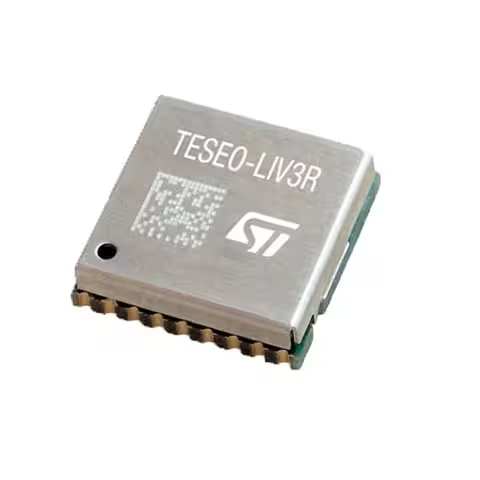
TESEO-LIV3R
STMicroelectronics
-
M20048-1
Antenova
-
CMX994EQ4
CML Micro
Tech Hub

A practical engineering and sourcing framework covering lifecycle verification, lifetime-buy calculations, replacement qualification, supplier checks and counterfeit-risk controls.

TTL and CMOS logic families differ in thresholds, loading, output drive, power and timing. This engineering guide compares 74HC and 74HCT, calculates noise margins and checks 3.3 V/5 V compatibility.

A practical engineering guide to 3.3V and 5V logic compatibility, input thresholds, resistor dividers, translator ICs, MOSFET level shifting, I2C pull-ups, timing limits and power-sequencing risks.

The 74HC595 uses push-pull logic outputs, while the TPIC6B595 uses 50 V open-drain DMOS sinks for higher-power loads. This guide compares timing, current limits, 3.3 V interfacing, load wiring, thermal…

The 74HC595 converts serial data into eight stable parallel outputs. This guide covers pin functions, shift and storage timing, OE and MR behavior, drive-current limits, cascading, voltage compatibilit…

A technical comparison of level-sensitive latches and edge-triggered flip-flops, covering timing windows, setup and hold limits, master–slave operation, time borrowing, race-through, HDL inference and…

A D latch stores one bit while Enable controls when data can pass. This reference covers gate-level operation, truth tables, transparency, setup and hold timing, LE versus OE, common ICs and practical …

An SR latch stores one bit through cross-coupled feedback. This engineering reference covers NOR and NAND implementations, truth tables, forbidden-state recovery, gated operation, switch debouncing, fa…

Latch circuits retain one bit through feedback. This technical reference covers SR and D latches, truth tables, transparency, timing limits, latch-versus-flip-flop behavior, applications and common log…

An engineering guide to LED driver operation, constant-current and constant-voltage outputs, linear and switching topologies, dimming, IC selection, calculations, replacement compatibility, and fault c…


