
 My Inquiry
 My Account


STMicroelectronics TDA7808-ZST
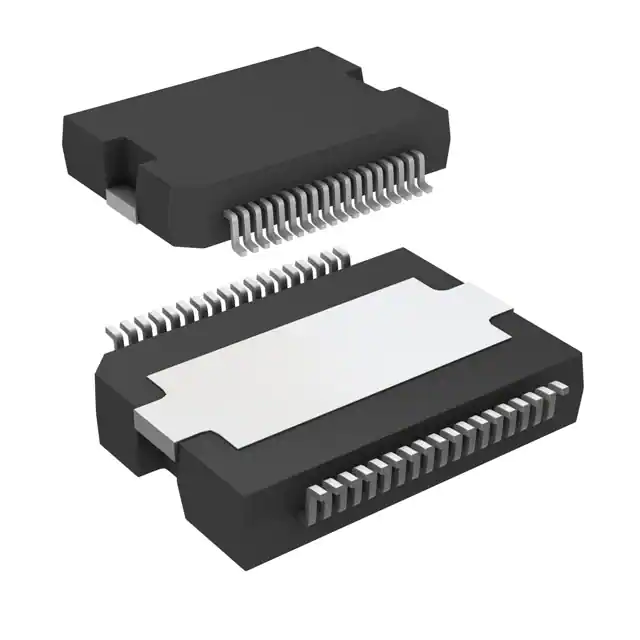
- Part No.:
- TDA7808-ZST
- Manufacturer:
- STMicroelectronics
- Category:
- Audio Special Purpose
- Package:
- PowerSO-36 Exposed Top Pad
- Datasheet:
-
 TDA7808-ZST.pdf
- Description:
- HIGH EFFICIENCY DIGITAL INPUT AU
- Quantity:
- Payment:

- Shipping:

Inventory:2,554
Please send an inquiry. Send us your inquiry, and we will respond immediately.
Product details
Overview
TDA7808-ZST from STMicroelectronics is an AEC-Q100 qualified, quad-channel Class-AB/G hybrid automotive audio power amplifier with 24-bit digital input interface (I2S/TDM), 115 dB A-weighted dynamic range, and start-stop battery compatibility down to 6 V. It delivers 4 × 27 W into 4 Ω at 14.4 V/1 kHz/10% THD and integrates a programmable PLL, independent front/rear clipping detection, and SB-I high-efficiency operation for reduced thermal dissipation in infotainment head units.
For engineers reviewing the TDA7808-ZST datasheet, TDA7808-ZST pinout, TDA7808-ZST application, or TDA7808-ZST equivalent, key selection considerations include its PowerSO-36 (slug-up) package, I²C-addressable mode control (4 selectable addresses), flexible serial audio interface (TDM up to 16 ch), and dual-domain ground separation (DGND/AGND/PWGND) for low-noise automotive audio systems.
Technical Context
The TDA7808-ZST implements a full digital-to-analog conversion chain with integrated 24-bit DAC, enabling 115 dB SNR and >110 dB dynamic range. Its SB-I (Switched-Bias Improved) architecture dynamically modulates supply rails to reduce average power dissipation by up to 50% versus conventional Class AB under real-world music signals.
It supports sample rates of 44.1/48/96/192 kHz via configurable I2S or TDM interfaces (4/8/16-channel), and integrates a lockable PLL synchronized to 64×Fs. The device operates across 6–18.5 V supply, maintaining full functionality during engine cranking and start-stop cycles.
Key Specifications
| Parameter | Value and Actual Design Meaning |
|---|---|
| Output Channels | Quad bridge (4×); independent front/rear mute and play control |
| Max Output Power | 4 × 27 W @ 4 Ω, 14.4 V, 1 kHz, THD = 10% - sufficient for mid-power OEM head units |
| Dynamic Range | 115 dB (A-weighted) - enables high-fidelity reproduction with minimal noise floor |
| Supply Range | 6–18.5 V - supports full start-stop battery profile (6 V minimum operational) |
| Digital Interface | I2S/TDM (4/8/16 ch), 1.8 V/3.3 V logic - compatible with SoC audio processors and DSPs |
| Efficiency Mode | SB-I (Switched-Bias Improved) - reduces average dissipation by up to 50% vs. Class AB |
| Protection Features | Thermal shutdown, overcurrent limiting, offset/clipping detection, pop-free mute transitions |
Pinout & Package
Package: PowerSO-36 (slug-up), thermally enhanced surface-mount package with exposed metal slug for direct heatsink mounting and Rth j-case = 1 °C/W.
| Pin | Circuit Role | Design Meaning |
|---|---|---|
| 1, 18–19, 36 | TAB | Exposed slug connected to GND - primary thermal path and EMI reference plane |
| 2 | OUT4− | Negative output for channel 4 (right rear) - requires symmetric PCB layout with OUT4+ |
| 3, 21, 34 | VCC34 / VCC12 | Separate battery rails for channels 3/4 and 1/2 - enables independent power domain routing |
| 7 | CD/DIAG | Open-drain diagnostic output - asserts low on clipping or fault; supports system-level error logging |
| 8–9 | SDA / SCL | I²C bus interface (1.8 V/3.3 V tolerant) - used for configuration, gain, and mode control |
| 10 | ADD | I²C address select input - sets one of four device addresses (0x48–0x4B) for multi-device buses |
| 11 | STBY | CMOS-compatible standby enable - active-low; controls global power state and quiescent current (≤4 μA) |
| 13 | UNMUTEhw | Hardware unmute control - overrides digital mute for fail-safe audio recovery |
| 14, 17, 20, 23, 32, 35 | OUTx+, OUTx− | Differential power outputs per channel - require Kelvin-sense routing and local RC snubbers |
| 27–28 | DGND / AGND | Separated digital/analog grounds - must be joined at single point near device to prevent noise coupling |
Key Features
| Feature | Design Value |
|---|---|
| Start-stop compatibility | Operates continuously from 6 V - eliminates audio dropout during engine restart in modern ICE/EV platforms |
| SB-I high-efficiency architecture | Reduces average power dissipation by up to 50% vs. Class AB - lowers heatsink size and system cost |
| Independent front/rear clipping detection | Per-channel overload monitoring via CD/DIAG pin - enables adaptive volume limiting and speaker protection |
| Flexible digital gain control | Configurable digital gains per channel - enables precise line-out level matching without external attenuators |
| Pop-free mute/play transitions | Internal soft-start/soft-stop sequencing - prevents audible transients during source switching or mute events |
Applications
| Automotive Infotainment Head Unit | OEM Digital Radio Receiver |
|---|---|
|
Use Scenario: Integrated 4-channel audio amplification in compact dashboard-mounted head units with digital tuner and navigation. IC Role / Device Role / Timing Role: Quad bridge power stage with embedded 24-bit DAC and I2S/TDM interface - replaces external DAC + analog amp stack. Use Value: Eliminates analog signal path degradation and reduces BOM count by 3+ components while maintaining 115 dB dynamic range. |
Use Scenario: High-fidelity audio playback in factory-installed DAB+/HD Radio receivers with multi-zone output capability. IC Role / Device Role / Timing Role: Digital-input amplifier with independent front/rear mute control - enables seamless source switching between FM/DAB/Bluetooth. Use Value: Hardware UNMUTEhw pin ensures guaranteed audio recovery after power interruption, meeting OEM functional safety requirements. |
| Start-Stop Compatible Rear Seat Entertainment | Automotive Active Noise Cancellation Module |
|
Use Scenario: Compact rear-seat audio system powered directly from vehicle battery with cranking voltage tolerance. IC Role / Device Role / Timing Role: Low-voltage operational amplifier (6 V min) with SB-I efficiency - sustains playback during 500-ms 6–8 V battery dips. Use Value: Avoids need for auxiliary DC-DC boost converter, reducing solution size and EMI emissions. |
Use Scenario: Real-time ANC processing unit requiring ultra-low latency analog output and precise gain staging. IC Role / Device Role / Timing Role: Low-offset (±25 mV), low-distortion (0.015% THD) analog output stage - synchronizes with DSP-generated anti-noise waveforms. Use Value: Integrated offset detector and clipping diagnostics enable closed-loop ANC stability monitoring without external sensors. |
Equivalent & Alternatives
The following parts are listed as comparable options for similar quad-channel automotive digital-input amplifier applications.
| Alternative Part | Technical Difference | Application Difference | Selection Advice |
|---|---|---|---|
| TDA7803TR | 3-channel variant, same PowerSO-36 package, identical SB-I architecture and 115 dB DR | Lacks fourth channel and TDM-16 support; optimized for 3-speaker layouts (e.g., center + left/right) | Select when system requires only three amplified zones and space-constrained layout favors footprint reuse |
| MAX9877ETJ+ | 3.3 V only supply, 2-channel, Class D, 102 dB DR, no start-stop support below 9 V | Higher efficiency but incompatible with 6 V cranking; lacks clipping diagnostics and hardware unmute | Choose for non-start-stop platforms prioritizing peak efficiency over battery-profile robustness |
Compared with TDA7808-ZST, TDA7803TR offers channel-count reduction without sacrificing SB-I efficiency or AEC-Q100 compliance, while MAX9877ETJ+ trades start-stop resilience and diagnostic depth for higher peak efficiency in stable-supply environments.
Availability
TDA7808-ZST is available at Aetrix Electronics and suitable for automotive infotainment head units, OEM digital radio receivers, and start-stop compatible rear seat entertainment systems requiring stable component supply across extended product lifecycles.
Supply support for TDA7808-ZST includes scheduled delivery planning, volume procurement assistance, BOM continuity management, traceable sourcing, and lifecycle availability coordination for OEM customers, industrial embedded developers, connected-device designers, and electronics production programs.
Manufacturer
STMicroelectronics is a global semiconductor leader specializing in automotive-grade analog, power, and microcontroller solutions with broad AEC-Q100 portfolio coverage.
The TDA7808 belongs to ST's automotive audio power amplifier product line, designed specifically for digital-input, start-stop compatible infotainment systems demanding high fidelity, thermal efficiency, and functional safety-aware diagnostics.
FAQ
What is the function of the ADD pin on TDA7808-ZST?
The ADD pin selects one of four I²C slave addresses (0x48–0x4B) by pulling it high/low, enabling multiple TDA7808-ZST devices on the same I²C bus without address conflict. It is sampled at power-on reset and remains latched until next reset; no external pull-up/down is required if using default address 0x48.
Does TDA7808-ZST support TDM16 mode with 8+8 channel interleaving?
Yes - the TDA7808-ZST supports TDM16 format with two 8-channel groups (TDM 8ch + TDM 8ch), as defined in Figure 29 of DS12230 Rev 4. This allows connection to dual-DSP or multi-core SoC audio interfaces where left/right data streams are time-multiplexed across 16 slots per frame.
How does SB-I efficiency differ from standard Class G operation?
SB-I dynamically adjusts internal bias rails based on instantaneous audio envelope-not just signal amplitude-enabling finer-grained power optimization for uncorrelated music signals. Unlike fixed-rail Class G, SB-I achieves up to 50% lower average dissipation while retaining full Class AB linearity and 115 dB dynamic range.
Can TDA7808-ZST operate with 1.8 V I²C and 3.3 V I²S simultaneously?
Yes - the TDA7808-ZST supports mixed-voltage operation: SDA/SCL pins tolerate 1.8 V logic levels (with internal 3.3 V pull-ups enabled), while WS/SCK/SD13/SD24 accept 1.8 V or 3.3 V inputs. This allows direct interfacing with 1.8 V application processors and 3.3 V audio codecs without level shifters.
TDA7808-ZST Specifications
- Product attributes
- Attribute value
- Manufacturer:
- STMicroelectronics
- Series:
- -
- Package/Case:
- PowerSO-36 Exposed Top Pad
- Packaging:
- Tape & Reel (TR)
- Product Status:
- Active
- Function:
- Audio Amplifier
- Applications:
- Audio
- Number of Channels:
- 4
- Interface:
- I2C, I2S, TDM
- Voltage - Supply:
- 6V ~ 18.5V
- Operating Temperature:
- -40°C ~ 105°C (TA)
- Specifications:
- 115dB
- Mounting Type:
- Surface Mount
- Grade:
- Automotive
TDA7808-ZST FAQ
1.How can I place an order for TDA7808-ZST through Aetrix?
Please submit a Request for Quotation (RFQ) for TDA7808-ZST on Aetrix. Our sales agent will provide a competitive quotation and guide you through the order confirmation once you accept the terms.
2.Are the price and stock information for TDA7808-ZST reliable?
The price and inventory of TDA7808-ZST are updated periodically and may fluctuate due to market conditions. Stock and pricing data are typically refreshed every 24 hours. Quotation validity for TDA7808-ZST is usually 5 days.
3.What payment methods are accepted for TDA7808-ZST?
We accept Wire Transfer, PayPal, Credit Card, Western Union, MoneyGram, and Escrow for TDA7808-ZST transactions.
Note: Certain payment methods may incur a processing fee.
4.How is shipping managed for TDA7808-ZST?
TDA7808-ZST orders can be shipped via leading logistics carriers, including DHL, UPS, FedEx, TNT, or Registered Mail.
Once your TDA7808-ZST order is processed, you will receive an email with the shipment details and tracking number.
Note: Tracking information may take up to 24 hours to appear. Express delivery typically takes 3–5 business days.
5.How can I obtain technical support or documentation for TDA7808-ZST?
For technical support, including TDA7808-ZST datasheets, pinout diagrams, or application guidance, please contact our engineering support team. They can provide detailed documentation and assistance for your TDA7808-ZST requirements.
6.How does Aetrix verify that TDA7808-ZST is sourced from the original manufacturer or authorized distributors?
All TDA7808-ZST products on Aetrix are procured from qualified distributors and authorized channels. Our dedicated quality assurance team conducts strict verification, including traceability checks and, if necessary, third-party testing. This ensures that TDA7808-ZST meets industry standards.
7.What is the process for return or replacement of TDA7808-ZST?
All TDA7808-ZST units undergo pre-shipment inspection (PSI). If there is an issue with TDA7808-ZST, returns or replacements are accepted under the following conditions:
1.Quantity discrepancies, incorrect items, or visible external defects (such as breakage or corrosion), acknowledged by Aetrix.
2.The issue is reported within 90 days of delivery.
3.The TDA7808-ZST part is unused and in its original packaging.
Return procedure for TDA7808-ZST:
1.Submit a request within 90 days.
2.Obtain a Return Material Authorization (RMA) from Aetrix.
TDA7808-ZST Tags
-
SA571DR2G
onsemi
-
ADAU7002ACBZ-R7
Analog Devices Inc.

-
DRV135UA/2K5
Texas Instruments
-
DRV134UA/1K
Texas Instruments
-
DRV134PA
Texas Instruments
-
DRV134UA
Texas Instruments
-
DRV135UA
Texas Instruments
-
SA572DR2G
onsemi
-
PGA2311U/1K
Texas Instruments
-
SI8244BB-D-IS1R
Skyworks Solutions Inc.

-
CS8416K-CZZR
Cirrus Logic Inc.
-
SRC4392IPFBR
Texas Instruments
Tech Hub

A practical engineering and sourcing framework covering lifecycle verification, lifetime-buy calculations, replacement qualification, supplier checks and counterfeit-risk controls.

TTL and CMOS logic families differ in thresholds, loading, output drive, power and timing. This engineering guide compares 74HC and 74HCT, calculates noise margins and checks 3.3 V/5 V compatibility.

A practical engineering guide to 3.3V and 5V logic compatibility, input thresholds, resistor dividers, translator ICs, MOSFET level shifting, I2C pull-ups, timing limits and power-sequencing risks.

The 74HC595 uses push-pull logic outputs, while the TPIC6B595 uses 50 V open-drain DMOS sinks for higher-power loads. This guide compares timing, current limits, 3.3 V interfacing, load wiring, thermal…

The 74HC595 converts serial data into eight stable parallel outputs. This guide covers pin functions, shift and storage timing, OE and MR behavior, drive-current limits, cascading, voltage compatibilit…

A technical comparison of level-sensitive latches and edge-triggered flip-flops, covering timing windows, setup and hold limits, master–slave operation, time borrowing, race-through, HDL inference and…

A D latch stores one bit while Enable controls when data can pass. This reference covers gate-level operation, truth tables, transparency, setup and hold timing, LE versus OE, common ICs and practical …

An SR latch stores one bit through cross-coupled feedback. This engineering reference covers NOR and NAND implementations, truth tables, forbidden-state recovery, gated operation, switch debouncing, fa…

Latch circuits retain one bit through feedback. This technical reference covers SR and D latches, truth tables, transparency, timing limits, latch-versus-flip-flop behavior, applications and common log…

An engineering guide to LED driver operation, constant-current and constant-voltage outputs, linear and switching topologies, dimming, IC selection, calculations, replacement compatibility, and fault c…


