
 My Inquiry
 My Account


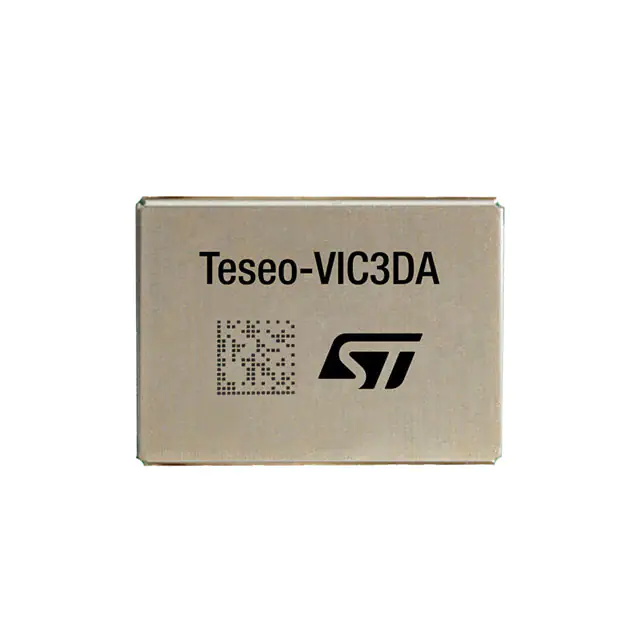
STMicroelectronics TESEO-VIC3DA
- Part No.:
- TESEO-VIC3DA
- Manufacturer:
- STMicroelectronics
- Category:
- RF Receivers
- Package:
- 24-SMD Module
- Datasheet:
-
 TESEO-VIC3DA.pdf
- Description:
- TESEOVIC3DA: AUTOMOTIVE GNSS DEA
- Quantity:
- Payment:

- Shipping:

Inventory:369
Please send an inquiry. Send us your inquiry, and we will respond immediately.
Product details
Overview
TESEO-VIC3DA from STMicroelectronics is an AEC-Q100 qualified automotive GNSS dead-reckoning module integrating a Teseo III GNSS receiver, 6-axis inertial sensor (ASM330LHH), TCXO, RTC, and 16 Mb stacked flash. It delivers 1.5 m CEP autonomous positioning, -163 dBm tracking sensitivity, and 30 Hz dead-reckoning fix rate for tunnel/urban canyon navigation. Used in automotive telematics, ADAS map-matching, and fleet tracking systems.
For engineers reviewing the TESEO-VIC3DA datasheet, TESEO-VIC3DA pinout, TESEO-VIC3DA application, or TESEO-VIC3DA equivalent, key selection criteria include AEC-Q100 qualification, simultaneous GPS/Galileo/GLONASS/BeiDou/QZSS support, embedded DRAW firmware, 17 μA standby current, and LCC-24 package compatibility with automotive thermal (-40°C to +85°C) and mechanical requirements.
Technical Context
The TESEO-VIC3DA implements a tightly coupled GNSS/IMU fusion architecture using ARM-core firmware (TESEO-DRAW) that processes raw accelerometer and gyroscope data from the integrated ASM330LHH alongside multi-constellation satellite measurements. Its dedicated RTC oscillator enables sub-2-second hot TTFF and supports periodic low-power wake-up modes.
Signal acquisition leverages a high-stability TCXO for RF down-conversion and timing integrity, while dual UART, I²C, and configurable GPIOs (WHEELTICK, FWD, PPS) enable direct odometer integration and NMEA-based host communication. Firmware configurability allows runtime selection of constellations, SBAS services (WAAS/EGNOS/GAGAN/MSAS), and assisted GNSS modes (ST-AGNSS up to 7-day prediction, RT-AGNSS via server).
Key Specifications
| Parameter | Value and Actual Design Meaning |
|---|---|
| GNSS Constellations | Simultaneous GPS L1C/A, Galileo E1B/C, GLONASS L1OF, BeiDou B1, QZSS L1C/A - enables robust positioning across global regions and signal-degraded environments |
| Positioning Accuracy | 1.5 m CEP (autonomous, 24h static, roof antenna) - meets automotive lane-level navigation requirements without external correction |
| Tracking Sensitivity | -163 dBm - sustains lock under weak-signal conditions such as urban canyons or partial indoor coverage |
| Dead-Reckoning Rate | Up to 30 Hz - provides high-temporal-resolution vehicle motion estimation during GNSS outages |
| Supply Voltage | 3.3 V ±10% (VCC and V_BAT) - compatible with standard automotive 3.3 V power domains and backup battery circuits |
| Operating Temperature | -40°C to +85°C - certified for under-hood and dashboard-mounted automotive deployment |
| Standby Current | 17 μA (RTC active) - enables multi-year battery-backed operation in always-on telematics applications |
| TTFF (Hot Start) | < 2 s (GPS+Galileo) - reduces time-to-navigation after ignition or brief signal loss |
Pinout & Package
LCC-24 surface-mount package (16.0 mm × 12.2 mm × 2.42 mm), RoHS-compliant, designed for reflow soldering per JEDEC J-STD-020 profile (peak 245°C ±5°C). Pin 1 marked by dot; pins 10, 12, 13, and 24 are GND for low-noise RF and digital grounding.
| Pin/Terminal | Circuit Role | Design Meaning |
|---|---|---|
| 1 Wake-up | Input | External interrupt to exit standby mode - enables host-controlled low-power sequencing |
| 3 PPS | Output | Pulse-per-second timing reference - synchronizes host system clocks to GNSS time with ±19.6 ns accuracy |
| 4 WHEELTICK | Input | Draw wheel tick signal - feeds vehicle odometry directly into TESEO-DRAW firmware for drift-compensated DR |
| 8 nReset | Input | Active-low hardware reset - ensures deterministic recovery from fault or brown-out conditions |
| 9 VCC_RF | Output | 3.3 V regulated supply for external active antennas - eliminates need for separate LDO in antenna path |
| 11 RF_IN | Input | 50 Ω single-ended GNSS RF input - accepts signals from ceramic patch or SAW-filtered antennas |
| 14 Ant_OFF | Output | Antenna power control - enables host to disable active antenna during standby to reduce system leakage |
| 15 FWD | Input | Draw forward direction signal - resolves vehicle heading ambiguity during reverse motion in dead-reckoning |
| 18 I2C_SDA | I/O | Open-drain I²C data line - supports NMEA message transport at 100/400 kHz for resource-constrained hosts |
| 19 I2C_SCL | I/O | Open-drain I²C clock line - enables shared-bus configuration with other automotive sensors |
| 20 UART-TX / 21 UART-RX | O / I | Full-duplex UART interface - carries NMEA-0183 and proprietary commands for configuration and data streaming |
| 22 V_BAT | Input | Backup supply for RTC and SRAM retention - maintains timekeeping and configuration state during main power loss |
| 23 VCC | Input | Main 3.3 V digital supply - powers GNSS core, IMU, flash, and interface logic |
Key Features
| Feature | Design Value |
|---|---|
| AEC-Q100 Grade 2 qualification | Validated for automotive use across -40°C to +105°C junction range - ensures reliability in safety-critical telematics |
| Embedded TESEO-DRAW firmware | Real-time GNSS/IMU sensor fusion algorithm - delivers continuous positioning during >30 s GNSS outages without external processing |
| Onboard 16 Mb stacked flash | Stores firmware, ephemeris predictions, and configuration - enables field-upgradable AGNSS and feature enhancements |
| Dual UART + I²C interfaces | Redundant NMEA transport paths - allows host processor to maintain GNSS data flow even if one interface fails |
| TCXO + RTC co-design | Stable 32.768 kHz RTC reference with trimming - reduces TTFF variance and improves long-term timing holdover accuracy |
| Free firmware configurability | Runtime NMEA command set for constellation selection, SBAS enable/disable, and AGNSS mode switching - eliminates need for pre-flashed variants |
Applications
| Automotive Telematics Control Unit (TCU) | ADAS Map-Matching Engine |
|---|---|
Use Scenario: Real-time vehicle location reporting in connected car platforms with cellular backhaul. IC Role / Device Role / Timing Role: Primary GNSS/DR positioning source feeding location data to cloud services and OTA update managers. Use Value: 1.5 m CEP accuracy and 30 Hz DR output enable precise geofence triggering and predictive maintenance routing. | Use Scenario: Lane-level position alignment for adaptive cruise control and lane-keeping assist. IC Role / Device Role / Timing Role: High-integrity motion estimator fusing GNSS, wheel ticks, and IMU to correct GPS drift on curved highways. Use Value: Sub-2° heading accuracy at 30 m/s and 0.01 m/s velocity resolution ensure stable lateral control during GNSS-denied segments. |
| Fleet Management Terminal | Emergency Call (eCall) Module |
Use Scenario: Asset tracking for commercial vehicles operating across multi-constellation coverage zones (EU, Asia, North America). IC Role / Device Role / Timing Role: Multi-regional GNSS engine supporting WAAS, EGNOS, GAGAN, and MSAS augmentation for consistent accuracy. Use Value: Simultaneous GPS+Galileo+BeiDou tracking ensures <2 s TTFF and <1.4 m SBAS-enhanced accuracy in all operational regions. | Use Scenario: Automatic crash notification with precise location stamping within 100 ms of airbag deployment. IC Role / Device Role / Timing Role: Always-on positioning subsystem powered by V_BAT, delivering last-known position and time pulse (PPS) upon wake-up. Use Value: 17 μA standby current and RTC-anchored fast reacquisition guarantee location availability even after extended vehicle shutdown. |
Equivalent & Alternatives
The following parts are listed as comparable options for similar GNSS dead-reckoning applications.
| Alternative Part | Technical Difference | Application Difference | Selection Advice |
|---|---|---|---|
| u-blox UDR7 | Supports GPS/Galileo/GLONASS only; no BeiDou/QZSS; uses external IMU; no embedded flash for firmware updates | Targeted at industrial asset tracking, not AEC-Q100 automotive systems | Select when multi-constellation flexibility is secondary to cost and legacy u-blox ecosystem integration |
| Texas Instruments CC2652RB | Bluetooth SoC with integrated crystal; lacks dedicated GNSS/IMU; requires external GNSS module and sensor fusion software | Designed for low-power IoT nodes, not automotive-grade positioning | Select when BLE connectivity dominates over high-accuracy dead reckoning and GNSS autonomy |
Compared with u-blox UDR7 and TI CC2652RB, TESEO-VIC3DA uniquely integrates AEC-Q100 qualification, multi-constellation GNSS, 6-axis IMU, TCXO, RTC, and flash in a single LCC-24 package - eliminating BOM complexity and validation effort for automotive OEMs.
Availability
TESEO-VIC3DA is available at Aetrix Electronics and suitable for automotive telematics, ADAS map-matching, fleet management terminals, and emergency call (eCall) modules requiring stable component supply across extended temperature ranges and long product lifecycles.
Supply support for TESEO-VIC3DA includes scheduled delivery planning, volume procurement assistance, BOM continuity management, traceable sourcing, and lifecycle availability coordination for OEM customers, industrial embedded developers, connected-device designers, and electronics production programs.
Manufacturer
STMicroelectronics is a global semiconductor leader headquartered in Geneva, Switzerland, designing and manufacturing microcontrollers, sensors, power ICs, and automotive-grade solutions used in over 10 billion devices annually.
The Teseo product line delivers certified, ready-to-deploy GNSS modules optimized for automotive safety, precision navigation, and regulatory compliance - with TESEO-VIC3DA specifically engineered for AEC-Q100-compliant dead-reckoning in telematics and ADAS systems.
FAQ
What GNSS constellations does TESEO-VIC3DA support simultaneously?
TESEO-VIC3DA supports simultaneous reception and tracking of GPS L1C/A, Galileo E1B/C, GLONASS L1OF, BeiDou B1, and QZSS L1C/A signals. Firmware configuration allows selective activation of constellations; default is GPS+GLONASS. Concurrent BeiDou and GLONASS are mutually exclusive per design, but either may run with GPS and Galileo.
How is dead reckoning implemented and what inputs does it require?
Dead reckoning is implemented via embedded TESEO-DRAW firmware that fuses raw 6-axis IMU data (from the integrated ASM330LHH) with GNSS measurements. Required inputs include WHEELTICK (pin #4) for odometer pulses and FWD (pin #15) for forward/reverse direction detection. Optional map-matching feedback can be provided via host processor to further refine position estimates during GNSS outages.
Does TESEO-VIC3DA support assisted GNSS, and what types are available?
Yes, TESEO-VIC3DA supports two assisted GNSS modes: ST-AGNSS (ST-Assisted GNSS) and RT-AGNSS (Real-Time Assisted GNSS). ST-AGNSS uses internally predicted ephemeris (up to 7 days) derived from previously downloaded satellite data. RT-AGNSS downloads real-time ephemeris from an external server via UART or I²C using proprietary NMEA commands and credentials provided by STMicroelectronics partners.
What is the role of the VCC_RF pin and how should it be used?
VCC_RF (pin #9) is a 3.3 V regulated output supplying power to external active GNSS antennas. It remains active during software standby mode, so host firmware must assert Ant_OFF (pin #14) to disable the antenna and prevent unnecessary current draw. During VCC standby (main supply off), VCC_RF is inactive, eliminating antenna power leakage entirely.
TESEO-VIC3DA Specifications
- Product attributes
- Attribute value
- Manufacturer:
- STMicroelectronics
- Series:
- -
- Package/Case:
- 24-SMD Module
- Packaging:
- Tray
- Product Status:
- Active
- Frequency:
- 1.561GHz, 1.575GHz
- Sensitivity:
- -163dBm
- Data Rate (Max):
- -
- Modulation or Protocol:
- BeiDou, Galileo, GLONASS, GNSS, GPS
- Applications:
- GPS
- Current - Receiving:
- -
- Data Interface:
- I2C, UART
- Memory Size:
- -
- Antenna Connector:
- Not Included
- Features:
- -
- Voltage - Supply:
- 2.97V ~ 3.63V
- Operating Temperature:
- -40°C ~ 85°C (TA)
- Grade:
- Automotive
- Qualification:
- AEC-Q100
- Mounting Type:
- Surface Mount
- Supplier Device Package:
- -
TESEO-VIC3DA FAQ
1.How can I place an order for TESEO-VIC3DA through Aetrix?
Please submit a Request for Quotation (RFQ) for TESEO-VIC3DA on Aetrix. Our sales agent will provide a competitive quotation and guide you through the order confirmation once you accept the terms.
2.Are the price and stock information for TESEO-VIC3DA reliable?
The price and inventory of TESEO-VIC3DA are updated periodically and may fluctuate due to market conditions. Stock and pricing data are typically refreshed every 24 hours. Quotation validity for TESEO-VIC3DA is usually 5 days.
3.What payment methods are accepted for TESEO-VIC3DA?
We accept Wire Transfer, PayPal, Credit Card, Western Union, MoneyGram, and Escrow for TESEO-VIC3DA transactions.
Note: Certain payment methods may incur a processing fee.
4.How is shipping managed for TESEO-VIC3DA?
TESEO-VIC3DA orders can be shipped via leading logistics carriers, including DHL, UPS, FedEx, TNT, or Registered Mail.
Once your TESEO-VIC3DA order is processed, you will receive an email with the shipment details and tracking number.
Note: Tracking information may take up to 24 hours to appear. Express delivery typically takes 3–5 business days.
5.How can I obtain technical support or documentation for TESEO-VIC3DA?
For technical support, including TESEO-VIC3DA datasheets, pinout diagrams, or application guidance, please contact our engineering support team. They can provide detailed documentation and assistance for your TESEO-VIC3DA requirements.
6.How does Aetrix verify that TESEO-VIC3DA is sourced from the original manufacturer or authorized distributors?
All TESEO-VIC3DA products on Aetrix are procured from qualified distributors and authorized channels. Our dedicated quality assurance team conducts strict verification, including traceability checks and, if necessary, third-party testing. This ensures that TESEO-VIC3DA meets industry standards.
7.What is the process for return or replacement of TESEO-VIC3DA?
All TESEO-VIC3DA units undergo pre-shipment inspection (PSI). If there is an issue with TESEO-VIC3DA, returns or replacements are accepted under the following conditions:
1.Quantity discrepancies, incorrect items, or visible external defects (such as breakage or corrosion), acknowledged by Aetrix.
2.The issue is reported within 90 days of delivery.
3.The TESEO-VIC3DA part is unused and in its original packaging.
Return procedure for TESEO-VIC3DA:
1.Submit a request within 90 days.
2.Obtain a Return Material Authorization (RMA) from Aetrix.
TESEO-VIC3DA Tags
-
MICRF220AYQS-TR
Microchip Technology
-
SX1239IMLTRT
Semtech Corporation
-
SI4356-B1A-FMR
Silicon Labs

-
SI4362-C2A-GMR
Silicon Labs

-
MAX1473EUI+T
Analog Devices Inc./Maxim Integrated

-
CMX992Q3
CML Micro

-
CMX994AQ4
CML Micro

-
MAX2112ETI+
Analog Devices Inc./Maxim Integrated
-
MAX2112ETI+T
Analog Devices Inc./Maxim Integrated
-
TESEO-LIV3R
STMicroelectronics
-
M20048-1
Antenova
-
CMX994EQ4
CML Micro
Tech Hub

A practical engineering and sourcing framework covering lifecycle verification, lifetime-buy calculations, replacement qualification, supplier checks and counterfeit-risk controls.

TTL and CMOS logic families differ in thresholds, loading, output drive, power and timing. This engineering guide compares 74HC and 74HCT, calculates noise margins and checks 3.3 V/5 V compatibility.

A practical engineering guide to 3.3V and 5V logic compatibility, input thresholds, resistor dividers, translator ICs, MOSFET level shifting, I2C pull-ups, timing limits and power-sequencing risks.

The 74HC595 uses push-pull logic outputs, while the TPIC6B595 uses 50 V open-drain DMOS sinks for higher-power loads. This guide compares timing, current limits, 3.3 V interfacing, load wiring, thermal…

The 74HC595 converts serial data into eight stable parallel outputs. This guide covers pin functions, shift and storage timing, OE and MR behavior, drive-current limits, cascading, voltage compatibilit…

A technical comparison of level-sensitive latches and edge-triggered flip-flops, covering timing windows, setup and hold limits, master–slave operation, time borrowing, race-through, HDL inference and…

A D latch stores one bit while Enable controls when data can pass. This reference covers gate-level operation, truth tables, transparency, setup and hold timing, LE versus OE, common ICs and practical …

An SR latch stores one bit through cross-coupled feedback. This engineering reference covers NOR and NAND implementations, truth tables, forbidden-state recovery, gated operation, switch debouncing, fa…

Latch circuits retain one bit through feedback. This technical reference covers SR and D latches, truth tables, transparency, timing limits, latch-versus-flip-flop behavior, applications and common log…

An engineering guide to LED driver operation, constant-current and constant-voltage outputs, linear and switching topologies, dimming, IC selection, calculations, replacement compatibility, and fault c…


