
 My Inquiry
 My Account


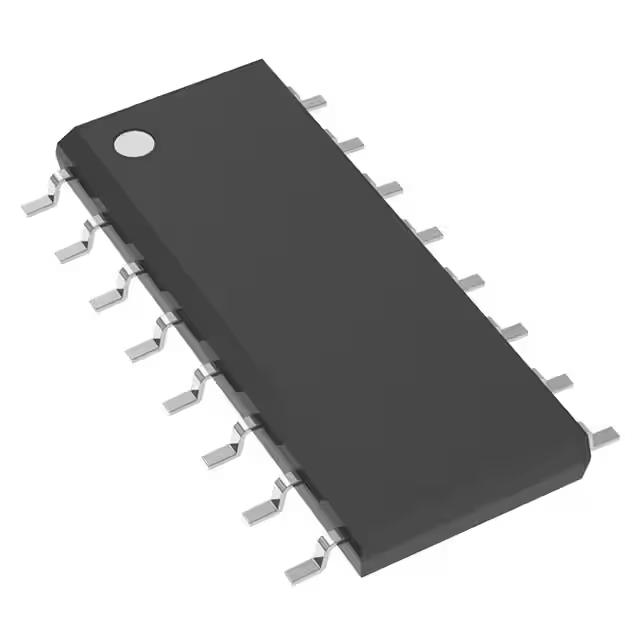
Texas Instruments TLC5916IDG4
- Part No.:
- TLC5916IDG4
- Manufacturer:
- Texas Instruments
- Category:
- LED Drivers
- Package:
- 16-SOIC (0.154", 3.90mm Width)
- Datasheet:
-
 TLC5916IDG4.pdf
- Description:
- IC LED DRVR LINEAR 120MA 16SOIC
- Quantity:
- Payment:

- Shipping:

Inventory:1,781
Please send an inquiry. Send us your inquiry, and we will respond immediately.
Product details
Overview
TLC5916IDG4 from Texas Instruments is an 8-channel constant-current LED sink driver IC designed for precise LED current control in display and lighting systems. It delivers 3–120 mA per channel with ±3% inter-channel accuracy, supports 3.0–5.5 V supply, and features open-load and overtemperature detection. It operates in cascaded LED driver configurations for large-panel signage and video billboards.
For engineers reviewing the TLC5916IDG4 datasheet, TLC5916IDG4 pinout, TLC5916IDG4 application, or TLC5916IDG4 equivalent, key selection criteria include its 30-MHz serial clock capability, single R-EXT current setting, error-detection mode via OE/LE dual-function pins, and SOIC-16 package compatibility with industrial LED panel layouts.
Technical Context
The TLC5916IDG4 integrates an 8-bit shift register and parallel output latches to convert serial data into independent channel control signals. Its current regulation uses an external R-EXT resistor to set a global sink current across all eight outputs, with invariant performance up to 20 V LED voltage.
It supports two operational modes: Normal Mode for LED data loading and latching, and Special Mode (triggered by OE(ED2) pulse) for reading error status or programming 256-step global current gain. Unlike the TLC5917, it lacks short-circuit detection but retains open-load and overtemperature fault reporting per channel.
Key Specifications
| Parameter | Value and Actual Design Meaning |
|---|---|
| Output channels | 8 independent constant-current sink outputs (OUT0–OUT7) |
| Output current range | 3 mA to 120 mA per channel, set by single R-EXT resistor |
| Inter-channel accuracy | < ±3% max - ensures uniform LED brightness across all 8 outputs |
| Supply voltage | 3.0 V to 5.5 V - compatible with both 3.3-V and 5-V logic systems |
| Max LED voltage | 20 V - supports multi-LED strings or high-VF white/UV LEDs |
| Serial clock frequency | 30 MHz - enables fast refresh rates for high-resolution scrolling displays |
| Fault detection | Open-load and overtemperature per channel - enables system-level LED health monitoring |
Pinout & Package
Package: SOIC-16 (9.90 mm × 3.91 mm), surface-mount, RoHS-compliant.
| Pin/Terminal | Circuit Role | Design Meaning |
|---|---|---|
| GND (Pin 1) | Ground reference | Common return path for logic and sink current; must be low-impedance for stable current regulation |
| SDI (Pin 2) | Serial data input | Accepts 8-bit LED on/off data synchronized to CLK rising edge |
| CLK (Pin 3) | Serial clock input | Rising-edge-triggered shift register clock; supports up to 30 MHz operation |
| LE(ED1) (Pin 4) | Latch enable / Error detect control | High→low transition latches shift register to output latch; used with OE(ED2) to enter Special Mode |
| OUT0–OUT7 (Pins 5–12) | Constant-current sink outputs | Each drives one LED cathode; sinks up to 120 mA with thermal foldback protection |
| VDD (Pin 16) | Power supply | 3.0–5.5 V supply for logic and internal regulators; bypass capacitor required at pin |
| R-EXT (Pin 15) | Current-setting reference | Connects external resistor to GND to define full-scale output current (e.g., 720 Ω → 26 mA) |
| SDO (Pin 14) | Serial data output | Shifts out latched data or error status code; enables daisy-chaining multiple TLC5916IDG4 devices |
| OE(ED2) (Pin 13) | Output enable / Error detect control | Active-low enables outputs; one-clock pulse initiates Special Mode for error readback or gain programming |
Key Features
| Feature | Design Value |
|---|---|
| Single-resistor current tuning | One external R-EXT sets identical current for all 8 channels - simplifies BOM and eliminates per-channel trimming |
| 256-step global current gain | Runtime-programmable gain (1/12 to 127/128) compensates inter-IC current variation - critical for white-balanced RGB panels |
| Per-channel fault reporting | Open-load and overtemperature errors stored in 8-bit status register - readable via SDO in Special Mode without interrupting display operation |
| Schmitt-trigger inputs | CLK, LE(ED1), OE(ED2), and SDI accept slow or noisy logic edges - improves noise immunity in industrial environments |
| Daisy-chain capability | SDI/SDO interface supports unlimited cascading - reduces microcontroller GPIO count for large LED arrays |
Applications
| LED Video Billboards | 7-Segment Display Modules |
|---|---|
Use Scenario: Outdoor digital signage requiring high-brightness, long-life LED arrays with real-time fault visibility. IC Role / Device Role / Timing Role: TLC5916IDG4 acts as a constant-current sink driver for individual LED segments, controlled via SPI-like serial interface with 30-MHz clock support. Use Value: Enables uniform luminance across thousands of LEDs while detecting open-circuit failures before visible dark zones appear. | Use Scenario: Industrial control panels using multiplexed 7-segment numeric displays with variable brightness requirements. IC Role / Device Role / Timing Role: TLC5916IDG4 provides independent on/off control and current scaling for each segment, driven by microcontroller GPIO and serial clock. Use Value: Eliminates need for discrete current-limiting resistors per segment and allows dynamic brightness adjustment via global gain register. |
| Gaming Machine Displays | White Goods Indicator Panels |
Use Scenario: High-reliability, animated LED displays in slot machines and arcade cabinets subject to vibration and thermal cycling. IC Role / Device Role / Timing Role: TLC5916IDG4 serves as fault-aware LED driver, with overtemperature shutdown protecting against localized hot spots during extended gameplay. Use Value: Prevents catastrophic LED failure and reports thermal events to host controller for predictive maintenance alerts. | Use Scenario: Appliance control panels (refrigerators, washing machines) needing robust, low-cost LED indicators with ESD resilience. IC Role / Device Role / Timing Role: TLC5916IDG4 drives status LEDs directly from MCU serial port, leveraging Schmitt-trigger inputs for noise immunity in electrically noisy environments. Use Value: Reduces component count vs. discrete transistor+resistor solutions and meets IEC 61000-4-2 Level 2 ESD requirements (±1500 V HBM). |
Equivalent & Alternatives
The following parts are listed as comparable options for similar constant-current LED sink driver applications.
| Alternative Part | Technical Difference | Application Difference | Selection Advice |
|---|---|---|---|
| TLC5916IPW | TSSOP-16 package (5.00 mm × 4.40 mm); identical electrical specs and pinout | Better thermal performance (RθJA = 113.9°C/W vs. 87.4°C/W for SOIC) and smaller footprint | Select for space-constrained PCBs or higher ambient temperature operation where thermal margin is critical |
| STP16DP05PTR | 16-channel sink driver; 5–100 mA range; built-in PWM dimming; no open-load detection | Higher channel density but lacks per-channel fault reporting and R-EXT simplicity | Choose when expanding channel count per IC is prioritized over diagnostic capability and analog current tuning |
Compared with TLC5916IPW, the TLC5916IDG4 offers lower thermal resistance in SOIC packaging for simpler heatsinking, while STP16DP05PTR trades diagnostic features for double the channel count and integrated PWM - making TLC5916IDG4 optimal for reliability-critical, medium-channel LED systems requiring field-serviceable fault visibility.
Availability
TLC5916IDG4 is available at Aetrix Electronics and suitable for LED video billboards, 7-segment display modules, and gaming machine displays requiring stable component supply, long-term lifecycle support, and traceable sourcing.
Supply support for TLC5916IDG4 includes scheduled delivery planning, volume procurement assistance, BOM continuity management, traceable sourcing, and lifecycle availability coordination for OEM customers, industrial embedded developers, connected-device designers, and electronics production programs.
Manufacturer
Texas Instruments is a U.S.-based semiconductor company specializing in analog and embedded processing technologies, with leadership in precision power management and signal chain solutions.
The TLC591x product line was engineered for LED display and general lighting applications demanding accurate, scalable, and fault-aware constant-current drive - particularly where uniformity, thermal resilience, and serial configurability are essential.
FAQ
What is the maximum output voltage rating for the TLC5916IDG4?
The TLC5916IDG4 supports up to 20 V at its OUT0–OUT7 terminals, enabling direct drive of multi-LED series strings or high-forward-voltage LEDs such as white, blue, or UV types. This rating is independent of VDD and applies under normal operating conditions with proper thermal management.
Does the TLC5916IDG4 support short-circuit detection like the TLC5917?
No, the TLC5916IDG4 does not support short-circuit detection. Per the official datasheet (SLVS695D), only the TLC5917 variant includes short-to-VLED detection circuitry. The TLC5916IDG4 implements open-load and overtemperature detection only - confirmed by Device Comparison Table and Feature Description sections.
How is output current set on the TLC5916IDG4?
Output current on the TLC5916IDG4 is set by connecting an external resistor (R-EXT) between Pin 15 (R-EXT) and GND. The value determines full-scale current across all 8 channels - e.g., 720 Ω yields ~26 mA per channel at 25°C. Current scales linearly with 1/R-EXT and is further adjustable via 256-step global gain register.
Can multiple TLC5916IDG4 ICs be cascaded, and how does data flow work?
Yes, multiple TLC5916IDG4 ICs can be cascaded using the SDI-to-SDO connection. Serial data enters the first device's SDI, shifts through its 8-bit register, exits via SDO to the next device's SDI, and so on. A single 8×N-bit stream configures N devices, with LE(ED1) latching all registers simultaneously - enabling synchronized LED updates across large arrays.
What fault conditions does the TLC5916IDG4 report, and how is error status read?
The TLC5916IDG4 reports open-load and overtemperature faults per channel. To read error status, the system enters Special Mode by pulsing OE(ED2), then clocks out an 8-bit error code via SDO synchronized to CLK. Each bit corresponds to one output channel (bit 0 = OUT0), where '1' indicates normal operation and '0' signals a detected fault.
TLC5916IDG4 Specifications
- Product attributes
- Attribute value
- Manufacturer:
- Texas Instruments
- Series:
- -
- Package/Case:
- 16-SOIC (0.154", 3.90mm Width)
- Packaging:
- Tube
- Product Status:
- Discontinued at Digi-Key
- Type:
- Linear
- Topology:
- Shift Register
- Internal Switch(s):
- Yes
- Number of Outputs:
- 8
- Voltage - Supply (Min):
- 3V
- Voltage - Supply (Max):
- 5.5V
- Voltage - Output:
- 20V
- Current - Output / Channel:
- 120mA
- Frequency:
- 30MHz
- Dimming:
- -
- Applications:
- Signage
- Operating Temperature:
- -40°C ~ 125°C (TA)
- Grade:
- -
- Qualification:
- -
- Mounting Type:
- Surface Mount
- Supplier Device Package:
- 16-SOIC
TLC5916IDG4 FAQ
1.How can I place an order for TLC5916IDG4 through Aetrix?
Please submit a Request for Quotation (RFQ) for TLC5916IDG4 on Aetrix. Our sales agent will provide a competitive quotation and guide you through the order confirmation once you accept the terms.
2.Are the price and stock information for TLC5916IDG4 reliable?
The price and inventory of TLC5916IDG4 are updated periodically and may fluctuate due to market conditions. Stock and pricing data are typically refreshed every 24 hours. Quotation validity for TLC5916IDG4 is usually 5 days.
3.What payment methods are accepted for TLC5916IDG4?
We accept Wire Transfer, PayPal, Credit Card, Western Union, MoneyGram, and Escrow for TLC5916IDG4 transactions.
Note: Certain payment methods may incur a processing fee.
4.How is shipping managed for TLC5916IDG4?
TLC5916IDG4 orders can be shipped via leading logistics carriers, including DHL, UPS, FedEx, TNT, or Registered Mail.
Once your TLC5916IDG4 order is processed, you will receive an email with the shipment details and tracking number.
Note: Tracking information may take up to 24 hours to appear. Express delivery typically takes 3–5 business days.
5.How can I obtain technical support or documentation for TLC5916IDG4?
For technical support, including TLC5916IDG4 datasheets, pinout diagrams, or application guidance, please contact our engineering support team. They can provide detailed documentation and assistance for your TLC5916IDG4 requirements.
6.How does Aetrix verify that TLC5916IDG4 is sourced from the original manufacturer or authorized distributors?
All TLC5916IDG4 products on Aetrix are procured from qualified distributors and authorized channels. Our dedicated quality assurance team conducts strict verification, including traceability checks and, if necessary, third-party testing. This ensures that TLC5916IDG4 meets industry standards.
7.What is the process for return or replacement of TLC5916IDG4?
All TLC5916IDG4 units undergo pre-shipment inspection (PSI). If there is an issue with TLC5916IDG4, returns or replacements are accepted under the following conditions:
1.Quantity discrepancies, incorrect items, or visible external defects (such as breakage or corrosion), acknowledged by Aetrix.
2.The issue is reported within 90 days of delivery.
3.The TLC5916IDG4 part is unused and in its original packaging.
Return procedure for TLC5916IDG4:
1.Submit a request within 90 days.
2.Obtain a Return Material Authorization (RMA) from Aetrix.
TLC5916IDG4 Tags
-
BCR402RE6327HTSA1
Infineon Technologies

-
BCR430UXTSA2
Infineon Technologies
-
BCR420UE6433HTMA1
Infineon Technologies
-
BCR420UE6327HTSA1
Infineon Technologies
-
BCR421UE6327HTSA1
Infineon Technologies
-
LYT1604D-TL
Power Integrations

-
HV9910CLG-G
Microchip Technology
-
CL2N8-G
Microchip Technology
-
BCR420UW6-7
Diodes Incorporated
-
BCR421UW6-7
Diodes Incorporated
-
BCR420UFD-7
Diodes Incorporated
-
BCR421UFD-7
Diodes Incorporated
Tech Hub

A practical engineering guide to 3.3V and 5V logic compatibility, input thresholds, resistor dividers, translator ICs, MOSFET level shifting, I2C pull-ups, timing limits and power-sequencing risks.

The 74HC595 uses push-pull logic outputs, while the TPIC6B595 uses 50 V open-drain DMOS sinks for higher-power loads. This guide compares timing, current limits, 3.3 V interfacing, load wiring, thermal…

The 74HC595 converts serial data into eight stable parallel outputs. This guide covers pin functions, shift and storage timing, OE and MR behavior, drive-current limits, cascading, voltage compatibilit…

A technical comparison of level-sensitive latches and edge-triggered flip-flops, covering timing windows, setup and hold limits, master–slave operation, time borrowing, race-through, HDL inference and…

A D latch stores one bit while Enable controls when data can pass. This reference covers gate-level operation, truth tables, transparency, setup and hold timing, LE versus OE, common ICs and practical …

An SR latch stores one bit through cross-coupled feedback. This engineering reference covers NOR and NAND implementations, truth tables, forbidden-state recovery, gated operation, switch debouncing, fa…

Latch circuits retain one bit through feedback. This technical reference covers SR and D latches, truth tables, transparency, timing limits, latch-versus-flip-flop behavior, applications and common log…

An engineering guide to LED driver operation, constant-current and constant-voltage outputs, linear and switching topologies, dimming, IC selection, calculations, replacement compatibility, and fault c…

Operational amplifier guide covering op amp basics, feedback, ideal vs real op amps, common configurations, buffer circuits, offset, bias current, gain-bandwidth, slew rate, rail-to-rail limits and sel…

Jumper cables guide covering safe connection order, red and black clamp placement, final ground connection, cable gauge, length, clamp quality, copper vs CCA cables, jump starter comparison and battery…


