
 My Inquiry
 My Account


Infineon Technologies TLE493DA1B6HTSA1
- Part No.:
- TLE493DA1B6HTSA1
- Manufacturer:
- Infineon Technologies
- Category:
- Linear, Compass (ICs)
- Package:
- SOT-23-6 Thin, TSOT-23-6
- Datasheet:
-
 TLE493DA1B6HTSA1.pdf
- Description:
- IC 3D MAGN SENSOR TSOP6-6
- Quantity:
- Payment:

- Shipping:

Inventory:3,314
Please send an inquiry. Send us your inquiry, and we will respond immediately.
Product details
Overview
TLE493DA1B6HTSA1 from Infineon Technologies is an automotive-qualified 3D Hall-effect magnetic sensor in TSOP6 package, delivering simultaneous Bx/By/Bz field measurements with ±60 mT range, 12-bit resolution per axis, and integrated temperature sensing. It operates from 2.9 V to 3.5 V, supports I²C interface (7-bit address configurable via ADDR pin), and targets rotary/linear position sensing in gear sticks, multi-function knobs, and pedal/valve systems.
For engineers reviewing the TLE493DA1B6HTSA1 datasheet, TLE493DA1B6HTSA1 pinout, TLE493DA1B6HTSA1 application, or TLE493DA1B6HTSA1 equivalent, key selection criteria include ultra-low active current (5 µA @ 6 Hz), 7 nA power-down mode, interrupt-driven measurement completion signaling, and automotive-grade operation from −40 °C to +125 °C junction temperature.
Technical Context
The device integrates three spinning vertical Hall plates (X/Y) and a lateral Hall plate (Z) with sequential multiplexing into a single 12-bit SAR ADC. Its power mode control unit features dual oscillators - a low-power oscillator for timing in sleep modes and a fast oscillator activated during measurement cycles - enabling dynamic update rate configuration without external clocking.
Measurement sequencing is fully managed internally: after power-up or I²C wake command, it sequentially samples Bx, By, Bz, then optionally temperature (enabled by default), all synchronized to internal timing. The /INT pin asserts open-drain low upon data readiness, eliminating polling overhead in microcontroller-based systems.
Key Specifications
| Parameter | Value and Actual Design Meaning |
|---|---|
| Supply Voltage | 2.9 V to 3.5 V - compatible with automotive 3.3 V rail; no level-shifting required for standard I²C hosts. |
| Operating Temperature | −40 °C to +125 °C (Tj) - qualified for under-hood and steering column placement per AEC-Q100 Grade 1. |
| Magnetic Range (Bx/By/Bz) | ±60 mT - enables robust angular position detection up to 360° with high linearity and X/Y channel matching. |
| Current Consumption | 5 µA typical @ 6 Hz sampling; 7 nA in power-down - extends battery life in always-on vehicle subsystems. |
| Data Resolution | 12-bit per axis + 12-bit temperature - delivers 0.015° angular resolution and <0.5 °C thermal accuracy. |
| I²C Interface | Standard-mode (100 kHz) and fast-mode (400 kHz); 7-bit address set by ADDR pin logic level at power-up. |
| Interrupt Output | /INT open-drain signal - asserts low when new XYZT data is ready, enabling event-driven firmware architecture. |
Pinout & Package
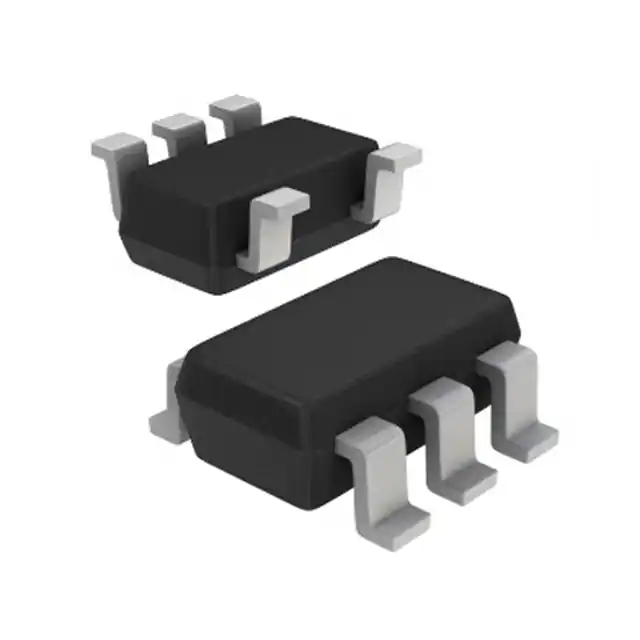
Package: PG-TSOP6-6-5 - 6-pin thin shrink small outline package (2.9 mm × 1.5 mm × 1.05 mm), lead-free, RoHS-compliant, optimized for automated SMT assembly in space-constrained automotive modules.
| Pin/Terminal | Circuit Role | Design Meaning |
|---|---|---|
| 1: SCL /INT | I²C clock input / interrupt output | Dual-function pin: accepts master clock during communication; drives open-drain low on measurement completion. |
| 2: GND | Ground reference | Primary ground connection; decoupling capacitor must be placed adjacent to this pin for noise immunity. |
| 3: GND | Ground reference | Second ground terminal - improves thermal dissipation and reduces ground loop impedance in high-noise environments. |
| 4: VDD | Power supply input | Accepts 2.9–3.5 V; requires local 100 nF ceramic decoupling between VDD and Pin 2 GND. |
| 5: GND | Ground reference | Third ground terminal - enhances EMC performance and stabilizes internal bias networks across temperature. |
| 6: SDA /ADDR | I²C data I/O / address configuration | Open-drain bidirectional data line; logic level at power-up sets I²C slave address (0x1E or 0x1F). |
Key Features
| Feature | Design Value |
|---|---|
| 3-axis magnetic field measurement | Simultaneous Bx, By, Bz acquisition with matched gain/offset - enables drift-compensated angle calculation without external calibration. |
| Configurable power modes | Four operational states (active, low-power, standby, power-down) selectable via I²C - allows runtime trade-off between latency and energy. |
| Integrated temperature sensor | On-die thermal measurement (12-bit) enabled by default - supports real-time compensation of Hall offset drift over temperature. |
| Interrupt-driven data readiness | /INT pin eliminates polling delay and CPU wake cycles - reduces system-level power by >30% in intermittent-sensing applications. |
| Automotive qualification | AEC-Q100 Grade 1 compliant - validated for vibration, thermal cycling, ESD (±2 kV HBM), and long-term reliability in safety-critical zones. |
Applications
| Steering Column Position Sensing | Electronic Gear Shift Detection |
|---|---|
|
Use Scenario: Detecting rotation angle and axial displacement of steering column-mounted controls for turn signal and wiper activation. IC Role / Device Role / Timing Role: 3D magnetic sensor providing real-time Bx/By/Bz vector data to MCU for contactless angular decoding and direction inference. Use Value: Eliminates mechanical potentiometers and slip rings; achieves >10M-cycle lifetime and IP67-rated sealing compatibility. |
Use Scenario: Monitoring gear lever position in automatic transmission systems using magnet-coupled rotary motion. IC Role / Device Role / Timing Role: Measures magnetic field vector changes as lever rotates; outputs calibrated XYZ values via I²C every 16.7 ms (60 Hz). Use Value: Enables fail-safe neutral/park detection with <±0.5° angular error across full temperature range. |
| Brake Pedal Angle Monitoring | Multi-Function Knob Interface |
|
Use Scenario: Capturing brake pedal travel and release timing for brake-by-wire and regenerative braking coordination. IC Role / Device Role / Timing Role: Mounted on pedal arm with diametrically magnetized ring magnet; reports Z-axis field strength proportional to pedal displacement. Use Value: Delivers sub-millimeter linear resolution and <10 µs latency - meets ASIL-B functional safety timing requirements. |
Use Scenario: Enabling touchless rotary and push detection in center console knobs for HVAC and infotainment control. IC Role / Device Role / Timing Role: Detects 3D field perturbations from rotating and pressing magnets embedded in knob assembly. Use Value: Supports gesture recognition (rotate + press = menu enter) with zero mechanical wear and EMI-immune operation. |
Equivalent & Alternatives
The following parts are listed as comparable options for similar 3D magnetic sensing applications.
| Alternative Part | Technical Difference | Application Difference | Selection Advice |
|---|---|---|---|
| MLX90393EDC-ABA-000-TU | Higher supply range (1.7–3.6 V); 16-bit resolution; SPI/I²C dual interface; no integrated temp sensor in base config. | Supports wider voltage rails and higher precision but lacks factory-calibrated temperature compensation path. | Preferred when system requires >12-bit angular resolution or mixed-voltage domain interfacing. |
| AK09918C | Lower power (3 µA @ 10 Hz); only I²C; no interrupt pin; ±50 mT range; uncalibrated sensitivity. | Requires host-side temperature compensation and external interrupt generation logic. | Selected for cost-sensitive non-safety applications where full AEC-Q100 compliance is not mandated. |
Compared with MLX90393 and AK09918C, the TLE493DA1B6HTSA1 provides tighter X/Y matching, guaranteed automotive qualification, integrated interrupt signaling, and factory-trimmed temperature compensation - reducing firmware complexity and validation effort in production ECUs.
Availability
TLE493DA1B6HTSA1 is available at Aetrix Electronics and suitable for automotive gear shift detection, steering column controls, and brake pedal position monitoring requiring stable component supply across extended temperature ranges and long product lifecycles.
Supply support for TLE493DA1B6HTSA1 includes scheduled delivery planning, volume procurement assistance, BOM continuity management, traceable sourcing, and lifecycle availability coordination for OEM customers, industrial embedded developers, connected-device designers, and electronics production programs.
Manufacturer
Infineon Technologies is a German semiconductor manufacturer specializing in power management, automotive ICs, and sensor solutions, with global R&D and manufacturing infrastructure.
This device belongs to Infineon's TLE493D 3D Hall sensor family, engineered specifically for contactless position sensing in harsh automotive environments where reliability, low power, and precise vector field measurement are critical.
FAQ
What is the I²C address configuration method for TLE493DA1B6HTSA1?
The I²C slave address is determined by the logic level on the SDA/ADDR pin at power-up: low = 0x1E, high = 0x1F. This configuration is latched internally and remains fixed until next power cycle. No register write is needed to set the address, simplifying initialization in multi-sensor systems.
Does TLE493DA1B6HTSA1 require external components for basic operation?
Only two external components are mandatory: a 100 nF ceramic decoupling capacitor between VDD and Pin 2 GND, and pull-up resistors (typically 4.7 kΩ) on SCL and SDA lines. No external oscillator, reference, or calibration circuitry is required - all timing and compensation are handled on-chip.
How does the /INT pin function during continuous measurement mode?
In continuous mode, /INT asserts low for ≥1 µs each time a full measurement cycle (Bx, By, Bz, and optional temperature) completes and new data is written to output registers. The pin releases high immediately after, allowing edge-triggered interrupts on microcontroller GPIO pins without debouncing.
Can TLE493DA1B6HTSA1 operate reliably in high-vibration environments like engine compartments?
Yes - it is qualified to AEC-Q100 Grade 1 (−40 °C to +125 °C) and tested for mechanical shock (1000 g) and random vibration (20–2000 Hz, 20 g rms). The monolithic silicon design and TSOP6 package eliminate moving parts and solder joint fatigue risks common in electromechanical sensors.
TLE493DA1B6HTSA1 Specifications
- Product attributes
- Attribute value
- Manufacturer:
- Infineon Technologies
- Series:
- -
- Package/Case:
- SOT-23-6 Thin, TSOT-23-6
- Packaging:
- Tape & Reel (TR)
- Product Status:
- Discontinued at Digi-Key
- Technology:
- Hall Effect
- Axis:
- X, Y, Z
- Output Type:
- I2C
- Sensing Range:
- ±60mT
- Voltage - Supply:
- 2.9V ~ 3.5V
- Current - Supply (Max):
- -
- Current - Output (Max):
- -
- Resolution:
- -
- Bandwidth:
- -
- Operating Temperature:
- -40°C ~ 125°C (TJ)
- Grade:
- -
- Qualification:
- -
- Features:
- -
- Supplier Device Package:
- PG-TSOP-6-6-5
- Mounting Type:
- Surface Mount
TLE493DA1B6HTSA1 FAQ
1.How can I place an order for TLE493DA1B6HTSA1 through Aetrix?
Please submit a Request for Quotation (RFQ) for TLE493DA1B6HTSA1 on Aetrix. Our sales agent will provide a competitive quotation and guide you through the order confirmation once you accept the terms.
2.Are the price and stock information for TLE493DA1B6HTSA1 reliable?
The price and inventory of TLE493DA1B6HTSA1 are updated periodically and may fluctuate due to market conditions. Stock and pricing data are typically refreshed every 24 hours. Quotation validity for TLE493DA1B6HTSA1 is usually 5 days.
3.What payment methods are accepted for TLE493DA1B6HTSA1?
We accept Wire Transfer, PayPal, Credit Card, Western Union, MoneyGram, and Escrow for TLE493DA1B6HTSA1 transactions.
Note: Certain payment methods may incur a processing fee.
4.How is shipping managed for TLE493DA1B6HTSA1?
TLE493DA1B6HTSA1 orders can be shipped via leading logistics carriers, including DHL, UPS, FedEx, TNT, or Registered Mail.
Once your TLE493DA1B6HTSA1 order is processed, you will receive an email with the shipment details and tracking number.
Note: Tracking information may take up to 24 hours to appear. Express delivery typically takes 3–5 business days.
5.How can I obtain technical support or documentation for TLE493DA1B6HTSA1?
For technical support, including TLE493DA1B6HTSA1 datasheets, pinout diagrams, or application guidance, please contact our engineering support team. They can provide detailed documentation and assistance for your TLE493DA1B6HTSA1 requirements.
6.How does Aetrix verify that TLE493DA1B6HTSA1 is sourced from the original manufacturer or authorized distributors?
All TLE493DA1B6HTSA1 products on Aetrix are procured from qualified distributors and authorized channels. Our dedicated quality assurance team conducts strict verification, including traceability checks and, if necessary, third-party testing. This ensures that TLE493DA1B6HTSA1 meets industry standards.
7.What is the process for return or replacement of TLE493DA1B6HTSA1?
All TLE493DA1B6HTSA1 units undergo pre-shipment inspection (PSI). If there is an issue with TLE493DA1B6HTSA1, returns or replacements are accepted under the following conditions:
1.Quantity discrepancies, incorrect items, or visible external defects (such as breakage or corrosion), acknowledged by Aetrix.
2.The issue is reported within 90 days of delivery.
3.The TLE493DA1B6HTSA1 part is unused and in its original packaging.
Return procedure for TLE493DA1B6HTSA1:
1.Submit a request within 90 days.
2.Obtain a Return Material Authorization (RMA) from Aetrix.
TLE493DA1B6HTSA1 Tags
-
DRV5053VAQDBZR
Texas Instruments
-
MMC5603NJ
Memsic Inc.
-
DRV5055A1QDBZR
Texas Instruments
-
MLX90392ELQ-AAA-011-RE
Melexis Technologies NV

-
CT100LW-HS6
Allegro MicroSystems
-
DRV5056A1ELPGMQ1
Texas Instruments
-
A1304ELHLX-T
Allegro MicroSystems
-
MMC5633NJL
Memsic Inc.
-
A1308KUA-2-T
Allegro MicroSystems
-
A1308KUA-1-T
Allegro MicroSystems
-
SI7210-B-04-IVR
Silicon Labs
-
A1308LLHLT-2-T
Allegro MicroSystems
Tech Hub

Operational amplifier guide covering op amp basics, feedback, ideal vs real op amps, common configurations, buffer circuits, offset, bias current, gain-bandwidth, slew rate, rail-to-rail limits and sel…

Jumper cables guide covering safe connection order, red and black clamp placement, final ground connection, cable gauge, length, clamp quality, copper vs CCA cables, jump starter comparison and battery…

LDO regulator guide covering low dropout voltage, power dissipation, thermal design, PSRR, output noise, capacitor stability, adjustable LDO circuits, LDO vs buck converter and datasheet selection chec…

Conditional Access Module guide covering CAM meaning, CI/CI+ interface, smart card authorization, DVB security workflow, TV and set-top box compatibility, internal electronics, ESD protection, connecto…

Guide to electronic component obsolescence covering EOL risk, PCN/PDN notices, last-time buy planning, replacement options, form-fit-function validation, counterfeit risk and BOM lifecycle management.

18650 battery guide covering lithium-ion cell basics, 3.6V/3.7V voltage, 4.2V charging, mAh and Wh capacity, protected cells, chargers, BMS, series-parallel packs, holders, welding and sourcing checks.…

Hall effect sensor guide covering working principle, linear and digital sensors, Arduino circuits, current sensing, speed detection, automotive applications, A3144 examples, signal filtering and datash…

Product Change Notification guide for electronic components, covering PCN meaning, PCN vs PDN/EOL, common change types, risk levels, form-fit-function review, engineering validation, BOM control, LTB/L…

A practical guide to blend door actuators, covering HVAC function, symptoms, location, AC and heater issues, reset and calibration, replacement cost, electrical diagnosis, compatibility checks, and rep…

Engineering guide to Raspberry Pi alternatives, covering chip-level differences, Orange Pi, ROCK, Jetson, Banana Pi, NanoPi, Compute Module, Pico, GPIO, camera, HAT compatibility, and replacement risks…


