
 My Inquiry
 My Account


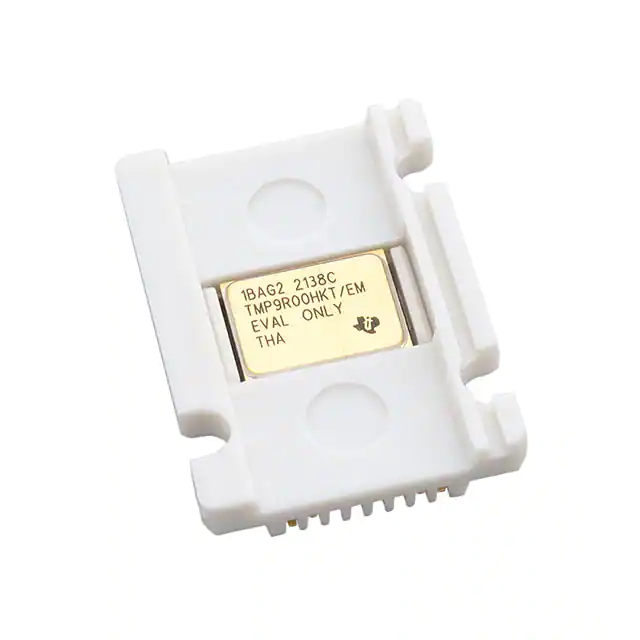
Texas Instruments TMP9R00HKT/EM
- Part No.:
- TMP9R00HKT/EM
- Manufacturer:
- Texas Instruments
- Category:
- Analog and Digital Output
- Package:
- 16-CFlatPack
- Datasheet:
-
 TMP9R00HKT/EM.pdf
- Description:
- RADIATION HARDNESS ASSURED (RHA)
- Quantity:
- Payment:

- Shipping:

Inventory:1,127
Please send an inquiry. Send us your inquiry, and we will respond immediately.
Product details
Overview
TMP9R00HKT/EM from Texas Instruments is a radiation-hardened, 9-channel (8-remote + 1-local) digital temperature sensor in a 16-lead ceramic HKT package, delivering ±1.5°C local/remote accuracy, 0.0625°C resolution, and operation from –55°C to 125°C ambient (–55°C to 150°C remote junction), designed for thermal monitoring of FPGAs, ADCs, DACs, and ASICs in space-grade systems.
For engineers reviewing the TMP9R00HKT/EM datasheet, TMP9R00HKT/EM pinout, TMP9R00HKT/EM application, or TMP9R00HKT/EM equivalent, this page provides verified specifications, radiation-hardened operating context, dual THERM interrupt functionality, series resistance cancellation, and I²C/SMBus interface details essential for satellite, avionics, and spacecraft telemetry design.
Technical Context
The TMP9R00HKT/EM implements an integrated 13-bit ADC with dedicated local BJT and eight remote diode sensing channels, supporting simultaneous multi-zone measurement via a single two-wire bus. Its architecture includes on-chip series resistance cancellation (up to 1 kΩ), η-factor correction, and programmable offset compensation per channel.
It operates exclusively as a target device on I²C/SMBus buses with pin-programmable address (GND/V+/SDA/SCL), supports fast-mode (400 kHz) and high-speed mode (2.56 MHz), and features dual open-drain THERM/THERM2 outputs with independently programmable thresholds and hysteresis for overtemperature response in safety-critical subsystems.
Key Specifications
| Parameter | Value and Actual Design Meaning |
|---|---|
| Temperature Accuracy | ±1.5°C for local and remote channels - ensures reliable thermal margining in radiation-exposed environments without calibration overhead. |
| Resolution | 0.0625°C - enables fine-grained thermal trending for predictive thermal management in FPGA/ASIC power domains. |
| Supply Range | 1.7 V to 2.0 V - matches low-voltage spacecraft power rails and reduces system-level voltage translation complexity. |
| Operating Current | 67 µA at 1 SPS (all channels active) - minimizes power impact in always-on housekeeping telemetry chains. |
| Shutdown Current | 0.3 µA - enables ultra-low-power dormant states during non-critical mission phases without external control circuitry. |
| Remote Junction Range | –55°C to 150°C - supports direct monitoring of high-temperature semiconductor junctions in power converters and RF front-ends. |
| Radiation Tolerance | 100 krad(Si) TID (LDR), SEL immune to 76 MeV·cm²/mg at 125°C - qualified for long-duration LEO/GEO missions without derating. |
Pinout & Package
Package: 16-lead Ceramic Flatpack (CFP), 10.16 mm × 7.10 mm, thermally enhanced for space-grade thermal dissipation (RθJA = 52.6°C/W).
| Pin/Terminal | Circuit Role | Design Meaning |
|---|---|---|
| D1+ to D8+ | Analog input (positive) | Eight dedicated inputs for remote diode sensors; unused channels must be tied to D− to prevent fault detection false triggers. |
| D− | Analog input (common negative) | Shared return path for all eight remote channels; enables differential remote sensing with inherent noise rejection. |
| GND | Ground reference | Primary supply return; requires low-inductance connection to minimize measurement noise in high-EMI spacecraft environments. |
| ADD | Digital input | Pin-selectable I²C/SMBus address (GND/V+/SDA/SCL); eliminates need for external address configuration resistors. |
| THERM / THERM2 | Digital output (open-drain) | Two independent overtemperature alert outputs; each configurable with unique threshold/hysteresis for staged thermal response. |
| SDA / SCL | Bidirectional I/O / Input | I²C/SMBus interface pins with integrated Schmitt triggers and spike suppression - robust against bus transients in launch/vibration environments. |
| V+ | Power supply | 1.7–2.0 V supply input requiring 0.1 µF bypass capacitor; strict voltage window prevents latch-up in radiation-burst conditions. |
Key Features
| Feature | Design Value |
|---|---|
| Series resistance cancellation | Compensates up to 1 kΩ routing resistance in remote diode paths - eliminates board-level calibration for PCB trace length variations. |
| Dual programmable THERM outputs | Independent limit registers and hysteresis per output - enables hierarchical thermal shutdown (e.g., warn → throttle → power-off). |
| Register lock function | Hardware-enforced write protection for critical configuration registers - prevents accidental reconfiguration during radiation-induced bit flips. |
| Diode fault detection | Automatic open-circuit, short-circuit, and reverse-connection detection on all remote channels - reports faults via status register bits. |
| Low-voltage I/O compatibility | 1.7–3.6 V logic range on SDA/SCL/THERM/THERM2 - interoperates directly with 1.8 V and 3.3 V host controllers without level shifters. |
Applications
| Satellite Payload Thermal Monitoring | Avionics FPGA Temperature Control |
|---|---|
Use Scenario: Real-time junction temperature tracking of Xilinx Kintex Ultrascale+ FPGAs in LEO satellite payloads under varying solar flux and eclipse cycles. IC Role / Device Role / Timing Role: Primary remote temperature sensor aggregating eight analog diode inputs from FPGA thermal diodes and one local die temperature reading. Use Value: Enables dynamic clock throttling and power gating based on validated ±1.5°C accuracy across –55°C to 125°C, meeting ECSS-Q-ST-60-13C thermal qualification requirements. |
Use Scenario: Closed-loop thermal management of radiation-tolerant ADC/DAC signal chains in flight computers, where thermal drift directly impacts ENOB and SFDR. IC Role / Device Role / Timing Role: High-resolution (0.0625°C) temperature reference for compensating analog front-end gain/offset drift in real time. Use Value: Reduces calibration frequency by 70% versus uncalibrated systems, leveraging series resistance cancellation to maintain accuracy despite aging interconnects. |
| Spacecraft Housekeeping Telemetry | Onboard Power Converter Thermal Safety |
Use Scenario: Periodic polling of 16+ thermal zones (via daisy-chained TMP9R00HKT/EM devices) for downlinked health telemetry in deep-space probes. IC Role / Device Role / Timing Role: Low-power (67 µA active, 0.3 µA shutdown) node in a distributed SMBus network, reporting via shared bus with collision avoidance. Use Value: Extends battery life during coast phases by enabling synchronized shutdown across all sensors while retaining bus responsiveness for emergency wake-up. |
Use Scenario: Overtemperature protection for GaN-based DC-DC converters in propulsion control modules, where junction temperatures exceed 130°C during transient loads. IC Role / Device Role / Timing Role: Remote diode sensor interfaced to GaN FET body diode, triggering THERM2 to disable gate driver upon reaching 145°C with 5°C hysteresis. Use Value: Prevents destructive thermal runaway without relying on slower microcontroller polling loops - response latency < 20 ms from threshold breach. |
Equivalent & Alternatives
The following parts are listed as comparable options for similar multi-channel remote temperature sensing applications.
| Alternative Part | Technical Difference | Application Difference | Selection Advice |
|---|---|---|---|
| MAX31826ATM+ | Single remote + local channel; ±2.0°C accuracy; 3.0–5.5 V supply; no radiation hardening. | Limited to commercial/industrial systems without TID/SEL requirements; lacks dual THERM outputs and series resistance cancellation. | Consider only for non-radiation environments where cost and footprint are prioritized over accuracy and fault resilience. |
| LM95235EVAL/NOPB | 8-channel remote + local; ±1.0°C accuracy; 3.0–3.6 V supply; not space-qualified; CFP-24 package. | Higher accuracy but incompatible with 1.7–2.0 V rails; no RHA certification; unsuitable for flight hardware without requalification. | Use only for ground-test simulation where radiation tolerance is irrelevant and higher voltage rails are available. |
Compared with MAX31826ATM+ and LM95235EVAL/NOPB, TMP9R00HKT/EM uniquely combines radiation-hardened operation, 1.7–2.0 V supply compliance, dual independent thermal alerts, and on-chip series resistance cancellation - making it the sole qualified solution for production spacecraft thermal management.
Availability
TMP9R00HKT/EM is available at Aetrix Electronics and suitable for satellite payload integration, avionics thermal control, and spacecraft housekeeping telemetry requiring stable component supply across extended mission lifetimes and rigorous qualification cycles.
Supply support for TMP9R00HKT/EM includes scheduled delivery planning, volume procurement assistance, BOM continuity management, traceable sourcing, and lifecycle availability coordination for OEM customers, industrial embedded developers, connected-device designers, and electronics production programs.
Manufacturer
Texas Instruments is a global semiconductor leader specializing in analog, embedded processing, and space-grade ICs, with decades of heritage in radiation-tolerant design for NASA, ESA, and defense programs.
The TMP9R00HKT/EM belongs to TI's space-grade temperature sensor product line, engineered specifically for high-reliability thermal monitoring in satellites, launch vehicles, and planetary exploration systems where accuracy, radiation resilience, and long-term stability are non-negotiable.
FAQ
What is the radiation qualification status of the TMP9R00HKT/EM?
The TMP9R00HKT/EM is QMLV qualified per 5962R2021401VXC, with Radiation-Hardness-Assured (RHA) performance up to 100 krad(Si) total ionizing dose at low dose rate (10 mrad/s) and Single Event Latchup immunity to 76 MeV·cm²/mg at 125°C. These ratings are verified per MIL-STD-883 TM1019 and TM1020, and apply directly to the TMP9R00HKT/EM engineering sample variant as documented in the SBOSA22A datasheet revision.
Can the TMP9R00HKT/EM measure temperature accurately with long PCB traces to remote diodes?
Yes - the TMP9R00HKT/EM includes hardware-accelerated series resistance cancellation supporting up to 1 kΩ of trace resistance, eliminating temperature error caused by copper trace impedance. This feature is active by default and requires no software configuration, ensuring ±1.5°C remote accuracy even with 10 cm of 10-mil PCB traces between the TMP9R00HKT/EM and remote diode sensors.
What is the functional difference between THERM and THERM2 on the TMP9R00HKT/EM?
THERM and THERM2 are independent open-drain outputs on the TMP9R00HKT/EM, each with its own set of programmable upper/lower temperature limits and hysteresis values. They can be configured for distinct thermal responses - for example, THERM may trigger fan activation at 85°C while THERM2 initiates processor throttling at 105°C - enabling layered thermal safety without external logic.
Does the TMP9R00HKT/EM support standard I²C communication speeds?
Yes - the TMP9R00HKT/EM supports standard-mode (100 kHz), fast-mode (400 kHz), and high-speed mode (2.56 MHz) I²C/SMBus timing, with full compliance to JEDEC JS-001 (HBM ±2000 V) and JS-002 (CDM ±750 V) ESD standards. Its SDA/SCL pins include integrated Schmitt triggers and spike suppression filters, ensuring robust operation in electrically noisy spacecraft bus environments.
Is the TMP9R00HKT/EM pin-compatible with the TMP9R00-SP production grade part?
Yes - the TMP9R00HKT/EM shares identical pinout, package dimensions (16-lead CFP, 10.16 mm × 7.10 mm), and electrical interface with the TMP9R00-SP (5962R2021401VXC). However, TMP9R00HKT/EM units are engineering samples processed in a noncompliant flow and are not warranted for full MIL temperature range (–55°C to 125°C) or flight use; they are intended solely for bench evaluation and design validation.
TMP9R00HKT/EM Specifications
- Product attributes
- Attribute value
- Manufacturer:
- Texas Instruments
- Series:
- -
- Package/Case:
- 16-CFlatPack
- Packaging:
- Bulk
- Product Status:
- Discontinued at Digi-Key
- Sensor Type:
- Analog/Digital, Local/Remote
- Sensing Temperature - Local:
- -55°C ~ 125°C
- Sensing Temperature - Remote:
- -55°C ~ 150°C
- Output Type:
- 2-Wire Serial, I2C/SMBUS
- Voltage - Supply:
- 1.7V ~ 2V
- Resolution:
- 13 b
- Features:
- One-Shot, Programmable Limit, Shutdown Mode, Standby Mode
- Accuracy - Highest (Lowest):
- ±1.5°C (±2°C)
- Test Condition:
- -55°C ~ 125°C (-55°C ~ 150°C)
- Operating Temperature:
- -55°C ~ 125°C (TA)
- Mounting Type:
- Surface Mount
- Grade:
- -
- Qualification:
- -
- Supplier Device Package:
- 16-CFP
TMP9R00HKT/EM FAQ
1.How can I place an order for TMP9R00HKT/EM through Aetrix?
Please submit a Request for Quotation (RFQ) for TMP9R00HKT/EM on Aetrix. Our sales agent will provide a competitive quotation and guide you through the order confirmation once you accept the terms.
2.Are the price and stock information for TMP9R00HKT/EM reliable?
The price and inventory of TMP9R00HKT/EM are updated periodically and may fluctuate due to market conditions. Stock and pricing data are typically refreshed every 24 hours. Quotation validity for TMP9R00HKT/EM is usually 5 days.
3.What payment methods are accepted for TMP9R00HKT/EM?
We accept Wire Transfer, PayPal, Credit Card, Western Union, MoneyGram, and Escrow for TMP9R00HKT/EM transactions.
Note: Certain payment methods may incur a processing fee.
4.How is shipping managed for TMP9R00HKT/EM?
TMP9R00HKT/EM orders can be shipped via leading logistics carriers, including DHL, UPS, FedEx, TNT, or Registered Mail.
Once your TMP9R00HKT/EM order is processed, you will receive an email with the shipment details and tracking number.
Note: Tracking information may take up to 24 hours to appear. Express delivery typically takes 3–5 business days.
5.How can I obtain technical support or documentation for TMP9R00HKT/EM?
For technical support, including TMP9R00HKT/EM datasheets, pinout diagrams, or application guidance, please contact our engineering support team. They can provide detailed documentation and assistance for your TMP9R00HKT/EM requirements.
6.How does Aetrix verify that TMP9R00HKT/EM is sourced from the original manufacturer or authorized distributors?
All TMP9R00HKT/EM products on Aetrix are procured from qualified distributors and authorized channels. Our dedicated quality assurance team conducts strict verification, including traceability checks and, if necessary, third-party testing. This ensures that TMP9R00HKT/EM meets industry standards.
7.What is the process for return or replacement of TMP9R00HKT/EM?
All TMP9R00HKT/EM units undergo pre-shipment inspection (PSI). If there is an issue with TMP9R00HKT/EM, returns or replacements are accepted under the following conditions:
1.Quantity discrepancies, incorrect items, or visible external defects (such as breakage or corrosion), acknowledged by Aetrix.
2.The issue is reported within 90 days of delivery.
3.The TMP9R00HKT/EM part is unused and in its original packaging.
Return procedure for TMP9R00HKT/EM:
1.Submit a request within 90 days.
2.Obtain a Return Material Authorization (RMA) from Aetrix.
TMP9R00HKT/EM Tags
-
MCP9700T-E/TT
Microchip Technology
-
MCP9700T-E/LT
Microchip Technology
-
MCP9701T-E/TT
Microchip Technology
-
MCP9701T-E/LT
Microchip Technology
-
TMP235A4DBZR
Texas Instruments
-
MCP9700AT-E/TT
Microchip Technology
-
MCP9700AT-E/LT
Microchip Technology
-
MCP9701AT-E/LT
Microchip Technology
-
MCP9701AT-E/TT
Microchip Technology
,TO-226_straightlead.jpg)
-
LM335Z
STMicroelectronics
-
TMP1075NDRLR
Texas Instruments
-
TMP1075DGKR
Texas Instruments
Tech Hub

A practical engineering guide to 3.3V and 5V logic compatibility, input thresholds, resistor dividers, translator ICs, MOSFET level shifting, I2C pull-ups, timing limits and power-sequencing risks.

The 74HC595 uses push-pull logic outputs, while the TPIC6B595 uses 50 V open-drain DMOS sinks for higher-power loads. This guide compares timing, current limits, 3.3 V interfacing, load wiring, thermal…

The 74HC595 converts serial data into eight stable parallel outputs. This guide covers pin functions, shift and storage timing, OE and MR behavior, drive-current limits, cascading, voltage compatibilit…

A technical comparison of level-sensitive latches and edge-triggered flip-flops, covering timing windows, setup and hold limits, master–slave operation, time borrowing, race-through, HDL inference and…

A D latch stores one bit while Enable controls when data can pass. This reference covers gate-level operation, truth tables, transparency, setup and hold timing, LE versus OE, common ICs and practical …

An SR latch stores one bit through cross-coupled feedback. This engineering reference covers NOR and NAND implementations, truth tables, forbidden-state recovery, gated operation, switch debouncing, fa…

Latch circuits retain one bit through feedback. This technical reference covers SR and D latches, truth tables, transparency, timing limits, latch-versus-flip-flop behavior, applications and common log…

An engineering guide to LED driver operation, constant-current and constant-voltage outputs, linear and switching topologies, dimming, IC selection, calculations, replacement compatibility, and fault c…

Operational amplifier guide covering op amp basics, feedback, ideal vs real op amps, common configurations, buffer circuits, offset, bias current, gain-bandwidth, slew rate, rail-to-rail limits and sel…

Jumper cables guide covering safe connection order, red and black clamp placement, final ground connection, cable gauge, length, clamp quality, copper vs CCA cables, jump starter comparison and battery…


