
 My Inquiry
 My Account


onsemi TN8D51A-HB11-E
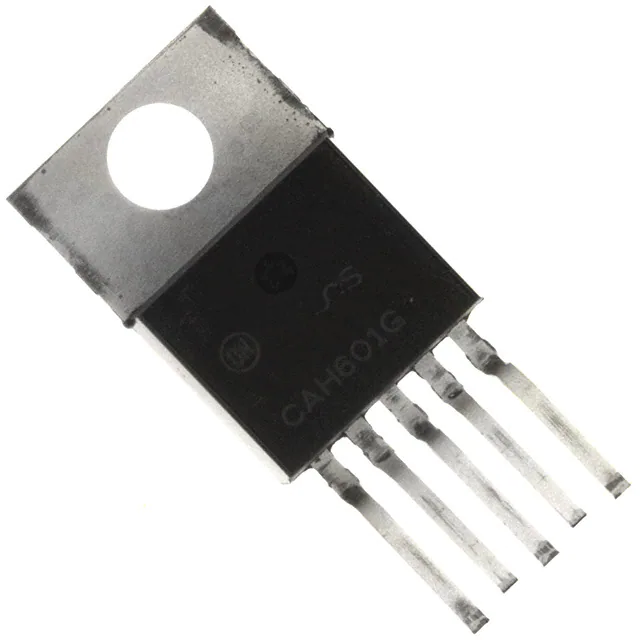
- Part No.:
- TN8D51A-HB11-E
- Manufacturer:
- onsemi
- Package:
- TO-220-5 Full Pack, Formed Leads
- Datasheet:
-
 TN8D51A-HB11-E.pdf
- Description:
- IC REG BUCK 12V 8A TO220F5I5H-HB
- Quantity:
- Payment:

- Shipping:

Inventory:3,148
Please send an inquiry. Send us your inquiry, and we will respond immediately.
Product details
Overview
TN8D51A-HB11-E from SANYO Semiconductor is a monolithic step-down switching regulator IC integrating a vertical P-channel MOSFET (RDS(on) = 80 mΩ), delivering 12 V at up to 8 A output current with 92% efficiency at 30 V input and 3 A load. It features built-in over-current, under-voltage, and over-temperature protection with self-recovery behavior, plus soft-start and standby-mode control via the SS pin. It is used in industrial DC/DC power supplies requiring high reliability and compact integration.
For engineers reviewing the TN8D51A-HB11-E datasheet, pinout, applications, or equivalent options, key selection criteria include its 120–180 kHz switching frequency, -60 V MOSFET breakdown voltage, 88–96% maximum duty cycle, ±1.2 mV/°C output voltage temperature coefficient, and TO-220FI5H-HB package thermal performance up to 125°C junction temperature.
Technical Context
The TN8D51A-HB11-E implements a separately-excited buck topology with internal P-ch MOSFET switching, fixed 12 V output regulation, and feedback-controlled PWM using an external resistor divider on the FB pin. Its oscillator operates at 120–180 kHz with temperature-stable frequency control.
Protection functions are fully integrated: over-current detection uses internal sense circuitry triggering at 8.1–16 A (pulse-dependent), UVLO activates at 7.2–8.8 V with 1.0 V hysteresis, and thermal shutdown engages at 165°C with 25°C hysteresis and self-recovery at 140°C. Soft-start timing is externally adjustable via capacitor on the SS pin.
Key Specifications
| Parameter | Value and Actual Design Meaning |
|---|---|
| Output Voltage | 12.0 V ±0.3 V (tight regulation across line/load/temp; enables stable 12 V rail for logic and analog circuits) |
| Max Output Current | 8 A continuous (supports high-power industrial loads without external current boosting) |
| Switching Frequency | 120–180 kHz (enables use of compact 100 μH inductor and reduces EMI vs. low-frequency alternatives) |
| MOSFET RDS(on) | 80 mΩ (minimizes conduction loss at full load; contributes to 92% peak efficiency) |
| Input Voltage Range | 20–48 V (compatible with 24 V and 36 V industrial bus systems; withstands transients up to 57 V) |
| Thermal Shutdown Threshold | 165°C (junction), self-recovering at 140°C (prevents latch-up during transient overload or poor heatsinking) |
| Soft-Start Control | Via external capacitor on SS pin (enables controlled inrush current limiting and system sequencing) |
Pinout & Package
Package: TO-220FI5H-HB - thermally enhanced 5-pin through-hole package with isolated tab; case temperature rating up to 125°C; requires mechanical mounting to heatsink for >2 W dissipation.
| Pin/Terminal | Circuit Role | Design Meaning |
|---|---|---|
| 1: VIN | Power supply input | Accepts 20–48 V DC input; handles transient surges up to 57 V; connects directly to bulk input capacitor |
| 2: GND | Ground reference | Common return for power, feedback, and control circuits; must be low-impedance connection to minimize noise coupling |
| 3: SWOUT | Switch node output | Drives external choke and freewheeling diode; carries high di/dt pulsed current; requires short, wide PCB trace |
| 4: FB | Feedback input | Monitors output voltage via resistive divider; sets regulation point; sensitive node requiring local 0.1 μF bypass |
| 5: SS | Soft-start & standby control | Connects to external capacitor for ramp-up timing; pulled ≤0.3 V to enter standby (low-IQ mode); max 7 V absolute rating |
Key Features
| Feature | Design Value |
|---|---|
| Integrated P-ch MOSFET | Vertical structure with 80 mΩ RDS(on) and -60 V VDSS, eliminating external high-side switch and gate driver complexity |
| Self-recovering protections | Over-current, under-voltage, and over-temperature faults automatically clear after fault condition removal-no manual reset required |
| Externally programmable soft-start | Capacitor value on SS pin directly controls output voltage ramp time, preventing inrush into downstream capacitance |
| Standby mode via SS pin | Driving SS ≤0.3 V disables switching and reduces quiescent current to 500 μA, enabling low-power system sleep states |
| High-efficiency buck regulation | 92% typical efficiency at 30 V/3 A enables minimal thermal design overhead in enclosed industrial enclosures |
Applications
| Industrial PLC Power Supply | Telecom Remote Radio Unit (RRU) |
|---|---|
Use Scenario: Providing regulated 12 V power to I/O modules and communication interfaces inside programmable logic controllers operating in harsh factory environments. IC Role / Device Role / Timing Role: Primary DC/DC converter IC delivering stable 12 V output from 24 V or 36 V backplane; manages load transients and thermal stress autonomously. Use Value: Integrated protection eliminates need for external monitoring ICs; 8 A capability supports multiple modules without parallel regulators. | Use Scenario: Generating 12 V bias for RF power amplifiers and digital baseband circuitry in outdoor 4G/5G remote radio heads exposed to wide ambient temperature swings. IC Role / Device Role / Timing Role: High-reliability buck controller with thermal foldback and self-recovery, ensuring uninterrupted operation during ambient spikes up to +85°C. Use Value: ±1.2 mV/°C output drift and 165°C thermal cutoff maintain signal integrity and prevent amplifier damage under sustained load. |
| Automotive Test Equipment | Factory Automation Sensor Hub |
Use Scenario: Powering diagnostic tools and calibration instruments that connect to vehicle 24 V systems but require clean, regulated 12 V for microcontrollers and ADCs. IC Role / Device Role / Timing Role: Input-transient-tolerant regulator accepting 20–48 V input while rejecting battery dump energy via internal clamping and fast UVLO response. Use Value: 57 V absolute max input rating and 1.0 V UVLO hysteresis prevent brownout resets during engine cranking or alternator ripple. | Use Scenario: Centralized power management for multi-sensor nodes (temperature, pressure, vibration) deployed on production lines with limited board space. IC Role / Device Role / Timing Role: Compact, single-chip 12 V supply enabling dense sensor integration; SS pin enables synchronized wake-up across distributed nodes. Use Value: Standby current of 500 μA allows battery-backed operation during maintenance windows without compromising runtime. |
Equivalent & Alternatives
The following parts are listed as comparable options for similar step-down regulator applications.
| Alternative Part | Technical Difference | Application Difference | Selection Advice |
|---|---|---|---|
| TPS54821RHLR | 3.5–20 V input, 8 A sync-buck; no integrated high-side FET; requires external MOSFETs and compensation | Designed for lower-input systems (e.g., 12 V intermediate bus); lacks self-recovering OCP/OTP | Choose when input is <24 V and design flexibility outweighs integration benefits of TN8D51A-HB11-E |
| LM5116WMAX/NOPB | Wide-input (6–100 V), external N-ch FET controller; no integrated MOSFET; supports synchronous rectification | Targeted at ultra-wide-input industrial or transportation systems; higher BOM count and layout sensitivity | Prefer when input exceeds 48 V or when synchronous efficiency >95% is mandatory-TN8D51A-HB11-E is simpler for 24–36 V fixed-rail use |
Compared with TPS54821RHLR and LM5116WMAX/NOPB, the TN8D51A-HB11-E delivers plug-and-play 12 V regulation with fewer external components, built-in protection recovery, and optimized thermal performance in TO-220FI5H-HB-ideal for cost-sensitive, space-constrained industrial DC/DC where input stays within 20–48 V.
Availability
TN8D51A-HB11-E is available at Aetrix Electronics and suitable for industrial PLC power supplies, telecom remote radio units, automotive test equipment, and factory automation sensor hubs requiring stable component supply and long-term manufacturability.
Supply support for TN8D51A-HB11-E includes scheduled delivery planning, volume procurement assistance, BOM continuity management, traceable sourcing, and lifecycle availability coordination for OEM customers, industrial embedded developers, connected-device designers, and electronics production programs.
Manufacturer
SANYO Semiconductor was a Japanese semiconductor manufacturer specializing in power management, analog, and discrete devices before its acquisition by ON Semiconductor in 2013; legacy products remain widely deployed in industrial infrastructure.
The TN8D51A-HB11-E belongs to SANYO's ExPD (Excellent-Performance Power & RF Device) family, designed specifically for robust, integrated DC/DC conversion in harsh-environment industrial and transportation systems where reliability and protection autonomy are critical.
FAQ
What is the maximum allowable input voltage for the TN8D51A-HB11-E?
The TN8D51A-HB11-E has an absolute maximum input voltage rating of 57 V. Its recommended operating input range is 20–48 V. Exceeding 57 V-even momentarily-may cause permanent damage. The device includes under-voltage lockout (UVLO) that activates below 7.2–8.8 V and releases above 8.1–9.9 V, ensuring clean startup and brownout immunity. Always verify input transient suppression in final designs.
Does the TN8D51A-HB11-E require an external MOSFET?
No, the TN8D51A-HB11-E integrates a vertical P-channel MOSFET with 80 mΩ RDS(on) and -60 V VDSS, eliminating the need for any external high-side switch. This monolithic architecture simplifies layout, reduces BOM count, and improves reliability versus controller-only solutions. External components required are limited to input/output capacitors, inductor, feedback resistors, and optional soft-start capacitor.
How does the soft-start function work on the TN8D51A-HB11-E?
The TN8D51A-HB11-E implements soft-start via an external capacitor connected between the SS pin (Pin 5) and GND. Charging this capacitor linearly ramps the internal reference, delaying full output voltage rise and limiting inrush current. Typical values range from 0.01 μF (fast start) to 0.22 μF (slow, gentle ramp). The SS pin also serves as standby enable: pulling it ≤0.3 V halts switching and reduces quiescent current to 500 μA.
What thermal derating applies to the TN8D51A-HB11-E?
The TN8D51A-HB11-E allows 20 W power dissipation at Tc = 25°C but derates linearly to zero at Tc = 125°C. Without a heatsink, allowable power drops to 2.0 W at Ta = 25°C. For 8 A operation, a properly mounted heatsink maintaining Tc ≤ 85°C is essential. The device includes over-temperature protection triggering at 165°C (self-recovering at 140°C), but this is a safety limit-not a design target.
Can the TN8D51A-HB11-E be used in automotive applications?
The TN8D51A-HB11-E is specified for industrial use (–25°C to +125°C junction, –10°C to +85°C ambient recommended operation) and is not qualified to AEC-Q100. While it powers automotive test equipment and aftermarket systems, SANYO explicitly excludes "special applications" like safety-critical vehicle subsystems. For production automotive ECUs, consult ON Semiconductor's automotive-grade equivalents and confirm qualification status before design-in.
TN8D51A-HB11-E Specifications
- Product attributes
- Attribute value
- Manufacturer:
- onsemi
- Series:
- -
- Package/Case:
- TO-220-5 Full Pack, Formed Leads
- Packaging:
- Bulk
- Product Status:
- Obsolete
- Function:
- Step-Down
- Output Configuration:
- Positive
- Topology:
- Buck
- Output Type:
- Fixed
- Number of Outputs:
- 1
- Voltage - Input (Min):
- 20V
- Voltage - Input (Max):
- 48V
- Voltage - Output (Min/Fixed):
- 12V
- Voltage - Output (Max):
- -
- Current - Output:
- 8A
- Frequency - Switching:
- 150kHz
- Synchronous Rectifier:
- No
- Operating Temperature:
- -10°C ~ 85°C (TA)
- Grade:
- -
- Qualification:
- -
- Mounting Type:
- Through Hole
- Supplier Device Package:
- TO-220F5I5H-HB
TN8D51A-HB11-E FAQ
1.How can I place an order for TN8D51A-HB11-E through Aetrix?
Please submit a Request for Quotation (RFQ) for TN8D51A-HB11-E on Aetrix. Our sales agent will provide a competitive quotation and guide you through the order confirmation once you accept the terms.
2.Are the price and stock information for TN8D51A-HB11-E reliable?
The price and inventory of TN8D51A-HB11-E are updated periodically and may fluctuate due to market conditions. Stock and pricing data are typically refreshed every 24 hours. Quotation validity for TN8D51A-HB11-E is usually 5 days.
3.What payment methods are accepted for TN8D51A-HB11-E?
We accept Wire Transfer, PayPal, Credit Card, Western Union, MoneyGram, and Escrow for TN8D51A-HB11-E transactions.
Note: Certain payment methods may incur a processing fee.
4.How is shipping managed for TN8D51A-HB11-E?
TN8D51A-HB11-E orders can be shipped via leading logistics carriers, including DHL, UPS, FedEx, TNT, or Registered Mail.
Once your TN8D51A-HB11-E order is processed, you will receive an email with the shipment details and tracking number.
Note: Tracking information may take up to 24 hours to appear. Express delivery typically takes 3–5 business days.
5.How can I obtain technical support or documentation for TN8D51A-HB11-E?
For technical support, including TN8D51A-HB11-E datasheets, pinout diagrams, or application guidance, please contact our engineering support team. They can provide detailed documentation and assistance for your TN8D51A-HB11-E requirements.
6.How does Aetrix verify that TN8D51A-HB11-E is sourced from the original manufacturer or authorized distributors?
All TN8D51A-HB11-E products on Aetrix are procured from qualified distributors and authorized channels. Our dedicated quality assurance team conducts strict verification, including traceability checks and, if necessary, third-party testing. This ensures that TN8D51A-HB11-E meets industry standards.
7.What is the process for return or replacement of TN8D51A-HB11-E?
All TN8D51A-HB11-E units undergo pre-shipment inspection (PSI). If there is an issue with TN8D51A-HB11-E, returns or replacements are accepted under the following conditions:
1.Quantity discrepancies, incorrect items, or visible external defects (such as breakage or corrosion), acknowledged by Aetrix.
2.The issue is reported within 90 days of delivery.
3.The TN8D51A-HB11-E part is unused and in its original packaging.
Return procedure for TN8D51A-HB11-E:
1.Submit a request within 90 days.
2.Obtain a Return Material Authorization (RMA) from Aetrix.
TN8D51A-HB11-E Tags
-
TPS562201DDCR
Texas Instruments
-
MC34063ABD-TR
STMicroelectronics
-
TPS561201DDCR
Texas Instruments

-
MC33063ADR
Texas Instruments
-
MC34063ADR
Texas Instruments
-
TPS560200DBVR
Texas Instruments
-
AP3012KTR-G1
Diodes Incorporated
-
TLV61048DBVR
Texas Instruments
-
AZ34063UMTR-G1
Diodes Incorporated
-
TPS562200DDCR
Texas Instruments
-
AP62300TWU-7
Diodes Incorporated
-
MC34063EBD-TR
STMicroelectronics
Tech Hub
Counterfeit components can hide behind convincing markings and passing basic function tests. This engineering reference covers source traceability, external inspection, X-ray, XRF, electrical testing, …

A practical engineering and sourcing framework covering lifecycle verification, lifetime-buy calculations, replacement qualification, supplier checks and counterfeit-risk controls.

TTL and CMOS logic families differ in thresholds, loading, output drive, power and timing. This engineering guide compares 74HC and 74HCT, calculates noise margins and checks 3.3 V/5 V compatibility.

A practical engineering guide to 3.3V and 5V logic compatibility, input thresholds, resistor dividers, translator ICs, MOSFET level shifting, I2C pull-ups, timing limits and power-sequencing risks.

The 74HC595 uses push-pull logic outputs, while the TPIC6B595 uses 50 V open-drain DMOS sinks for higher-power loads. This guide compares timing, current limits, 3.3 V interfacing, load wiring, thermal…

The 74HC595 converts serial data into eight stable parallel outputs. This guide covers pin functions, shift and storage timing, OE and MR behavior, drive-current limits, cascading, voltage compatibilit…

A technical comparison of level-sensitive latches and edge-triggered flip-flops, covering timing windows, setup and hold limits, master–slave operation, time borrowing, race-through, HDL inference and…

A D latch stores one bit while Enable controls when data can pass. This reference covers gate-level operation, truth tables, transparency, setup and hold timing, LE versus OE, common ICs and practical …

An SR latch stores one bit through cross-coupled feedback. This engineering reference covers NOR and NAND implementations, truth tables, forbidden-state recovery, gated operation, switch debouncing, fa…

Latch circuits retain one bit through feedback. This technical reference covers SR and D latches, truth tables, transparency, timing limits, latch-versus-flip-flop behavior, applications and common log…


