
 My Inquiry
 My Account


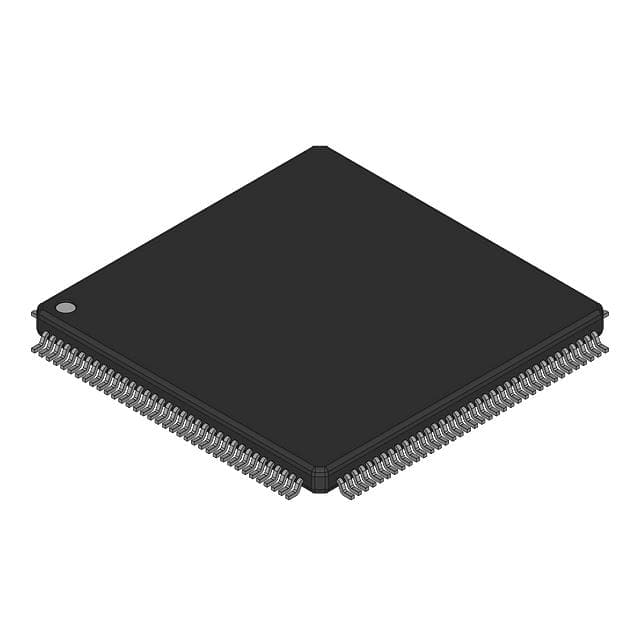
Texas Instruments TNETX15VEPGE
- Part No.:
- TNETX15VEPGE
- Manufacturer:
- Texas Instruments
- Category:
- Microprocessors
- Package:
- -
- Datasheet:
-
 TNETX15VEPGE.pdf
- Description:
- MICROPROCESSOR CIRCUIT PQFP144
- Quantity:
- Payment:

- Shipping:

Inventory:520
Please send an inquiry. Send us your inquiry, and we will respond immediately.
Product details
Overview
TNETX15VEPGE from Texas Instruments is a VLAN-engine address-lookup device designed to perform hardware-accelerated MAC address matching and forwarding decisions for the TNETX3150/TNETX3150A Ethernet switch. It supports up to 2K address entries, provides glueless EAM interface connectivity, integrates JTAG-compliant boundary-scan test logic, and enables VLAN-aware routing with spanning-tree support in managed or unmanaged mode.
For engineers reviewing the TNETX15VEPGE datasheet, TNETX15VEPGE pinout, TNETX15VEPGE application, or TNETX15VEPGE equivalent, this device is critical for Ethernet switch designs requiring deterministic address lookup, secure port-based forwarding, EEPROM auto-configuration without CPU involvement, and MII-managed PHY control via MDIO/MDCLK.
Technical Context
The TNETX15VEPGE operates as a dedicated offload engine interfacing directly with the TNETX3150/TNETX3150A DRAM bus to extract frame headers, source/destination MAC addresses, VLAN tags, and port identifiers. Its internal arbiter prioritizes wire-speed LOOKUP operations over DELETE, ADD, FIND, and AGE functions, ensuring real-time forwarding decisions.
Address storage relies on external ×16 SRAM (up to 4K entries), while internal 4K×16 SRAM manages FIFOs for BPDU handling and bus-watcher metadata. The device implements dual-mode EAM output-single-port (EAM15=1) for unicast and multiple-port (EAM15=0) for VLAN multicast-with discard code 0x0000 and IEEE 802.1D spanning-tree BPDU support.
Key Specifications
| Parameter | Value and Actual Design Meaning |
|---|---|
| Function | VLAN-engine address-lookup accelerator for ThunderSWITCH Ethernet switches |
| Max Address Entries | 2K MAC addresses stored in external ×16 SRAM with hardware aging |
| Interface Types | Glueless EAM (16-bit), DRAM bus watcher (36-bit data + DRAS/DCAS/DWE), DIO (2-bit addr + 8-bit data), MDIO/MDCLK/MRESET, EEPROM (EDIO/ECLK), JTAG (TRST/TMS/TCLK/TDI/TDO) |
| Power Supply | 3.3-V core logic with 5-V tolerant I/O; requires both 3.3-V and 5-V rails |
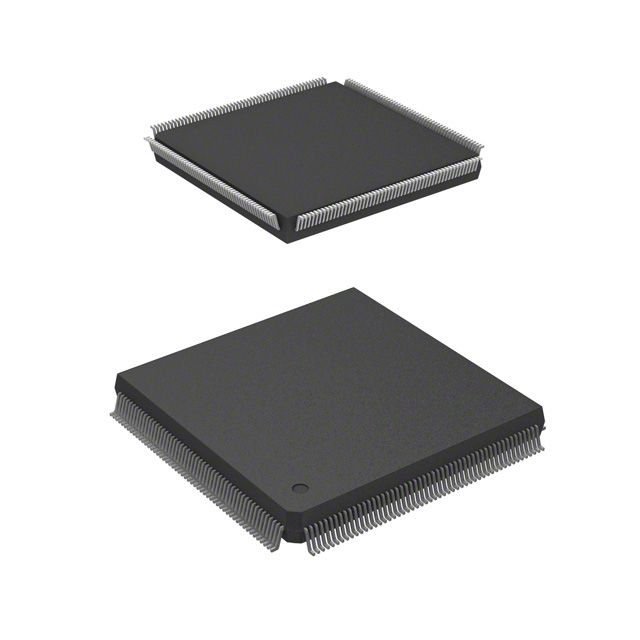
| Package | 144-terminal plastic quad flatpack (PGE), lead-free compatible per TI SPWS028B |
| Standards Support | IEEE Std 802.3u MII management, IEEE Std 1149.1 JTAG boundary-scan (with external pullups on TDI/TMS/TRST) |
| Operating Mode | Unmanaged (EEPROM auto-load at reset) or managed (microprocessor DIO control with interrupt-driven status reporting) |
Pinout & Package
Packaged in 144-terminal plastic quad flatpack (PGE), the TNETX15VEPGE features dedicated buses for external SRAM (EA20–EA0, ED15–ED0, EOE, EWE), DRAM monitoring (DD35–DD0, DRAS, DCAS, DWE), EAM routing output (EAM15–EAM0), DIO management (SAD1–SAD0, SDATA7–SDATA0, SRNW, SRDY, ESCS), MDIO interface (MDIO, MDCLK, MRESET), EEPROM (EDIO, ECLK), and JTAG (TRST, TMS, TCLK, TDI, TDO).
| Pin/Terminal | Circuit Role | Design Meaning |
|---|---|---|
| EAM15–EAM0 | External Address Match output bus | 16-bit routing code: EAM15=1 → single-port unicast; EAM15=0 → 14-bit VLAN multicast mask (ports 00–14) |
| DD35–DD0 | DRAM data bus input | 36-bit parallel interface to TNETX3150/TNETX3150A DRAM bus for frame header extraction |
| EA20–EA0 / ED15–ED0 | External SRAM address/data bus | 21-bit address + 16-bit bidirectional data path to external ×16 SRAM storing MAC table |
| SAD1–SAD0 / SDATA7–SDATA0 | DIO management interface | 2-bit register select + 8-bit data bus for host microprocessor access to control/status/lookup registers |
| MDIO / MDCLK / MRESET | MII management interface | Serial interface to configure and monitor IEEE 802.3u-compliant PHY devices |
Key Features
| Feature | Design Value |
|---|---|
| Hardware address lookup acceleration | Full wire-speed MAC matching with priority-based arbiter (LOOKUP > DELETE > ADD > FIND > AGE) |
| EEPROM auto-configuration | No CPU required: startup register values loaded from x24C02 EEPROM via EDIO/ECLK interface |
| User-selectable aging threshold | Configurable time-based deletion of inactive MAC entries via Age-Deletion Time-Select Register |
| Secure port binding | Prevents MAC address migration across ports; supports VLAN isolation and uplink port security |
| Spanning-tree protocol support | BPDU source tracking in 32-entry FIFO; automatic forwarding-block state updates per IEEE 802.1D |
Applications
| Managed Ethernet Switch | Unmanaged Ethernet Switch |
|---|---|
Use Scenario: Enterprise or industrial switch with centralized SNMP management and VLAN segmentation. IC Role / Device Role / Timing Role: Offloads MAC address learning, VLAN-aware forwarding, and spanning-tree BPDU handling from host CPU to dedicated hardware. Use Value: Enables deterministic sub-microsecond lookup latency and eliminates software-based table management overhead. |
Use Scenario: Cost-sensitive SOHO or embedded switch requiring zero-configuration plug-and-play operation. IC Role / Device Role / Timing Role: Performs autonomous address learning and forwarding using EEPROM-loaded defaults at power-up. Use Value: Eliminates need for external microcontroller or firmware development; reduces BOM count and system boot time. |
| VLAN-Aware Uplink Expansion | Third-Party PHY Interconnect |
Use Scenario: Cascaded switch stack where inter-switch links require VLAN tagging and port filtering. IC Role / Device Role / Timing Role: Generates multi-port EAM codes (e.g., 0x0125 for ports 08/05/02/00) and enforces VLAN membership rules. Use Value: Enables precise broadcast domain control without modifying upstream ThunderSWITCH logic. |
Use Scenario: Integration of non-TI PHYs into ThunderSWITCH-based systems using standard MII. IC Role / Device Role / Timing Role: Acts as MDIO master to configure and monitor third-party PHY registers via serial interface. Use Value: Provides unified management plane for heterogeneous PHYs without requiring host processor intervention. |
Equivalent & Alternatives
The following parts are listed as comparable options for similar VLAN-aware address-lookup applications.
| Alternative Part | Technical Difference | Application Difference | Selection Advice |
|---|---|---|---|
| TNETX15V | Same functional block diagram and pinout, but lacks PGE package marking; datasheet revision SPWS028A (April 1997) vs. SPWS028B (September 1997) | Identical use cases; minor errata fixes in SPWS028B affect aging timer initialization sequence | Select TNETX15VEPGE for production designs requiring latest documented timing and EEPROM auto-load behavior. |
| TNETX15VPGE | Identical part number prefix and PGE package; TI documentation treats TNETX15VPGE as obsolete variant superseded by TNETX15VEPGE | No functional difference; TI's SPWS028B explicitly references TNETX15VEPGE as current version | TNETX15VEPGE is the designated production version; TNETX15VPGE may be available only as legacy stock. |
Compared with TNETX15V and TNETX15VPGE, the TNETX15VEPGE offers updated aging logic initialization, clarified EEPROM loading sequence, and formalized support for VLAN multicast coding - making it the recommended choice for new ThunderSWITCH-based switch designs requiring long-term supply stability and documented compliance with SPWS028B.
Availability
TNETX15VEPGE is available at Aetrix Electronics and suitable for managed Ethernet switches, unmanaged SOHO switches, and VLAN-aware uplink expansion modules requiring stable component supply, long-lifecycle support, and compatibility with legacy ThunderSWITCH platforms.
Supply support for TNETX15VEPGE includes scheduled delivery planning, volume procurement assistance, BOM continuity management, traceable sourcing, and lifecycle availability coordination for OEM customers, industrial embedded developers, connected-device designers, and electronics production programs.
Manufacturer
Texas Instruments is a global semiconductor company founded in 1930, specializing in analog, embedded processing, and connectivity solutions for industrial, automotive, and communications markets.
The TNETX15VEPGE belongs to TI's ThunderSWITCH family of Ethernet switching ICs, engineered specifically to enable scalable, low-latency Layer 2 switching with hardware-accelerated VLAN and spanning-tree functionality for carrier-grade and enterprise infrastructure.
FAQ
What is the primary function of the TNETX15VEPGE in an Ethernet switch system?
The TNETX15VEPGE serves as a dedicated VLAN-engine address-lookup device that performs real-time MAC address matching, VLAN-aware forwarding decisions, and spanning-tree BPDU handling for the TNETX3150/TNETX3150A ThunderSWITCH. It interfaces gluelessly via the EAM bus and offloads these functions from the main switch fabric, enabling deterministic latency and reduced host CPU involvement in TNETX15VEPGE-based systems.
Does the TNETX15VEPGE require an external microprocessor to operate?
No - the TNETX15VEPGE supports unmanaged operation via EEPROM auto-configuration: startup register values are loaded from an external x24C02 EEPROM at reset, enabling fully autonomous address learning and forwarding without any microprocessor. However, a microprocessor can be attached via the DIO interface for managed operation, statistics monitoring, and dynamic table updates in TNETX15VEPGE-based systems.
How does the TNETX15VEPGE handle VLAN multicast routing?
The TNETX15VEPGE uses its 16-bit EAM interface to output multi-port routing codes when EAM15=0: each bit EAM14–EAM0 corresponds to ports 01–14 (plus uplink port 00), where a '1' enables forwarding to that port. For example, multicast to ports 08/05/02/00 maps to EAM15–EAM0 = 0x0125. This native VLAN-aware coding eliminates software-based packet replication in TNETX15VEPGE-integrated switch designs.
What power supply requirements does the TNETX15VEPGE have?
The TNETX15VEPGE requires two independent supplies: a 3.3-V rail for core logic operation and a 5-V rail for I/O buffer biasing. All digital I/O pins (EAM, DRAM, SRAM, DIO, MDIO) are 5-V tolerant, allowing direct interfacing with 5-V peripherals without level shifters - a key design consideration for TNETX15VEPGE integration into mixed-voltage Ethernet switch platforms.
Is the TNETX15VEPGE JTAG-compliant, and what are the implementation requirements?
Yes, the TNETX15VEPGE implements full IEEE Std 1149.1 JTAG boundary-scan functionality on TRST, TMS, TCLK, TDI, and TDO pins. However, TI specifies that external pullup resistors must be applied to TDI, TMS, and TRST to ensure proper test-port initialization - a mandatory requirement for reliable board-level testing and debug in TNETX15VEPGE-based products.
TNETX15VEPGE Specifications
- Product attributes
- Attribute value
- Manufacturer:
- Texas Instruments
- Package/Case:
- -
- Series:
- *
- Packaging:
- Bulk
- Product Status:
- Active
- Core Processor:
- -
- Number of Cores/Bus Width:
- -
- Speed:
- -
- Co-Processors/DSP:
- -
- RAM Controllers:
- -
- Graphics Acceleration:
- -
- Display & Interface Controllers:
- -
- Ethernet:
- -
- SATA:
- -
- USB:
- -
- Voltage - I/O:
- -
- Operating Temperature:
- -
- Grade:
- -
- Qualification:
- -
- Security Features:
- -
- Mounting Type:
- -
- Supplier Device Package:
- -
- Additional Interfaces:
- -
TNETX15VEPGE FAQ
1.How can I place an order for TNETX15VEPGE through Aetrix?
Please submit a Request for Quotation (RFQ) for TNETX15VEPGE on Aetrix. Our sales agent will provide a competitive quotation and guide you through the order confirmation once you accept the terms.
2.Are the price and stock information for TNETX15VEPGE reliable?
The price and inventory of TNETX15VEPGE are updated periodically and may fluctuate due to market conditions. Stock and pricing data are typically refreshed every 24 hours. Quotation validity for TNETX15VEPGE is usually 5 days.
3.What payment methods are accepted for TNETX15VEPGE?
We accept Wire Transfer, PayPal, Credit Card, Western Union, MoneyGram, and Escrow for TNETX15VEPGE transactions.
Note: Certain payment methods may incur a processing fee.
4.How is shipping managed for TNETX15VEPGE?
TNETX15VEPGE orders can be shipped via leading logistics carriers, including DHL, UPS, FedEx, TNT, or Registered Mail.
Once your TNETX15VEPGE order is processed, you will receive an email with the shipment details and tracking number.
Note: Tracking information may take up to 24 hours to appear. Express delivery typically takes 3–5 business days.
5.How can I obtain technical support or documentation for TNETX15VEPGE?
For technical support, including TNETX15VEPGE datasheets, pinout diagrams, or application guidance, please contact our engineering support team. They can provide detailed documentation and assistance for your TNETX15VEPGE requirements.
6.How does Aetrix verify that TNETX15VEPGE is sourced from the original manufacturer or authorized distributors?
All TNETX15VEPGE products on Aetrix are procured from qualified distributors and authorized channels. Our dedicated quality assurance team conducts strict verification, including traceability checks and, if necessary, third-party testing. This ensures that TNETX15VEPGE meets industry standards.
7.What is the process for return or replacement of TNETX15VEPGE?
All TNETX15VEPGE units undergo pre-shipment inspection (PSI). If there is an issue with TNETX15VEPGE, returns or replacements are accepted under the following conditions:
1.Quantity discrepancies, incorrect items, or visible external defects (such as breakage or corrosion), acknowledged by Aetrix.
2.The issue is reported within 90 days of delivery.
3.The TNETX15VEPGE part is unused and in its original packaging.
Return procedure for TNETX15VEPGE:
1.Submit a request within 90 days.
2.Obtain a Return Material Authorization (RMA) from Aetrix.
TNETX15VEPGE Tags
-
AT91SAM9260B-CU-999
Microchip Technology
-
AT91SAM9G25-CU
Microchip Technology
-
ATSAMA5D27C-CU
Microchip Technology
-
AT91SAM9X35-CU
Microchip Technology
-
AT91SAM9X25-CU
Microchip Technology
-
MCIMX6Y2CVM08AB
NXP Semiconductors
.JPG)
-
AM3352BZCZ100
Texas Instruments
-
AT91SAM9260B-CU
Microchip Technology
-
AT91SAM9260B-QU
Microchip Technology
-
ATSAMA5D31A-CU
Microchip Technology
-
AT91SAM9G20B-CU-999
Microchip Technology
-
MCIMX6Y2CVM05AB
NXP Semiconductors
Tech Hub

A practical engineering guide to 3.3V and 5V logic compatibility, input thresholds, resistor dividers, translator ICs, MOSFET level shifting, I2C pull-ups, timing limits and power-sequencing risks.

The 74HC595 uses push-pull logic outputs, while the TPIC6B595 uses 50 V open-drain DMOS sinks for higher-power loads. This guide compares timing, current limits, 3.3 V interfacing, load wiring, thermal…

The 74HC595 converts serial data into eight stable parallel outputs. This guide covers pin functions, shift and storage timing, OE and MR behavior, drive-current limits, cascading, voltage compatibilit…

A technical comparison of level-sensitive latches and edge-triggered flip-flops, covering timing windows, setup and hold limits, master–slave operation, time borrowing, race-through, HDL inference and…

A D latch stores one bit while Enable controls when data can pass. This reference covers gate-level operation, truth tables, transparency, setup and hold timing, LE versus OE, common ICs and practical …

An SR latch stores one bit through cross-coupled feedback. This engineering reference covers NOR and NAND implementations, truth tables, forbidden-state recovery, gated operation, switch debouncing, fa…

Latch circuits retain one bit through feedback. This technical reference covers SR and D latches, truth tables, transparency, timing limits, latch-versus-flip-flop behavior, applications and common log…

An engineering guide to LED driver operation, constant-current and constant-voltage outputs, linear and switching topologies, dimming, IC selection, calculations, replacement compatibility, and fault c…

Operational amplifier guide covering op amp basics, feedback, ideal vs real op amps, common configurations, buffer circuits, offset, bias current, gain-bandwidth, slew rate, rail-to-rail limits and sel…

Jumper cables guide covering safe connection order, red and black clamp placement, final ground connection, cable gauge, length, clamp quality, copper vs CCA cables, jump starter comparison and battery…


