
 My Inquiry
 My Account


Texas Instruments TPA5051RSAR
- Part No.:
- TPA5051RSAR
- Manufacturer:
- Texas Instruments
- Category:
- Audio Special Purpose
- Package:
- 16-VQFN Exposed Pad
- Datasheet:
-
 TPA5051RSAR.pdf
- Description:
- IC AUDIO SIGNAL PROCESSOR 16QFN
- Quantity:
- Payment:

- Shipping:

Inventory:1,907
Please send an inquiry. Send us your inquiry, and we will respond immediately.
Product details
Overview
TPA5051RSAR from Texas Instruments is a four-channel digital audio lip-sync delay IC with I²C control, supporting dual serial audio inputs (I²S/right-justified/left-justified), 16–24-bit resolution, and per-channel delay up to 85 ms at 48 kHz sampling rate. It operates from 3.3 V with 5 V–tolerant I/O and eliminates erroneous output data on power-up or delay changes.
For engineers reviewing the TPA5051RSAR datasheet, TPA5051RSAR pinout, TPA5051RSAR application, or TPA5051RSAR equivalent, this device addresses precise audio-video synchronization in flat-panel TVs, home theater rear-channel effects, wireless speaker front-channel alignment, and ATSC processor interfacing - requiring sample-accurate delay control, independent input clocking, and I²C-configurable format selection.
Technical Context
The TPA5051RSAR implements two independent serial audio input paths, each with dedicated BCLK/LRCLK/DATA interfaces and separate delay memory blocks. Delay is configured via I²C registers (0x02–0x05 for Channel 1; 0x0A–0x0D for Channel 2), supporting either sample-based (up to 4095 samples) or frame-based delay calculation using programmable frame rate (50/59.94 Hz) and audio sample rate (32–192 kHz).
Internal clock generation derives entirely from incoming audio clocks - no external crystal or oscillator required. The I²C interface (400 kHz max, 5 V tolerant) uses three address pins (ADD0–ADD2) to select one of eight slave addresses (0xD0–0xDE), enabling daisy-chained configurations of up to eight devices for extended delay.
Key Specifications
| Parameter | Value and Actual Design Meaning |
|---|---|
| Delay Range | Up to 4095 audio samples per channel → 85.3 ms max at 48 kHz fs; enables precise A/V sync in video processing pipelines. |
| Audio Formats | I²S, right-justified, left-justified (16–24 bit); selected per channel via I²C control register - supports mixed-format system integration. |
| BCLK Support | 32× to 64× fs (fs = 32–192 kHz) → supports standard audio bit rates from 1.024 MHz to 12.288 MHz without external clock synthesis. |
| I/O Voltage Tolerance | 5 V tolerant on all digital I/O (BCLK, LRCLK, DATA, SDA, SCL, ADDx) with 3.3 V supply → simplifies level-shifting in mixed-voltage systems. |
| Power Supply | 3.0–3.6 V VDD; typical IDD = 3 mA at 3.3 V, 48 kHz fs, 32× BCLK → suitable for low-power AV subsystems. |
| Operating Temperature | –40°C to +85°C ambient → qualified for consumer electronics and industrial display applications. |
| Package | 16-pin QFN (4 mm × 4 mm, RSA package) with exposed thermal pad → requires PCB thermal land for 1.0 W power dissipation at 85°C. |
Pinout & Package
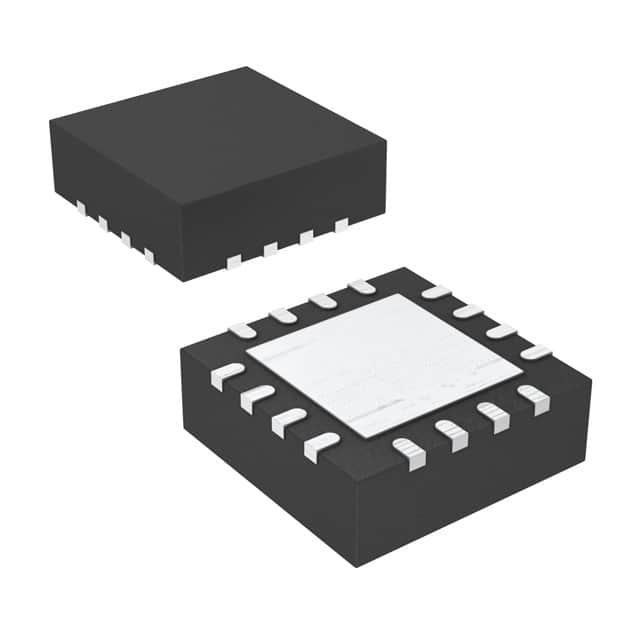
TPA5051RSAR is housed in a surface-mount 4 mm × 4 mm, 16-pin QFN (RSA) package with an exposed thermal pad that must be soldered to a PCB thermal land for thermal management and mechanical stability.
| Pin/Terminal | Circuit Role | Design Meaning |
|---|---|---|
| ADD0–ADD2 | I²C address select inputs | Set 3-bit LSB of 7-bit slave address (0xD0–0xDE); 5 V tolerant - enables up to 8 devices on same I²C bus. |
| BCLK1 / BCLK2 | Audio bit clock inputs | Accept independent bit clocks per channel (32–64× fs); rising-edge sampled - allows asynchronous dual-input timing. |
| LRCLK1 / LRCLK2 | Audio word clock inputs | Define left/right channel boundaries at fs (32–192 kHz); 5 V tolerant - supports variable sample-rate streams. |
| DATA1 / DATA2 | Serial audio data inputs | Sample-synchronous input for I²S/right/left-justified formats; 5 V tolerant - accepts standard audio processor outputs. |
| DATA_OUT1 / DATA_OUT2 | Delayed serial audio outputs | Output delayed audio with identical format as input; no format conversion - preserves signal integrity end-to-end. |
| SCL / SDA | I²C interface signals | 400 kHz fast-mode I²C bus; 5 V tolerant with ≤2 kΩ pull-up - compatible with 3.3 V or 5 V microcontrollers. |
| VDD / GND (pins 5,13,14) | Power and ground terminals | VDD = 3.3 V supply; GND pins provide low-impedance return path - thermal pad (pin #) must be connected to GND plane. |
Key Features
| Feature | Design Value |
|---|---|
| Per-channel delay configuration | Independent 13-bit delay registers (0x02–0x05 and 0x0A–0x0D) enable asymmetric left/right delays - critical for stereo image correction. |
| Frame-based delay mode | Configurable via Frame Delay register (0x06/0x0E) using frame rate (50/59.94 Hz) and fs (32–192 kHz) - aligns audio to video frames, not samples. |
| Complete Update register | Atomic commit of delay/format settings via 0x08/0x10 LSB write - prevents audio pops/clicks during live reconfiguration. |
| Dual independent clock domains | Separate BCLK/LRCLK pairs for each input allow different fs and bit-clock ratios - supports multi-source audio routing. |
| No external timing components | All clocks derived from audio inputs - eliminates crystal oscillators, PLLs, and associated layout complexity and cost. |
Applications
| Flat-Panel TV Lip-Sync Correction | Home Theater Rear-Channel Effects |
|---|---|
|
Use Scenario: Video processing pipeline introduces variable latency (e.g., deinterlacing, scaling, HDR tone mapping), causing audio to lead video by up to 100 ms. IC Role / Device Role / Timing Role: TPA5051RSAR inserts calibrated delay into HDMI/SPDIF audio path to match video pipeline latency - applied per-channel with sample-level precision. Use Value: Enables real-time A/V sync without firmware intervention; supports dynamic delay adjustment via I²C as video processing mode changes. |
Use Scenario: Surround sound system routes rear-channel audio through separate DSP or amplifier with longer signal path than front channels. IC Role / Device Role / Timing Role: TPA5051RSAR delays rear-channel audio stream to match front-channel propagation time - configured independently per channel pair. Use Value: Preserves spatial coherence and phase alignment across all speakers; avoids perceptible echo or smearing in immersive audio playback. |
| Wireless Speaker Front-Channel Alignment | ATSC Broadcast Processor Interface |
|
Use Scenario: Wireless speaker receives front-channel audio over Bluetooth/Wi-Fi with variable packetization delay, while wired subwoofer has fixed latency. IC Role / Device Role / Timing Role: TPA5051RSAR adds deterministic delay to wired audio path to match wireless latency - updated dynamically via host MCU I²C commands. Use Value: Eliminates audible timing mismatch between wireless and wired outputs; maintains tight lip-sync even during connection handover or codec switching. |
Use Scenario: ATSC demodulator outputs baseband audio with jitter and variable buffering, requiring stable timing before DAC or amplifier stages. IC Role / Device Role / Timing Role: TPA5051RSAR buffers and re-times audio using clean LRCLK/BCLK derived from system master clock - acts as jitter-insensitive interface bridge. Use Value: Removes bursty latency from transport-layer audio; delivers continuous, glitch-free stream to downstream audio processors (e.g., TAS5504A, TAS3108). |
Equivalent & Alternatives
The following parts are listed as comparable options for similar digital audio delay applications.
| Alternative Part | Technical Difference | Application Difference | Selection Advice |
|---|---|---|---|
| TAS5504A | Integrated audio processor with built-in 5.1-channel delay, EQ, and volume control; requires external I²C host; no dual independent input ports. | Targeted at full-system audio processing (not standalone delay); higher BOM cost and design complexity. | Choose TAS5504A when delay is one function within broader audio post-processing - not when only precise, low-overhead lip-sync delay is needed. |
| CS8422-CZZ | Audio sample-rate converter (SRC) with integrated 256-word FIFO; supports 16–24-bit I²S; no I²C-configurable delay or frame-based mode. | Used for jitter reduction and fs translation - not for deterministic A/V sync; lacks per-channel delay control and lip-sync optimization features. | Choose CS8422-CZZ when sample-rate mismatch exists between sources - not when video-aligned delay is the primary requirement. |
Compared with TAS5504A and CS8422-CZZ, the TPA5051RSAR delivers dedicated, low-latency lip-sync delay with minimal external components, independent dual-input support, and frame-aware synchronization - making it optimal for cost-sensitive, space-constrained A/V sync applications where simplicity and determinism are critical.
Availability
TPA5051RSAR is available at Aetrix Electronics and suitable for flat-panel TV manufacturing, home theater OEM integration, wireless speaker development, and ATSC broadcast equipment requiring stable component supply and long-term production continuity.
Supply support for TPA5051RSAR includes scheduled delivery planning, volume procurement assistance, BOM continuity management, traceable sourcing, and lifecycle availability coordination for OEM customers, industrial embedded developers, connected-device designers, and electronics production programs.
Manufacturer
Texas Instruments is a global semiconductor leader specializing in analog, embedded processing, and connectivity technologies, with decades of expertise in high-fidelity audio signal chain solutions.
The TPA5051RSAR belongs to TI's digital audio interface and synchronization product line, designed specifically to solve lip-sync challenges in modern video display systems - emphasizing precision delay, format flexibility, and seamless integration with audio processors and amplifiers.
FAQ
What is the maximum audio delay achievable with the TPA5051RSAR?
The TPA5051RSAR supports up to 4095 audio samples of delay per channel. At a 48 kHz sampling rate, this equals 85.3 ms (4095 ÷ 48000). Delay time scales inversely with fs - e.g., 42.7 ms at 96 kHz. Frame-based delay mode also supports up to 8 frames at 50 Hz (160 ms theoretical), but is capped at 4095 samples internally. The TPA5051RSAR enforces this limit to ensure buffer integrity and deterministic operation.
Does the TPA5051RSAR require an external crystal or oscillator?
No, the TPA5051RSAR does not require any external crystal or oscillator. All internal clocks - including those for delay memory, I²C interface, and data path timing - are generated directly from the incoming BCLK and LRCLK signals. This eliminates timing component count, reduces board area, and avoids crystal aging or temperature drift concerns. The TPA5051RSAR remains fully functional as long as valid audio clocks are present on BCLK1/BCLK2 and LRCLK1/LRCLK2.
Can the TPA5051RSAR handle different audio formats on its two input channels simultaneously?
Yes, the TPA5051RSAR supports independent format selection per channel via separate I²C control registers (0x01 for Channel 1, 0x09 for Channel 2). One channel can be configured for I²S while the other uses right-justified format - with distinct packet length, delay, and mute settings. This capability enables flexible integration with heterogeneous audio sources, such as an HDMI receiver (I²S) and a Bluetooth baseband processor (right-justified), both feeding into a single TPA5051RSAR.
How does the Complete Update register prevent audio artifacts during reconfiguration?
The Complete Update register (0x08 for Channel 1, 0x10 for Channel 2) acts as an atomic commit flag. When a '1' is written to its LSB, the TPA5051RSAR simultaneously transfers all pending delay, format, and packet-length settings from shadow registers into the active delay logic - avoiding partial updates that cause clicks or dropouts. Without this mechanism, writing delay upper/lower bytes separately would result in transient misalignment. The TPA5051RSAR ensures glitch-free operation during live A/V sync adjustments.
Is the TPA5051RSAR pin-compatible with other TI audio delay ICs like the TPA5050?
No, the TPA5051RSAR is not pin-compatible with the TPA5050 or any other TI audio delay device. Its 16-pin QFN (RSA) footprint, pin assignments (e.g., dual BCLK/LRCLK inputs, ADD0–ADD2 address pins), and internal architecture are unique to the TPA5051 family. Substituting with another part would require PCB redesign, firmware adaptation, and validation of timing behavior. The TPA5051RSAR must be used with its designated layout and decoupling (0.1 µF VDD–GND capacitor, thermal pad grounded).
TPA5051RSAR Specifications
- Product attributes
- Attribute value
- Manufacturer:
- Texas Instruments
- Series:
- -
- Package/Case:
- 16-VQFN Exposed Pad
- Packaging:
- Tape & Reel (TR)
- Product Status:
- Active
- Function:
- Audio Signal Processor
- Applications:
- Signal Mixing
- Number of Channels:
- 2
- Interface:
- I2C
- Voltage - Supply:
- 3V ~ 3.6V
- Operating Temperature:
- -40°C ~ 85°C (TA)
- Specifications:
- Delay
- Mounting Type:
- Surface Mount
- Grade:
- -
TPA5051RSAR FAQ
1.How can I place an order for TPA5051RSAR through Aetrix?
Please submit a Request for Quotation (RFQ) for TPA5051RSAR on Aetrix. Our sales agent will provide a competitive quotation and guide you through the order confirmation once you accept the terms.
2.Are the price and stock information for TPA5051RSAR reliable?
The price and inventory of TPA5051RSAR are updated periodically and may fluctuate due to market conditions. Stock and pricing data are typically refreshed every 24 hours. Quotation validity for TPA5051RSAR is usually 5 days.
3.What payment methods are accepted for TPA5051RSAR?
We accept Wire Transfer, PayPal, Credit Card, Western Union, MoneyGram, and Escrow for TPA5051RSAR transactions.
Note: Certain payment methods may incur a processing fee.
4.How is shipping managed for TPA5051RSAR?
TPA5051RSAR orders can be shipped via leading logistics carriers, including DHL, UPS, FedEx, TNT, or Registered Mail.
Once your TPA5051RSAR order is processed, you will receive an email with the shipment details and tracking number.
Note: Tracking information may take up to 24 hours to appear. Express delivery typically takes 3–5 business days.
5.How can I obtain technical support or documentation for TPA5051RSAR?
For technical support, including TPA5051RSAR datasheets, pinout diagrams, or application guidance, please contact our engineering support team. They can provide detailed documentation and assistance for your TPA5051RSAR requirements.
6.How does Aetrix verify that TPA5051RSAR is sourced from the original manufacturer or authorized distributors?
All TPA5051RSAR products on Aetrix are procured from qualified distributors and authorized channels. Our dedicated quality assurance team conducts strict verification, including traceability checks and, if necessary, third-party testing. This ensures that TPA5051RSAR meets industry standards.
7.What is the process for return or replacement of TPA5051RSAR?
All TPA5051RSAR units undergo pre-shipment inspection (PSI). If there is an issue with TPA5051RSAR, returns or replacements are accepted under the following conditions:
1.Quantity discrepancies, incorrect items, or visible external defects (such as breakage or corrosion), acknowledged by Aetrix.
2.The issue is reported within 90 days of delivery.
3.The TPA5051RSAR part is unused and in its original packaging.
Return procedure for TPA5051RSAR:
1.Submit a request within 90 days.
2.Obtain a Return Material Authorization (RMA) from Aetrix.
TPA5051RSAR Tags
-
SA571DR2G
onsemi
-
ADAU7002ACBZ-R7
Analog Devices Inc.

-
DRV135UA/2K5
Texas Instruments
-
DRV134UA/1K
Texas Instruments
-
DRV134PA
Texas Instruments
-
DRV134UA
Texas Instruments
-
DRV135UA
Texas Instruments
-
SA572DR2G
onsemi
-
PGA2311U/1K
Texas Instruments
-
SI8244BB-D-IS1R
Skyworks Solutions Inc.

-
CS8416K-CZZR
Cirrus Logic Inc.
-
SRC4392IPFBR
Texas Instruments
Tech Hub

A practical engineering guide to 3.3V and 5V logic compatibility, input thresholds, resistor dividers, translator ICs, MOSFET level shifting, I2C pull-ups, timing limits and power-sequencing risks.

The 74HC595 uses push-pull logic outputs, while the TPIC6B595 uses 50 V open-drain DMOS sinks for higher-power loads. This guide compares timing, current limits, 3.3 V interfacing, load wiring, thermal…

The 74HC595 converts serial data into eight stable parallel outputs. This guide covers pin functions, shift and storage timing, OE and MR behavior, drive-current limits, cascading, voltage compatibilit…

A technical comparison of level-sensitive latches and edge-triggered flip-flops, covering timing windows, setup and hold limits, master–slave operation, time borrowing, race-through, HDL inference and…

A D latch stores one bit while Enable controls when data can pass. This reference covers gate-level operation, truth tables, transparency, setup and hold timing, LE versus OE, common ICs and practical …

An SR latch stores one bit through cross-coupled feedback. This engineering reference covers NOR and NAND implementations, truth tables, forbidden-state recovery, gated operation, switch debouncing, fa…

Latch circuits retain one bit through feedback. This technical reference covers SR and D latches, truth tables, transparency, timing limits, latch-versus-flip-flop behavior, applications and common log…

An engineering guide to LED driver operation, constant-current and constant-voltage outputs, linear and switching topologies, dimming, IC selection, calculations, replacement compatibility, and fault c…

Operational amplifier guide covering op amp basics, feedback, ideal vs real op amps, common configurations, buffer circuits, offset, bias current, gain-bandwidth, slew rate, rail-to-rail limits and sel…

Jumper cables guide covering safe connection order, red and black clamp placement, final ground connection, cable gauge, length, clamp quality, copper vs CCA cables, jump starter comparison and battery…


