
 My Inquiry
 My Account


Texas Instruments TPA5052RSAR
- Part No.:
- TPA5052RSAR
- Manufacturer:
- Texas Instruments
- Category:
- Audio Special Purpose
- Package:
- 16-VQFN Exposed Pad
- Datasheet:
-
 TPA5052RSAR.pdf
- Description:
- IC AUDIO SIGNAL PROCESSOR 16QFN
- Quantity:
- Payment:

- Shipping:

Inventory:2,941
Please send an inquiry. Send us your inquiry, and we will respond immediately.
Product details
Overview
TPA5052RSAR from Texas Instruments is a stereo digital audio lip-sync delay IC that accepts a single I²S serial input (16–24-bit), applies programmable sample-based delay up to 8191 samples per channel, and outputs delayed I²S data-enabling precise audio-video synchronization in flat-panel TVs and home theater systems at fs = 32–192 kHz.
For engineers reviewing the TPA5052RSAR datasheet, TPA5052RSAR pinout, TPA5052RSAR application, or TPA5052RSAR equivalent, this device delivers deterministic, hardware-configured delay with no external clock required, 5 V-tolerant I/O, and QFN-16 thermal-pad package optimized for compact AV processing boards.
Technical Context
The TPA5052RSAR implements a fixed-function delay pipeline with dual-channel synchronous buffering: audio data enters via BCLK/LRCLK/DATA, is stored in on-chip memory, and exits as delayed DATA_OUT with identical I²S timing structure. Delay is set entirely by five logic-level DEL[4:0] pins-no register writes or firmware needed.
All internal clocks derive from the incoming BCLK; no crystal, oscillator, or PLL is used. The device supports bit clock rates from 1.024 MHz to 12.288 MHz (32× to 64× fs), operates from 3.0 V to 3.6 V, and clears delay memory on power-up or DELx change to prevent output of stale data.
Key Specifications
| Parameter | Value and Actual Design Meaning |
|---|---|
| Delay Range | 255–8191 samples per channel (≈5.3–170.6 ms at fs = 48 kHz); set by 5-pin binary encoding |
| Audio Interface | I²S-compatible 3-wire serial: BCLK (32–64× fs), LRCLK (32–192 kHz), DATA input → DATA_OUT output |
| Supply Voltage | 3.0 V to 3.6 V; supports 5 V-tolerant I/O on all digital pins (BCLK, LRCLK, DATA, DEL[4:0]) |
| Supply Current | 1.8–3.0 mA typical at VDD = 3.3 V, fs = 48 kHz, BCLK = 32×fs |
| Package | 16-pin QFN (RSA), 4 mm × 4 mm, 0.65 mm pitch, exposed thermal pad (must be soldered) |
| Operating Temp | –40°C to +85°C ambient; junction temperature rated to +125°C |
Pinout & Package
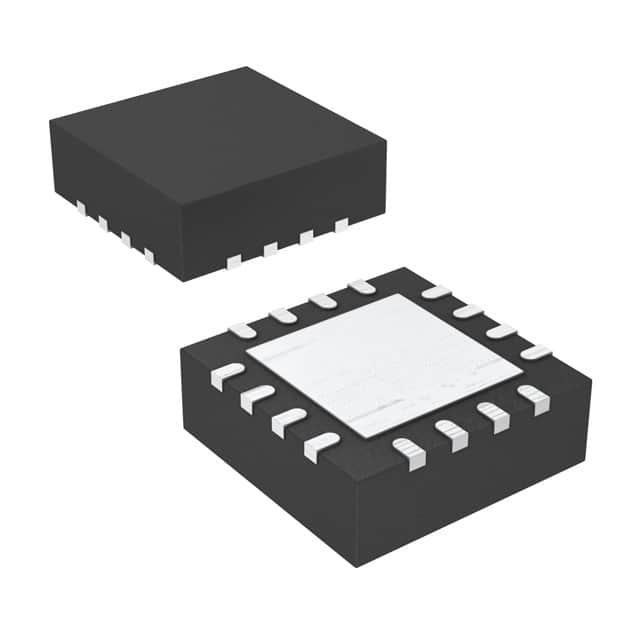
TPA5052RSAR uses a 4 mm × 4 mm, 16-pin QFN package (RSA) with an exposed thermal pad requiring PCB soldering for thermal and mechanical integrity. Pin 1 is located in Quadrant Q2 per tape-and-reel orientation.
| Pin/Terminal | Circuit Role | Design Meaning |
|---|---|---|
| DEL0–DEL4 (Pins 10,11,12,3,4) | Delay select inputs | 5-bit binary control: DEL4 = MSB, DEL0 = LSB; sets delay from 255 to 8191 samples |
| BCLK (Pin 16) | Bit clock input | Synchronizes serial data sampling; accepts 1.024–12.288 MHz; 5 V tolerant |
| LRCLK (Pin 1) | Word clock input | Indicates left/right channel boundary; operates at fs = 32–192 kHz; 5 V tolerant |
| DATA (Pin 2) | Serial audio input | I²S data stream input (MSB-first, 16–24-bit); 5 V tolerant |
| DATA_OUT (Pin 15) | Delayed serial output | Exact I²S format as input, delayed by configured sample count; drives next stage directly |
| VDD (Pins 13,14) | Power supply | 3.0–3.6 V core supply; both pins must connect to same rail; decoupling: 0.1 µF recommended |
| GND (Pins 5–9) | Ground reference | Eight dedicated ground terminals; all must connect to low-impedance system GND plane |
| Thermal Pad | Thermal & mechanical anchor | Exposed copper pad beneath die; must be soldered to PCB thermal land for reliability and thermal performance |
Key Features
| Feature | Design Value |
|---|---|
| No external clock required | All timing derived from BCLK; eliminates crystal, oscillator, and associated layout complexity |
| Hardware-configured delay | 5-pin binary interface enables deterministic, glitch-free delay setting without software or registers |
| Mute-on-delay-change | Automatically mutes both channels during DELx reconfiguration to prevent pops/clicks in audio output |
| 5 V-tolerant digital I/O | Interfaces directly with 5 V logic (e.g., audio processors, FPGA I/O banks) without level shifters |
| Low-power operation | Typical 2.4 mA supply current at 3.3 V/48 kHz enables use in thermally constrained TV backlights and slim enclosures |
Applications
| High Definition TV Lip-Sync Correction | Home Theater Rear-Channel Effects |
|---|---|
|
Use Scenario: Video processing pipelines in HDTVs introduce variable latency (e.g., deinterlacing, scaling, motion estimation), causing audio to lead video by up to 100+ ms. IC Role / Device Role / Timing Role: TPA5052RSAR inserts precise, adjustable delay into the digital audio path before DAC conversion to realign audio with rendered video frames. Use Value: Enables factory-calibrated or user-adjustable lip-sync correction without modifying video timing or adding complex audio buffer management. |
Use Scenario: In 5.1/7.1 surround sound systems, rear-channel audio may arrive earlier than front channels due to shorter signal paths or different processing delays. IC Role / Device Role / Timing Role: TPA5052RSAR delays rear-channel I²S streams to match front-channel latency, ensuring coherent spatial imaging. Use Value: Achieves channel-aligned playback using simple hardware configuration-no DSP firmware updates or system-level synchronization protocols. |
| Flat Panel TV Audio Delay Compensation | Wireless Speaker Front-Channel Synchronization |
|
Use Scenario: Slim-panel LCD/LED TVs integrate video processing ASICs with long pipeline depths but lack built-in audio delay capability. IC Role / Device Role / Timing Role: TPA5052RSAR sits between the main audio processor and HDMI audio extractor or DAC, adding calibrated delay to match video latency. Use Value: Solves audio-video sync issues in cost-sensitive consumer displays using a single, low-BOM-count IC with zero software overhead. |
Use Scenario: Wireless speaker systems transmit front-channel audio over RF/Bluetooth, introducing variable transmission latency versus wired rear channels. IC Role / Device Role / Timing Role: TPA5052RSAR delays the wired front-channel I²S stream to match wireless latency, enabling synchronized multi-room playback. Use Value: Eliminates need for proprietary wireless timing protocols or adaptive audio buffering-uses fixed, predictable delay aligned to worst-case RF jitter. |
Equivalent & Alternatives
The following parts are listed as comparable options for similar digital audio delay applications.
| Alternative Part | Technical Difference | Application Difference | Selection Advice |
|---|---|---|---|
| TAS3103A | Multi-channel audio processor with integrated 24-bit DSP, programmable delay blocks, and I²S routing; requires firmware configuration and external memory | Supports dynamic delay adjustment, EQ, mixing, and multi-zone audio-not limited to fixed stereo delay | Choose TAS3103A when system requires flexible audio processing beyond lip-sync; avoid if only deterministic hardware delay is needed |
| CS8416-CZZ | Digital audio receiver (S/PDIF/I²S) with 128-word FIFO and basic delay capability; max ~2.7 ms at 48 kHz; no 5-pin hardware control | Limited to short-term jitter buffering and minor alignment; lacks extended delay range and mute-on-change behavior | Choose CS8416-CZZ for jitter cleanup in digital receivers; not suitable for full lip-sync correction requiring >100 ms delay |
Compared with TAS3103A and CS8416-CZZ, the TPA5052RSAR provides the only dedicated, pin-strapped stereo delay solution offering 170 ms maximum delay, hardware-only configuration, and pop-free reconfiguration-making it optimal for cost-sensitive, fixed-function AV sync applications.
Availability
TPA5052RSAR is available at Aetrix Electronics and suitable for high-definition television manufacturing, home theater system integration, and flat-panel display design requiring stable component supply and long-lifecycle support.
Supply support for TPA5052RSAR includes scheduled delivery planning, volume procurement assistance, BOM continuity management, traceable sourcing, and lifecycle availability coordination for OEM customers, industrial embedded developers, connected-device designers, and electronics production programs.
Manufacturer
Texas Instruments is a global semiconductor company specializing in analog, embedded processing, and digital signal technologies, with leadership in audio, power management, and interface solutions.
The TPA5052RSAR belongs to TI's audio timing and synchronization product line, designed specifically to solve deterministic audio-video alignment challenges in consumer display and entertainment systems without software intervention.
FAQ
What is the maximum delay achievable with the TPA5052RSAR at 48 kHz sampling rate?
The TPA5052RSAR achieves a maximum delay of 8191 samples per channel. At fs = 48 kHz, this equals 8191 ÷ 48,000 ≈ 170.6 ms. This value is confirmed in the datasheet's delay calculation formula and Table 1, and applies identically to both left and right channels.
Does the TPA5052RSAR require an external crystal or oscillator?
No, the TPA5052RSAR does not require any external crystal or oscillator. All internal timing-including delay memory clocking and output synchronization-is derived directly from the incoming BCLK signal, as explicitly stated in the "No External Crystal or Oscillator Required" feature and functional block diagram.
How does the TPA5052RSAR prevent audio artifacts when changing delay settings?
The TPA5052RSAR holds both audio channels in internal mute mode until the newly configured number of samples has fully passed through the delay buffer. This behavior-documented under "Mute-on-Delay-Change"-eliminates pops, clicks, or discontinuities during real-time delay adjustments, ensuring clean transitions.
Can the TPA5052RSAR be cascaded with another TPA5052RSAR to increase total delay?
Yes, the TPA5052RSAR supports series connection: the DATA_OUT of one device connects to the DATA input of the next. Figure 4 in the datasheet confirms this topology, enabling cumulative delay up to 2 × 170.6 ms (at 48 kHz), with each device independently configured via its own DEL[4:0] pins.
What is the purpose of the exposed thermal pad on the TPA5052RSAR QFN package?
The exposed thermal pad on the TPA5052RSAR serves dual mechanical and thermal functions: it must be soldered to a PCB thermal land to ensure reliable mechanical attachment and to dissipate heat-critical for maintaining junction temperature within the rated –40°C to +125°C range, as specified in the Absolute Maximum Ratings table.
TPA5052RSAR Specifications
- Product attributes
- Attribute value
- Manufacturer:
- Texas Instruments
- Series:
- -
- Package/Case:
- 16-VQFN Exposed Pad
- Packaging:
- Tape & Reel (TR)
- Product Status:
- Active
- Function:
- Audio Signal Processor
- Applications:
- Signal Mixing
- Number of Channels:
- 1
- Interface:
- I2S
- Voltage - Supply:
- 3V ~ 3.6V
- Operating Temperature:
- -40°C ~ 85°C (TA)
- Specifications:
- Delay
- Mounting Type:
- Surface Mount
- Grade:
- -
TPA5052RSAR FAQ
1.How can I place an order for TPA5052RSAR through Aetrix?
Please submit a Request for Quotation (RFQ) for TPA5052RSAR on Aetrix. Our sales agent will provide a competitive quotation and guide you through the order confirmation once you accept the terms.
2.Are the price and stock information for TPA5052RSAR reliable?
The price and inventory of TPA5052RSAR are updated periodically and may fluctuate due to market conditions. Stock and pricing data are typically refreshed every 24 hours. Quotation validity for TPA5052RSAR is usually 5 days.
3.What payment methods are accepted for TPA5052RSAR?
We accept Wire Transfer, PayPal, Credit Card, Western Union, MoneyGram, and Escrow for TPA5052RSAR transactions.
Note: Certain payment methods may incur a processing fee.
4.How is shipping managed for TPA5052RSAR?
TPA5052RSAR orders can be shipped via leading logistics carriers, including DHL, UPS, FedEx, TNT, or Registered Mail.
Once your TPA5052RSAR order is processed, you will receive an email with the shipment details and tracking number.
Note: Tracking information may take up to 24 hours to appear. Express delivery typically takes 3–5 business days.
5.How can I obtain technical support or documentation for TPA5052RSAR?
For technical support, including TPA5052RSAR datasheets, pinout diagrams, or application guidance, please contact our engineering support team. They can provide detailed documentation and assistance for your TPA5052RSAR requirements.
6.How does Aetrix verify that TPA5052RSAR is sourced from the original manufacturer or authorized distributors?
All TPA5052RSAR products on Aetrix are procured from qualified distributors and authorized channels. Our dedicated quality assurance team conducts strict verification, including traceability checks and, if necessary, third-party testing. This ensures that TPA5052RSAR meets industry standards.
7.What is the process for return or replacement of TPA5052RSAR?
All TPA5052RSAR units undergo pre-shipment inspection (PSI). If there is an issue with TPA5052RSAR, returns or replacements are accepted under the following conditions:
1.Quantity discrepancies, incorrect items, or visible external defects (such as breakage or corrosion), acknowledged by Aetrix.
2.The issue is reported within 90 days of delivery.
3.The TPA5052RSAR part is unused and in its original packaging.
Return procedure for TPA5052RSAR:
1.Submit a request within 90 days.
2.Obtain a Return Material Authorization (RMA) from Aetrix.
TPA5052RSAR Tags
-
SA571DR2G
onsemi
-
ADAU7002ACBZ-R7
Analog Devices Inc.

-
DRV135UA/2K5
Texas Instruments
-
DRV134UA/1K
Texas Instruments
-
DRV134PA
Texas Instruments
-
DRV134UA
Texas Instruments
-
DRV135UA
Texas Instruments
-
SA572DR2G
onsemi
-
PGA2311U/1K
Texas Instruments
-
SI8244BB-D-IS1R
Skyworks Solutions Inc.

-
CS8416K-CZZR
Cirrus Logic Inc.
-
SRC4392IPFBR
Texas Instruments
Tech Hub

A practical engineering guide to 3.3V and 5V logic compatibility, input thresholds, resistor dividers, translator ICs, MOSFET level shifting, I2C pull-ups, timing limits and power-sequencing risks.

The 74HC595 uses push-pull logic outputs, while the TPIC6B595 uses 50 V open-drain DMOS sinks for higher-power loads. This guide compares timing, current limits, 3.3 V interfacing, load wiring, thermal…

The 74HC595 converts serial data into eight stable parallel outputs. This guide covers pin functions, shift and storage timing, OE and MR behavior, drive-current limits, cascading, voltage compatibilit…

A technical comparison of level-sensitive latches and edge-triggered flip-flops, covering timing windows, setup and hold limits, master–slave operation, time borrowing, race-through, HDL inference and…

A D latch stores one bit while Enable controls when data can pass. This reference covers gate-level operation, truth tables, transparency, setup and hold timing, LE versus OE, common ICs and practical …

An SR latch stores one bit through cross-coupled feedback. This engineering reference covers NOR and NAND implementations, truth tables, forbidden-state recovery, gated operation, switch debouncing, fa…

Latch circuits retain one bit through feedback. This technical reference covers SR and D latches, truth tables, transparency, timing limits, latch-versus-flip-flop behavior, applications and common log…

An engineering guide to LED driver operation, constant-current and constant-voltage outputs, linear and switching topologies, dimming, IC selection, calculations, replacement compatibility, and fault c…

Operational amplifier guide covering op amp basics, feedback, ideal vs real op amps, common configurations, buffer circuits, offset, bias current, gain-bandwidth, slew rate, rail-to-rail limits and sel…

Jumper cables guide covering safe connection order, red and black clamp placement, final ground connection, cable gauge, length, clamp quality, copper vs CCA cables, jump starter comparison and battery…


