
 My Inquiry
 My Account


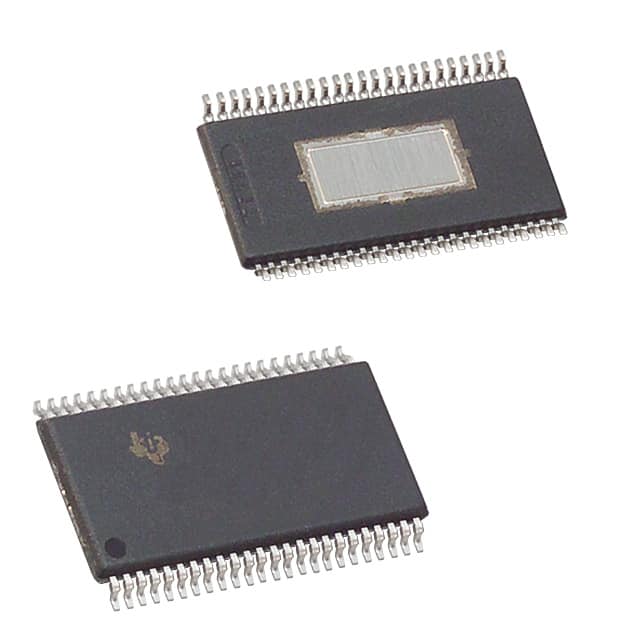
Texas Instruments TPIC71002TDCARQ1
- Part No.:
- TPIC71002TDCARQ1
- Manufacturer:
- Texas Instruments
- Category:
- Specialized
- Package:
- 48-PowerTFSOP (0.240", 6.10mm Width)
- Datasheet:
-
 TPIC71002TDCARQ1.pdf
- Description:
- IC INTFACE SPECIALIZED 48HTSSOP
- Quantity:
- Payment:

- Shipping:

Inventory:2,575
Please send an inquiry. Send us your inquiry, and we will respond immediately.
Product details
Overview
TPIC71002TDCARQ1 from Texas Instruments is a dual-channel automotive-grade squib driver IC for airbag deployment systems, featuring independent high-side and low-side drivers per channel, 1.2 A / 1.75 A programmable firing current, SPI slave interface with parity, and integrated thermal/avalanche protection. It operates across –40°C to 125°C ambient and supports diagnostic-level current monitoring and squib resistance measurement.
For engineers reviewing the TPIC71002TDCARQ1 datasheet, TPIC71002TDCARQ1 pinout, TPIC71002TDCARQ1 application, or TPIC71002TDCARQ1 equivalent, key selection criteria include dual-channel independent arming logic, programmable firing time up to 8.2 ms, 40-V pin tolerance (excluding supply/ground pins), ratio-metric ADC support via VA1/VA2, and fault reporting through AMX_OUT and SPI status registers.
Technical Context
The TPIC71002TDCARQ1 implements two fully independent deployment channels, each with thermally protected high-side (HS_FET) and low-side (LS_FET) switches. Each channel supports separate arming/safing inputs (TZ, IWD), programmable firing current limits (1.2 A or 1.75 A min), and configurable dwell time (0.5 ms to 8.2 ms).
Its SPI interface (SCLK, SIMO, SOMI, CS_N) enables register-based configuration of deployment parameters, diagnostic modes, and status readback with parity checking. Analog multiplexing via AMX_OUT allows external MCU ADC to measure squib voltage, leakage, or reference signals (SQREF1/SQREF2) without additional external circuitry.
Key Specifications
| Parameter | Value and Actual Design Meaning |
|---|---|
| Firing Current | 1.2 A or 1.75 A min per channel - sets minimum guaranteed deployment current under specified VZX–ZX voltage conditions |
| Firing Dwell Time | Programmable up to 8.2 ms - defines maximum ON-time before automatic thermal shutdown or forced turn-off |
| Operating Temp | –40°C to +125°C - qualified for under-hood automotive environments per AEC-Q100 Grade 1 |
| SPI Interface | 4-wire slave with parity - enables robust serial configuration and status reporting in noisy vehicle ECU environments |
| Pin Voltage Rating | 40 V max on all I/O pins except GNDx, AGND, DGND, VCC5, VDDIO, AMX_OUT - eliminates need for external clamping diodes during deployment transients |
| Package | 48-pin HTSSOP (DCA) with PowerPad™ - provides enhanced thermal dissipation for sustained 1.75-A firing current per channel |
| Diagnostic Capability | Independent HS/LS switch test, squib leakage (to battery/ground/inter-channel), and resistance measurement - enables pre-deployment BIST without load |
Pinout & Package
TPIC71002TDCARQ1 uses a thermally enhanced 48-pin HTSSOP (DCA) package with exposed PowerPad™ for improved heat transfer. Pin numbering follows standard counter-clockwise layout from pin 1 (top-left corner, marked dot).
| Pin/Terminal | Circuit Role | Design Meaning |
|---|---|---|
| Z1, Z2, Z3 | Squib Load Connection (Low-Side Output) | Direct connection points for squib loads; sink deployment/diagnostic current; avalanche-protected |
| ZM1, ZM2 | Squib Monitor Return (Low-Side Sense) | Provides Kelvin-sense return path for accurate squib current measurement and leakage detection |
| VZ1, VZ2, VZ3 | Squib Supply (High-Side Output) | Source deployment/diagnostic current to squib; regulated current mode operation during firing |
| AMX_OUT | Analog Multiplexed Output | Single-pin analog output for squib voltage, SQREF1/2, or diagnostic signals - reduces MCU ADC channel count |
| SIMO, SOMI, SCLK, CS_N | SPI Serial Interface | Full-duplex 4-wire SPI slave interface with parity - enables secure register access and fault reporting |
| TZ, IWD | Hardware Arming/Safing Inputs | External safety logic inputs required to enable deployment sequence - prevents inadvertent firing |
| RESET_N | Active-Low Reset Input | Asynchronous reset signal synchronized internally; must be held high after power stabilization |
| VDDIO, VCC5, DGND1/2, AGND, GND1/2 | Power & Ground Rails | Dual-domain supplies (digital/analog) with separate ground planes - minimize noise coupling into sensitive squib sensing paths |
Key Features
| Feature | Design Value |
|---|---|
| Dual Independent Deployment Channels | Each channel has separate high-side/low-side control, current limits, timers, and diagnostics - enables asymmetric airbag staging (e.g., driver + passenger with different timing) |
| Programmable Firing Current & Time | Two selectable firing current levels (1.2 A / 1.75 A) and dwell time up to 8.2 ms - supports diverse squib resistances and vehicle-specific deployment profiles |
| Ratiometric Squib Resistance Measurement | VA1/VA2 pins provide external ADC reference tied to internal VADC - enables precise, temperature-stable squib resistance calculation without calibration drift |
| No External Clamping Required | 40-V pin rating on Zx/VZx pins - withstands dynamic shorts-to-ground during deployment without substrate injection risk or external TVS devices |
| Comprehensive Loop Diagnostics | On-chip detection of open-circuit, short-to-battery, short-to-ground, inter-channel leakage, and squib degradation - reduces need for external test hardware |
Applications
| Driver-Side Airbag Deployment | Passenger-Side Airbag Deployment |
|---|---|
|
Use Scenario: Frontal collision triggering rapid inflation of driver airbag within 20–30 ms of impact detection. IC Role / Device Role / Timing Role: Dual-channel squib driver providing precisely timed, current-regulated firing pulses to driver squib via Z1/VZ1 and ZM1 paths. Use Value: Programmable 0.5-ms dwell at 1.75-A ensures reliable ignition of low-resistance driver squibs while thermal protection prevents latch-up during transient faults. |
Use Scenario: Passenger airbag deployment requiring longer dwell time due to higher squib resistance and greater distance to occupant. IC Role / Device Role / Timing Role: Second channel (Z2/VZ2/ZM2) configured for 2-ms dwell at 1.2-A firing current to match passenger squib characteristics. Use Value: Independent channel programming avoids over-stressing passenger squib while maintaining compliance with FMVSS 208 deployment timing envelopes. |
| Side-Curtain Airbag Sequencing | Occupant Detection Integration |
|
Use Scenario: Side-impact event requiring staged deployment of multiple curtain airbags to manage occupant kinematics. IC Role / Device Role / Timing Role: TPIC71002TDCARQ1 channels coordinated via SPI to fire Z1/VZ1 first, then Z2/VZ2 after 15-ms delay using software-controlled turn-off sequencing. Use Value: Independent high/low-side switch control per channel enables precise inter-airbag timing without external timing ICs or FPGA logic. |
Use Scenario: Integration with seat occupancy sensor and weight-based ECU to disable passenger airbag when child seat detected. IC Role / Device Role / Timing Role: TPIC71002TDCARQ1 remains powered but held in safe state via TZ/IWD logic; squib resistance measured periodically via AMX_OUT to verify integrity during sleep mode. Use Value: Built-in diagnostic mode and ratio-metric VA1 referencing allow continuous squib health monitoring without waking main ECU - reducing system power consumption. |
Equivalent & Alternatives
The following parts are listed as comparable options for similar squib driver applications.
| Alternative Part | Technical Difference | Application Difference | Selection Advice |
|---|---|---|---|
| TPIC71001TDCARQ1 | Single-channel version with identical pinout, specs, and feature set per channel | Used where only one airbag (e.g., knee airbag) requires dedicated driver; lacks second channel logic and associated pins (Z2/ZM2/VZ2, etc.) | Select when BOM cost reduction is critical and system requires only one deployment path; requires PCB redesign to remove unused channel traces |
| MC33816AEKR2 | NXP's 2-channel squib driver with CAN interface, integrated watchdog, and different SPI register map; 32-pin QFN vs. 48-pin HTSSOP | Targeted for CAN-connected airbag ECUs needing distributed diagnostics; lacks AMX_OUT analog mux and ratiometric VA1/VA2 architecture | Choose when CAN bus integration and multi-node diagnostics are required; not drop-in - requires new layout, firmware adaptation, and qualification |
Compared with TPIC71002TDCARQ1, TPIC71001TDCARQ1 reduces channel count but retains full diagnostic fidelity per active channel, while MC33816AEKR2 shifts toward networked airbag systems at the expense of analog measurement flexibility and thermal performance in high-current scenarios.
Availability
TPIC71002TDCARQ1 is available at Aetrix Electronics and suitable for automotive airbag control units, occupant restraint system ECUs, and advanced driver assistance system (ADAS) integration modules requiring stable component supply, AEC-Q100 qualification, and long-term lifecycle support.
Supply support for TPIC71002TDCARQ1 includes scheduled delivery planning, volume procurement assistance, BOM continuity management, traceable sourcing, and lifecycle availability coordination for OEM customers, industrial embedded developers, connected-device designers, and electronics production programs.
Manufacturer
Texas Instruments is a global semiconductor company specializing in analog, embedded processing, and automotive ICs, with leadership in functional safety and AEC-Q100-compliant products.
The TPIC71002TDCARQ1 belongs to TI's automotive squib driver product line, engineered specifically for ASIL-B compliant airbag deployment systems requiring dual-channel independence, diagnostic coverage, and robust transient immunity.
FAQ
What is the maximum firing current supported by TPIC71002TDCARQ1?
The TPIC71002TDCARQ1 supports two programmable firing current levels per channel: 1.2 A minimum and 1.75 A minimum. These values are defined under specific VZX–ZX voltage conditions (e.g., 35 V firing voltage, 32.56 V typical) and are set via SPI registers and EEPROM configuration. The low-side driver current limit is fixed above the high-side limit to ensure proper current sharing during deployment.
Does TPIC71002TDCARQ1 require external clamping diodes on squib pins?
No, the TPIC71002TDCARQ1 does not require external clamping diodes on Zx or VZx pins. All I/O pins (except GNDx, AGND, DGND, VCC5, VDDIO, AMX_OUT) are rated for 40-V absolute maximum, enabling direct connection to squib loads even during dynamic shorts-to-ground events. This eliminates substrate injection risks and simplifies PCB layout.
How does TPIC71002TDCARQ1 support squib resistance measurement?
The TPIC71002TDCARQ1 supports ratiometric squib resistance measurement using VA1 and VA2 pins as external ADC references tied to internal VADC. Combined with AMX_OUT analog multiplexing, it enables precise measurement of squib voltage drop, SQREF1/SQREF2, or diagnostic signals - all without requiring external precision references or additional ADC channels.
What safety logic inputs are required to enable deployment on TPIC71002TDCARQ1?
Deployment on TPIC71002TDCARQ1 requires two independent hardware safety inputs: TZ (Test Zone) must be high and IWD (Independent Watchdog) must be low. These signals, combined with correct SPI configuration and register settings, form a multi-layered arming sequence that prevents inadvertent airbag deployment due to single-point failures.
Is TPIC71002TDCARQ1 compatible with standard SPI controllers?
Yes, TPIC71002TDCARQ1 implements a standard 4-wire SPI slave interface (SCLK, SIMO, SOMI, CS_N) with support for mode 0 (CPOL = 0, CPHA = 0) and parity checking on all transactions. It is compatible with common microcontroller SPI peripherals used in automotive ECUs, provided clock frequency stays within datasheet-specified limits (max 10 MHz).
TPIC71002TDCARQ1 Specifications
- Product attributes
- Attribute value
- Manufacturer:
- Texas Instruments
- Series:
- -
- Package/Case:
- 48-PowerTFSOP (0.240", 6.10mm Width)
- Packaging:
- Tape & Reel (TR)
- Product Status:
- Active
- Applications:
- Airbag
- Interface:
- SPI Serial
- Voltage - Supply:
- -
- Supplier Device Package:
- 48-HTSSOP
- Grade:
- Automotive
- Qualification:
- AEC-Q100
- Mounting Type:
- Surface Mount
TPIC71002TDCARQ1 FAQ
1.How can I place an order for TPIC71002TDCARQ1 through Aetrix?
Please submit a Request for Quotation (RFQ) for TPIC71002TDCARQ1 on Aetrix. Our sales agent will provide a competitive quotation and guide you through the order confirmation once you accept the terms.
2.Are the price and stock information for TPIC71002TDCARQ1 reliable?
The price and inventory of TPIC71002TDCARQ1 are updated periodically and may fluctuate due to market conditions. Stock and pricing data are typically refreshed every 24 hours. Quotation validity for TPIC71002TDCARQ1 is usually 5 days.
3.What payment methods are accepted for TPIC71002TDCARQ1?
We accept Wire Transfer, PayPal, Credit Card, Western Union, MoneyGram, and Escrow for TPIC71002TDCARQ1 transactions.
Note: Certain payment methods may incur a processing fee.
4.How is shipping managed for TPIC71002TDCARQ1?
TPIC71002TDCARQ1 orders can be shipped via leading logistics carriers, including DHL, UPS, FedEx, TNT, or Registered Mail.
Once your TPIC71002TDCARQ1 order is processed, you will receive an email with the shipment details and tracking number.
Note: Tracking information may take up to 24 hours to appear. Express delivery typically takes 3–5 business days.
5.How can I obtain technical support or documentation for TPIC71002TDCARQ1?
For technical support, including TPIC71002TDCARQ1 datasheets, pinout diagrams, or application guidance, please contact our engineering support team. They can provide detailed documentation and assistance for your TPIC71002TDCARQ1 requirements.
6.How does Aetrix verify that TPIC71002TDCARQ1 is sourced from the original manufacturer or authorized distributors?
All TPIC71002TDCARQ1 products on Aetrix are procured from qualified distributors and authorized channels. Our dedicated quality assurance team conducts strict verification, including traceability checks and, if necessary, third-party testing. This ensures that TPIC71002TDCARQ1 meets industry standards.
7.What is the process for return or replacement of TPIC71002TDCARQ1?
All TPIC71002TDCARQ1 units undergo pre-shipment inspection (PSI). If there is an issue with TPIC71002TDCARQ1, returns or replacements are accepted under the following conditions:
1.Quantity discrepancies, incorrect items, or visible external defects (such as breakage or corrosion), acknowledged by Aetrix.
2.The issue is reported within 90 days of delivery.
3.The TPIC71002TDCARQ1 part is unused and in its original packaging.
Return procedure for TPIC71002TDCARQ1:
1.Submit a request within 90 days.
2.Obtain a Return Material Authorization (RMA) from Aetrix.
TPIC71002TDCARQ1 Tags
-
NVT4857UKAZ
NXP Semiconductors
-
TCA8418RTWR
Texas Instruments

-
PCA9546APWR
Texas Instruments

-
MD0100N8-G
Microchip Technology
-
PCA9548APW,118
NXP Semiconductors
-
PCA9540BDP,118
NXP Semiconductors
-
PCA9548APWR
Texas Instruments
-
PCA9546APW,118
NXP Semiconductors
-
PTN3360DBS,518
NXP Semiconductors
-
PCA9546ABS,118
NXP Semiconductors
-
PCA9518PWR
Texas Instruments
-
PCA9545APW,118
NXP Semiconductors
Tech Hub

A practical engineering guide to 3.3V and 5V logic compatibility, input thresholds, resistor dividers, translator ICs, MOSFET level shifting, I2C pull-ups, timing limits and power-sequencing risks.

The 74HC595 uses push-pull logic outputs, while the TPIC6B595 uses 50 V open-drain DMOS sinks for higher-power loads. This guide compares timing, current limits, 3.3 V interfacing, load wiring, thermal…

The 74HC595 converts serial data into eight stable parallel outputs. This guide covers pin functions, shift and storage timing, OE and MR behavior, drive-current limits, cascading, voltage compatibilit…

A technical comparison of level-sensitive latches and edge-triggered flip-flops, covering timing windows, setup and hold limits, master–slave operation, time borrowing, race-through, HDL inference and…

A D latch stores one bit while Enable controls when data can pass. This reference covers gate-level operation, truth tables, transparency, setup and hold timing, LE versus OE, common ICs and practical …

An SR latch stores one bit through cross-coupled feedback. This engineering reference covers NOR and NAND implementations, truth tables, forbidden-state recovery, gated operation, switch debouncing, fa…

Latch circuits retain one bit through feedback. This technical reference covers SR and D latches, truth tables, transparency, timing limits, latch-versus-flip-flop behavior, applications and common log…

An engineering guide to LED driver operation, constant-current and constant-voltage outputs, linear and switching topologies, dimming, IC selection, calculations, replacement compatibility, and fault c…

Operational amplifier guide covering op amp basics, feedback, ideal vs real op amps, common configurations, buffer circuits, offset, bias current, gain-bandwidth, slew rate, rail-to-rail limits and sel…

Jumper cables guide covering safe connection order, red and black clamp placement, final ground connection, cable gauge, length, clamp quality, copper vs CCA cables, jump starter comparison and battery…


