
 My Inquiry
 My Account


Texas Instruments TPS92311D/NOPB
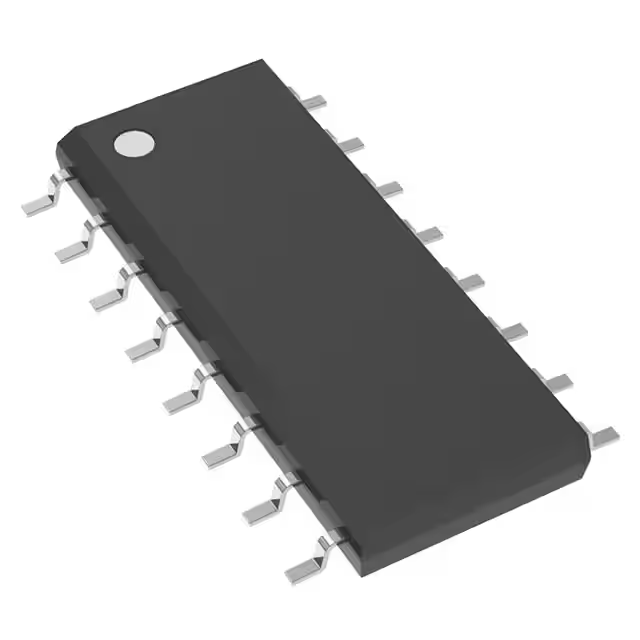
- Part No.:
- TPS92311D/NOPB
- Manufacturer:
- Texas Instruments
- Category:
- LED Drivers
- Package:
- 16-SOIC (0.154", 3.90mm Width)
- Datasheet:
-
 TPS92311D/NOPB.pdf
- Description:
- IC LED DRIVER OFFL 16SOIC
- Quantity:
- Payment:

- Shipping:

Inventory:3,904
Please send an inquiry. Send us your inquiry, and we will respond immediately.
Product details
Overview
TPS92311D/NOPB from Texas Instruments is a primary-side sensing, off-line LED driver IC with integrated 600V/3.75Ω power MOSFET, adaptive constant-on-time (COT) control, and critical-conduction-mode (CRM) operation for inherent PFC. It delivers up to 8W output with ±7% LED current regulation, supports isolated/non-isolated flyback topologies, and targets A19, PAR30/38, and GU10 LED lamps.
For engineers reviewing the TPS92311D/NOPB datasheet, TPS92311D/NOPB pinout, TPS92311D/NOPB application, or TPS92311D/NOPB equivalent, key selection considerations include its 600V MOSFET breakdown voltage, programmable delay timing via DLY pin, ZCD-based valley switching, thermal shutdown at 165°C, and dual-mode configuration (MODE1/MODE2) for isolated vs. non-isolated designs.
Technical Context
The TPS92311D/NOPB implements CRM operation using zero-current detection via the ZCD pin, dynamically adjusting switch on-time based on auxiliary winding voltage and primary peak current. Its adaptive COT algorithm maintains high power factor without secondary-side feedback.
Control is implemented through two configurable modes: Constant ON-Time (COT) for high PF and Peak Current Mode (PCM) for lower output ripple. Protection includes cycle-by-cycle overcurrent detection (0.61V/3.4V thresholds), output overvoltage protection triggered by ZCD-PEAK exceeding 4.3V, and thermal shutdown with 20°C hysteresis.
Key Specifications
| Parameter | Value and Actual Design Meaning |
|---|---|
| Integrated MOSFET | 600V drain-source breakdown, 3.75Ω RDS(on) - enables direct AC/DC conversion without external HV switch |
| LED Current Regulation | ±7% accuracy - ensures consistent luminous output across line/load variations |
| Operating Mode Control | MODE1/MODE2 pins select isolated COT, isolated PCM, or non-isolated COT - determines topology and performance trade-offs |
| ZCD Thresholds | VZCD-ARM = 1.24V, VZCD-TRIG = 0.6V - defines zero-crossing detection window for valley switching |
| Thermal Protection | Shuts down at 165°C junction temperature, restarts at 145°C - prevents permanent damage under sustained overload |
| Startup UVLO | Turns on at 25.6V, turns off at 13V - ensures reliable start-up from rectified AC line with hysteresis |
| Delay Timing | DLY pin sets tDLY via resistor to ground - optimizes EMI and switching loss by controlling turn-on delay after ZCD trigger |
Pinout & Package
TPS92311D/NOPB is housed in a 16-pin narrow SOIC package (SOIC-16N) with exposed pad for thermal enhancement. Pin 1 is located at the top-left corner adjacent to the index mark.
| Pin/Terminal | Circuit Role | Design Meaning |
|---|---|---|
| 1, 2, 15, 16 | SW | Drain of internal 600V MOSFET - connects directly to primary winding and must be routed with low-inductance layout |
| 4 | ZCD | Zero-crossing detection input - monitors auxiliary winding voltage via resistor divider to enable valley switching |
| 5, 12 | GND | Analog/digital ground reference - requires low-impedance connection to minimize noise coupling into ISNS/COMP |
| 6 | VIN | VCC supply input - powers internal circuitry; derived from auxiliary winding post-startup |
| 8 | COMP | Error amplifier output - connects to RC compensation network to stabilize LED current regulation loop |
| 9 | DLY | Delay control input - sets time between ZCD trigger and MOSFET turn-on via external resistor to GND |
| 10, 11 | MODE2, MODE1 | Mode selection inputs - configure isolated COT, isolated PCM, or non-isolated COT operation per Table 1 |
| 13 | ISNS | Current sense input - monitors voltage across RISNS for cycle-by-cycle overcurrent protection and peak current limiting |
Key Features
| Feature | Design Value |
|---|---|
| Primary-side regulation | Eliminates optocoupler and secondary-side feedback components - reduces BOM count and improves reliability |
| Adaptive COT control | Maintains >0.9 power factor across 85–265VAC input range without active PFC controller - simplifies compliance |
| Quasi-resonant valley switching | Reduces switching losses and EMI by turning on MOSFET at minimum drain voltage - improves efficiency and eases EMC filtering |
| Configurable topology support | Single IC supports isolated flyback and non-isolated buck-derived topologies via MODE pins - increases design reuse |
| Comprehensive protection suite | Includes OCP (dual-threshold), OVP (ZCD-based), UVLO, and thermal shutdown - enables robust field operation |
Applications
| LED Lamps: A19 (E26/27) | LED Lamps: PAR30/38 |
|---|---|
Use Scenario: Retrofit replacement for incandescent A19 bulbs in residential ceiling fixtures operating from 120VAC mains. IC Role / Device Role / Timing Role: Primary-side regulated flyback controller managing 7-series LED string (21V, 350mA) with inherent PFC and valley switching. Use Value: Achieves >85% efficiency and >0.9 PF without secondary feedback, meeting Energy Star requirements for compact form factor. | Use Scenario: Directional lighting in recessed downlights requiring thermal resilience and stable lumen output. IC Role / Device Role / Timing Role: Non-isolated buck-derived LED driver configured via MODE1/GND and MODE2/OPEN for higher efficiency at 24V output. Use Value: Delivers ±7% current regulation across -40°C to +85°C ambient, enabling consistent beam intensity in enclosed housings. |
| LED Lamps: GU10 | Solid State Lighting Modules |
Use Scenario: MR16/GU10 spotlight modules powered directly from 230VAC European mains with tight thermal constraints. IC Role / Device Role / Timing Role: Isolated flyback controller with ZCD-based valley switching and programmable DLY delay to minimize EMI in metal housings. Use Value: Enables 8W output in <12mm height profile while passing EN55015 Class B conducted emissions with minimal filtering. | Use Scenario: Integrated LED engine for commercial troffer and panel lights requiring long-life, maintenance-free operation. IC Role / Device Role / Timing Role: Primary-side sensing controller with thermal shutdown (165°C) and auto-restart OVP protection for unattended operation. Use Value: Supports 50,000-hour lifetime by preventing thermal runaway and open-circuit overvoltage stress on LED strings. |
Equivalent & Alternatives
The following parts are listed as comparable options for similar LED driver applications.
| Alternative Part | Technical Difference | Application Difference | Selection Advice |
|---|---|---|---|
| UCC28810DR | Fixed-frequency CRM controller without integrated MOSFET - requires external 600V switch and gate driver | Higher BOM count but greater flexibility in MOSFET selection and thermal management | Choose UCC28810DR when designing >15W systems or requiring discrete MOSFET optimization |
| NCP1015ST100T3G | 700V integrated MOSFET, fixed 100kHz frequency, no ZCD or adaptive COT - simpler control but lower PF | Limited to non-isolated buck or flyback with basic current regulation | Choose NCP1015ST100T3G for cost-sensitive <5W indicator lighting where PF >0.7 is acceptable |
Compared with UCC28810DR and NCP1015ST100T3G, the TPS92311D/NOPB uniquely combines integrated 600V MOSFET, adaptive COT, and ZCD-based valley switching in a single SOIC-16 package - delivering best-in-class PF, efficiency, and design simplicity for 5–8W LED lamps.
Availability
TPS92311D/NOPB is available at Aetrix Electronics and suitable for LED lamp retrofit, directional lighting, and solid-state lighting modules requiring stable component supply, long-lifecycle assurance, and full traceability.
Supply support for TPS92311D/NOPB includes scheduled delivery planning, volume procurement assistance, BOM continuity management, traceable sourcing, and lifecycle availability coordination for OEM customers, industrial embedded developers, connected-device designers, and electronics production programs.
Manufacturer
Texas Instruments is a global semiconductor company headquartered in Dallas, Texas, specializing in analog, embedded processing, and power management technologies.
The TPS92311D/NOPB belongs to TI's LED lighting controller product line, engineered specifically for cost-effective, high-PF, primary-side regulated AC/DC LED drivers targeting residential and commercial retrofit lamps.
FAQ
What is the maximum output power supported by the TPS92311D/NOPB?
The TPS92311D/NOPB is optimized for LED loads up to 8W, as confirmed in the official datasheet's "Features" and "Typical Application" sections. This limit arises from thermal constraints of the integrated 3.75Ω/600V MOSFET and the SOIC-16 package's 95°C/W junction-to-ambient thermal resistance. Exceeding 8W risks thermal shutdown activation above 125°C junction temperature, making the TPS92311D/NOPB unsuitable for >10W designs without significant derating or heatsinking.
How does the TPS92311D/NOPB achieve power factor correction without a dedicated PFC controller?
The TPS92311D/NOPB achieves inherent power factor correction through adaptive constant-on-time (COT) control in critical-conduction-mode (CRM) operation. By synchronizing MOSFET turn-on with valley switching detected via the ZCD pin and dynamically adjusting on-time based on line voltage, it shapes input current to closely follow the sinusoidal input voltage waveform - yielding >0.9 PF across 85–265VAC without auxiliary PFC circuitry. This behavior is explicitly documented in the "APPLICATION INFORMATION" section of the SNVS811B datasheet.
What are the exact voltage thresholds for overvoltage protection on the TPS92311D/NOPB?
The TPS92311D/NOPB triggers overvoltage protection (OVP) when the ZCD pin voltage (VZCD-PEAK) exceeds 4.3V (typical), with a guaranteed threshold range of 4.1V to 4.5V across temperature and process variation. This condition must persist for three consecutive switching cycles before OVP activates, causing the IC to halt switching and discharge VCC until UVLO reset occurs. The threshold is set internally and cannot be adjusted externally, as specified in the "Electrical Characteristics" table under VZCD-OVP.
Can the TPS92311D/NOPB drive LEDs in a non-isolated configuration?
Yes, the TPS92311D/NOPB supports non-isolated operation using Constant ON-Time (COT) mode, configured by grounding MODE2 and leaving MODE1 floating (per Table 1 in the datasheet). In this mode, it functions as a buck-derived regulator with primary-side current sensing, offering higher efficiency and better load regulation than isolated topologies. However, non-isolated designs require careful attention to safety isolation requirements and user-accessible circuit separation per IEC 61347-1.
What is the purpose of the DLY pin on the TPS92311D/NOPB, and how is it configured?
The DLY pin on the TPS92311D/NOPB sets the delay time between ZCD trigger detection and MOSFET turn-on to minimize switching loss and EMI. It is configured by connecting a single resistor (RDLY) from DLY to GND; typical values range from 1kΩ to 100kΩ, corresponding to delays of ~100ns to ~2000ns per Figure 18. The internal DLY reference voltage is 1.23V (±2%), and the source current is 250µA, enabling precise timing control without additional components.
TPS92311D/NOPB Specifications
- Product attributes
- Attribute value
- Manufacturer:
- Texas Instruments
- Series:
- -
- Package/Case:
- 16-SOIC (0.154", 3.90mm Width)
- Packaging:
- Tube
- Product Status:
- Obsolete
- Type:
- AC DC Offline Switcher
- Topology:
- Flyback
- Internal Switch(s):
- Yes
- Number of Outputs:
- 1
- Voltage - Supply (Min):
- 13V
- Voltage - Supply (Max):
- 36V
- Voltage - Output:
- -
- Current - Output / Channel:
- -
- Frequency:
- 60kHz ~ 150kHz
- Dimming:
- -
- Applications:
- -
- Operating Temperature:
- -40°C ~ 125°C (TJ)
- Grade:
- -
- Qualification:
- -
- Mounting Type:
- Surface Mount
- Supplier Device Package:
- 16-SOIC
TPS92311D/NOPB FAQ
1.How can I place an order for TPS92311D/NOPB through Aetrix?
Please submit a Request for Quotation (RFQ) for TPS92311D/NOPB on Aetrix. Our sales agent will provide a competitive quotation and guide you through the order confirmation once you accept the terms.
2.Are the price and stock information for TPS92311D/NOPB reliable?
The price and inventory of TPS92311D/NOPB are updated periodically and may fluctuate due to market conditions. Stock and pricing data are typically refreshed every 24 hours. Quotation validity for TPS92311D/NOPB is usually 5 days.
3.What payment methods are accepted for TPS92311D/NOPB?
We accept Wire Transfer, PayPal, Credit Card, Western Union, MoneyGram, and Escrow for TPS92311D/NOPB transactions.
Note: Certain payment methods may incur a processing fee.
4.How is shipping managed for TPS92311D/NOPB?
TPS92311D/NOPB orders can be shipped via leading logistics carriers, including DHL, UPS, FedEx, TNT, or Registered Mail.
Once your TPS92311D/NOPB order is processed, you will receive an email with the shipment details and tracking number.
Note: Tracking information may take up to 24 hours to appear. Express delivery typically takes 3–5 business days.
5.How can I obtain technical support or documentation for TPS92311D/NOPB?
For technical support, including TPS92311D/NOPB datasheets, pinout diagrams, or application guidance, please contact our engineering support team. They can provide detailed documentation and assistance for your TPS92311D/NOPB requirements.
6.How does Aetrix verify that TPS92311D/NOPB is sourced from the original manufacturer or authorized distributors?
All TPS92311D/NOPB products on Aetrix are procured from qualified distributors and authorized channels. Our dedicated quality assurance team conducts strict verification, including traceability checks and, if necessary, third-party testing. This ensures that TPS92311D/NOPB meets industry standards.
7.What is the process for return or replacement of TPS92311D/NOPB?
All TPS92311D/NOPB units undergo pre-shipment inspection (PSI). If there is an issue with TPS92311D/NOPB, returns or replacements are accepted under the following conditions:
1.Quantity discrepancies, incorrect items, or visible external defects (such as breakage or corrosion), acknowledged by Aetrix.
2.The issue is reported within 90 days of delivery.
3.The TPS92311D/NOPB part is unused and in its original packaging.
Return procedure for TPS92311D/NOPB:
1.Submit a request within 90 days.
2.Obtain a Return Material Authorization (RMA) from Aetrix.
TPS92311D/NOPB Tags
-
BCR402RE6327HTSA1
Infineon Technologies

-
BCR430UXTSA2
Infineon Technologies
-
BCR420UE6433HTMA1
Infineon Technologies
-
BCR420UE6327HTSA1
Infineon Technologies
-
BCR421UE6327HTSA1
Infineon Technologies
-
LYT1604D-TL
Power Integrations

-
HV9910CLG-G
Microchip Technology
-
CL2N8-G
Microchip Technology
-
BCR420UW6-7
Diodes Incorporated
-
BCR421UW6-7
Diodes Incorporated
-
BCR420UFD-7
Diodes Incorporated
-
BCR421UFD-7
Diodes Incorporated
Tech Hub

A practical engineering guide to 3.3V and 5V logic compatibility, input thresholds, resistor dividers, translator ICs, MOSFET level shifting, I2C pull-ups, timing limits and power-sequencing risks.

The 74HC595 uses push-pull logic outputs, while the TPIC6B595 uses 50 V open-drain DMOS sinks for higher-power loads. This guide compares timing, current limits, 3.3 V interfacing, load wiring, thermal…

The 74HC595 converts serial data into eight stable parallel outputs. This guide covers pin functions, shift and storage timing, OE and MR behavior, drive-current limits, cascading, voltage compatibilit…

A technical comparison of level-sensitive latches and edge-triggered flip-flops, covering timing windows, setup and hold limits, master–slave operation, time borrowing, race-through, HDL inference and…

A D latch stores one bit while Enable controls when data can pass. This reference covers gate-level operation, truth tables, transparency, setup and hold timing, LE versus OE, common ICs and practical …

An SR latch stores one bit through cross-coupled feedback. This engineering reference covers NOR and NAND implementations, truth tables, forbidden-state recovery, gated operation, switch debouncing, fa…

Latch circuits retain one bit through feedback. This technical reference covers SR and D latches, truth tables, transparency, timing limits, latch-versus-flip-flop behavior, applications and common log…

An engineering guide to LED driver operation, constant-current and constant-voltage outputs, linear and switching topologies, dimming, IC selection, calculations, replacement compatibility, and fault c…

Operational amplifier guide covering op amp basics, feedback, ideal vs real op amps, common configurations, buffer circuits, offset, bias current, gain-bandwidth, slew rate, rail-to-rail limits and sel…

Jumper cables guide covering safe connection order, red and black clamp placement, final ground connection, cable gauge, length, clamp quality, copper vs CCA cables, jump starter comparison and battery…


