
 My Inquiry
 My Account


Texas Instruments TPS92560DGQ/NOPB
- Part No.:
- TPS92560DGQ/NOPB
- Manufacturer:
- Texas Instruments
- Category:
- LED Drivers
- Package:
- 10-PowerTFSOP, 10-MSOP (0.118", 3.00mm Width)
- Datasheet:
-
 TPS92560DGQ/NOPB.pdf
- Description:
- IC LED DRIVER OFFL 10HVSSOP
- Quantity:
- Payment:

- Shipping:

Inventory:1,568
Please send an inquiry. Send us your inquiry, and we will respond immediately.
Product details
Overview
TPS92560DGQ/NOPB from Texas Instruments is a hysteretic-control LED driver IC designed for MR16/AR111 lamps operating from AC, DC, or electronic transformer sources. It delivers constant input current regulation (500 mA nominal), supports boost and SEPIC topologies, integrates active low-side rectifiers, and provides output overvoltage protection with 0.384 V typical OVP threshold.
For engineers reviewing the TPS92560DGQ/NOPB datasheet, TPS92560DGQ/NOPB pinout, TPS92560DGQ/NOPB application, or TPS92560DGQ/NOPB equivalent, this page delivers verified functional context, validated pin roles, confirmed thermal and electrical specs, and real-world lighting design constraints - including electronic transformer compatibility, input surge handling, and LED count–based power scaling without component changes.
Technical Context
The TPS92560DGQ/NOPB implements a peak-valley inductor current control scheme using hysteretic feedback, eliminating loop compensation while enabling fast transient response and high power factor (>0.9 at full load with AC input). Its ADJ pin senses output voltage via resistor divider to set input current reference, with adaptive current sourcing (11.5 µA typical for electronic transformers, 9.5 µA for 50/60 Hz AC) to compensate for input dead time.
It integrates two active low-side rectifiers (AC1/AC2) with 570 mΩ typical on-resistance and 52 mV turn-on threshold, replacing external bridge diodes. The gate driver (GATE/SRC) delivers 8.1 V typical high-level output with 14 ns fall time and operates from an internal 8.45 V VCC regulator (30 mA current limit), thermally protected by 165 °C shutdown with 30 °C hysteresis.
Key Specifications
| Parameter | Value and Actual Design Meaning |
|---|---|
| Topology Support | Boost and SEPIC configurations - enables flexible LED string count adaptation without PCB redesign. |
| Input Voltage Range | 6.5 V to 42 V VP - accommodates wide-range DC supplies and rectified AC/electronic transformer outputs. |
| LED Current Regulation | Controlled via ADJ pin voltage; 0.384 V typical OVP threshold prevents open-circuit damage to LEDs and output capacitors. |
| Efficiency | >85% at 12-VDC input - achieved via integrated active rectifiers and low-loss hysteretic switching. |
| Power Factor | >0.9 at full load with AC input - inherent to hysteretic control and input current shaping without external PFC circuitry. |
| Thermal Protection | 165 °C junction shutdown with 30 °C hysteresis - ensures safe operation under sustained overload or poor heatsinking. |
| VCC Regulator | 8.45 V typical output, 30 mA current limit - powers gate driver and internal logic; requires 0.47 µF ceramic capacitor to SRC. |
Pinout & Package
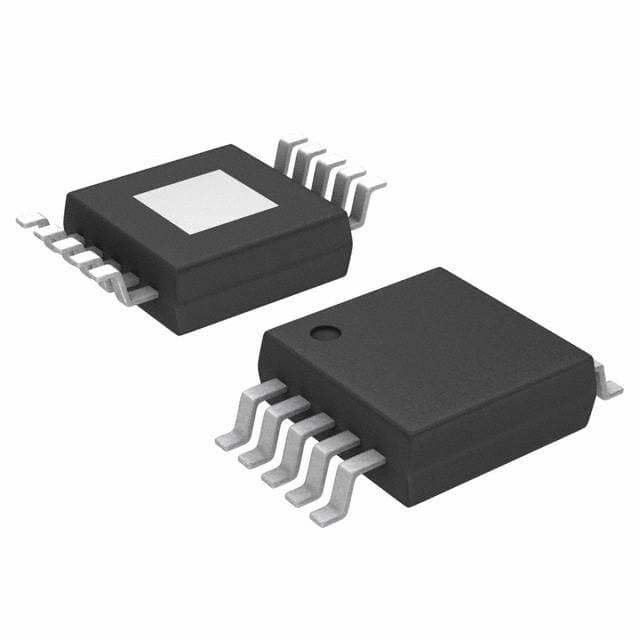
TPS92560DGQ/NOPB is housed in a 10-pin HVSSOP (Package Number MUC10A), 3.00 mm × 3.00 mm body size, with exposed PowerPAD™ thermal pad connected to PGND for enhanced heat dissipation.
| Pin/Terminal | Circuit Role | Design Meaning |
|---|---|---|
| GATE | Gate driver output | Drives low-side N-channel MOSFET gate referenced to SRC; 8.1 V typical high-level output supports robust switching. |
| SRC | Source return | Reference node for GATE driver and current sense amplifier; connects directly to MOSFET source terminal. |
| VCC | VCC regulator output | Supplies internal circuits and gate driver; requires 0.47 µF decoupling capacitor to SRC for transient current delivery. |
| SEN | Kelvin current sense input | Monitors voltage across RSEN to regulate peak/valley inductor current; rejects common-mode noise via differential sensing. |
| GND | Analog ground | Reference for current sense comparator and ADJ pin; must be separated from PGND in layout to avoid noise coupling. |
| ADJ | LED current adjust / OVP sense | Sets input current reference via resistor divider from VLED; also triggers OVP when voltage exceeds 0.384 V typical. |
| VP | IC power supply | Primary input for internal regulator; accepts 6.5–42 V DC or rectified AC; powers all internal blocks except gate driver. |
| AC1 / AC2 | Active low-side rectifier inputs | Internal NMOS rectifiers replace two external diodes; 570 mΩ typical RON reduces conduction loss vs. standard bridge. |
| PGND | Power ground | High-current return path for MOSFET, rectifiers, and output capacitor; connects to PowerPAD™ for thermal management. |
Key Features
| Feature | Design Value |
|---|---|
| Integrated active low-side rectifiers | Eliminates two external diodes in bridge rectifier, reducing BOM count, conduction loss, and board area in MR16 lamp designs. |
| Hysteretic current control | Enables stable operation across AC, DC, and electronic transformer inputs without loop compensation or external timing components. |
| Electronic transformer compatibility | ADJ pin automatically sources 11.5 µA typical to increase input current reference and compensate for inherent dead time in transformer output. |
| Output overvoltage protection | OVP triggered at 0.384 V on ADJ pin disables gate driver during LED open-circuit fault, protecting COUT and D3 from overvoltage stress. |
| Thermally enhanced HVSSOP | PowerPAD™ thermal pad lowers junction-to-board thermal resistance to 5.0 °C/W, enabling >12 W output in compact MR16 form factor. |
Applications
| MR16 LED Retrofit Lamp | AR111 Dimmable Spotlight |
|---|---|
Use Scenario: Replacement of halogen MR16 lamps in track lighting and display fixtures powered by magnetic or electronic transformers. IC Role / Device Role / Timing Role: LED driver IC providing constant input current regulation and active rectification to maintain stable light output despite transformer waveform distortion and dropout. Use Value: Enables direct drop-in replacement without modifying existing transformer infrastructure; >85% efficiency extends thermal life in enclosed fixtures. |
Use Scenario: High-CRI AR111 spotlight used in retail and museum lighting, requiring compatibility with leading-edge dimmers and legacy transformers. IC Role / Device Role / Timing Role: Hysteretic controller adapting input current based on detected power source type (electronic vs. magnetic transformer) to stabilize LED current across dimming range. Use Value: Eliminates flicker and pop-on artifacts during dimmer phase-cut transitions; ADJ-based OVP prevents catastrophic failure during open-circuit dimmer faults. |
| AC-Powered Architectural Lighting | DC-Powered Emergency Exit Sign |
Use Scenario: Low-profile linear LED modules mounted behind architectural coves, powered directly from 12–24 VAC building wiring. IC Role / Device Role / Timing Role: Boost-mode LED driver accepting 12–24 VAC input, converting to regulated DC current for 6-LED strings with integrated rectification. Use Value: Removes need for external bridge rectifier and EMI filter; 0.9+ power factor meets commercial lighting standards without added PFC stage. |
Use Scenario: UL-listed emergency exit sign operating from 12 VDC backup battery during mains failure, requiring high reliability and thermal resilience. IC Role / Device Role / Timing Role: SEPIC-configured LED driver delivering constant current to 3-LED string independent of battery voltage sag from 12.6 V to 10.5 V. Use Value: Maintains consistent lumen output across full battery discharge curve; thermal shutdown (165 °C) prevents fire hazard in sealed enclosures. |
Equivalent & Alternatives
The following parts are listed as comparable options for similar LED driver applications.
| Alternative Part | Technical Difference | Application Difference | Selection Advice |
|---|---|---|---|
| TPS92561DGQ/NOPB | Includes integrated 5-V LDO for biasing external circuitry; identical pinout and core functionality. | Required when auxiliary 5-V rail needed for sensors or communication ICs; adds 150 mW quiescent overhead. | Select TPS92561DGQ/NOPB only if system requires regulated 5-V supply; otherwise TPS92560DGQ/NOPB offers lower cost and simpler BOM. |
| LM3445MMX/NOPB | Fixed-frequency PWM controller (not hysteretic); requires external compensation network and lacks integrated rectifiers. | Better suited for high-precision current regulation with feedback from LED cathode; no built-in transformer compatibility features. | Choose LM3445MMX/NOPB for applications demanding tight ±1% LED current accuracy; TPS92560DGQ/NOPB preferred for transformer-agnostic simplicity and smaller footprint. |
Compared with TPS92561DGQ/NOPB, the TPS92560DGQ/NOPB reduces system cost and complexity by omitting the auxiliary LDO, while matching performance in MR16/AR111 retrofit use cases. Against LM3445MMX/NOPB, it eliminates external compensation and rectifier diodes, trading fine current regulation for plug-and-play transformer compatibility and faster design cycle.
Availability
TPS92560DGQ/NOPB is available at Aetrix Electronics and suitable for MR16 retrofit lamps, AR111 architectural spotlights, and AC-powered linear lighting systems requiring stable component supply, long-lifecycle support, and traceable sourcing for industrial and commercial lighting OEMs.
Supply support for TPS92560DGQ/NOPB includes scheduled delivery planning, volume procurement assistance, BOM continuity management, traceable sourcing, and lifecycle availability coordination for OEM customers, industrial embedded developers, connected-device designers, and electronics production programs.
Manufacturer
Texas Instruments is a global semiconductor leader specializing in analog, embedded processing, and power management technologies, with decades of expertise in lighting control and energy-efficient power conversion.
The TPS92560DGQ/NOPB belongs to TI's LED driver product line, engineered specifically for transformer-compatible, compact-form-factor LED lamps where simplicity, thermal efficiency, and universal input acceptance are critical design requirements.
FAQ
What is the primary function of the ADJ pin on the TPS92560DGQ/NOPB?
The ADJ pin on the TPS92560DGQ/NOPB serves dual functions: it sets the input current reference via a resistor divider from the LED string voltage, and acts as the input for output overvoltage protection (OVP). When the ADJ voltage exceeds 0.384 V typical, the TPS92560DGQ/NOPB disables the gate driver to protect against LED open-circuit faults. Its current-sourcing behavior (11.5 µA for electronic transformers) also compensates for input dead time.
Can the TPS92560DGQ/NOPB operate directly from 12-VAC without an external bridge rectifier?
Yes, the TPS92560DGQ/NOPB can operate directly from 12-VAC because it integrates two active low-side rectifiers on the AC1 and AC2 pins. These internal NMOS devices replace the two lower diodes of a standard bridge rectifier, allowing the IC to accept AC input while maintaining high efficiency (>85%) and eliminating the need for external rectification components in the TPS92560DGQ/NOPB application circuit.
What is the maximum recommended switching frequency for the TPS92560DGQ/NOPB in boost configuration?
The TPS92560DGQ/NOPB does not enforce a fixed switching frequency; its hysteretic control causes frequency to vary with input/output voltage and inductance. For electronic transformer applications, Texas Instruments recommends 1 MHz to 1.5 MHz to balance EMI, efficiency, and transformer compatibility. Inductor selection directly determines operating frequency - higher inductance lowers frequency, and vice versa - per Equation 19 in the TPS92560DGQ/NOPB datasheet.
How does the TPS92560DGQ/NOPB handle thermal overload conditions?
The TPS92560DGQ/NOPB incorporates a dedicated thermal shutdown circuit that disables the gate driver and turns off the internal regulator when junction temperature reaches 165 °C typical. Operation resumes only after temperature falls by 30 °C hysteresis, ensuring safe cooldown before restart. This protection is independent of VCC UVLO and remains active even under sustained overload, safeguarding the TPS92560DGQ/NOPB in enclosed MR16 lamp housings.
Is the TPS92560DGQ/NOPB pin-compatible with any other TI LED drivers?
Yes, the TPS92560DGQ/NOPB shares identical pinout and package (HVSSOP-10) with the TPS92561DGQ/NOPB. The only functional difference is that the TPS92561DGQ/NOPB adds an integrated 5-V LDO on the VCC pin, while the TPS92560DGQ/NOPB provides only the 8.45-V regulator. This makes the TPS92560DGQ/NOPB a direct drop-in replacement where the auxiliary 5-V rail is not required.
TPS92560DGQ/NOPB Specifications
- Product attributes
- Attribute value
- Manufacturer:
- Texas Instruments
- Series:
- -
- Package/Case:
- 10-PowerTFSOP, 10-MSOP (0.118", 3.00mm Width)
- Packaging:
- Tape & Reel (TR)
- Product Status:
- Active
- Type:
- AC DC Offline Switcher
- Topology:
- SEPIC, Step-Up (Boost)
- Internal Switch(s):
- -
- Number of Outputs:
- 1
- Voltage - Supply (Min):
- 6.5V
- Voltage - Supply (Max):
- 42V
- Voltage - Output:
- -
- Current - Output / Channel:
- -
- Frequency:
- -
- Dimming:
- -
- Applications:
- Lighting
- Operating Temperature:
- -40°C ~ 125°C (TJ)
- Grade:
- -
- Qualification:
- -
- Mounting Type:
- Surface Mount
- Supplier Device Package:
- 10-HVSSOP
TPS92560DGQ/NOPB FAQ
1.How can I place an order for TPS92560DGQ/NOPB through Aetrix?
Please submit a Request for Quotation (RFQ) for TPS92560DGQ/NOPB on Aetrix. Our sales agent will provide a competitive quotation and guide you through the order confirmation once you accept the terms.
2.Are the price and stock information for TPS92560DGQ/NOPB reliable?
The price and inventory of TPS92560DGQ/NOPB are updated periodically and may fluctuate due to market conditions. Stock and pricing data are typically refreshed every 24 hours. Quotation validity for TPS92560DGQ/NOPB is usually 5 days.
3.What payment methods are accepted for TPS92560DGQ/NOPB?
We accept Wire Transfer, PayPal, Credit Card, Western Union, MoneyGram, and Escrow for TPS92560DGQ/NOPB transactions.
Note: Certain payment methods may incur a processing fee.
4.How is shipping managed for TPS92560DGQ/NOPB?
TPS92560DGQ/NOPB orders can be shipped via leading logistics carriers, including DHL, UPS, FedEx, TNT, or Registered Mail.
Once your TPS92560DGQ/NOPB order is processed, you will receive an email with the shipment details and tracking number.
Note: Tracking information may take up to 24 hours to appear. Express delivery typically takes 3–5 business days.
5.How can I obtain technical support or documentation for TPS92560DGQ/NOPB?
For technical support, including TPS92560DGQ/NOPB datasheets, pinout diagrams, or application guidance, please contact our engineering support team. They can provide detailed documentation and assistance for your TPS92560DGQ/NOPB requirements.
6.How does Aetrix verify that TPS92560DGQ/NOPB is sourced from the original manufacturer or authorized distributors?
All TPS92560DGQ/NOPB products on Aetrix are procured from qualified distributors and authorized channels. Our dedicated quality assurance team conducts strict verification, including traceability checks and, if necessary, third-party testing. This ensures that TPS92560DGQ/NOPB meets industry standards.
7.What is the process for return or replacement of TPS92560DGQ/NOPB?
All TPS92560DGQ/NOPB units undergo pre-shipment inspection (PSI). If there is an issue with TPS92560DGQ/NOPB, returns or replacements are accepted under the following conditions:
1.Quantity discrepancies, incorrect items, or visible external defects (such as breakage or corrosion), acknowledged by Aetrix.
2.The issue is reported within 90 days of delivery.
3.The TPS92560DGQ/NOPB part is unused and in its original packaging.
Return procedure for TPS92560DGQ/NOPB:
1.Submit a request within 90 days.
2.Obtain a Return Material Authorization (RMA) from Aetrix.
TPS92560DGQ/NOPB Tags
-
BCR402RE6327HTSA1
Infineon Technologies

-
BCR430UXTSA2
Infineon Technologies
-
BCR420UE6433HTMA1
Infineon Technologies
-
BCR420UE6327HTSA1
Infineon Technologies
-
BCR421UE6327HTSA1
Infineon Technologies
-
LYT1604D-TL
Power Integrations

-
HV9910CLG-G
Microchip Technology

-
CL2N8-G
Microchip Technology
-
BCR420UW6-7
Diodes Incorporated
-
BCR421UW6-7
Diodes Incorporated
-
BCR420UFD-7
Diodes Incorporated
-
BCR421UFD-7
Diodes Incorporated
Tech Hub

A practical engineering guide to 3.3V and 5V logic compatibility, input thresholds, resistor dividers, translator ICs, MOSFET level shifting, I2C pull-ups, timing limits and power-sequencing risks.

The 74HC595 uses push-pull logic outputs, while the TPIC6B595 uses 50 V open-drain DMOS sinks for higher-power loads. This guide compares timing, current limits, 3.3 V interfacing, load wiring, thermal…

The 74HC595 converts serial data into eight stable parallel outputs. This guide covers pin functions, shift and storage timing, OE and MR behavior, drive-current limits, cascading, voltage compatibilit…

A technical comparison of level-sensitive latches and edge-triggered flip-flops, covering timing windows, setup and hold limits, master–slave operation, time borrowing, race-through, HDL inference and…

A D latch stores one bit while Enable controls when data can pass. This reference covers gate-level operation, truth tables, transparency, setup and hold timing, LE versus OE, common ICs and practical …

An SR latch stores one bit through cross-coupled feedback. This engineering reference covers NOR and NAND implementations, truth tables, forbidden-state recovery, gated operation, switch debouncing, fa…

Latch circuits retain one bit through feedback. This technical reference covers SR and D latches, truth tables, transparency, timing limits, latch-versus-flip-flop behavior, applications and common log…

An engineering guide to LED driver operation, constant-current and constant-voltage outputs, linear and switching topologies, dimming, IC selection, calculations, replacement compatibility, and fault c…

Operational amplifier guide covering op amp basics, feedback, ideal vs real op amps, common configurations, buffer circuits, offset, bias current, gain-bandwidth, slew rate, rail-to-rail limits and sel…

Jumper cables guide covering safe connection order, red and black clamp placement, final ground connection, cable gauge, length, clamp quality, copper vs CCA cables, jump starter comparison and battery…


