
 My Inquiry
 My Account


Texas Instruments TS3A226AEYFFR
- Part No.:
- TS3A226AEYFFR
- Manufacturer:
- Texas Instruments
- Category:
- Audio Special Purpose
- Package:
- 9-UFBGA, DSBGA
- Datasheet:
-
 TS3A226AEYFFR.pdf
- Description:
- IC AUDIO SWITCH 9DSBGA
- Quantity:
- Payment:

- Shipping:

Inventory:3,921
Please send an inquiry. Send us your inquiry, and we will respond immediately.
Product details
Overview
TS3A226AEYFFR from Texas Instruments is an autonomous audio headset switch IC for 3.5mm TRS/TRRS accessory detection and routing, featuring 60mΩ typical ground FET on-resistance, ±8kV IEC 61000-4-2 ESD protection on SLEEVE/RING2 pins, and FM signal pass-through capability via ground FETs. It enables plug-and-play operation with 3-pole headphones or 4-pole headsets (MIC on SLEEVE or RING2) in mobile handsets without software intervention.
For engineers reviewing the TS3A226AEYFFR datasheet, TS3A226AEYFFR pinout, TS3A226AEYFFR application, or TS3A226AEYFFR equivalent, key selection considerations include autonomous MIC-location detection logic, dual low-RON ground FETs for FM antenna reuse, THD of 0.002% at 200mVPP, and WCSP package compatibility with space-constrained portable designs.
Technical Context
The TS3A226AEYFFR implements autonomous analog detection circuitry that identifies jack pole configuration (TRS vs. TRRS) and MIC placement (SLEEVE or RING2) by measuring impedance signatures across TIP, RING2, SLEEVE, and GND paths. Its internal state machine controls two independent ground-switching FETs (FET1/FET2) and two signal-path switches (SW1/SW2), enabling dynamic reconfiguration of MIC bias, ground return, and audio routing.
It supports FM transmission through the ground path by maintaining broadband signal integrity up to 200MHz (–3dB bandwidth), while delivering –80dB isolation between SLEEVE/RING2 and MICP at 20kHz and –110dB power supply rejection at 217Hz - critical for noise-sensitive mobile audio front-ends.
Key Specifications
| Parameter | Value and Actual Design Meaning |
|---|---|
| VDD Range | 2.6 V to 4.5 V - compatible with single-cell Li-ion battery rails and LDO outputs in portable systems. |
| FET1/FET2 RON | 60 mΩ typical - minimizes voltage drop and thermal rise in ground-return paths carrying microphone bias and FM signals. |
| THD (MIC) | 0.002% typical at 200mVPP - preserves high-fidelity microphone signal integrity in voice capture applications. |
| ESD Rating | ±8 kV contact discharge (IEC 61000-4-2) on SLEEVE/RING2 - eliminates need for external TVS diodes on jack interface lines. |
| Detection Time | 180 ms max - ensures reliable accessory recognition within user-perceptible time after insertion. |
| Quiescent Current | 6.5 µA typical - extends battery life during headset standby in always-on mobile audio subsystems. |
| Bandwidth (FET1/FET2) | 200 MHz (–3 dB) - enables undistorted FM radio signal transmission over shared ground line. |
Pinout & Package
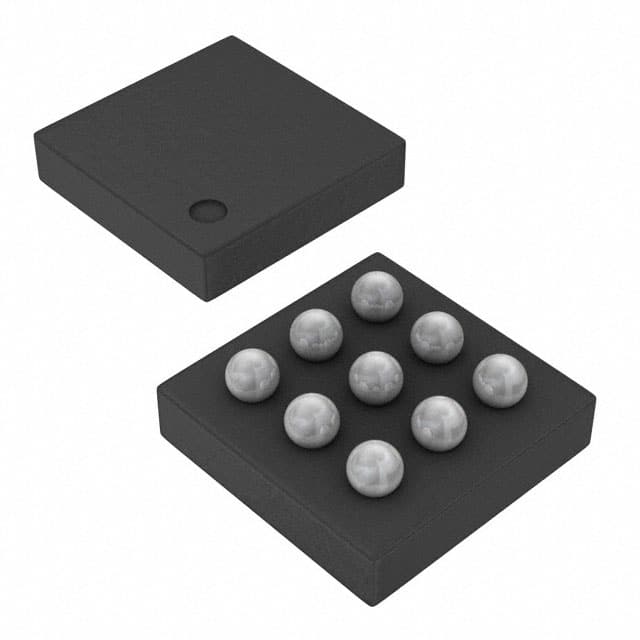
TS3A226AEYFFR is housed in a 1.2 mm × 1.2 mm, 9-ball DSBGA (YFF) package with 0.4 mm pitch and 0.25 mm bump diameter. The die size and ultra-thin profile (max height 0.625 mm) support integration into slim mobile phone PCBs with tight Z-height constraints.
| Pin/Terminal | Circuit Role | Design Meaning |
|---|---|---|
| VDD (A1) | Power supply input | Supplies internal logic and switch drivers; requires local 1µF bypass capacitor near A1 ball. |
| GNDB (A2) | FET2 ground reference | Provides dedicated low-impedance return path for FET2-controlled ground routing (e.g., RING2-to-GND). |
| RING2 (A3) | Jack RING2 segment I/O | Auto-routed to MICP or GNDB based on accessory type; supports ±8kV ESD protection. |
| MICp (B1) | Microphone signal interface | Receives MIC bias from codec and routes microphone signal; isolated at –80dB from SLEEVE/RING2. |
| GNDA (B2) | FET1 ground reference | Provides dedicated low-impedance return path for FET1-controlled ground routing (e.g., SLEEVE-to-GND). |
| SLEEVE (B3) | Jack SLEEVE segment I/O | Auto-routed to MICP or GNDA based on accessory type; supports ±8kV ESD protection. |
| EN (C1) | Detection trigger input | Rising-edge activated; can be tied to mechanical jack switch for automatic detection on insertion. |
| TIP (C2) | Jack TIP segment I/O | Fixed audio left channel path; no switching - remains connected to codec TIP output at all times. |
| GND (C3) | Chip substrate ground | Primary reference for internal logic; must be connected to system ground plane with low-inductance path. |
Key Features
| Feature | Design Value |
|---|---|
| Autonomous headset detection | Identifies TRS (3-pole) vs. TRRS (4-pole) and MIC location (SLEEVE or RING2) without host CPU involvement - reduces firmware complexity and boot-time latency. |
| Dual low-RON ground FETs | 60 mΩ typical on-resistance enables use of shared ground line for both microphone bias return and FM antenna - eliminates need for separate RF ground trace. |
| FM signal pass-through | 200 MHz bandwidth and –85 dB PSR at 20 kHz allow clean FM radio signal coupling through ground FETs without external filtering or matching networks. |
| Click/pop noise reduction | Controlled switch timing and bias sequencing suppress transient artifacts during plug-in/out events - improves user experience in consumer audio devices. |
| Ultra-low quiescent current | 6.5 µA typical supply current in detection-ready state - extends standby battery life in always-connected mobile platforms. |
Applications
| Smartphone Audio Switching | Tablet Headset Interface |
|---|---|
Use Scenario: A smartphone detects whether a user inserts a 3-pole headphone or 4-pole headset with microphone and automatically configures audio routing and MIC bias. IC Role / Device Role / Timing Role: TS3A226AEYFFR acts as autonomous analog switch controller, managing TIP/RING2/SLEEVE connectivity and ground path selection within 180 ms of EN assertion. Use Value: Eliminates requirement for OS-level accessory detection drivers and enables seamless plug-and-play across diverse OEM headset accessories. |
Use Scenario: A tablet supports simultaneous audio playback and voice recording using a single 3.5mm jack, while also allowing FM radio reception via the same headset cable. IC Role / Device Role / Timing Role: TS3A226AEYFFR routes MIC signal to codec, establishes low-impedance ground return, and maintains broadband continuity for FM carrier frequencies up to 108 MHz. Use Value: Enables dual-function jack without additional RF switches or antennas - reduces BOM count and PCB area in compact tablet designs. |
| Notebook Integrated Audio | Ultrabook Voice Assistant Interface |
Use Scenario: An ultraportable notebook uses a single 3.5mm combo jack for stereo output and mono microphone input, supporting both legacy headphones and modern headsets. IC Role / Device Role / Timing Role: TS3A226AEYFFR performs real-time impedance-based classification and reconfigures SW1/SW2 and FET1/FET2 states to match accessory topology. Use Value: Provides hardware-level compatibility with >95% of consumer 3.5mm accessories - avoids customer complaints about non-functional microphones or unbalanced audio. |
Use Scenario: An Ultrabook with voice assistant functionality requires low-noise microphone input and robust ESD protection on the headset jack exposed to frequent handling. IC Role / Device Role / Timing Role: TS3A226AEYFFR delivers 0.002% THD at full-scale MIC signal levels and ±8kV contact ESD protection on all jack-facing pins (SLEEVE, RING2, TIP). Use Value: Ensures clear far-field voice capture under real-world conditions while eliminating external ESD protection components and associated layout overhead. |
Equivalent & Alternatives
The following parts are listed as comparable options for similar audio headset switching applications.
| Alternative Part | Technical Difference | Application Difference | Selection Advice |
|---|---|---|---|
| MAX14521E+T | Higher RON (120mΩ), no FM pass-through support, 12-ball WLP package | Lacks ground-FET bandwidth for FM antenna reuse; suited for pure audio switching only | Select when FM functionality is not required and board space allows larger footprint. |
| TPD3F003DSQR | ESD-protected analog switch only (no detection logic), 0.5Ω RON, 6-pin SOT-23 | Requires external MCU control for accessory detection and routing - adds firmware overhead | Select when system already implements software-based detection and needs minimal-cost protection + switching. |
Compared with MAX14521E+T and TPD3F003DSQR, TS3A226AEYFFR uniquely integrates autonomous detection, dual low-RON ground FETs, and FM-capable bandwidth in a 1.2mm × 1.2mm package - making it the only single-chip solution for space-constrained mobile devices requiring zero-software headset interoperability and FM antenna sharing.
Availability
TS3A226AEYFFR is available at Aetrix Electronics and suitable for mobile phones, tablet PCs, and notebook/ultrabook computers requiring stable component supply, guaranteed long-term sourcing, and production-ready packaging (3000-piece tape-and-reel, YFF0009 outline).
Supply support for TS3A226AEYFFR includes scheduled delivery planning, volume procurement assistance, BOM continuity management, traceable sourcing, and lifecycle availability coordination for OEM customers, industrial embedded developers, connected-device designers, and electronics production programs.
Manufacturer
Texas Instruments is a global semiconductor company specializing in analog, embedded processing, and digital signal technologies for industrial, automotive, and consumer applications.
The TS3A226AEYFFR belongs to TI's audio interface switch product line, designed specifically to simplify 3.5mm headset integration in battery-powered portable devices by replacing multi-component detection + switching solutions with a single autonomous IC.
FAQ
What is the primary function of the TS3A226AEYFFR in a mobile audio system?
The TS3A226AEYFFR serves as an autonomous audio headset switch that detects 3-pole or 4-pole 3.5mm accessories and routes microphone, ground, and audio signals without host processor intervention. It enables plug-and-play compatibility across diverse headset types while supporting FM signal transmission through its low-RON ground FETs - a core capability of the TS3A226AEYFFR in modern smartphones and tablets.
Does the TS3A226AEYFFR require external firmware or driver support to operate?
No, the TS3A226AEYFFR operates autonomously using on-chip analog detection circuitry to identify headset configuration (TRS vs. TRRS) and MIC location (SLEEVE or RING2). Once EN is asserted, it self-configures internal switches and FETs within 180 ms - eliminating dependency on OS-level drivers or application firmware. This behavior is intrinsic to the TS3A226AEYFFR design and verified across all production units.
How does the TS3A226AEYFFR support FM radio functionality through a standard headset jack?
The TS3A226AEYFFR supports FM radio by routing FM signals through its ground FETs (FET1/FET2), which exhibit 200 MHz –3dB bandwidth and maintain signal integrity up to 108 MHz. Its 60 mΩ typical RON ensures minimal insertion loss, allowing the shared ground line to function as an effective FM antenna - a documented capability of the TS3A226AEYFFR confirmed in TI's SCDS346A datasheet Figure 1 and functional tables.
What package type and dimensions does the TS3A226AEYFFR use?
The TS3A226AEYFFR uses a 1.2 mm × 1.2 mm, 9-ball DSBGA (YFF) package with 0.4 mm pitch and maximum height of 0.625 mm. Its land pattern follows TI's YFF0009 outline, requiring non-solder-mask-defined pads and 0.25 mm stencil apertures - specifications fully defined for the TS3A226AEYFFR in TI's official packaging documentation and board layout examples.
What level of ESD protection does the TS3A226AEYFFR provide on jack-facing pins?
The TS3A226AEYFFR provides ±8 kV contact discharge ESD protection per IEC 61000-4-2 on SLEEVE, RING2, and TIP pins - sufficient to eliminate external TVS diodes in most mobile designs. This rating is measured and guaranteed for the TS3A226AEYFFR, as specified in the Absolute Maximum Ratings table of its official datasheet (SCDS346A, Rev A).
TS3A226AEYFFR Specifications
- Product attributes
- Attribute value
- Manufacturer:
- Texas Instruments
- Series:
- -
- Package/Case:
- 9-UFBGA, DSBGA
- Packaging:
- Tape & Reel (TR)
- Product Status:
- Active
- Function:
- Audio Switch
- Applications:
- Consumer Audio
- Number of Channels:
- 1
- Interface:
- -
- Voltage - Supply:
- 2.6V ~ 4.5V
- Operating Temperature:
- -40°C ~ 85°C (TA)
- Specifications:
- FM
- Mounting Type:
- Surface Mount
- Grade:
- -
TS3A226AEYFFR FAQ
1.How can I place an order for TS3A226AEYFFR through Aetrix?
Please submit a Request for Quotation (RFQ) for TS3A226AEYFFR on Aetrix. Our sales agent will provide a competitive quotation and guide you through the order confirmation once you accept the terms.
2.Are the price and stock information for TS3A226AEYFFR reliable?
The price and inventory of TS3A226AEYFFR are updated periodically and may fluctuate due to market conditions. Stock and pricing data are typically refreshed every 24 hours. Quotation validity for TS3A226AEYFFR is usually 5 days.
3.What payment methods are accepted for TS3A226AEYFFR?
We accept Wire Transfer, PayPal, Credit Card, Western Union, MoneyGram, and Escrow for TS3A226AEYFFR transactions.
Note: Certain payment methods may incur a processing fee.
4.How is shipping managed for TS3A226AEYFFR?
TS3A226AEYFFR orders can be shipped via leading logistics carriers, including DHL, UPS, FedEx, TNT, or Registered Mail.
Once your TS3A226AEYFFR order is processed, you will receive an email with the shipment details and tracking number.
Note: Tracking information may take up to 24 hours to appear. Express delivery typically takes 3–5 business days.
5.How can I obtain technical support or documentation for TS3A226AEYFFR?
For technical support, including TS3A226AEYFFR datasheets, pinout diagrams, or application guidance, please contact our engineering support team. They can provide detailed documentation and assistance for your TS3A226AEYFFR requirements.
6.How does Aetrix verify that TS3A226AEYFFR is sourced from the original manufacturer or authorized distributors?
All TS3A226AEYFFR products on Aetrix are procured from qualified distributors and authorized channels. Our dedicated quality assurance team conducts strict verification, including traceability checks and, if necessary, third-party testing. This ensures that TS3A226AEYFFR meets industry standards.
7.What is the process for return or replacement of TS3A226AEYFFR?
All TS3A226AEYFFR units undergo pre-shipment inspection (PSI). If there is an issue with TS3A226AEYFFR, returns or replacements are accepted under the following conditions:
1.Quantity discrepancies, incorrect items, or visible external defects (such as breakage or corrosion), acknowledged by Aetrix.
2.The issue is reported within 90 days of delivery.
3.The TS3A226AEYFFR part is unused and in its original packaging.
Return procedure for TS3A226AEYFFR:
1.Submit a request within 90 days.
2.Obtain a Return Material Authorization (RMA) from Aetrix.
TS3A226AEYFFR Tags
-
SA571DR2G
onsemi
-
ADAU7002ACBZ-R7
Analog Devices Inc.

-
DRV135UA/2K5
Texas Instruments
-
DRV134UA/1K
Texas Instruments
-
DRV134PA
Texas Instruments
-
DRV134UA
Texas Instruments
-
DRV135UA
Texas Instruments
-
SA572DR2G
onsemi
-
PGA2311U/1K
Texas Instruments
-
SI8244BB-D-IS1R
Skyworks Solutions Inc.

-
CS8416K-CZZR
Cirrus Logic Inc.
-
SRC4392IPFBR
Texas Instruments
Tech Hub

A practical engineering guide to 3.3V and 5V logic compatibility, input thresholds, resistor dividers, translator ICs, MOSFET level shifting, I2C pull-ups, timing limits and power-sequencing risks.

The 74HC595 uses push-pull logic outputs, while the TPIC6B595 uses 50 V open-drain DMOS sinks for higher-power loads. This guide compares timing, current limits, 3.3 V interfacing, load wiring, thermal…

The 74HC595 converts serial data into eight stable parallel outputs. This guide covers pin functions, shift and storage timing, OE and MR behavior, drive-current limits, cascading, voltage compatibilit…

A technical comparison of level-sensitive latches and edge-triggered flip-flops, covering timing windows, setup and hold limits, master–slave operation, time borrowing, race-through, HDL inference and…

A D latch stores one bit while Enable controls when data can pass. This reference covers gate-level operation, truth tables, transparency, setup and hold timing, LE versus OE, common ICs and practical …

An SR latch stores one bit through cross-coupled feedback. This engineering reference covers NOR and NAND implementations, truth tables, forbidden-state recovery, gated operation, switch debouncing, fa…

Latch circuits retain one bit through feedback. This technical reference covers SR and D latches, truth tables, transparency, timing limits, latch-versus-flip-flop behavior, applications and common log…

An engineering guide to LED driver operation, constant-current and constant-voltage outputs, linear and switching topologies, dimming, IC selection, calculations, replacement compatibility, and fault c…

Operational amplifier guide covering op amp basics, feedback, ideal vs real op amps, common configurations, buffer circuits, offset, bias current, gain-bandwidth, slew rate, rail-to-rail limits and sel…

Jumper cables guide covering safe connection order, red and black clamp placement, final ground connection, cable gauge, length, clamp quality, copper vs CCA cables, jump starter comparison and battery…


