
 My Inquiry
 My Account


STMicroelectronics TS556CN
- Part No.:
- TS556CN
- Manufacturer:
- STMicroelectronics
- Category:
- Programmable Timers and Oscillators
- Package:
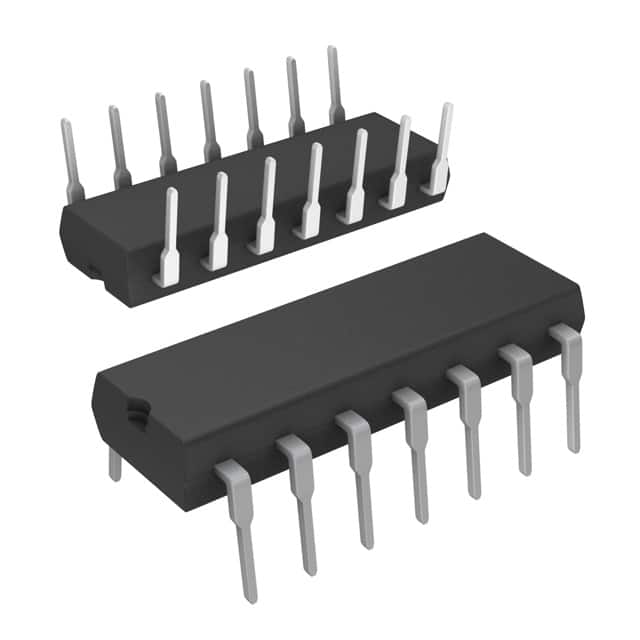
- 14-DIP (0.300", 7.62mm)
- Datasheet:
-
 TS556CN.pdf
- Description:
- IC OSC TIMER DUAL 2.7MHZ 14-DIP
- Quantity:
- Payment:

- Shipping:

Inventory:1,715
Please send an inquiry. Send us your inquiry, and we will respond immediately.
Product details
Overview
TS556CN from STMicroelectronics is a dual CMOS timer IC designed for precision timing in monostable and astable configurations. It delivers 220 µA typical supply current at 5 V, supports up to 2.7 MHz astable frequency, operates across 2–16 V supply range, and features 10¹² Ω input impedance - enabling low-power sensor interface and battery-operated pulse generation circuits.
For engineers reviewing the TS556CN datasheet, TS556CN pinout, TS556CN application, or TS556CN equivalent, key selection considerations include its ultra-low ICC versus bipolar NE556, reduced supply current spikes during output transitions, high-impedance trigger/threshold inputs, and SO14 package compatibility with legacy 556 layouts.
Technical Context
The TS556 integrates two independent CMOS-based 555-style timer cores sharing a common VCC and GND. Each section implements a voltage divider (three 50 kΩ resistors), dual comparators, SR flip-flop, discharge transistor, and push-pull output stage - all fabricated in ST's low-power CMOS process.
Timing accuracy is maintained across voltage (±0.1 %/V in astable mode) and temperature (75 ppm/°C), enabled by supply-proportional threshold/trigger reference generation and matched internal resistor ratios. Output rise/fall times are 25 ns/20 ns (10 pF load), supporting clean digital edge generation without external buffering.
Key Specifications
| Parameter | Value and Actual Design Meaning |
|---|---|
| Supply Current (Typ) | 220 µA at VCC = 5 V - enables >1-year battery life in coin-cell-powered timers |
| Max Astable Frequency | 2.7 MHz - supports ultrasonic driver clocking and fast PWM generation |
| Supply Voltage Range | 2 V to 16 V - interoperable with Li-ion, 3.3 V logic, and 12 V industrial rails |
| Input Impedance | 10¹² Ω - permits use of high-value timing resistors (>10 MΩ) and low-leakage capacitors |
| Output Compatibility | TTL/CMOS/MOS logic-level drive - eliminates level-shifter requirements in mixed-voltage systems |
| Timing Accuracy (Astable) | ±3 % - ensures stable frequency in oscillator applications without calibration |
| Temp Range | -40 °C to +125 °C - qualified for under-hood automotive and industrial control environments |
Pinout & Package
TS556CN is housed in a 14-pin SOIC (SO14) plastic micropackage per ECOPACK specifications, with 1.27 mm pitch, 8.75 mm body length, and 4.0 mm body width. Pin 1 is marked by a beveled corner or dot; top-view orientation follows standard JEDEC SOIC convention.
| Pin/Terminal | Circuit Role | Design Meaning |
|---|---|---|
| 1 (GND) | Ground reference | Common return path for both timer sections and discharge transistor sinks |
| 2 (Trigger) | Monostable start input | Falling edge below 1/3 VCC sets flip-flop; high-impedance CMOS input (≤10 pA leakage) |
| 3 (Output) | Timer output (Section A) | Push-pull CMOS output capable of sourcing 2 mA / sinking 8 mA at 5 V |
| 4 (Reset) | Asynchronous reset | Active-low override: forces output LOW and discharges timing capacitor when pulled ≤0.3 V |
| 5 (Control Voltage) | Threshold reference adjust | Direct access to internal 2/3 VCC divider node; bypass capacitor reduces noise sensitivity |
| 6 (Threshold) | Astable timing input | Rising edge above 2/3 VCC resets flip-flop; high-impedance input tied to RC network |
| 7 (Discharge) | Capacitor discharge switch | Open-drain NMOS transistor (RDS(on) ≤0.35 Ω at VCC=5 V) for precise RC timing discharge |
| 8 (VCC) | Positive supply | Single rail powers both timer sections; decoupling capacitor required due to reduced current spikes |
| 9 (GND) | Ground reference | Shared ground with Pin 1 - no separate analog/digital ground separation |
| 10 (Trigger) | Monostable start input (Section B) | Independent trigger input for second timer; identical electrical behavior to Pin 2 |
| 11 (Output) | Timer output (Section B) | Independent push-pull output; electrically isolated from Pin 3 except via shared VCC/GND |
| 12 (Reset) | Asynchronous reset (Section B) | Independent active-low reset; does not affect Section A unless externally wired |
| 13 (Control Voltage) | Threshold reference adjust (Section B) | Separate CV pin for Section B; allows independent frequency modulation per channel |
| 14 (Threshold) | Astable timing input (Section B) | Independent threshold input; enables dual independent oscillators or cascaded timing |
Key Features
| Feature | Design Value |
|---|---|
| Ultra-low quiescent current | 220 µA typ at 5 V - reduces system standby power by >96% vs. bipolar NE556 (6 mA) |
| Reduced supply current spikes | Minimizes required decoupling capacitance to 100 nF (vs. ≥1 µF for NE556), saving board space |
| High input impedance (10¹² Ω) | Enables timing networks with >100 s time constants using standard film capacitors and MΩ resistors |
| Wide supply range (2–16 V) | Eliminates need for LDOs in multi-rail systems - direct interface with 2-cell alkaline, LiFePO₄, or 12 V bus |
| Pin-to-pin compatible with NE556 | Drop-in replacement in existing PCBs; same SO14 footprint and signal mapping (no layout change) |
Applications
| LED Flasher Control | Industrial Sensor Wake-Up Timer |
|---|---|
|
Use Scenario: Generating precise on/off intervals for status LEDs in HMI panels and PLC I/O modules. IC Role / Device Role / Timing Role: Dual-section astable oscillator driving two independent LED banks with adjustable duty cycle. Use Value: 2.7 MHz max frequency allows sub-millisecond flash rates; low ICC extends panel battery life without compromising visibility. |
Use Scenario: Periodically waking low-power sensors (e.g., temperature, humidity) in remote monitoring nodes. IC Role / Device Role / Timing Role: Monostable one-shot triggering MCU wake-up interrupt after programmable sleep interval (1 s to 10 min). Use Value: 10¹² Ω input impedance enables use of 10 µF electrolytic + 10 MΩ resistor for 100 s timing - no costly tantalum or supercapacitors needed. |
| DC Motor Speed Controller | Power Supply Sequencing |
|
Use Scenario: Generating variable-duty-cycle PWM for brushed DC motor speed regulation in portable tools. IC Role / Device Role / Timing Role: Astable multivibrator feeding gate driver with frequency-tunable PWM (100 Hz–10 kHz). Use Value: ±3 % astable accuracy ensures consistent motor torque; 2–16 V operation matches battery pack voltage sag during load. |
Use Scenario: Controlling power-up sequence of FPGA, ADC, and RF transceiver in communication modules. IC Role / Device Role / Timing Role: Cascaded monostables generating staggered enable signals with 10 ms–100 ms delays. Use Value: Independent reset pins (Pins 4 & 12) allow external synchronization to system reset line, ensuring deterministic sequencing. |
Equivalent & Alternatives
The following parts are listed as comparable options for similar dual timer applications.
| Alternative Part | Technical Difference | Application Difference | Selection Advice |
|---|---|---|---|
| NE556DR | Bipolar process; 6 mA ICC at 5 V; 0.1 MHz max astable frequency; higher ESD sensitivity (HBM 500 V) | Higher power dissipation limits use in sealed enclosures; lower frequency restricts PWM resolution | Select only if legacy design requires identical thermal signature or existing stock must be consumed |
| LM556CN | Higher ICC (10 mA); wider temp range (-55 to +125 °C); no CV pin access; 1 MHz max frequency | Lower timing accuracy (±5 %); lacks independent control voltage for frequency modulation | Prefer where extended cold-temp operation is critical and CMOS power savings are secondary |
Compared with NE556DR and LM556CN, TS556CN provides superior energy efficiency, higher frequency capability, and greater timing stability - making it optimal for modern battery-constrained and high-precision timing designs.
Availability
TS556CN is available at Aetrix Electronics and suitable for industrial sensor nodes, portable medical devices, and automotive body control modules requiring stable component supply across extended temperature ranges and long production lifecycles.
Supply support for TS556CN includes scheduled delivery planning, volume procurement assistance, BOM continuity management, traceable sourcing, and lifecycle availability coordination for OEM customers, industrial embedded developers, connected-device designers, and electronics production programs.
Manufacturer
STMicroelectronics is a global semiconductor leader headquartered in Geneva, Switzerland, specializing in microcontrollers, power management, analog ICs, and automotive-grade components.
The TS556CN belongs to ST's precision analog timer product line, engineered specifically for low-power, high-accuracy timing in space- and energy-constrained embedded systems.
FAQ
Can TS556CN replace NE556 in existing PCB layouts?
Yes - TS556CN uses the same SO14 package and identical pinout as NE556, including matching VCC, GND, trigger, threshold, discharge, reset, control voltage, and output assignments. No PCB modification is required, though decoupling capacitor value may be reduced due to lower supply current spikes.
What is the maximum load the TS556CN output can drive directly?
At VCC = 5 V, each output can source up to 2 mA or sink up to 8 mA while maintaining VOL ≤ 0.6 V and VOH ≥ 4.4 V. This supports direct drive of small-signal MOSFET gates, LED indicators with series resistors ≥620 Ω, and TTL/CMOS inputs without buffering.
Does TS556CN support independent operation of its two timer sections?
Yes - both sections share only VCC and GND; all other pins (trigger, threshold, reset, control voltage, discharge, output) are fully independent. This enables true dual-channel functionality such as synchronized but non-identical oscillators or cascaded monostable delays.
How does the 10¹² Ω input impedance improve timing capacitor selection?
With leakage current <10 pA, the TS556CN minimizes error from capacitor self-discharge, allowing use of low-cost polyester or ceramic timing capacitors instead of expensive low-leakage types. For example, a 1 µF polyester cap with 100 nA leakage would introduce >10 % timing error in a 10 s monostable - TS556CN avoids this entirely.
TS556CN Specifications
- Product attributes
- Attribute value
- Manufacturer:
- STMicroelectronics
- Series:
- -
- Package/Case:
- 14-DIP (0.300", 7.62mm)
- Packaging:
- Tube
- Product Status:
- Obsolete
- Type:
- 555 Type, Timer/Oscillator (Dual)
- Count:
- -
- Frequency:
- 2.7MHz
- Voltage - Supply:
- 2V ~ 16V
- Current - Supply:
- 130 µA
- Operating Temperature:
- 0°C ~ 70°C
- Supplier Device Package:
- 14-DIP
- Mounting Type:
- Through Hole
- Grade:
- -
- Qualification:
- -
TS556CN FAQ
1.How can I place an order for TS556CN through Aetrix?
Please submit a Request for Quotation (RFQ) for TS556CN on Aetrix. Our sales agent will provide a competitive quotation and guide you through the order confirmation once you accept the terms.
2.Are the price and stock information for TS556CN reliable?
The price and inventory of TS556CN are updated periodically and may fluctuate due to market conditions. Stock and pricing data are typically refreshed every 24 hours. Quotation validity for TS556CN is usually 5 days.
3.What payment methods are accepted for TS556CN?
We accept Wire Transfer, PayPal, Credit Card, Western Union, MoneyGram, and Escrow for TS556CN transactions.
Note: Certain payment methods may incur a processing fee.
4.How is shipping managed for TS556CN?
TS556CN orders can be shipped via leading logistics carriers, including DHL, UPS, FedEx, TNT, or Registered Mail.
Once your TS556CN order is processed, you will receive an email with the shipment details and tracking number.
Note: Tracking information may take up to 24 hours to appear. Express delivery typically takes 3–5 business days.
5.How can I obtain technical support or documentation for TS556CN?
For technical support, including TS556CN datasheets, pinout diagrams, or application guidance, please contact our engineering support team. They can provide detailed documentation and assistance for your TS556CN requirements.
6.How does Aetrix verify that TS556CN is sourced from the original manufacturer or authorized distributors?
All TS556CN products on Aetrix are procured from qualified distributors and authorized channels. Our dedicated quality assurance team conducts strict verification, including traceability checks and, if necessary, third-party testing. This ensures that TS556CN meets industry standards.
7.What is the process for return or replacement of TS556CN?
All TS556CN units undergo pre-shipment inspection (PSI). If there is an issue with TS556CN, returns or replacements are accepted under the following conditions:
1.Quantity discrepancies, incorrect items, or visible external defects (such as breakage or corrosion), acknowledged by Aetrix.
2.The issue is reported within 90 days of delivery.
3.The TS556CN part is unused and in its original packaging.
Return procedure for TS556CN:
1.Submit a request within 90 days.
2.Obtain a Return Material Authorization (RMA) from Aetrix.
TS556CN Tags

-
NE555DR
Texas Instruments
-
SA555DR
Texas Instruments
-
NA555DR
Texas Instruments
-
SE555DR
Texas Instruments
-
NE555P
Texas Instruments
-
CD4541BM96
Texas Instruments
-
CD4541BE
Texas Instruments
-
TLC555QDR
Texas Instruments
-
TLC555IDR
Texas Instruments
-
TLC555QDRQ1
Texas Instruments
-
TPL5010DDCR
Texas Instruments
-
TLC555CP
Texas Instruments
Tech Hub

A practical engineering and sourcing framework covering lifecycle verification, lifetime-buy calculations, replacement qualification, supplier checks and counterfeit-risk controls.

TTL and CMOS logic families differ in thresholds, loading, output drive, power and timing. This engineering guide compares 74HC and 74HCT, calculates noise margins and checks 3.3 V/5 V compatibility.

A practical engineering guide to 3.3V and 5V logic compatibility, input thresholds, resistor dividers, translator ICs, MOSFET level shifting, I2C pull-ups, timing limits and power-sequencing risks.

The 74HC595 uses push-pull logic outputs, while the TPIC6B595 uses 50 V open-drain DMOS sinks for higher-power loads. This guide compares timing, current limits, 3.3 V interfacing, load wiring, thermal…

The 74HC595 converts serial data into eight stable parallel outputs. This guide covers pin functions, shift and storage timing, OE and MR behavior, drive-current limits, cascading, voltage compatibilit…

A technical comparison of level-sensitive latches and edge-triggered flip-flops, covering timing windows, setup and hold limits, master–slave operation, time borrowing, race-through, HDL inference and…

A D latch stores one bit while Enable controls when data can pass. This reference covers gate-level operation, truth tables, transparency, setup and hold timing, LE versus OE, common ICs and practical …

An SR latch stores one bit through cross-coupled feedback. This engineering reference covers NOR and NAND implementations, truth tables, forbidden-state recovery, gated operation, switch debouncing, fa…

Latch circuits retain one bit through feedback. This technical reference covers SR and D latches, truth tables, transparency, timing limits, latch-versus-flip-flop behavior, applications and common log…

An engineering guide to LED driver operation, constant-current and constant-voltage outputs, linear and switching topologies, dimming, IC selection, calculations, replacement compatibility, and fault c…


