
 My Inquiry
 My Account


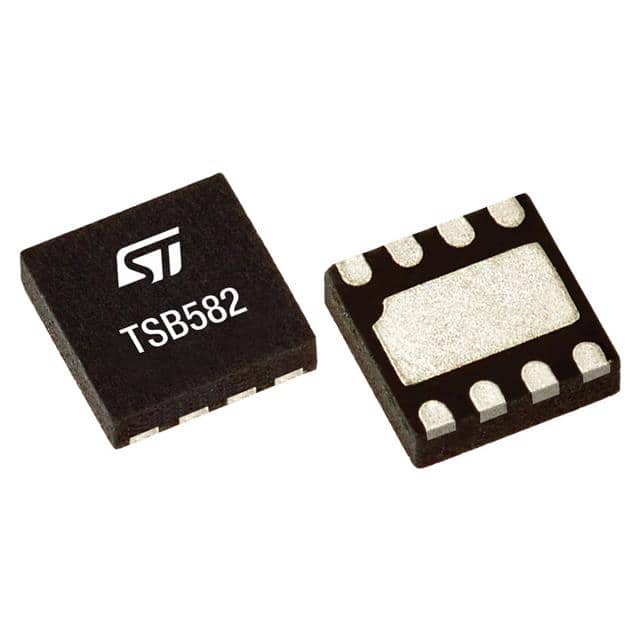
STMicroelectronics TSB582IQ2T
- Part No.:
- TSB582IQ2T
- Manufacturer:
- STMicroelectronics
- Category:
- Instrumentation, Op Amps, Buffer Amps
- Package:
- 8-WDFN Exposed Pad
- Datasheet:
-
 TSB582IQ2T.pdf
- Description:
- HIGH OUTPUT CURRENT WITH THERMAL
- Quantity:
- Payment:

- Shipping:

Inventory:3,582
Please send an inquiry. Send us your inquiry, and we will respond immediately.
Product details
Overview
TSB582IQ2T from STMicroelectronics is a dual, unity-gain-stable, high-voltage (4–36 V), high-output-current (200 mA per channel) operational amplifier with rail-to-rail output and low-rail input capability. It integrates thermal shutdown, output current limiting, 4 kV HBM ESD tolerance, and enhanced RF noise immunity. Designed for driving inductive loads such as angle resolvers and piezo actuators in automotive-grade industrial systems.
For engineers reviewing the TSB582IQ2T datasheet, TSB582IQ2T pinout, TSB582IQ2T application, or TSB582IQ2T equivalent, key selection criteria include its 3.1 MHz gain bandwidth, 2 V/µs slew rate, -40 °C to +125 °C operating range, 45 nV/√Hz input noise at 1 kHz, and dual-channel parallel/bridge-tied drive capability.
Technical Context
The TSB582IQ2T employs a BiCMOS process enabling both high voltage operation (up to 36 V supply) and robust output current delivery (200 mA per channel). Its internal protection architecture includes thermal shutdown triggered at 168–180 °C junction temperature and current limiting active during overload conditions.
It features dual independent amplifiers with matched input offset voltage (≤3 mV over full temperature range), high common-mode rejection (≥81 dB), and supply voltage rejection (≥116 dB), supporting precision signal conditioning in noisy automotive and industrial environments where rail-to-rail output swing and low input bias current (<5 nA) are critical.
Key Specifications
| Parameter | Value and Actual Design Meaning |
|---|---|
| Supply Voltage Range | 4 V to 36 V - supports wide-input industrial and automotive power rails without external regulation |
| Output Current (per channel) | 200 mA - drives low-impedance inductive loads (e.g., solenoids, resolvers) directly without external buffers |
| Gain Bandwidth Product | 3.1 MHz - enables stable closed-loop operation up to ~300 kHz with moderate gain in unity-gain stable configuration |
| Slew Rate | 2 V/µs - supports fast transient response in servo and motor control feedback paths |
| Input Offset Voltage | ≤3 mV (full temp range) - ensures <0.1% error in 12-bit precision analog front-ends at 10 V full scale |
| Input Noise Density | 45 nV/√Hz @ 1 kHz - maintains SNR > 90 dB in 20 kHz bandwidth instrumentation applications |
| Operating Temperature | -40 °C to +125 °C - qualified for under-hood automotive and harsh industrial environments |
| ESD Rating | 4 kV HBM - meets AEC-Q101-001 for robustness in assembly and field operation |
Pinout & Package
TSB582IQ2T is packaged in DFN8 (3 × 3 mm) with wettable flanks and exposed pad, optimized for thermal performance (RthJA = 40 °C/W) and automated optical inspection in automotive PCB assembly.
| Pin/Terminal | Circuit Role | Design Meaning |
|---|---|---|
| 1 (Out1) | Channel 1 output | High-current source/sink node; supports bridge-tied or parallel configuration with Out2 |
| 2 (In1–) | Channel 1 inverting input | Differential input node with ±42 V absolute max rating; requires series resistor if |Vid| > 1.3 V |
| 3 (In1+) | Channel 1 non-inverting input | Common-mode range extends to VCC–; usable down to negative rail for single-supply sensing |
| 4 (VCC–) | Negative supply rail | Reference for both channels; exposed pad may be connected here for optimal thermal path |
| 5 (In2+) | Channel 2 non-inverting input | Independent input with same CMRR and ESD protection as In1+ |
| 6 (In2–) | Channel 2 inverting input | Matched electrical characteristics to In1–; enables dual-channel differential sensing |
| 7 (Out2) | Channel 2 output | Electrically identical to Out1; enables load sharing or push-pull drive when paralleled |
| 8 (VCC+) | Positive supply rail | Supports up to 42 V absolute max; decoupling capacitor ≥22 nF required per supply pin |
| ep (Exposed Pad) | Thermal & electrical ground | Must be soldered to PCB copper pour; improves thermal dissipation and reduces EMI susceptibility |
Key Features
| Feature | Design Value |
|---|---|
| Rail-to-rail output with low-rail input | Enables true single-supply operation down to 4 V while maintaining full dynamic range at VCC– |
| Internal thermal shutdown & current limiter | Prevents destructive failure during short-circuit or overload; auto-recovery at 130–146 °C |
| Enhanced RF noise immunity (EMIRR) | Minimizes offset shift from 10 MHz–2.4 GHz interference-critical for automotive EMC compliance |
| Unity-gain stable with capacitive load support | Stable with ≥100 pF load; RISO = 30 Ω ensures stability regardless of capacitance value |
| Automotive-grade qualification | AEC-Q101 qualified; guaranteed operation across -40 °C to +125 °C ambient with traceable lot control |
| Low input bias current & noise | <5 nA bias current and 45 nV/√Hz noise enable high-impedance sensor interfacing without signal degradation |
Applications
| Angle Resolver Interface | Servo Motor Driver |
|---|---|
|
Use Scenario: Excitation and sine/cosine signal conditioning for rotary position sensing in electric power steering (EPS) and traction motors. IC Role / Device Role / Timing Role: Dual-channel amplifier providing matched excitation drive (Out1) and differential resolver output amplification (Out2). Use Value: 200 mA output current drives 50–100 Ω resolver primaries; low offset drift (<3 mV) preserves angular accuracy over temperature. |
Use Scenario: Closed-loop current/voltage amplification in brushless DC (BLDC) servo drives for robotics and CNC motion control. IC Role / Device Role / Timing Role: High-slew-rate (2 V/µs), rail-to-rail output stage delivering precise PWM-modulated phase currents. Use Value: 3.1 MHz GBW supports >100 kHz loop bandwidth; thermal shutdown prevents latch-up during stall conditions. |
| Industrial Valve Actuator | LED Driver for Automotive Lighting |
|
Use Scenario: Proportional current control of 24 V solenoid valves in process automation and hydraulic control systems. IC Role / Device Role / Timing Role: High-current op-amp configured as precision current source (IOUT = VREF/RSENSE) with integrated overload protection. Use Value: Internal current limit avoids external sense resistor burnout; 36 V max supply accommodates 24 V industrial bus with ripple margin. |
Use Scenario: Constant-current driver for high-brightness LED arrays in adaptive front lighting systems (AFS) and DRL modules. IC Role / Device Role / Timing Role: Dual-channel amplifier implementing analog dimming and current mirror reference in LED string biasing circuits. Use Value: Low 45 nV/√Hz noise prevents visible flicker; -40 °C to +125 °C rating ensures reliability in under-hood thermal cycling. |
Equivalent & Alternatives
The following parts are listed as comparable options for similar high-current, high-voltage op-amp applications.
| Alternative Part | Technical Difference | Application Difference | Selection Advice |
|---|---|---|---|
| TSC2010IDT | Single-channel, 120 mA output, 2.5 MHz GBW, no thermal shutdown | Lacks dual-channel integration and overload protection; suited only for lower-power signal conditioning | Select only when single-channel operation and reduced thermal safety margin are acceptable |
| LM7332MA/NOPB | Dual-channel, 60 mA output, 20 MHz GBW, rail-to-rail I/O, no current limiting | Higher speed but insufficient drive strength for inductive loads; no automotive qualification | Prefer for wideband signal processing where load current <60 mA and AEC-Q101 not required |
Compared with TSC2010IDT and LM7332MA/NOPB, TSB582IQ2T uniquely combines dual-channel 200 mA drive, automotive qualification, integrated thermal/current protection, and 36 V operation-making it the only option for robust, high-power analog actuation in safety-critical systems.
Availability
TSB582IQ2T is available at Aetrix Electronics and suitable for servo driver, valve driver, and industrial process control applications requiring stable component supply, long-term lifecycle assurance, and automotive-grade traceability.
Supply support for TSB582IQ2T includes scheduled delivery planning, volume procurement assistance, BOM continuity management, traceable sourcing, and lifecycle availability coordination for OEM customers, industrial embedded developers, connected-device designers, and electronics production programs.
Manufacturer
STMicroelectronics is a global semiconductor leader headquartered in Geneva, Switzerland, designing and manufacturing microcontrollers, power ICs, sensors, and analog components for automotive, industrial, and consumer markets.
The TSB582IQ2T belongs to ST's high-voltage, high-output-current operational amplifier product line-engineered specifically for ruggedized analog actuation in automotive electrification and industrial automation where reliability under overload and thermal stress is mandatory.
FAQ
What is the maximum continuous output current per channel for TSB582IQ2T?
The TSB582IQ2T delivers up to 200 mA per channel continuously under specified thermal conditions (TA ≤ 85 °C, PCB copper area ≥ 200 mm², RthJA = 40 °C/W). At higher ambient temperatures or reduced copper area, derating applies per Figure 29–30 SOA curves. Output current remains limited to prevent junction temperature exceeding 150 °C.
Can TSB582IQ2T drive capacitive loads without external compensation?
Yes, the TSB582IQ2T is unity-gain stable and supports ≥100 pF capacitive loads without oscillation. For loads >100 pF, adding a 10–30 Ω series resistor (RISO) at the output ensures stability across all conditions; 30 Ω guarantees stability regardless of capacitance value while preserving DC accuracy for purely capacitive loads.
Is the exposed pad on the DFN8 package electrically connected?
Yes-the exposed pad is internally connected to VCC– and must be soldered to a PCB copper pour tied to the negative supply plane. Leaving it floating degrades thermal performance (RthJA increases by ~15 °C/W) and reduces ESD/EMI immunity. Wettable flanks ensure reliable automated optical inspection during SMT assembly.
How does the thermal shutdown mechanism behave during sustained overload?
When junction temperature exceeds 168–180 °C, the output stage disables until die temperature falls below 130–146 °C, then automatically resumes operation. This cycle prevents permanent damage but is not intended for continuous operation. System design must ensure average power dissipation stays within SOA limits-external fusing or PTCs are recommended for fault-prone applications.
TSB582IQ2T Specifications
- Product attributes
- Attribute value
- Manufacturer:
- STMicroelectronics
- Series:
- -
- Package/Case:
- 8-WDFN Exposed Pad
- Packaging:
- Tape & Reel (TR)
- Product Status:
- Active
- Amplifier Type:
- CMOS
- Number of Circuits:
- 2
- Output Type:
- Rail-to-Rail
- Slew Rate:
- 2V/µs
- Gain Bandwidth Product:
- 3.1 MHz
- -3db Bandwidth:
- -
- Current - Input Bias:
- 2 nA
- Voltage - Input Offset:
- 2.4 mV
- Current - Supply:
- 2.5mA (x2 Channels)
- Current - Output / Channel:
- 200 mA
- Voltage - Supply Span (Min):
- 2 V
- Voltage - Supply Span (Max):
- 36 V
- Operating Temperature:
- -40°C ~ 125°C
- Grade:
- -
- Qualification:
- -
- Mounting Type:
- Surface Mount
- Supplier Device Package:
- 8-DFN (3x3)
TSB582IQ2T FAQ
1.How can I place an order for TSB582IQ2T through Aetrix?
Please submit a Request for Quotation (RFQ) for TSB582IQ2T on Aetrix. Our sales agent will provide a competitive quotation and guide you through the order confirmation once you accept the terms.
2.Are the price and stock information for TSB582IQ2T reliable?
The price and inventory of TSB582IQ2T are updated periodically and may fluctuate due to market conditions. Stock and pricing data are typically refreshed every 24 hours. Quotation validity for TSB582IQ2T is usually 5 days.
3.What payment methods are accepted for TSB582IQ2T?
We accept Wire Transfer, PayPal, Credit Card, Western Union, MoneyGram, and Escrow for TSB582IQ2T transactions.
Note: Certain payment methods may incur a processing fee.
4.How is shipping managed for TSB582IQ2T?
TSB582IQ2T orders can be shipped via leading logistics carriers, including DHL, UPS, FedEx, TNT, or Registered Mail.
Once your TSB582IQ2T order is processed, you will receive an email with the shipment details and tracking number.
Note: Tracking information may take up to 24 hours to appear. Express delivery typically takes 3–5 business days.
5.How can I obtain technical support or documentation for TSB582IQ2T?
For technical support, including TSB582IQ2T datasheets, pinout diagrams, or application guidance, please contact our engineering support team. They can provide detailed documentation and assistance for your TSB582IQ2T requirements.
6.How does Aetrix verify that TSB582IQ2T is sourced from the original manufacturer or authorized distributors?
All TSB582IQ2T products on Aetrix are procured from qualified distributors and authorized channels. Our dedicated quality assurance team conducts strict verification, including traceability checks and, if necessary, third-party testing. This ensures that TSB582IQ2T meets industry standards.
7.What is the process for return or replacement of TSB582IQ2T?
All TSB582IQ2T units undergo pre-shipment inspection (PSI). If there is an issue with TSB582IQ2T, returns or replacements are accepted under the following conditions:
1.Quantity discrepancies, incorrect items, or visible external defects (such as breakage or corrosion), acknowledged by Aetrix.
2.The issue is reported within 90 days of delivery.
3.The TSB582IQ2T part is unused and in its original packaging.
Return procedure for TSB582IQ2T:
1.Submit a request within 90 days.
2.Obtain a Return Material Authorization (RMA) from Aetrix.
TSB582IQ2T Tags

-
LM358DT
STMicroelectronics

-
LM358DR
Texas Instruments
-
LM2904DR
Texas Instruments
-
LM358ADR
Texas Instruments
-
LM2904DGKR
Texas Instruments
-
LM324DR
Texas Instruments
-
MCP6006T-E/OT
Microchip Technology
-
MCP6006UT-E/OT
Microchip Technology
-
LM324PWR
Texas Instruments
-
LM2902PWR
Texas Instruments
-
LM2902DR
Texas Instruments
-
LM358P
Texas Instruments
Tech Hub
Schmitt triggers use separate rising and falling thresholds to stabilize slow or noisy signals. This guide covers hysteresis, 74HC14 and 74HCT14 selection, comparator calculations, RC oscillators and p…
Counterfeit components can hide behind convincing markings and passing basic function tests. This engineering reference covers source traceability, external inspection, X-ray, XRF, electrical testing, …

A practical engineering and sourcing framework covering lifecycle verification, lifetime-buy calculations, replacement qualification, supplier checks and counterfeit-risk controls.

TTL and CMOS logic families differ in thresholds, loading, output drive, power and timing. This engineering guide compares 74HC and 74HCT, calculates noise margins and checks 3.3 V/5 V compatibility.

A practical engineering guide to 3.3V and 5V logic compatibility, input thresholds, resistor dividers, translator ICs, MOSFET level shifting, I2C pull-ups, timing limits and power-sequencing risks.

The 74HC595 uses push-pull logic outputs, while the TPIC6B595 uses 50 V open-drain DMOS sinks for higher-power loads. This guide compares timing, current limits, 3.3 V interfacing, load wiring, thermal…

The 74HC595 converts serial data into eight stable parallel outputs. This guide covers pin functions, shift and storage timing, OE and MR behavior, drive-current limits, cascading, voltage compatibilit…

A technical comparison of level-sensitive latches and edge-triggered flip-flops, covering timing windows, setup and hold limits, master–slave operation, time borrowing, race-through, HDL inference and…

A D latch stores one bit while Enable controls when data can pass. This reference covers gate-level operation, truth tables, transparency, setup and hold timing, LE versus OE, common ICs and practical …

An SR latch stores one bit through cross-coupled feedback. This engineering reference covers NOR and NAND implementations, truth tables, forbidden-state recovery, gated operation, switch debouncing, fa…


