
 My Inquiry
 My Account


Texas Instruments TSC2008IRGVT
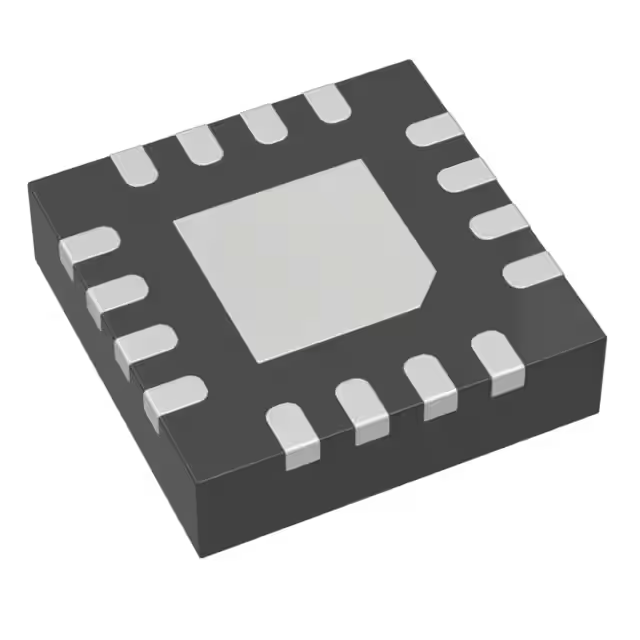
- Part No.:
- TSC2008IRGVT
- Manufacturer:
- Texas Instruments
- Category:
- Touch Screen Controllers
- Package:
- 16-VFQFN Exposed Pad
- Datasheet:
-
 TSC2008IRGVT.pdf
- Description:
- IC SCREEN CNTRL 12BIT 16QFN
- Quantity:
- Payment:

- Shipping:

Inventory:3,600
Please send an inquiry. Send us your inquiry, and we will respond immediately.
Product details
Overview
TSC2008IRGVT from Texas Instruments is a 12-bit, nanopower, 4-wire resistive touch screen controller with SPI interface, operating from 1.2V to 3.6V supply, featuring ratiometric conversion, on-chip temperature sensing (±2°C accuracy), and touch pressure measurement. It delivers up to 10kHz effective throughput at 12-bit resolution and integrates preprocessing logic to reduce host bus activity in portable handheld systems.
For engineers reviewing the TSC2008IRGVT datasheet, TSC2008IRGVT pinout, TSC2008IRGVT application, or TSC2008IRGVT equivalent, this device supports low-voltage battery-powered designs requiring precise X/Y coordinate acquisition, Z-pressure estimation, and ambient temperature monitoring - especially where ESD robustness (±15kV contact), ultra-low quiescent current (30.4µA @ 1.2V), and compact QFN-16 packaging are critical.
Technical Context
The TSC2008IRGVT implements a SAR ADC architecture with internal clock generation (1.6–1.91MHz at 12-bit mode), integrated touch panel drivers, and a programmable 8-/12-bit resolution command interface compatible with TSC2046. Its analog front-end includes low-on-resistance switches (X+/Y+ ≤6Ω, X−/Y− ≤5Ω) and dual diode-based temperature sensing (TEMP1/TEMP2) for differential or calibrated absolute measurement.
It uses a CMOS-compatible SPI slave interface (CPOL=0, CPHA=0) supporting up to 25MHz SCLK, with digital I/Os compliant across 1.2–3.6V VDD. PENIRQ is a buffered, programmable-pull-up interrupt output synchronized to conversion completion, and preprocessing includes median + averaging filtering (MAV) to suppress noise without host intervention.
Key Specifications
| Parameter | Value and Actual Design Meaning |
|---|---|
| Resolution | Programmable 8-bit or 12-bit; enables trade-off between speed (20kHz @ 8-bit) and precision (10kHz @ 12-bit) for varying screen size and latency needs. |
| Supply Voltage Range | 1.2V to 3.6V; supports single-cell Li-ion or alkaline battery operation without LDO, reducing system BOM and power loss. |
| Quiescent Current | 30.4µA @ 1.2V, 5MHz SCLK, 12-bit mode; enables >1-year battery life in always-on portable touch interfaces. |
| ESD Protection | ±15kV contact discharge (IEC 61000-4-2); eliminates need for external TVS diodes on X+/X−/Y+/Y− lines in handheld enclosures. |
| Internal Clock Frequency | 1.6–1.91MHz (12-bit mode); provides stable timing reference independent of host clock, simplifying timing-critical touch sampling. |
| Touch Pressure Measurement | Supports Z1/Z2 method using X/Y plate resistance and position data; enables force-sensitive UI feedback without external circuitry. |
| Temperature Accuracy | ±2°C (differential TEMP1/TEMP2 method); sufficient for battery thermal management and ambient compensation in consumer devices. |
Pinout & Package
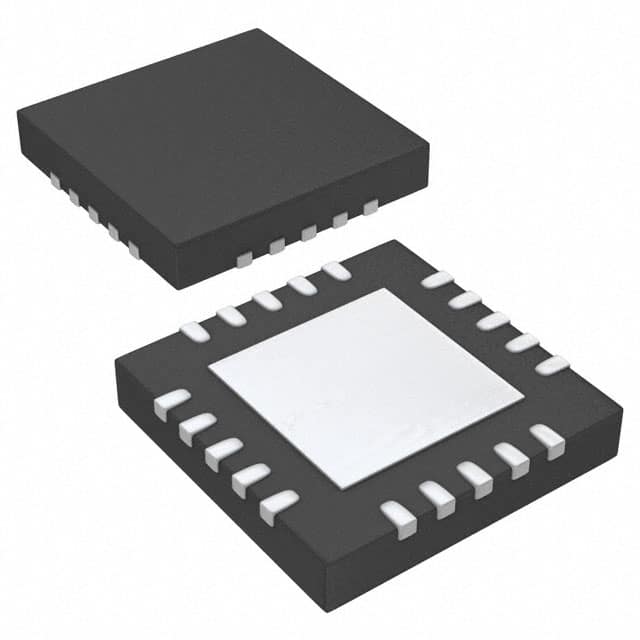
Package: 16-pin QFN (4 mm × 4 mm, RGV), thermally enhanced with exposed pad internally connected to substrate (recommended to connect to analog ground).
| Pin/Terminal | Circuit Role | Design Meaning |
|---|---|---|
| 1 (NC) | No connection | Unused pad; must remain unconnected per datasheet to avoid parasitic coupling. |
| 2 (SDI) | Serial data input | MOSI line for SPI command/data write; CMOS input with VIH = 0.7×VDD, enabling direct interface to 1.8V microcontrollers. |
| 3 (CS) | Chip select | Active-low enable for SPI transactions; supports multi-device buses with hardware-select arbitration. |
| 4 (SCLK) | Serial clock input | Host-provided SPI clock (up to 25MHz); timing-critical for PENIRQ synchronization and conversion latency control. |
| 5 (VDD/REF) | Supply and reference input | Single-pin dual-function: powers internal circuitry and sets ADC reference voltage; enables ratiometric measurement eliminating VDD drift errors. |
| 6 (X+) | X-axis positive input | Analog input for X+ electrode; high-impedance SAR ADC input with 12pF capacitance, optimized for direct ITO trace connection. |
| 7 (Y+) | Y-axis positive input | Analog input for Y+ electrode; shares same electrical specs as X+, supporting symmetrical 4-wire panel drive and readout. |
| 8 (X−) | X-axis negative input | Analog input for X− electrode; integrated low-RON (≤5Ω) switch allows active panel driving during measurement cycles. |
| 9 (Y−) | Y-axis negative input | Analog input for Y− electrode; complements X− to form full 4-wire touch coordinate acquisition path. |
| 10 (GND) | Analog ground | Reference return for all analog signals; must be separated from digital ground to maintain 12-bit linearity (±1.5 LSB). |
| 11 (NC) | No connection | Unused pad; no internal bond wire; floating or grounded per layout best practice. |
| 12 (AUX) | Auxiliary analog input | General-purpose 12-bit ADC channel; usable for battery voltage monitoring or sensor interfacing when touch is inactive. |
| 13 (NC) | No connection | Unused pad; no internal function; leave unconnected. |
| 14 (NC) | No connection | Unused pad; no internal function; leave unconnected. |
| 15 (PENIRQ) | Pen touch interrupt output | Open-drain, digitally buffered output with programmable pull-up (50kΩ/90kΩ); asserts low on touch detection and releases on EOC or release. |
| 16 (SDO) | Serial data output | MISO line for SPI readback; outputs straight-binary format data synchronized to SCLK falling edge per CPOL=0/CPHA=0 protocol. |
Key Features
| Feature | Design Value |
|---|---|
| Preprocessing logic (MAV filter) | Reduces host SPI traffic by up to 7× via on-chip median + averaging filtering, lowering CPU load and system power in continuous-scan applications. |
| Programmable PENIRQ pull-up | Configurable 50kΩ or 90kΩ internal pull-up eliminates external resistor, saving board space and ensuring consistent interrupt timing across VDD range. |
| Ratiometric conversion | Uses VDD as ADC reference, making X/Y coordinate measurements immune to supply rail variation - critical for battery-voltage droop during RF transmission. |
| Auto power-down control | Enters sub-µA sleep state (0.8µA max) when CS is high and no touch activity detected, extending standby time in intermittent-use devices. |
| Enhanced ESD protection | ±15kV contact / ±25kV air-gap discharge on all touch inputs meets IEC 61000-4-2 Level 4, enabling direct PCB routing without shielding or guard traces. |
| TSC2046 software compatibility | Command set and register map identical to TSC2046, allowing drop-in firmware reuse and minimizing qualification effort in legacy design upgrades. |
Applications
| Portable Media Players | Industrial Handheld Terminals |
|---|---|
Use Scenario: Resistive touch overlay on LCD display in battery-powered MP3/video players with stylus input. IC Role / Device Role / Timing Role: Primary touch coordinate acquisition IC, converting analog X/Y/Z signals into digital SPI packets synchronized to host frame rate. Use Value: 30.4µA quiescent current extends playback time; 1.2V operation matches single-cell Li-ion discharge curve; MAV filtering suppresses LCD backlight noise. |
Use Scenario: Ruggedized point-of-sale or warehouse inventory scanner with glove-compatible touch interface. IC Role / Device Role / Timing Role: Touch controller managing 4-wire panel and auxiliary battery voltage monitoring via AUX channel. Use Value: ±15kV ESD rating withstands repeated static discharge in dry environments; wide –40°C to +85°C temp range ensures reliability in uncontrolled field conditions. |
| Medical Diagnostic Handhelds | Smart Home Control Panels |
Use Scenario: Touch-enabled vital-sign monitor with temperature-compensated calibration and low-power sleep mode. IC Role / Device Role / Timing Role: Dual-role IC performing both touch position capture and ambient temperature sensing (via TEMP1/TEMP2 diodes). Use Value: Differential temperature measurement (±2°C) enables real-time thermal drift correction of touch coordinates; auto power-down reduces idle power to <1µA. |
Use Scenario: Wall-mounted thermostat or lighting control panel with capacitive-like responsiveness using resistive overlay. IC Role / Device Role / Timing Role: Touch interface IC delivering X/Y coordinates and Z-pressure data to MCU for gesture interpretation (e.g., swipe, press-hold). Use Value: Programmable 8-/12-bit resolution allows balancing of response speed (20kHz) vs. precision (4096-step resolution); PENIRQ edge signaling enables deterministic interrupt-driven polling. |
Equivalent & Alternatives
The following parts are listed as comparable options for similar touch screen controller applications.
| Alternative Part | Technical Difference | Application Difference | Selection Advice |
|---|---|---|---|
| TSC2046IPW | Legacy 12-bit controller; lacks MAV filter, lower ESD (±8kV HBM), higher quiescent current (220µA @ 3.3V), no internal temperature sensor. | Acceptable for cost-sensitive, non-battery-critical designs with existing TSC2046 firmware and no thermal monitoring requirement. | Select only if legacy compatibility outweighs power/ESD/feature advantages of TSC2008IRGVT. |
| ADS7843E | 12-bit SAR ADC with SPI interface; no integrated touch drivers, no PENIRQ, no temperature sensor, no preprocessing logic. | Requires external driver transistors and discrete interrupt logic; suitable only for custom-designed touch panels with full analog front-end control. | Choose only when full analog signal path customization is required and system-level integration is handled externally. |
Compared with TSC2046IPW and ADS7843E, the TSC2008IRGVT delivers superior power efficiency (13× lower current), integrated ESD protection eliminating external components, and on-chip temperature sensing - making it optimal for next-generation portable medical, industrial, and consumer touch interfaces where size, battery life, and robustness are prioritized.
Availability
TSC2008IRGVT is available at Aetrix Electronics and suitable for portable media players, industrial handheld terminals, and smart home control panels requiring stable component supply, long-term lifecycle support, and guaranteed traceable sourcing.
Supply support for TSC2008IRGVT includes scheduled delivery planning, volume procurement assistance, BOM continuity management, traceable sourcing, and lifecycle availability coordination for OEM customers, industrial embedded developers, connected-device designers, and electronics production programs.
Manufacturer
Texas Instruments is a global semiconductor leader specializing in analog, embedded processing, and connectivity technologies, with decades of expertise in precision data converters and human-interface solutions.
The TSC2008IRGVT belongs to TI's touch screen controller product line, designed specifically for ultra-low-power, battery-operated handheld devices requiring high-accuracy resistive touch sensing, integrated diagnostics, and robust ESD performance in compact form factors.
FAQ
What is the minimum supply voltage supported by the TSC2008IRGVT?
The TSC2008IRGVT operates down to 1.2V, enabling direct interface with single-cell lithium batteries across their full discharge curve (typically 4.2V to 2.8V for Li-ion, but also compatible with 1.5V alkaline). This low-voltage capability eliminates the need for intermediate regulators in space-constrained portable designs, and all specifications - including 12-bit linearity and 10kHz throughput - are guaranteed across the 1.2V–3.6V range. The TSC2008IRGVT maintains full functionality even at 1.2V, unlike many competing controllers that require ≥2.7V.
Does the TSC2008IRGVT support both 4-wire and 5-wire touch screens?
The TSC2008IRGVT is explicitly designed for 4-wire resistive touch screens only, as confirmed by its pinout (X+, X−, Y+, Y−), internal driver architecture, and datasheet specifications. It does not support 5-wire configurations - which require separate Z1/Z2 sensing and different switching topology - nor does it include the necessary fifth electrode driver or associated control logic. Using the TSC2008IRGVT with a 5-wire panel would result in incomplete or erroneous coordinate acquisition. For 5-wire applications, TI recommends the TSC2007 or other dedicated 5-wire controllers.
How does the TSC2008IRGVT achieve ±2°C temperature measurement accuracy?
The TSC2008IRGVT achieves ±2°C accuracy using its dual-diode (TEMP1/TEMP2) differential measurement method, which cancels out process-related offset and gain errors without requiring factory calibration. The device measures the voltage difference between two diodes with a fixed 91:1 resistance ratio, leveraging the known thermal coefficient (–2.1mV/°C) to compute absolute temperature via ΔV = VBE(TEMP2) − VBE(TEMP1). This method is implemented entirely within the TSC2008IRGVT's analog front-end and requires no external components or host-side compensation algorithms.
Can the TSC2008IRGVT operate without an external reference voltage?
Yes - the TSC2008IRGVT uses its VDD/REF pin as both power supply and ADC reference, enabling true ratiometric conversion. When VDD varies (e.g., due to battery discharge), the ADC full-scale range scales proportionally, preserving measurement accuracy of X/Y ratios and eliminating the need for a stable external reference. This architecture makes the TSC2008IRGVT inherently tolerant to supply ripple and droop, and no external reference component is required. However, if higher absolute accuracy is needed, an external reference can be applied to VDD/REF while powering the core from a separate VDD rail (not supported in standard configuration).
What is the purpose of the MAV filter in the TSC2008IRGVT?
The MAV (Median + Averaging) filter in the TSC2008IRGVT is an on-chip digital preprocessing block that reduces noise and spurious touch readings before data is sent to the host processor. It applies median filtering to reject outliers (e.g., ESD-induced glitches) followed by averaging to smooth stochastic noise - all without host CPU involvement. This reduces SPI bus traffic by up to 7× compared to raw sample streaming, lowers host processing load, and improves touch response consistency in electrically noisy environments like LCD-backlit displays. The MAV filter is enabled by default and configurable via command register.
TSC2008IRGVT Specifications
- Product attributes
- Attribute value
- Manufacturer:
- Texas Instruments
- Package/Case:
- 16-VFQFN Exposed Pad
- Touchscreen:
- 4 Wire Resistive
- Resolution (Bits):
- 8 b, 12 b
- Interface:
- SPI
- Voltage Reference:
- External
- Voltage - Supply:
- 1.2V ~ 3.6V
- Current - Supply:
- -
- Operating Temperature:
- -40°C ~ 85°C
- Mounting Type:
- Surface Mount
- Grade:
- -
- Qualification:
- -
- Supplier Device Package:
- 16-VQFN (3x3)
TSC2008IRGVT FAQ
1.How can I place an order for TSC2008IRGVT through Aetrix?
Please submit a Request for Quotation (RFQ) for TSC2008IRGVT on Aetrix. Our sales agent will provide a competitive quotation and guide you through the order confirmation once you accept the terms.
2.Are the price and stock information for TSC2008IRGVT reliable?
The price and inventory of TSC2008IRGVT are updated periodically and may fluctuate due to market conditions. Stock and pricing data are typically refreshed every 24 hours. Quotation validity for TSC2008IRGVT is usually 5 days.
3.What payment methods are accepted for TSC2008IRGVT?
We accept Wire Transfer, PayPal, Credit Card, Western Union, MoneyGram, and Escrow for TSC2008IRGVT transactions.
Note: Certain payment methods may incur a processing fee.
4.How is shipping managed for TSC2008IRGVT?
TSC2008IRGVT orders can be shipped via leading logistics carriers, including DHL, UPS, FedEx, TNT, or Registered Mail.
Once your TSC2008IRGVT order is processed, you will receive an email with the shipment details and tracking number.
Note: Tracking information may take up to 24 hours to appear. Express delivery typically takes 3–5 business days.
5.How can I obtain technical support or documentation for TSC2008IRGVT?
For technical support, including TSC2008IRGVT datasheets, pinout diagrams, or application guidance, please contact our engineering support team. They can provide detailed documentation and assistance for your TSC2008IRGVT requirements.
6.How does Aetrix verify that TSC2008IRGVT is sourced from the original manufacturer or authorized distributors?
All TSC2008IRGVT products on Aetrix are procured from qualified distributors and authorized channels. Our dedicated quality assurance team conducts strict verification, including traceability checks and, if necessary, third-party testing. This ensures that TSC2008IRGVT meets industry standards.
7.What is the process for return or replacement of TSC2008IRGVT?
All TSC2008IRGVT units undergo pre-shipment inspection (PSI). If there is an issue with TSC2008IRGVT, returns or replacements are accepted under the following conditions:
1.Quantity discrepancies, incorrect items, or visible external defects (such as breakage or corrosion), acknowledged by Aetrix.
2.The issue is reported within 90 days of delivery.
3.The TSC2008IRGVT part is unused and in its original packaging.
Return procedure for TSC2008IRGVT:
1.Submit a request within 90 days.
2.Obtain a Return Material Authorization (RMA) from Aetrix.
TSC2008IRGVT Tags

-
TSC2046IPWR
Texas Instruments
-
TSC2007IPWR
Texas Instruments
-
TSC2046EIPWR
Texas Instruments
-
AR1021-I/SS
Microchip Technology
-
AR1020-I/SS
Microchip Technology
-
AR1100-I/MQ
Microchip Technology
-
AR1021T-I/ML
Microchip Technology
-
AR1100T-I/SS
Microchip Technology
-
TSC2003IPWR
Texas Instruments
-
TSC2004IRTJR
Texas Instruments
-
AR1100BRD
Microchip Technology
.jpg)
-
TSC2046IRGVR
Texas Instruments
Tech Hub

A practical engineering guide to 3.3V and 5V logic compatibility, input thresholds, resistor dividers, translator ICs, MOSFET level shifting, I2C pull-ups, timing limits and power-sequencing risks.

The 74HC595 uses push-pull logic outputs, while the TPIC6B595 uses 50 V open-drain DMOS sinks for higher-power loads. This guide compares timing, current limits, 3.3 V interfacing, load wiring, thermal…

The 74HC595 converts serial data into eight stable parallel outputs. This guide covers pin functions, shift and storage timing, OE and MR behavior, drive-current limits, cascading, voltage compatibilit…

A technical comparison of level-sensitive latches and edge-triggered flip-flops, covering timing windows, setup and hold limits, master–slave operation, time borrowing, race-through, HDL inference and…

A D latch stores one bit while Enable controls when data can pass. This reference covers gate-level operation, truth tables, transparency, setup and hold timing, LE versus OE, common ICs and practical …

An SR latch stores one bit through cross-coupled feedback. This engineering reference covers NOR and NAND implementations, truth tables, forbidden-state recovery, gated operation, switch debouncing, fa…

Latch circuits retain one bit through feedback. This technical reference covers SR and D latches, truth tables, transparency, timing limits, latch-versus-flip-flop behavior, applications and common log…

An engineering guide to LED driver operation, constant-current and constant-voltage outputs, linear and switching topologies, dimming, IC selection, calculations, replacement compatibility, and fault c…

Operational amplifier guide covering op amp basics, feedback, ideal vs real op amps, common configurations, buffer circuits, offset, bias current, gain-bandwidth, slew rate, rail-to-rail limits and sel…

Jumper cables guide covering safe connection order, red and black clamp placement, final ground connection, cable gauge, length, clamp quality, copper vs CCA cables, jump starter comparison and battery…


