
 My Inquiry
 My Account


Texas Instruments TUSB7320IRKMR
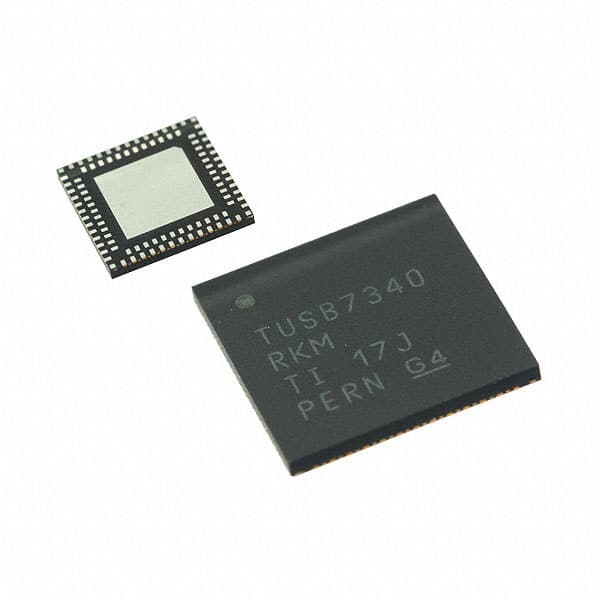
- Part No.:
- TUSB7320IRKMR
- Manufacturer:
- Texas Instruments
- Category:
- Controllers
- Package:
- 100-WQFN Dual Rows, Exposed Pad
- Datasheet:
-
 TUSB7320IRKMR.pdf
- Description:
- IC HUB CONTROLLER USB 100WQFN
- Quantity:
- Payment:

- Shipping:

Inventory:2,201
Please send an inquiry. Send us your inquiry, and we will respond immediately.
Product details
Overview
TUSB7320IRKMR from Texas Instruments is a USB 3.0-compliant xHCI host controller IC that implements a PCIe x1 Gen2 interface and provides two downstream USB ports supporting SuperSpeed (5 Gbps), high-speed (480 Mbps), full-speed (12 Mbps), and low-speed (1.5 Mbps) operation. It integrates adaptive receiver equalization, independent per-port power control and overcurrent detection, and internal spread-spectrum clock generation. It is used in desktop motherboards and embedded host systems requiring compact, low-power USB 3.0 expansion.
For engineers reviewing the TUSB7320IRKMR datasheet, TUSB7320IRKMR pinout, TUSB7320IRKMR application, or TUSB7320IRKMR equivalent, key selection criteria include PCIe Gen2 compatibility, dual-port USB 3.0 support with independent port enable/disable, integrated 1.1V core/3.3V I/O power domains, WQFN-MR 100-pin thermal pad package, and absence of external flash requirement for default configuration.
Technical Context
The TUSB7320IRKMR implements the xHCI 1.0 specification and interfaces with the host CPU via a PCIe x1 Gen2 (5 GT/s) link using differential REFCLK, TX/RX pairs, and PERST#/GRST# reset hierarchy. Its PHY layer supports per-port transmit swing (16 settings), de-emphasis (16 levels), and adaptive equalization with FTC-reversed mode as default for robust signal integrity across lossy PCB traces.
It operates with 1.1V core (VDD11), 3.3V analog (VDDA_3P3), and 3.3V I/O (VDD33) supplies, and includes dedicated pins for USB_SSTXP/SSTXN/SSRXP/SSRX on both downstream ports, plus PWRON#/OVERCUR# per port, JTAG debug, I²C configuration, and GPIOs - all mapped to a 100-pin WQFN-MR (RKM) exposed-pad package.
Key Specifications
| Parameter | Value and Actual Design Meaning |
|---|---|
| Interface | PCIe x1 Gen2 (5 GT/s) host interface; no external flash required for boot |
| USB Ports | 2 downstream USB 3.0 ports, each supporting SS/HS/FS/LS with independent enable/disable |
| Power Supplies | 1.1V core (VDD11), 3.3V analog (VDDA_3P3), 3.3V I/O (VDD33); 70.95 mW typical idle power |
| Signal Integrity | Adaptive receiver equalizer with FTC-reversed mode; 16-level transmit swing & de-emphasis control |
| Package | 100-pin WQFN-MR (RKM) with exposed thermal pad; 9.5°C/W junction-to-case (top) |
| Operating Temp | 0°C to 70°C ambient; junction temperature up to 105°C |
| ESD Rating | ±1500 V HBM, ±500 V CDM per JEDEC standards |
Pinout & Package
Package: 100-pin WQFN-MR (RKM) with exposed thermal pad, 7 mm × 7 mm footprint, 0.4 mm pitch, designed for thermal performance in space-constrained host applications.
| Pin/Terminal | Circuit Role | Design Meaning |
|---|---|---|
| PCIE_RXP / PCIE_RXN | PCIe Gen2 receiver differential input | Accepts 100 MHz differential reference clock; requires controlled-impedance routing |
| PCIE_TXP / PCIE_TXN | PCIe Gen2 transmitter differential output | Drives host PCIe root complex; supports Gen2 signaling at 5 GT/s |
| USB_SSTXP_DN1 / USB_SSTXN_DN1 | Port 1 SuperSpeed transmitter differential pair | Drives 5 Gbps USB 3.0 data; polarity swap allowed in layout |
| USB_SSRXP_DN1 / USB_SSRXN_DN1 | Port 1 SuperSpeed receiver differential pair | Receives 5 Gbps USB 3.0 data; adaptive equalization applied per-port |
| PWRON1# / OVERCUR1# | Port 1 power control & overcurrent sense | Active-low port power enable; open-drain overcurrent flag (0 = fault) |
| GRST# / PERST# | Global and PCIe reset inputs | GRST# resets all internal registers; PERST# synchronizes PCIe link initialization |
| XI / XO | Crystal oscillator input/output | Supports 24 MHz crystal with 12–24 pF load; internal 2 MΩ feedback resistor |
| VDD11 / VDDA_3P3 / VDD33 | Core, analog, and I/O supply rails | Three independent power domains; decoupling required per spec section 7.3 |
Key Features
| Feature | Design Value |
|---|---|
| PCIe Gen2 x1 interface | Enables direct attachment to modern host processors without bridge logic or additional controllers |
| Per-port independent control | Each downstream port can be enabled/disabled, powered, and monitored separately in software |
| Integrated adaptive equalizer | Compensates for up to 20 dB channel loss at 2.5 GHz; FTC-reversed mode optimizes jitter tolerance |
| No external flash required | Default xHCI configuration stored internally; optional EEPROM supports custom vendor descriptors |
| Low-jitter clock architecture | Internal spread-spectrum generation reduces EMI; supports low-cost 24 MHz crystals or oscillators |
Applications
| Desktop Motherboard Expansion | Rack Server USB Hub |
|---|---|
Use Scenario: Adding native USB 3.0 connectivity to entry-level ATX or microATX motherboards where chipset USB 3.0 lanes are limited or unavailable. IC Role / Device Role / Timing Role: xHCI host controller bridging PCIe Gen2 to dual USB 3.0 ports; handles enumeration, bandwidth allocation, and protocol translation. Use Value: Eliminates need for third-party USB 3.0 add-in cards; enables direct motherboard integration with minimal BOM impact and no external firmware storage. | Use Scenario: Providing dedicated, isolated USB 3.0 host capability on 1U/2U rack servers for BMC-connected peripherals (KVM, flash drives, diagnostics tools). IC Role / Device Role / Timing Role: Standalone USB host controller operating independently of main CPU USB resources; manages port power sequencing and overcurrent protection. Use Value: Enables hot-plug-safe USB access during server boot/post; per-port power control prevents bus faults from affecting system stability. |
| Industrial Embedded Host | Thin Client Peripheral Interface |
Use Scenario: Integrating USB 3.0 host functionality into fanless industrial PCs used in factory automation for vision cameras and motion controllers. IC Role / Device Role / Timing Role: Low-power xHCI controller with thermal-aware operation; supports D3cold wakeup via AUX_DET pin. Use Value: Maintains full USB 3.0 bandwidth while meeting 70°C ambient and 105°C junction thermal limits; enables auxiliary-powered wake from deep sleep. | Use Scenario: Supporting high-bandwidth peripherals (e.g., multi-touch displays, biometric scanners) in thin client endpoints with constrained board area. IC Role / Device Role / Timing Role: Compact USB 3.0 host controller in 7 mm × 7 mm WQFN-MR package; delivers 5 Gbps throughput with minimal layout complexity. Use Value: Reduces PCB real estate vs. discrete PHY + controller solutions; integrated equalization ensures reliable link training over short flex cables. |
Equivalent & Alternatives
The following parts are listed as comparable options for similar USB 3.0 host controller applications.
| Alternative Part | Technical Difference | Application Difference | Selection Advice |
|---|---|---|---|
| VIA Labs VL805-Q4 | PCIe x1 Gen2, 4-port USB 3.0 controller; requires external EEPROM for configuration; higher active power (1.4 W) | Supports four downstream ports; lacks integrated spread-spectrum clock generator | Select when >2 ports are needed and external flash is acceptable; verify thermal derating in enclosed enclosures |
| Renesas uPD720202 | PCIe x1 Gen2, 2-port USB 3.0 controller; supports USB Battery Charging v1.2; no integrated crystal oscillator circuitry | Includes BC1.2 charging support; requires external 24 MHz oscillator or crystal with external load caps | Select when USB charging compliance is mandatory; confirm layout allowance for external oscillator components |
Compared with VL805-Q4 and uPD720202, the TUSB7320IRKMR offers lower idle power (71 mW), integrated crystal drive with internal feedback resistor, and no mandatory external flash - making it optimal for cost-sensitive, thermally constrained, and flash-free embedded host designs.
Availability
TUSB7320IRKMR is available at Aetrix Electronics and suitable for desktop motherboard expansion, rack server USB hub modules, and industrial embedded host applications requiring stable component supply, long-term lifecycle support, and RoHS-compliant packaging.
Supply support for TUSB7320IRKMR includes scheduled delivery planning, volume procurement assistance, BOM continuity management, traceable sourcing, and lifecycle availability coordination for OEM customers, industrial embedded developers, connected-device designers, and electronics production programs.
Manufacturer
Texas Instruments is a global semiconductor company specializing in analog, embedded processing, and connectivity technologies, with leadership in interface, power management, and signal chain solutions.
The TUSB73x0 product line delivers USB 3.0 xHCI host controllers optimized for PCIe-based host systems - targeting space-constrained, thermally sensitive, and flash-free embedded platforms requiring native SuperSpeed USB connectivity.
FAQ
What is the maximum data rate supported by the TUSB7320IRKMR?
The TUSB7320IRKMR supports SuperSpeed USB 3.0 operation at 5 Gbps per downstream port, compliant with the USB 3.0 specification and xHCI 1.0 architecture. It also maintains backward compatibility with high-speed (480 Mbps), full-speed (12 Mbps), and low-speed (1.5 Mbps) USB devices on the same ports. This capability is implemented in hardware and does not require firmware updates to enable.
Does the TUSB7320IRKMR require an external flash memory for operation?
No, the TUSB7320IRKMR does not require external flash memory for default operation. It contains internal non-volatile configuration storage enabling full xHCI functionality at power-on. An optional serial EEPROM may be added for custom vendor descriptors, device strings, or advanced port configuration - but this is not mandatory for basic USB 3.0 host operation.
What package type and thermal characteristics does the TUSB7320IRKMR use?
The TUSB7320IRKMR uses a 100-pin WQFN-MR (RKM) package with an exposed thermal pad, measuring 7 mm × 7 mm with 0.4 mm pitch. Its thermal metrics include RθJA = 25.6°C/W, RθJC(top) = 9.5°C/W, and RθJB = 15.2°C/W. These values are measured under JEDEC JESD51-2 conditions and support operation up to 105°C junction temperature with appropriate PCB copper pour and via stitching.
How does the TUSB7320IRKMR handle USB port power control and overcurrent protection?
The TUSB7320IRKMR provides dedicated PWRON# (active-low enable) and OVERCUR# (active-low fault flag) signals for each of its two downstream ports. PWRON# controls external power switches, while OVERCUR# asserts low upon detected overcurrent. Both signals are electrically isolated per port, allowing independent power management and fault containment - critical for reliable operation in multi-peripheral host systems.
Can the TUSB7320IRKMR operate with a crystal or an external oscillator?
Yes, the TUSB7320IRKMR supports both configurations. It accepts a 24 MHz fundamental-mode crystal between XI and XO pins (with internal 2 MΩ feedback resistor), or a 24 MHz CMOS/LVCMOS oscillator driving the XI pin only (XO left unconnected). The FREQSEL pin must be held low in either case. Crystal load capacitance range is 12–24 pF; oscillator output must meet 1.8V DC input specs per Section 5.7.
TUSB7320IRKMR Specifications
- Product attributes
- Attribute value
- Manufacturer:
- Texas Instruments
- Package/Case:
- 100-WQFN Dual Rows, Exposed Pad
- Programmable:
- Not Verified
- Protocol:
- USB
- Function:
- Host Controller
- Interface:
- USB, PCIe
- Standards:
- USB 3.0
- Voltage - Supply:
- 1.1V, 3.3V
- Current - Supply:
- -
- Operating Temperature:
- -40°C ~ 85°C
- Supplier Device Package:
- 100-WQFN-MR (9x9)
- Grade:
- -
- Qualification:
- -
TUSB7320IRKMR FAQ
1.How can I place an order for TUSB7320IRKMR through Aetrix?
Please submit a Request for Quotation (RFQ) for TUSB7320IRKMR on Aetrix. Our sales agent will provide a competitive quotation and guide you through the order confirmation once you accept the terms.
2.Are the price and stock information for TUSB7320IRKMR reliable?
The price and inventory of TUSB7320IRKMR are updated periodically and may fluctuate due to market conditions. Stock and pricing data are typically refreshed every 24 hours. Quotation validity for TUSB7320IRKMR is usually 5 days.
3.What payment methods are accepted for TUSB7320IRKMR?
We accept Wire Transfer, PayPal, Credit Card, Western Union, MoneyGram, and Escrow for TUSB7320IRKMR transactions.
Note: Certain payment methods may incur a processing fee.
4.How is shipping managed for TUSB7320IRKMR?
TUSB7320IRKMR orders can be shipped via leading logistics carriers, including DHL, UPS, FedEx, TNT, or Registered Mail.
Once your TUSB7320IRKMR order is processed, you will receive an email with the shipment details and tracking number.
Note: Tracking information may take up to 24 hours to appear. Express delivery typically takes 3–5 business days.
5.How can I obtain technical support or documentation for TUSB7320IRKMR?
For technical support, including TUSB7320IRKMR datasheets, pinout diagrams, or application guidance, please contact our engineering support team. They can provide detailed documentation and assistance for your TUSB7320IRKMR requirements.
6.How does Aetrix verify that TUSB7320IRKMR is sourced from the original manufacturer or authorized distributors?
All TUSB7320IRKMR products on Aetrix are procured from qualified distributors and authorized channels. Our dedicated quality assurance team conducts strict verification, including traceability checks and, if necessary, third-party testing. This ensures that TUSB7320IRKMR meets industry standards.
7.What is the process for return or replacement of TUSB7320IRKMR?
All TUSB7320IRKMR units undergo pre-shipment inspection (PSI). If there is an issue with TUSB7320IRKMR, returns or replacements are accepted under the following conditions:
1.Quantity discrepancies, incorrect items, or visible external defects (such as breakage or corrosion), acknowledged by Aetrix.
2.The issue is reported within 90 days of delivery.
3.The TUSB7320IRKMR part is unused and in its original packaging.
Return procedure for TUSB7320IRKMR:
1.Submit a request within 90 days.
2.Obtain a Return Material Authorization (RMA) from Aetrix.
TUSB7320IRKMR Tags
-
PTN5150AHXMP
NXP Semiconductors
-
USB3740B-AI9-TR
Microchip Technology
-
USB3740B-AI2-TR
Microchip Technology
-
USB3300-EZK-TR
Microchip Technology
-
USB3300-EZK
Microchip Technology
-
FUSB340TMX
onsemi
-
FUSB302BMPX
onsemi
-
DP83826IRHBR
Texas Instruments
-
MCP2518FDT-E/QBB
Microchip Technology
-
FUSB302MPX
onsemi
-
MCP2518FDT-E/SL
Microchip Technology
-
FT260Q-R
FTDI, Future Technology Devices International Ltd
Tech Hub

A practical engineering guide to 3.3V and 5V logic compatibility, input thresholds, resistor dividers, translator ICs, MOSFET level shifting, I2C pull-ups, timing limits and power-sequencing risks.

The 74HC595 uses push-pull logic outputs, while the TPIC6B595 uses 50 V open-drain DMOS sinks for higher-power loads. This guide compares timing, current limits, 3.3 V interfacing, load wiring, thermal…

The 74HC595 converts serial data into eight stable parallel outputs. This guide covers pin functions, shift and storage timing, OE and MR behavior, drive-current limits, cascading, voltage compatibilit…

A technical comparison of level-sensitive latches and edge-triggered flip-flops, covering timing windows, setup and hold limits, master–slave operation, time borrowing, race-through, HDL inference and…

A D latch stores one bit while Enable controls when data can pass. This reference covers gate-level operation, truth tables, transparency, setup and hold timing, LE versus OE, common ICs and practical …

An SR latch stores one bit through cross-coupled feedback. This engineering reference covers NOR and NAND implementations, truth tables, forbidden-state recovery, gated operation, switch debouncing, fa…

Latch circuits retain one bit through feedback. This technical reference covers SR and D latches, truth tables, transparency, timing limits, latch-versus-flip-flop behavior, applications and common log…

An engineering guide to LED driver operation, constant-current and constant-voltage outputs, linear and switching topologies, dimming, IC selection, calculations, replacement compatibility, and fault c…

Operational amplifier guide covering op amp basics, feedback, ideal vs real op amps, common configurations, buffer circuits, offset, bias current, gain-bandwidth, slew rate, rail-to-rail limits and sel…

Jumper cables guide covering safe connection order, red and black clamp placement, final ground connection, cable gauge, length, clamp quality, copper vs CCA cables, jump starter comparison and battery…


