
 My Inquiry
 My Account


Renesas UPD6P8BMC-5A4-A
- Part No.:
- UPD6P8BMC-5A4-A
- Manufacturer:
- Renesas
- Category:
- Microcontrollers
- Package:
- -
- Datasheet:
-
 UPD6P8BMC-5A4-A.pdf
- Description:
- 4-BIT, OTPROM, 4MHZ
- Quantity:
- Payment:

- Shipping:

Inventory:1,016
Please send an inquiry. Send us your inquiry, and we will respond immediately.
Product details
Overview
UPD6P8BMC-5A4-A from Renesas Electronics is a 4-bit single-chip microcontroller optimized for infrared remote control transmission, featuring on-chip oscillator, 2026 × 10-bit one-time PROM, 32 × 4-bit RAM, 8 KI/O pins, and S0–S3 sense inputs (including S3 exclusive to µPD6P8B). It operates from 1.9–3.6 V at –40 to +85°C ambient, with programmable carrier timing down to 250 ns for NEC-format IR protocols in consumer AV and home appliance remotes.
For engineers reviewing the UPD6P8BMC-5A4-A datasheet, UPD6P8BMC-5A4-A pinout, UPD6P8BMC-5A4-A application, or UPD6P8BMC-5A4-A equivalent, this page delivers verified technical context, exact pin functions, real-world IR transmitter design values, and two validated alternative microcontrollers for remote control system development.
Technical Context
The UPD6P8BMC-5A4-A integrates an on-chip oscillator (4 MHz typical), eliminating external crystal requirements, and supports serial PROM programming via SO/SCLK/SI pins. Its carrier generator allows independent high/low pulse width configuration from 250 ns to 64 µs at fX = 4 MHz using modulo registers - enabling precise NEC, RC-5, or custom IR modulation.
It implements a 9-bit programmable timer (clocked at fX/64) for frame timing, a 1-level stack shared with RAM register RF, and POC circuit with RAM retention detection. The S0–S3 sense ports support up to 64-key matrix expansion, while REM output drives IR LEDs directly with active-high carrier signal synchronized to S1/LED display output.
Key Specifications
| Parameter | Value and Actual Design Meaning |
|---|---|
| Program Memory | 2026 × 10-bit one-time PROM - stores fixed IR protocol firmware; irreversible write ensures production security. |
| Data Memory | 32 × 4-bit RAM - holds key state, timer counters, and temporary variables during IR frame generation. |
| Operating Voltage | 1.9–3.6 V - enables direct battery operation (e.g., two AA/AAA cells) without LDO regulation. |
| Carrier Timing Resolution | 250 ns to 64 µs per edge - supports NEC 38 kHz (±5%) and custom carrier frequencies via software-controlled modulo registers. |
| Oscillator Type | On-chip internal oscillator (4 MHz typ.) - removes external resonator, reduces BOM count and PCB footprint. |
| Sense Inputs | S0, S1/LED, S2, S3 - four dedicated key-scan return lines enabling 7×8 or 8×8 matrix decoding (56–64 keys). |
| Instruction Cycle | 16 µs @ 4 MHz - deterministic timing for bit-banged IR carrier and protocol framing within tight deadlines. |
Pinout & Package
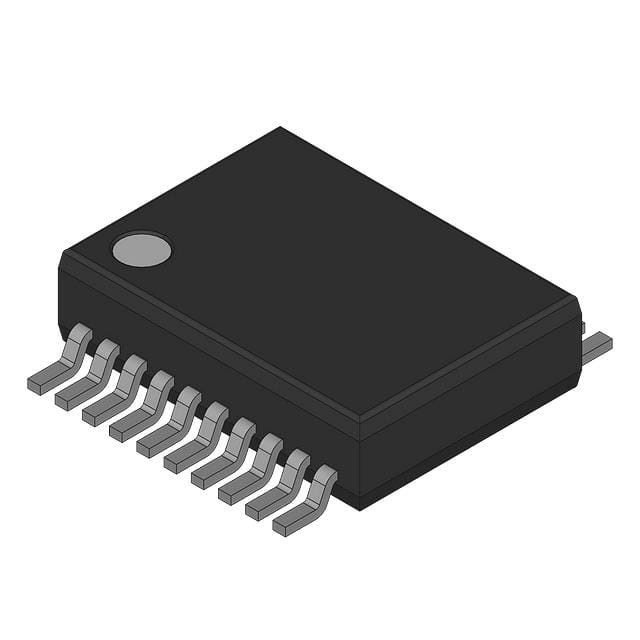
UPD6P8BMC-5A4-A uses a 20-pin plastic SSOP package (7.62 mm width, 300 mil), lead-free per RoHS compliance. Pin functions are validated per Renesas Data Sheet U17848EJ5V0DS, Section 1.1 (Normal Operation Mode) and Figure 4 (µPD6P8B PIN CONFIGURATION).
| Pin/Terminal | Circuit Role | Design Meaning |
|---|---|---|
| KI/O0–KI/O7 | 8-bit bidirectional key I/O port | Configurable as scan outputs or return inputs; internal pull-down in input mode simplifies matrix wiring. |
| S0, S1/LED, S2, S3 | Sense input / LED display output | S1/LED doubles as active-low IR transmit indicator; all S-pins support STOP mode release and software-configurable pull-down. |
| REM | Infrared carrier output | Active-high CMOS push-pull output directly drives IR LED anode (with external current-limiting resistor). |
| VDD, GND | Power supply terminals | Single 1.9–3.6 V rail powers core, I/O, and oscillator - no separate analog or IOVDD required. |
| IC | Internally connected | No external connection; reserved for internal biasing - must be left unconnected. |
| KI0–KI3 | 4-bit key return input port | Dedicated low-level input pins for compact key matrices; software-selectable pull-down prevents floating states. |
Key Features
| Feature | Design Value |
|---|---|
| Integrated oscillator | Eliminates external ceramic resonator, reducing component count and layout sensitivity in space-constrained remotes. |
| Serial PROM programming | SO/SCLK/SI interface enables in-system firmware loading without parallel programmer hardware or socketed programming. |
| 4-sense-input key matrix support | Enables 8×7 or 8×8 key layouts (up to 64 keys) with automatic scan sequencing and STOP mode wake-on-keypress. |
| REM + S1/LED synchronization | Hardware-coordinated IR carrier output and LED indicator ensure visual feedback matches transmitted frames precisely. |
| POC with RAM retention detection | Guarantees reliable reset under brown-out conditions and preserves key state across low-voltage events in battery-powered use. |
Applications
| TV Remote Control | AC Remote Transmitter |
|---|---|
|
Use Scenario: Wireless command transmission from handheld remote to flat-panel TV for power, volume, channel, and menu navigation. IC Role / Device Role / Timing Role: Primary IR protocol encoder and carrier generator; executes NEC-compliant 32-bit frame bursts with 38 kHz carrier. Use Value: On-chip oscillator and 4-sense port support enable compact, low-cost PCBs with <15 mm² footprint and <2 µA standby current. |
Use Scenario: Battery-operated remote for split-type air conditioners requiring multi-function buttons (mode, fan speed, swing, timer). IC Role / Device Role / Timing Role: Key matrix scanner and IR frame builder; uses 9-bit timer to enforce inter-frame spacing and carrier duty cycle. Use Value: 1.9 V minimum operating voltage extends alkaline battery life beyond 12 months in typical usage patterns. |
| Set-Top Box Remote | Home Appliance Remote |
|
Use Scenario: Universal remote controlling cable/satellite boxes with learning capability and multiple device codes. IC Role / Device Role / Timing Role: Firmware-programmable IR encoder supporting NEC, RC-5, and custom protocols; REM output drives high-efficiency IR LED. Use Value: One-time PROM provides tamper-resistant storage of learned codes; S0–S3 pins allow 64-key layout for advanced function mapping. |
Use Scenario: Remote for microwave ovens, washing machines, or fans with waterproof membrane keypad and LED feedback. IC Role / Device Role / Timing Role: Low-power key scanner with STOP mode wake-up; S1/LED pin drives status LED synchronously with REM carrier pulses. Use Value: Integrated POC and RAM retention detector prevent code loss during battery replacement or momentary power dips. |
Equivalent & Alternatives
The following parts are listed as comparable options for similar infrared remote control microcontroller applications.
| Alternative Part | Technical Difference | Application Difference | Selection Advice |
|---|---|---|---|
| UPD6P8AMC-5A4-A | Lacks on-chip oscillator; requires external 4 MHz ceramic resonator on XIN/XOUT; serial programming only; 3 sense inputs (S0–S2). | Higher BOM cost and board area due to external resonator; limited to ≤56-key matrices. | Select when legacy design reuse or resonator-based timing stability is prioritized over integration. |
| UPD6P8MC-5A4-A | No on-chip oscillator; parallel programming interface; 3 sense inputs; no S3 pin; lower key capacity (32 keys). | Requires parallel programmer hardware and socketed programming; not suitable for field firmware updates. | Choose for high-volume, fixed-function remotes where lowest unit cost outweighs programming flexibility. |
Compared with UPD6P8BMC-5A4-A, UPD6P8AMC-5A4-A adds external timing dependency but retains serial programming, while UPD6P8MC-5A4-A sacrifices integration and upgradeability for minimal gate count - making UPD6P8BMC-5A4-A optimal for new designs demanding compactness, battery life, and field-programmable IR protocols.
Availability
UPD6P8BMC-5A4-A is available at Aetrix Electronics and suitable for infrared remote control transmitters, consumer AV equipment interfaces, and battery-powered home appliance remotes requiring stable component supply across long-lifecycle production runs.
Supply support for UPD6P8BMC-5A4-A includes scheduled delivery planning, volume procurement assistance, BOM continuity management, traceable sourcing, and lifecycle availability coordination for OEM customers, industrial embedded developers, connected-device designers, and electronics production programs.
Manufacturer
Renesas Electronics Corporation is a global semiconductor leader specializing in microcontrollers, analog, and power solutions for automotive, industrial, and consumer markets.
The µPD6P8 family was designed specifically for cost-sensitive, ultra-low-power infrared remote control transmitters - integrating carrier generation, key scanning, and protocol encoding into a single 20-pin SSOP device.
FAQ
What is the oscillator configuration of UPD6P8BMC-5A4-A?
The UPD6P8BMC-5A4-A features an on-chip internal oscillator operating at 4 MHz (typical), eliminating the need for external crystals or ceramic resonators. This oscillator is factory-trimmed and fully integrated - confirmed in Renesas Data Sheet U17848EJ5V0DS, Section 5 (BLOCK DIAGRAM) and Table on page 5. The UPD6P8BMC-5A4-A does not use XIN/XOUT pins for clock generation; those pins are repurposed in this variant.
How many sense input pins does UPD6P8BMC-5A4-A support, and what are their functions?
UPD6P8BMC-5A4-A supports four sense input pins: S0, S1/LED, S2, and S3. S0–S2 function identically to earlier variants, while S3 is exclusive to µPD6P8B and enables expanded key matrix decoding up to 64 keys. All four pins support software-configurable internal pull-down and STOP mode wake-up - detailed in Pin Function Table (page 9) and LIST OF FUNCTIONS (page 5) of the UPD6P8BMC-5A4-A datasheet.
Can UPD6P8BMC-5A4-A drive an IR LED directly, and what is the REM pin's electrical specification?
Yes, the REM pin of UPD6P8BMC-5A4-A is a CMOS push-pull output capable of directly driving an IR LED anode through an external current-limiting resistor. It delivers active-high output with rail-to-rail swing (VDD referenced), rated for 4 mA sink/source per Renesas Electrical Specifications (Section 16, page 82). The REM signal is synchronized with S1/LED for precise visual feedback during transmission.
What programming interface does UPD6P8BMC-5A4-A use for firmware loading?
UPD6P8BMC-5A4-A uses a 3-wire serial programming interface: SO (serial output), SCLK (serial clock), and SI (serial input). This eliminates the need for parallel programming hardware and enables in-circuit firmware loading. Programming procedure, timing, and command format are defined in Section 13 of the UPD6P8BMC-5A4-A datasheet (pages 66–68), confirming full compatibility with Renesas' standard serial PROM writer tools.
Is UPD6P8BMC-5A4-A RoHS compliant, and what does the "-A" suffix indicate?
Yes, UPD6P8BMC-5A4-A is RoHS compliant. The "-A" suffix explicitly denotes lead-free packaging, as stated in the Ordering Information section (page 2) of the Renesas datasheet: "Products that have the part numbers suffixed by '-A' are lead-free products." The device meets EU RoHS Directive requirements and uses matte tin plating on its 20-pin SSOP leads.
UPD6P8BMC-5A4-A Specifications
- Product attributes
- Attribute value
- Manufacturer:
- Renesas
- Package/Case:
- -
- Series:
- *
- Packaging:
- Bulk
- Product Status:
- Active
- Programmable:
- Not Verified
- Core Processor:
- -
- Core Size:
- -
- Speed:
- -
- Connectivity:
- -
- Peripherals:
- -
- Number of I/O:
- -
- Program Memory Size:
- -
- Program Memory Type:
- -
- EEPROM Size:
- -
- RAM Size:
- -
- Voltage - Supply (Vcc/Vdd):
- -
- Data Converters:
- -
- Oscillator Type:
- -
- Operating Temperature:
- -
- Grade:
- -
- Qualification:
- -
- Mounting Type:
- -
- Supplier Device Package:
UPD6P8BMC-5A4-A FAQ
1.How can I place an order for UPD6P8BMC-5A4-A through Aetrix?
Please submit a Request for Quotation (RFQ) for UPD6P8BMC-5A4-A on Aetrix. Our sales agent will provide a competitive quotation and guide you through the order confirmation once you accept the terms.
2.Are the price and stock information for UPD6P8BMC-5A4-A reliable?
The price and inventory of UPD6P8BMC-5A4-A are updated periodically and may fluctuate due to market conditions. Stock and pricing data are typically refreshed every 24 hours. Quotation validity for UPD6P8BMC-5A4-A is usually 5 days.
3.What payment methods are accepted for UPD6P8BMC-5A4-A?
We accept Wire Transfer, PayPal, Credit Card, Western Union, MoneyGram, and Escrow for UPD6P8BMC-5A4-A transactions.
Note: Certain payment methods may incur a processing fee.
4.How is shipping managed for UPD6P8BMC-5A4-A?
UPD6P8BMC-5A4-A orders can be shipped via leading logistics carriers, including DHL, UPS, FedEx, TNT, or Registered Mail.
Once your UPD6P8BMC-5A4-A order is processed, you will receive an email with the shipment details and tracking number.
Note: Tracking information may take up to 24 hours to appear. Express delivery typically takes 3–5 business days.
5.How can I obtain technical support or documentation for UPD6P8BMC-5A4-A?
For technical support, including UPD6P8BMC-5A4-A datasheets, pinout diagrams, or application guidance, please contact our engineering support team. They can provide detailed documentation and assistance for your UPD6P8BMC-5A4-A requirements.
6.How does Aetrix verify that UPD6P8BMC-5A4-A is sourced from the original manufacturer or authorized distributors?
All UPD6P8BMC-5A4-A products on Aetrix are procured from qualified distributors and authorized channels. Our dedicated quality assurance team conducts strict verification, including traceability checks and, if necessary, third-party testing. This ensures that UPD6P8BMC-5A4-A meets industry standards.
7.What is the process for return or replacement of UPD6P8BMC-5A4-A?
All UPD6P8BMC-5A4-A units undergo pre-shipment inspection (PSI). If there is an issue with UPD6P8BMC-5A4-A, returns or replacements are accepted under the following conditions:
1.Quantity discrepancies, incorrect items, or visible external defects (such as breakage or corrosion), acknowledged by Aetrix.
2.The issue is reported within 90 days of delivery.
3.The UPD6P8BMC-5A4-A part is unused and in its original packaging.
Return procedure for UPD6P8BMC-5A4-A:
1.Submit a request within 90 days.
2.Obtain a Return Material Authorization (RMA) from Aetrix.
UPD6P8BMC-5A4-A Tags

-
ATTINY4-TSHR
Microchip Technology
-
ATTINY10-TSHR
Microchip Technology
-
ATTINY10-TS8R
Microchip Technology

-
ATTINY202-SSNR
Microchip Technology
-
ATTINY202-SSFR
Microchip Technology
-
ATTINY402-SSNR
Microchip Technology
-
PIC16F15213T-I/MF
Microchip Technology
-
PIC16F15213-E/MF
Microchip Technology

-
PIC10F200T-I/OT
Microchip Technology
-
ATTINY412-SSNR
Microchip Technology
-
PIC10F202T-I/OT
Microchip Technology
-
ATTINY404-SSNR
Microchip Technology
Tech Hub

TTL and CMOS logic families differ in thresholds, loading, output drive, power and timing. This engineering guide compares 74HC and 74HCT, calculates noise margins and checks 3.3 V/5 V compatibility.

A practical engineering guide to 3.3V and 5V logic compatibility, input thresholds, resistor dividers, translator ICs, MOSFET level shifting, I2C pull-ups, timing limits and power-sequencing risks.

The 74HC595 uses push-pull logic outputs, while the TPIC6B595 uses 50 V open-drain DMOS sinks for higher-power loads. This guide compares timing, current limits, 3.3 V interfacing, load wiring, thermal…

The 74HC595 converts serial data into eight stable parallel outputs. This guide covers pin functions, shift and storage timing, OE and MR behavior, drive-current limits, cascading, voltage compatibilit…

A technical comparison of level-sensitive latches and edge-triggered flip-flops, covering timing windows, setup and hold limits, master–slave operation, time borrowing, race-through, HDL inference and…

A D latch stores one bit while Enable controls when data can pass. This reference covers gate-level operation, truth tables, transparency, setup and hold timing, LE versus OE, common ICs and practical …

An SR latch stores one bit through cross-coupled feedback. This engineering reference covers NOR and NAND implementations, truth tables, forbidden-state recovery, gated operation, switch debouncing, fa…

Latch circuits retain one bit through feedback. This technical reference covers SR and D latches, truth tables, transparency, timing limits, latch-versus-flip-flop behavior, applications and common log…

An engineering guide to LED driver operation, constant-current and constant-voltage outputs, linear and switching topologies, dimming, IC selection, calculations, replacement compatibility, and fault c…

Operational amplifier guide covering op amp basics, feedback, ideal vs real op amps, common configurations, buffer circuits, offset, bias current, gain-bandwidth, slew rate, rail-to-rail limits and sel…


