
 My Inquiry
 My Account


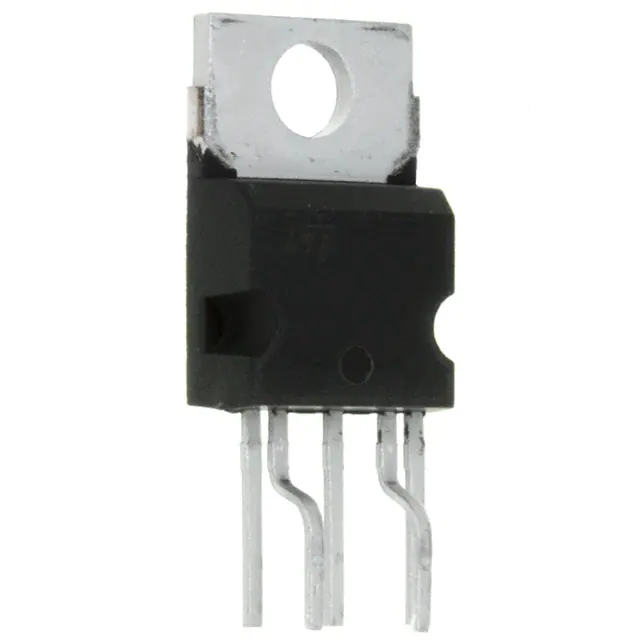
STMicroelectronics VIPER100-E
- Part No.:
- VIPER100-E
- Manufacturer:
- STMicroelectronics
- Category:
- AC DC Converters, Offline Switches
- Package:
- Pentawatt-5 HV (Bent and Staggered Leads)
- Datasheet:
-
 VIPER100-E.pdf
- Description:
- IC OFFLIN CONV FLBACK 5PENTAWATT
- Quantity:
- Payment:

- Shipping:

Inventory:1,693
Please send an inquiry. Send us your inquiry, and we will respond immediately.
Product details
Overview
VIPER100-E from STMicroelectronics is a high-voltage, current-mode PWM controller with integrated 620 V/3 A vertical power MOSFET, designed for primary-side switching in offline AC-DC flyback converters. It delivers up to 100 W in single-range operation, features adjustable 90–110 kHz switching frequency, internal 13 V VDD regulation, and burst-mode standby operation compliant with Germany's "Blue Angel" <1 W requirement.
For engineers reviewing the VIPER100-E datasheet, VIPER100-E pinout, VIPER100-E application, or VIPER100-E equivalent, key selection considerations include its integrated HV start-up current source, programmable peak current limit (3–5.3 A), thermal shutdown at 140–170 °C, and PENTAWATT HV (022Y) package compatibility with high-voltage primary-side PCB layouts.
Technical Context
The VIPER100-E implements a current-mode control topology with dual-loop regulation: an inner loop monitors primary peak current via sense-FET technique and compares it to the COMP pin voltage, while the outer loop uses transconductance error amplification (Gm = 1.1–1.9 mA/V) to adjust duty cycle. Its oscillator supports external synchronization via the OSC pin and maintains stable frequency (±1% RT, ±5% CT tolerance) across 9–15 V VDD range.
Standby operation is enabled by automatic burst mode triggered when VCOMP falls below 0.5 V, forcing zero-duty-cycle shutdown until VDD recovers to ≥11 V. Overtemperature protection activates at 140–170 °C with 40 °C hysteresis, and undervoltage lockout includes 2.4–3 V hysteresis between 7.5–9 V shutdown and 11–12 V reset thresholds.
Key Specifications
| Parameter | Value and Actual Design Meaning |
|---|---|
| VDSS | 620 V - Withstands full mains surge without external clamping in snubberless designs. |
| ID (peak) | 3–5.3 A - Programmable primary current limit sets max transformer energy per cycle. |
| RDS(on) | 2.5 Ω typ @ 100 °C - Determines conduction loss and thermal rise under full load. |
| FSW | 90–110 kHz - Adjustable via RT/CT network; enables EMI optimization and transformer sizing. |
| VDD Reg | 13 V ±2% - Internally trimmed reference ensures stable bias supply for control circuitry. |
| TSD | 140–170 °C - Thermal shutdown threshold protects silicon during overload or poor heatsinking. |
| IQ (standby) | <2 mA - Enables sub-1 W system standby power when combined with burst mode. |
Pinout & Package
The VIPER100-E is housed in a PENTAWATT HV (022Y) package - a 5-pin, high-voltage-optimized surface-mount package with extended creepage/clearance and isolated drain tab for direct heatsinking.
| Pin/Terminal | Circuit Role | Design Meaning |
|---|---|---|
| DRAIN | Integrated Power MOSFET Drain | High-voltage switching node; supplies internal start-up current during boot-up and handles full mains-referred primary current. |
| SOURCE | Power MOSFET Source | Primary-side ground reference; connects to transformer primary return and current-sense resistor. |
| VDD | Control Supply & Error Amp Reference | Provides low-voltage bias (9–15 V); internally regulated to 13 V; used as feedback reference for both primary and secondary regulation. |
| COMP | Error Amplifier Output & Shutdown Control | Transconductance amplifier output (0–5 V range); sinking/sourcing ±600 µA; falling below 0.5 V forces burst-mode shutdown. |
| OSC | Oscillator Timing & Sync Input | Accepts RT/CT network for frequency setting; tolerant to VDD variation; supports external clock sync with ≤500 ns pulses. |
Key Features
| Feature | Design Value |
|---|---|
| Integrated HV Start-up Current Source | Eliminates external high-voltage resistor network; draws bias directly from DRAIN pin during startup. |
| Snubberless Operation Capability | Withstands unclamped inductive turn-off surges up to 620 V, reducing BOM count and board space. |
| Programmable Burst Mode Standby | Automatically enters zero-duty-cycle mode when output load drops below ~0.5 W, meeting Blue Angel <1 W requirement. |
| Internal 13 V Trimmed VDD Regulator | Enables stable control supply without external LDO; supports both primary and optocoupler-based secondary regulation. |
| Blanking & Delay Compensation | 250 ns blanking + 250 ns current-sense delay prevents false triggering from transformer leakage spikes or diode recovery noise. |
Applications
| AC-DC Adapter | Smart Home Power Supply |
|---|---|
Use Scenario: 5–12 V, 1–5 A wall adapter for IoT sensors and USB-powered devices. IC Role / Device Role / Timing Role: Primary-side PWM controller and power switch in discontinuous conduction mode (DCM) flyback topology. Use Value: Integrated 620 V MOSFET and burst mode reduce component count and achieve <0.75 W no-load consumption. | Use Scenario: Low-power auxiliary supply for smart thermostats, doorbell cameras, and Zigbee gateways. IC Role / Device Role / Timing Role: Standalone offline regulator powering MCU, radio, and sensing circuitry from universal AC input. Use Value: 13 V internal regulation and COMP-based optocoupler interface enable precise secondary-side voltage control with minimal parts. |
| Industrial Control PSU | White Goods Auxiliary Supply |
Use Scenario: 15–24 V, 0.5–1 A isolated supply for PLC I/O modules and motor drivers. IC Role / Device Role / Timing Role: Primary-switching controller with overtemperature and overcurrent protection in wide-input industrial SMPS. Use Value: 170 °C thermal shutdown and 4.5 Ω RDS(on) max ensure robust operation under sustained overload or ambient >70 °C. | Use Scenario: 5 V/3.3 V auxiliary rail for microcontrollers and display logic in refrigerators and washing machines. IC Role / Device Role / Timing Role: High-reliability primary-side controller supporting long-life design and ESD-hardened operation (4 kV HBM). Use Value: PENTAWATT HV package provides >4 mm creepage and isolated drain tab for enhanced safety compliance in Class I appliances. |
Equivalent & Alternatives
The following parts are listed as comparable options for similar primary-side PWM controller applications.
| Alternative Part | Technical Difference | Application Difference | Selection Advice |
|---|---|---|---|
| ICE2QS03G | Fixed 65 kHz frequency; no integrated MOSFET; requires external 600 V FET and startup resistor. | Lacks burst mode and internal HV start-up; higher BOM count but better light-load efficiency above 0.5 W. | Choose for cost-sensitive designs where layout space allows discrete HV FET and tighter EMI control is needed. |
| LNK306P | 725 V breakdown; 0.44 A current limit; integrated 725 V switch; lower power rating (up to 12 W). | Optimized for ultra-low-power adapters; lacks programmable frequency and external sync capability. | Choose for sub-10 W applications requiring highest integration density and lowest no-load consumption (<30 mW). |
Compared with ICE2QS03G and LNK306P, the VIPER100-E uniquely balances medium-power capability (50–100 W), integrated HV start-up, and programmable burst mode-making it optimal for universal-input 24–48 V industrial and appliance auxiliary supplies where reliability and regulatory compliance are critical.
Availability
VIPER100-E is available at Aetrix Electronics and suitable for AC-DC adapters, smart home power supplies, industrial control PSUs, and white goods auxiliary supplies requiring stable component supply and long-term lifecycle support.
Supply support for VIPER100-E includes scheduled delivery planning, volume procurement assistance, BOM continuity management, traceable sourcing, and lifecycle availability coordination for OEM customers, industrial embedded developers, connected-device designers, and electronics production programs.
Manufacturer
STMicroelectronics is a global semiconductor leader headquartered in Geneva, Switzerland, specializing in power management, microcontrollers, and analog ICs for industrial, automotive, and consumer markets.
The VIPer™ product line delivers highly integrated, high-voltage AC-DC converter ICs targeting cost-effective, compact, and safety-compliant offline power supplies for universal-input applications.
FAQ
What is the maximum continuous output power achievable with VIPER100-E in a flyback design?
The VIPER100-E supports up to 50 W in universal-input (85–265 VAC) wide-range configurations and up to 100 W in single-range (230 VAC) or doubler configurations. Achievable power depends on transformer design, heatsinking, and ambient temperature-derating is required above 70 °C case temperature due to its 1.4 °C/W junction-to-case thermal resistance.
Can VIPER100-E operate with primary-side regulation only, without an optocoupler?
Yes. The VIPER100-E supports primary-side regulation using its internal 13 V VDD reference and feedback derived from auxiliary winding voltage. This eliminates the optocoupler and TL431, reducing cost and improving reliability-though accuracy is typically ±5%, versus ±1% with secondary-side regulation.
How does the internal blanking time prevent false current-limit triggering?
The VIPER100-E applies a fixed 250–360 ns blanking window after each MOSFET turn-on to ignore initial current spikes caused by transformer leakage inductance and secondary rectifier reverse recovery. This ensures the PWM comparator only responds to true primary current ramp, preventing premature switch-off and instability in DCM operation.
Is external synchronization of the oscillator supported, and what are the drive requirements?
Yes-the OSC pin accepts external clock signals for synchronization. A clean TTL/CMOS pulse with ≤500 ns width, 3–5 V amplitude, and ≤20 mA sink capability (e.g., via fast optocoupler) is required. The external signal overrides the internal oscillator, enabling multi-channel interleaving or EMI spreading without modifying RT/CT components.
VIPER100-E Specifications
- Product attributes
- Attribute value
- Manufacturer:
- STMicroelectronics
- Series:
- VIPER™
- Package/Case:
- Pentawatt-5 HV (Bent and Staggered Leads)
- Packaging:
- Tube
- Product Status:
- Obsolete
- Output Isolation:
- Isolated
- Internal Switch(s):
- Yes
- Voltage - Breakdown:
- 620V
- Topology:
- Flyback
- Voltage - Start Up:
- 11 V
- Voltage - Supply (Vcc/Vdd):
- 8V ~ 15V
- Duty Cycle:
- -
- Frequency - Switching:
- Up to 200kHz
- Power (Watts):
- 100 W
- Fault Protection:
- Current Limiting, Over Temperature
- Control Features:
- EN, Frequency Control, Soft Start
- Operating Temperature:
- -
- Grade:
- -
- Qualification:
- -
- Supplier Device Package:
- 5-PENTAWATT
- Mounting Type:
- Surface Mount
VIPER100-E FAQ
1.How can I place an order for VIPER100-E through Aetrix?
Please submit a Request for Quotation (RFQ) for VIPER100-E on Aetrix. Our sales agent will provide a competitive quotation and guide you through the order confirmation once you accept the terms.
2.Are the price and stock information for VIPER100-E reliable?
The price and inventory of VIPER100-E are updated periodically and may fluctuate due to market conditions. Stock and pricing data are typically refreshed every 24 hours. Quotation validity for VIPER100-E is usually 5 days.
3.What payment methods are accepted for VIPER100-E?
We accept Wire Transfer, PayPal, Credit Card, Western Union, MoneyGram, and Escrow for VIPER100-E transactions.
Note: Certain payment methods may incur a processing fee.
4.How is shipping managed for VIPER100-E?
VIPER100-E orders can be shipped via leading logistics carriers, including DHL, UPS, FedEx, TNT, or Registered Mail.
Once your VIPER100-E order is processed, you will receive an email with the shipment details and tracking number.
Note: Tracking information may take up to 24 hours to appear. Express delivery typically takes 3–5 business days.
5.How can I obtain technical support or documentation for VIPER100-E?
For technical support, including VIPER100-E datasheets, pinout diagrams, or application guidance, please contact our engineering support team. They can provide detailed documentation and assistance for your VIPER100-E requirements.
6.How does Aetrix verify that VIPER100-E is sourced from the original manufacturer or authorized distributors?
All VIPER100-E products on Aetrix are procured from qualified distributors and authorized channels. Our dedicated quality assurance team conducts strict verification, including traceability checks and, if necessary, third-party testing. This ensures that VIPER100-E meets industry standards.
7.What is the process for return or replacement of VIPER100-E?
All VIPER100-E units undergo pre-shipment inspection (PSI). If there is an issue with VIPER100-E, returns or replacements are accepted under the following conditions:
1.Quantity discrepancies, incorrect items, or visible external defects (such as breakage or corrosion), acknowledged by Aetrix.
2.The issue is reported within 90 days of delivery.
3.The VIPER100-E part is unused and in its original packaging.
Return procedure for VIPER100-E:
1.Submit a request within 90 days.
2.Obtain a Return Material Authorization (RMA) from Aetrix.
VIPER100-E Tags
-
LNK6407D-TL
Power Integrations
-
LNK3204D-TL
Power Integrations

-
SR10LG-G
Microchip Technology
-
TNY285DG-TL
Power Integrations
-
LNK304DN-TL
Power Integrations
-
TNY285KG-TL
Power Integrations
-
LNK3206D-TL
Power Integrations
-
LNK623DG-TL
Power Integrations
-
TNY286PG
Power Integrations
-
LNK624DG-TL
Power Integrations
-
LNK604DG-TL
Power Integrations

-
UCC28704DBVR-1
Texas Instruments
Tech Hub

A practical engineering and sourcing framework covering lifecycle verification, lifetime-buy calculations, replacement qualification, supplier checks and counterfeit-risk controls.

TTL and CMOS logic families differ in thresholds, loading, output drive, power and timing. This engineering guide compares 74HC and 74HCT, calculates noise margins and checks 3.3 V/5 V compatibility.

A practical engineering guide to 3.3V and 5V logic compatibility, input thresholds, resistor dividers, translator ICs, MOSFET level shifting, I2C pull-ups, timing limits and power-sequencing risks.

The 74HC595 uses push-pull logic outputs, while the TPIC6B595 uses 50 V open-drain DMOS sinks for higher-power loads. This guide compares timing, current limits, 3.3 V interfacing, load wiring, thermal…

The 74HC595 converts serial data into eight stable parallel outputs. This guide covers pin functions, shift and storage timing, OE and MR behavior, drive-current limits, cascading, voltage compatibilit…

A technical comparison of level-sensitive latches and edge-triggered flip-flops, covering timing windows, setup and hold limits, master–slave operation, time borrowing, race-through, HDL inference and…

A D latch stores one bit while Enable controls when data can pass. This reference covers gate-level operation, truth tables, transparency, setup and hold timing, LE versus OE, common ICs and practical …

An SR latch stores one bit through cross-coupled feedback. This engineering reference covers NOR and NAND implementations, truth tables, forbidden-state recovery, gated operation, switch debouncing, fa…

Latch circuits retain one bit through feedback. This technical reference covers SR and D latches, truth tables, transparency, timing limits, latch-versus-flip-flop behavior, applications and common log…

An engineering guide to LED driver operation, constant-current and constant-voltage outputs, linear and switching topologies, dimming, IC selection, calculations, replacement compatibility, and fault c…


