
 My Inquiry
 My Account


STMicroelectronics VIPER12-LED-EV
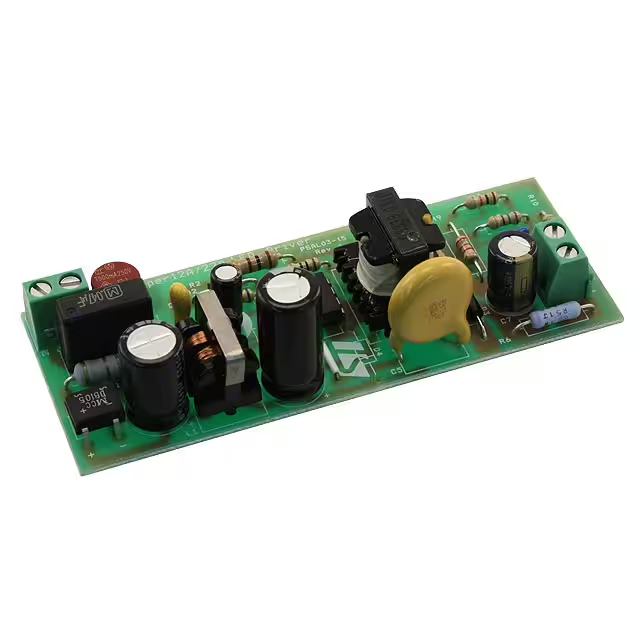
- Part No.:
- VIPER12-LED-EV
- Manufacturer:
- STMicroelectronics
- Category:
- LED Driver Evaluation Boards
- Package:
- Datasheet:
-
 VIPER12-LED-EV.pdf
- Description:
- EVAL BOARD FOR VIPER12A
- Quantity:
- Payment:

- Shipping:

Inventory:4,564
Please send an inquiry. Send us your inquiry, and we will respond immediately.
Product details
Overview
VIPER12-LED-EV from STMicroelectronics is a dedicated evaluation board for the VIPER12A primary-switcher IC, designed to demonstrate low-power offline SMPS operation in LED driver applications. It integrates the VIPER12A (730 V MOSFET + current-mode PWM controller), supports 85–265 Vac input, delivers up to 8 W output in DIP-8 configuration, features fixed 60 kHz switching, and includes overtemperature, overcurrent, and overvoltage protection with auto-restart.
For engineers reviewing the VIPER12-LED-EV datasheet, VIPER12-LED-EV pinout, VIPER12-LED-EV application, or VIPER12-LED-EV equivalent, this board enables rapid validation of constant-current LED driver topologies using auxiliary-winding feedback, burst-mode light-load management, and HICCUP-mode overvoltage recovery - critical for cost-sensitive, isolated AC/DC LED lighting designs.
Technical Context
The VIPER12-LED-EV implements a flyback converter topology with primary-side regulation via the VIPER12A's current-mode control and FB pin current-sensing architecture. It uses an optocoupler-coupled secondary feedback loop with TSM101 dual op-amp reference to achieve rectangular U-I output characteristics - enabling precise constant-current (CC) and constant-voltage (CV) boundary control essential for Li-ion-compatible and multi-stage LED charging.
Startup relies on the VIPER12A's internal high-voltage current source (–1 mA at 100–400 VDS) charging the VDD capacitor from the drain pin; regulation engages once VDD exceeds 14.5 V, with hysteresis (6.5 V) ensuring clean undervoltage lockout. Thermal shutdown activates at 170 °C with 40 °C hysteresis, and overvoltage protection triggers at 42 VVDD, latching only until VDD falls below 8 V before auto-restart.
Key Specifications
| Parameter | Value and Actual Design Meaning |
|---|---|
| Input Voltage Range | 85–265 Vac: enables global mains compatibility without manual voltage selection. |
| Output Power Capability | Up to 8 W (DIP-8 package): sufficient for mid-power LED strings (e.g., 24 V @ 330 mA). |
| Switching Frequency | Fixed 60 kHz ±6 kHz: balances EMI filtering cost and transformer size for compact LED drivers. |
| Protection Features | Auto-restart OVP (42 V), OTP (170 °C), OCP (0.4 A peak): ensures robust fault recovery in unattended LED installations. |
| Feedback Mechanism | Current-mode FB pin (0–1 V range): allows direct optocoupler interface without external error amplifier. |
| Start-up Method | High-voltage drain-connected current source (–1 mA): eliminates external start-up resistor, reducing BOM count. |
| Light-Load Behavior | Burst mode activation at ~50 mA drain current: maintains regulation down to <5% load with <300 mW no-load consumption. |
Availability
VIPER12-LED-EV is available at Aetrix Electronics and suitable for LED streetlight drivers, architectural accent lighting, industrial status indicators, and smart home lighting controls requiring stable component supply and validated reference design reuse.
Supply support for VIPER12-LED-EV includes scheduled delivery planning, volume procurement assistance, BOM continuity management, traceable sourcing, and lifecycle availability coordination for OEM customers, industrial embedded developers, connected-device designers, and electronics production programs.
Manufacturer
STMicroelectronics is a global semiconductor leader headquartered in Geneva, delivering silicon solutions for automotive, industrial, power, and analog applications with emphasis on energy efficiency and system integration.
The VIPER12-LED-EV belongs to ST's VIPer™ AC-DC primary switcher evaluation platform family, engineered specifically to accelerate development of cost-optimized, isolated LED drivers meeting IEC 61347-1/2-13 safety and EMC requirements.
FAQ
What is the maximum output current achievable with VIPER12-LED-EV in constant-current LED mode?
The board supports up to 330 mA output current at 24 V (8 W), limited by the VIPER12A's 0.4 A peak drain current and thermal derating of the DIP-8 package. Actual current depends on transformer turns ratio, feedback resistor (RFB), and optocoupler CTR - typical design achieves ±3% CC accuracy across line and temperature per ST Application Note AN2369.
Can VIPER12-LED-EV be modified for non-isolated buck-derived LED drivers?
No - the board is strictly configured as an isolated flyback converter with transformer-coupled output and primary-side sensing. Its layout, transformer, and VIPER12A's internal start-up architecture assume high-voltage isolation; removing isolation violates safety certification and risks latch-up due to missing VDD auxiliary winding supply.
Does VIPER12-LED-EV support dimming interfaces such as PWM or 0–10 V?
The base board does not include native dimming circuitry, but its FB node is accessible for external injection: applying a variable current (0–0.9 mA) into the FB pin modulates peak drain current linearly, enabling analog dimming. For PWM dimming, users must add external MOSFET gating on the LED string - ST recommends synchronizing PWM frequency above 1 kHz to avoid audible noise.
What safety certifications has VIPER12-LED-EV been tested against?
The board itself is not certified, but it implements a design compliant with EN 61347-1 (general lamp controlgear) and EN 61347-2-13 (LED controlgear), including reinforced insulation (≥4 mm creepage/clearance), Class II construction, and 3 kV AC hi-pot test margin. Full certification requires end-product-level testing per regional regulatory bodies (UL, CE, CCC).
VIPER12-LED-EV Specifications
- Product attributes
- Attribute value
- Manufacturer:
- STMicroelectronics
- Series:
- VIPER™
- Packaging:
- Box
- Product Status:
- Obsolete
- Current - Output / Channel:
- 1.05A, 700mA or 350mA
- Outputs and Type:
- 1 Isolated Output
- Voltage - Output:
- 14V
- Features:
- -
- Voltage - Input:
- 90 ~ 264 VAC
- Contents:
- Board(s)
- Utilized IC / Part:
- VIPer12A
VIPER12-LED-EV FAQ
1.How can I place an order for VIPER12-LED-EV through Aetrix?
Please submit a Request for Quotation (RFQ) for VIPER12-LED-EV on Aetrix. Our sales agent will provide a competitive quotation and guide you through the order confirmation once you accept the terms.
2.Are the price and stock information for VIPER12-LED-EV reliable?
The price and inventory of VIPER12-LED-EV are updated periodically and may fluctuate due to market conditions. Stock and pricing data are typically refreshed every 24 hours. Quotation validity for VIPER12-LED-EV is usually 5 days.
3.What payment methods are accepted for VIPER12-LED-EV?
We accept Wire Transfer, PayPal, Credit Card, Western Union, MoneyGram, and Escrow for VIPER12-LED-EV transactions.
Note: Certain payment methods may incur a processing fee.
4.How is shipping managed for VIPER12-LED-EV?
VIPER12-LED-EV orders can be shipped via leading logistics carriers, including DHL, UPS, FedEx, TNT, or Registered Mail.
Once your VIPER12-LED-EV order is processed, you will receive an email with the shipment details and tracking number.
Note: Tracking information may take up to 24 hours to appear. Express delivery typically takes 3–5 business days.
5.How can I obtain technical support or documentation for VIPER12-LED-EV?
For technical support, including VIPER12-LED-EV datasheets, pinout diagrams, or application guidance, please contact our engineering support team. They can provide detailed documentation and assistance for your VIPER12-LED-EV requirements.
6.How does Aetrix verify that VIPER12-LED-EV is sourced from the original manufacturer or authorized distributors?
All VIPER12-LED-EV products on Aetrix are procured from qualified distributors and authorized channels. Our dedicated quality assurance team conducts strict verification, including traceability checks and, if necessary, third-party testing. This ensures that VIPER12-LED-EV meets industry standards.
7.What is the process for return or replacement of VIPER12-LED-EV?
All VIPER12-LED-EV units undergo pre-shipment inspection (PSI). If there is an issue with VIPER12-LED-EV, returns or replacements are accepted under the following conditions:
1.Quantity discrepancies, incorrect items, or visible external defects (such as breakage or corrosion), acknowledged by Aetrix.
2.The issue is reported within 90 days of delivery.
3.The VIPER12-LED-EV part is unused and in its original packaging.
Return procedure for VIPER12-LED-EV:
1.Submit a request within 90 days.
2.Obtain a Return Material Authorization (RMA) from Aetrix.
VIPER12-LED-EV Tags
-
COM-13716
SparkFun Electronics
-
B-G474E-DPOW1
STMicroelectronics

-
EVB81116-A2
Melexis Technologies NV
-
EVB81116-A3
Melexis Technologies NV
-
LP5036EVM
Texas Instruments
-
LP5813-12WCSPEVM
Texas Instruments
-
LP8863EVM
Texas Instruments
-
1455
Adafruit Industries LLC
-
1427
Adafruit Industries LLC
-
WIG-13279
SparkFun Electronics
-
5650
Adafruit Industries LLC
-
1429
Adafruit Industries LLC
Tech Hub

A practical engineering and sourcing framework covering lifecycle verification, lifetime-buy calculations, replacement qualification, supplier checks and counterfeit-risk controls.

TTL and CMOS logic families differ in thresholds, loading, output drive, power and timing. This engineering guide compares 74HC and 74HCT, calculates noise margins and checks 3.3 V/5 V compatibility.

A practical engineering guide to 3.3V and 5V logic compatibility, input thresholds, resistor dividers, translator ICs, MOSFET level shifting, I2C pull-ups, timing limits and power-sequencing risks.

The 74HC595 uses push-pull logic outputs, while the TPIC6B595 uses 50 V open-drain DMOS sinks for higher-power loads. This guide compares timing, current limits, 3.3 V interfacing, load wiring, thermal…

The 74HC595 converts serial data into eight stable parallel outputs. This guide covers pin functions, shift and storage timing, OE and MR behavior, drive-current limits, cascading, voltage compatibilit…

A technical comparison of level-sensitive latches and edge-triggered flip-flops, covering timing windows, setup and hold limits, master–slave operation, time borrowing, race-through, HDL inference and…

A D latch stores one bit while Enable controls when data can pass. This reference covers gate-level operation, truth tables, transparency, setup and hold timing, LE versus OE, common ICs and practical …

An SR latch stores one bit through cross-coupled feedback. This engineering reference covers NOR and NAND implementations, truth tables, forbidden-state recovery, gated operation, switch debouncing, fa…

Latch circuits retain one bit through feedback. This technical reference covers SR and D latches, truth tables, transparency, timing limits, latch-versus-flip-flop behavior, applications and common log…

An engineering guide to LED driver operation, constant-current and constant-voltage outputs, linear and switching topologies, dimming, IC selection, calculations, replacement compatibility, and fault c…


