
 My Inquiry
 My Account


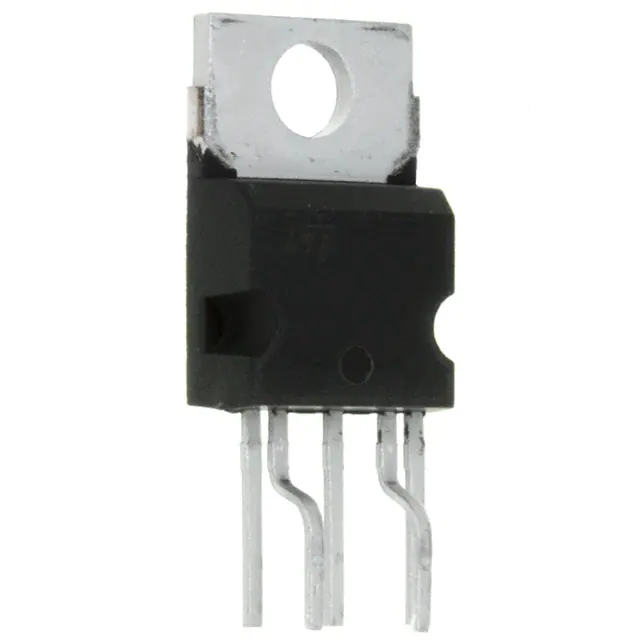
STMicroelectronics VIPER50A
- Part No.:
- VIPER50A
- Manufacturer:
- STMicroelectronics
- Category:
- AC DC Converters, Offline Switches
- Package:
- Pentawatt-5 HV (Bent and Staggered Leads)
- Datasheet:
-
 VIPER50A.pdf
- Description:
- IC OFFLIN CONV FLBACK 5PENTAWATT
- Quantity:
- Payment:

- Shipping:

Inventory:2,716
Please send an inquiry. Send us your inquiry, and we will respond immediately.
Product details
Overview
VIPER50A from STMicroelectronics is a high-voltage integrated primary-side SMPS controller combining a 700V avalanche-rugged vertical power MOSFET and current-mode PWM control circuitry in a single PowerSO-10™ package. It delivers up to 50W output in single-range configurations, features adjustable switching frequency up to 200 kHz, internal 13V VDD regulation, and automatic burst-mode operation for <1W standby consumption compliant with the German "Blue Angel" norm.
For engineers reviewing the VIPER50A datasheet, VIPER50A pinout, VIPER50A application, or VIPER50A equivalent, key selection considerations include its integrated 700V/1.5A MOSFET, programmable peak current limit (1.5–2.7 A), thermal shutdown at 140–170°C, and compatibility with both primary- and secondary-side regulation topologies using optocoupler feedback or auxiliary winding sensing.
Technical Context
The VIPER50A implements current-mode control with dual-loop regulation: an inner loop senses primary-side peak current via integrated SenseFET and compares it to the COMP pin voltage, while the outer loop uses transconductance error amplification (Gm = 1.1–1.9 mA/V) to adjust duty cycle. Its oscillator supports external Rt-Ct programming (e.g., 8.2 kΩ + 2.4 nF yields 100 kHz) and synchronization via the OSC pin.
Startup relies on an internal high-voltage current source connected to the DRAIN pin, enabling direct connection to rectified AC mains without auxiliary startup circuitry. Undervoltage lockout (UVLO) operates with hysteresis (VDDoff = 7.5–9 V, VDDon = 11–12 V), and overtemperature protection triggers at 140–170°C with 40°C hysteresis, latching shutdown until reset by VDD cycling.
Key Specifications
| Parameter | Value and Actual Design Meaning |
|---|---|
| VDSS | 700 V - Withstands unclamped inductive surges in snubberless flyback designs up to 700V drain-source blocking. |
| RDS(on) | 5.7 Ω @ Tj = 100°C - Enables efficient 50W single-range offline power supply operation with low conduction loss. |
| FSW | Adjustable 90–110 kHz (typ.) - Set via external Rt-Ct; stable across VDD = 8–15 V for robust line regulation. |
| IDPEAK | 1.5–2.7 A (adjustable) - Peak current limit defined by COMP pin voltage; enables precise output power scaling and short-circuit protection. |
| VDD Reg | 12.6–13.4 V - Internally trimmed reference maintains stable bias for control circuitry; supports primary or secondary regulation. |
| TSD | 140–170°C - Thermal shutdown threshold prevents device failure under overload or poor heatsinking; 40°C hysteresis ensures clean recovery. |
| ISTBY | <1 W total system consumption - Achieved via automatic burst mode during light/no-load, meeting Blue Angel eco-norm without external components. |
Pinout & Package
Package: PowerSO-10™ (022Y), surface-mount, thermally enhanced 10-pin package with exposed die pad for improved heat dissipation (Rthj-case = 1.9°C/W).
| Pin/Terminal | Circuit Role | Design Meaning |
|---|---|---|
| DRAIN | Power MOSFET drain terminal | Connects directly to rectified AC input; supplies internal startup current; handles 700V blocking and avalanche energy (EAR = 30 mJ). |
| SOURCE | Power MOSFET source terminal | Primary-side ground reference; used for current-sense feedback path; connects to transformer primary return. |
| VDD | Low-voltage supply & regulation node | Provides 13V regulated bias; activates UVLO (7.5–9 V off / 11–12 V on); accepts external feedback for secondary regulation. |
| COMP | Error amplifier output & shutdown control | Transconductance output (1.1–1.9 mA/V); shuts down PWM when V<0.5 V; interfaces with optocoupler or compensation network. |
| OSC | Oscillator timing & sync input | Accepts external Rt-Ct for frequency setting; supports external clock synchronization with ≤500 ns pulses. |
Key Features
| Feature | Design Value |
|---|---|
| Integrated 700V Power MOSFET | Eliminates discrete HV switch and gate driver; enables compact, snubberless flyback designs with reduced BOM count. |
| Current-Mode Control with Blanking | 250 ns blanking time prevents false turn-off from transformer leakage spikes; ensures reliable PWM timing under real-world parasitics. |
| Automatic Burst-Mode Standby | Zero external components needed to achieve <1 W no-load consumption; maintains output regulation with low-frequency ripple. |
| High-Voltage Startup Current Source | Draws bias directly from DRAIN pin; eliminates startup resistor and associated losses; supports universal AC input (85–265 VAC). |
| Thermal Shutdown with Hysteresis | 140–170°C trip point with 40°C hysteresis prevents thermal oscillation; protects against sustained overload or heatsink failure. |
Applications
| AC-DC Adapters | Set-Top Box Power Supplies |
|---|---|
|
Use Scenario: 12 V / 2 A universal-input adapter for consumer electronics. IC Role / Device Role / Timing Role: Primary-side PWM controller and power switch in discontinuous conduction mode (DCM) flyback topology. Use Value: Reduces component count by 50% vs. discrete solutions; achieves Blue Angel compliance with no auxiliary circuitry. |
Use Scenario: 5 V / 3 A standby and main rail supply in digital TV receivers. IC Role / Device Role / Timing Role: Dual-mode controller supporting burst-mode standby (<0.8 W) and full-power operation (50W). Use Value: Maintains tight output regulation during burst cycles; enables fast wake-up from standby without output droop. |
| Smart Meter Auxiliary Supplies | Industrial IoT Sensor Power |
|
Use Scenario: Isolated 3.3 V / 150 mA auxiliary supply for microcontroller and RF module in smart electricity meters. IC Role / Device Role / Timing Role: Primary-regulated flyback controller with integrated VDD clamp and UVLO hysteresis. Use Value: Operates reliably across wide input range (85–305 VAC); withstands surge transients per IEC 61000-4-5. |
Use Scenario: Compact 5 V / 100 mA isolated supply for battery-less wireless sensor nodes powered from 24 VAC HVAC lines. IC Role / Device Role / Timing Role: High-efficiency primary-side controller with minimal external components and low no-load draw. Use Value: Delivers >75% efficiency at 10% load; enables maintenance-free deployment with no transformer derating concerns. |
Equivalent & Alternatives
The following parts are listed as comparable options for similar SMPS primary-side controller applications.
| Alternative Part | Technical Difference | Application Difference | Selection Advice |
|---|---|---|---|
| ICE2QS03G (Infineon) | 650V MOSFET, fixed 65 kHz frequency, no internal VDD regulator - requires external bias winding. | Lacks burst-mode standby; needs external UVLO and soft-start; higher BOM count for same functionality. | Prefer when cost-sensitive, lower-power (<25W) designs accept added external components. |
| LNK306P (Power Integrations) | 725V MOSFET, integrated oscillator and feedback interface, but no programmable frequency or external COMP control. | Fixed internal compensation; limited flexibility for custom loop tuning or optocoupler integration. | Choose when rapid design cycle and safety certification (e.g., UL/EN60950) are prioritized over loop optimization. |
Compared with ICE2QS03G and LNK306P, VIPER50A offers unique programmability of switching frequency and peak current, full COMP pin accessibility for custom loop design, and integrated burst-mode logic - making it optimal for designers needing regulatory compliance, thermal resilience, and topology flexibility in 25–50W applications.
Availability
VIPER50A is available at Aetrix Electronics and suitable for AC-DC adapters, set-top box power supplies, smart meter auxiliary supplies, and industrial IoT sensor power requiring stable component supply, long-term lifecycle support, and consistent parametric performance.
Supply support for VIPER50A includes scheduled delivery planning, volume procurement assistance, BOM continuity management, traceable sourcing, and lifecycle availability coordination for OEM customers, industrial embedded developers, connected-device designers, and electronics production programs.
Manufacturer
STMicroelectronics is a global semiconductor leader headquartered in Geneva, Switzerland, specializing in power management, analog, MCU, and automotive ICs with strong manufacturing and R&D infrastructure across Europe and Asia.
The VIPer™ family was designed specifically for highly integrated, cost-optimized offline SMPS in consumer and industrial applications - emphasizing high-voltage integration, low standby power, and simplified board layout without compromising reliability or safety compliance.
FAQ
What is the maximum continuous output power achievable with VIPER50A in a flyback design?
The VIPER50A supports up to 50W output in single-range configurations (e.g., 230 VAC input) and 25W in universal-input (85–265 VAC) designs. This assumes proper heatsinking (Rthj-amb ≤ 50°C/W), operation below 100°C junction temperature, and use of recommended transformer design guidelines from ST Application Note AN2359.
Can VIPER50A be used in primary-side regulation (PSR) without an optocoupler?
Yes - VIPER50A supports primary-side regulation using the auxiliary winding on the transformer to feed back to the VDD pin. The internal 13V regulator acts as a precision reference, and the COMP pin remains unconnected; regulation accuracy depends on transformer turns ratio stability and VDD clamping tolerance (±2% over temperature).
How does the internal blanking time prevent false triggering during MOSFET turn-on?
The VIPER50A applies a fixed 250 ns blanking window after each MOSFET turn-on event, during which the current-sense comparator is disabled. This avoids misinterpretation of high dv/dt-induced spikes from transformer leakage inductance or secondary rectifier reverse recovery, ensuring accurate peak current detection and stable PWM operation.
Is external synchronization of the switching frequency supported, and what are the electrical requirements?
Yes - the OSC pin accepts external TTL/CMOS clock signals for synchronization. Input pulses must be ≤500 ns wide, with amplitude between 0 V and VDD, and driven by a low-impedance source. Exceeding 500 ns increases quiescent current; synchronization is disabled if the OSC pin voltage falls below 3.7 V or rises above 7.1 V (oscillator valley/peak thresholds).
VIPER50A Specifications
- Product attributes
- Attribute value
- Manufacturer:
- STMicroelectronics
- Series:
- VIPER™
- Package/Case:
- Pentawatt-5 HV (Bent and Staggered Leads)
- Packaging:
- Tube
- Product Status:
- Obsolete
- Output Isolation:
- Isolated
- Internal Switch(s):
- Yes
- Voltage - Breakdown:
- 700V
- Topology:
- Flyback
- Voltage - Start Up:
- 11 V
- Voltage - Supply (Vcc/Vdd):
- 8V ~ 15V
- Duty Cycle:
- -
- Frequency - Switching:
- Up to 200kHz
- Power (Watts):
- 50 W
- Fault Protection:
- Current Limiting, Over Temperature
- Control Features:
- Frequency Control, Soft Start, Sync
- Operating Temperature:
- -
- Grade:
- -
- Qualification:
- -
- Supplier Device Package:
- 5-PENTAWATT
- Mounting Type:
- Surface Mount
VIPER50A FAQ
1.How can I place an order for VIPER50A through Aetrix?
Please submit a Request for Quotation (RFQ) for VIPER50A on Aetrix. Our sales agent will provide a competitive quotation and guide you through the order confirmation once you accept the terms.
2.Are the price and stock information for VIPER50A reliable?
The price and inventory of VIPER50A are updated periodically and may fluctuate due to market conditions. Stock and pricing data are typically refreshed every 24 hours. Quotation validity for VIPER50A is usually 5 days.
3.What payment methods are accepted for VIPER50A?
We accept Wire Transfer, PayPal, Credit Card, Western Union, MoneyGram, and Escrow for VIPER50A transactions.
Note: Certain payment methods may incur a processing fee.
4.How is shipping managed for VIPER50A?
VIPER50A orders can be shipped via leading logistics carriers, including DHL, UPS, FedEx, TNT, or Registered Mail.
Once your VIPER50A order is processed, you will receive an email with the shipment details and tracking number.
Note: Tracking information may take up to 24 hours to appear. Express delivery typically takes 3–5 business days.
5.How can I obtain technical support or documentation for VIPER50A?
For technical support, including VIPER50A datasheets, pinout diagrams, or application guidance, please contact our engineering support team. They can provide detailed documentation and assistance for your VIPER50A requirements.
6.How does Aetrix verify that VIPER50A is sourced from the original manufacturer or authorized distributors?
All VIPER50A products on Aetrix are procured from qualified distributors and authorized channels. Our dedicated quality assurance team conducts strict verification, including traceability checks and, if necessary, third-party testing. This ensures that VIPER50A meets industry standards.
7.What is the process for return or replacement of VIPER50A?
All VIPER50A units undergo pre-shipment inspection (PSI). If there is an issue with VIPER50A, returns or replacements are accepted under the following conditions:
1.Quantity discrepancies, incorrect items, or visible external defects (such as breakage or corrosion), acknowledged by Aetrix.
2.The issue is reported within 90 days of delivery.
3.The VIPER50A part is unused and in its original packaging.
Return procedure for VIPER50A:
1.Submit a request within 90 days.
2.Obtain a Return Material Authorization (RMA) from Aetrix.
VIPER50A Tags
-
LNK6407D-TL
Power Integrations
-
LNK3204D-TL
Power Integrations

-
SR10LG-G
Microchip Technology
-
TNY285DG-TL
Power Integrations
-
LNK304DN-TL
Power Integrations
-
TNY285KG-TL
Power Integrations
-
LNK3206D-TL
Power Integrations
-
LNK623DG-TL
Power Integrations
-
TNY286PG
Power Integrations
-
LNK624DG-TL
Power Integrations
-
LNK604DG-TL
Power Integrations

-
UCC28704DBVR-1
Texas Instruments
Tech Hub

A practical engineering and sourcing framework covering lifecycle verification, lifetime-buy calculations, replacement qualification, supplier checks and counterfeit-risk controls.

TTL and CMOS logic families differ in thresholds, loading, output drive, power and timing. This engineering guide compares 74HC and 74HCT, calculates noise margins and checks 3.3 V/5 V compatibility.

A practical engineering guide to 3.3V and 5V logic compatibility, input thresholds, resistor dividers, translator ICs, MOSFET level shifting, I2C pull-ups, timing limits and power-sequencing risks.

The 74HC595 uses push-pull logic outputs, while the TPIC6B595 uses 50 V open-drain DMOS sinks for higher-power loads. This guide compares timing, current limits, 3.3 V interfacing, load wiring, thermal…

The 74HC595 converts serial data into eight stable parallel outputs. This guide covers pin functions, shift and storage timing, OE and MR behavior, drive-current limits, cascading, voltage compatibilit…

A technical comparison of level-sensitive latches and edge-triggered flip-flops, covering timing windows, setup and hold limits, master–slave operation, time borrowing, race-through, HDL inference and…

A D latch stores one bit while Enable controls when data can pass. This reference covers gate-level operation, truth tables, transparency, setup and hold timing, LE versus OE, common ICs and practical …

An SR latch stores one bit through cross-coupled feedback. This engineering reference covers NOR and NAND implementations, truth tables, forbidden-state recovery, gated operation, switch debouncing, fa…

Latch circuits retain one bit through feedback. This technical reference covers SR and D latches, truth tables, transparency, timing limits, latch-versus-flip-flop behavior, applications and common log…

An engineering guide to LED driver operation, constant-current and constant-voltage outputs, linear and switching topologies, dimming, IC selection, calculations, replacement compatibility, and fault c…


