
 My Inquiry
 My Account


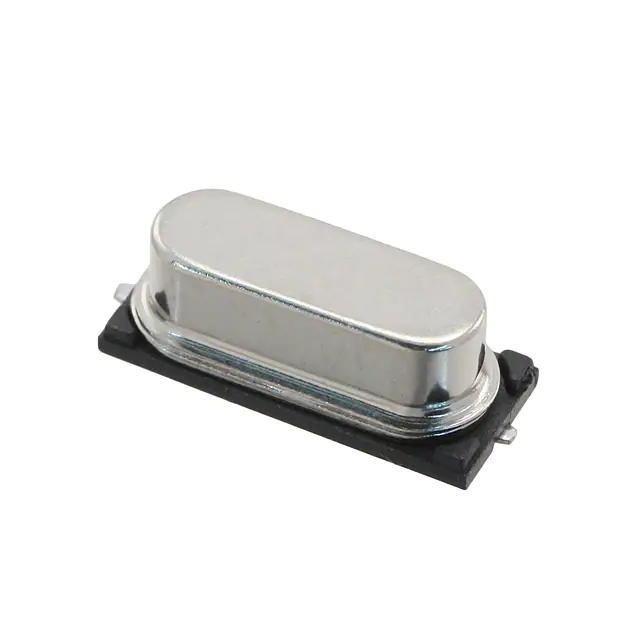
Microchip Technology VMK4-1EE-12-32K7680000TR

- Part No.:
- VMK4-1EE-12-32K7680000TR
- Manufacturer:
- Microchip Technology
- Category:
- Crystals
- Package:
- 2-SMD, No Lead
- Datasheet:
-
 VMK4-1EE-12-32K7680000TR.pdf
- Description:
- 2X1.2MM TUNING FORK CRYSTAL, +/-
- Quantity:
- Payment:

- Shipping:

Inventory:3,308
Please send an inquiry. Send us your inquiry, and we will respond immediately.
Product details
Overview
VMK4-1EE-12-32K7680000TR from Microchip Technology is a 32.768 kHz fundamental-mode tuning fork crystal with ±20 ppm frequency tolerance, 12.5 pF load capacitance, and –40°C to +85°C operating temperature range, designed for precision real-time clock (RTC) timing in space-constrained wearable and IoT devices.
For engineers reviewing the VMK4-1EE-12-32K7680000TR datasheet, VMK4-1EE-12-32K7680000TR pinout, VMK4-1EE-12-32K7680000TR application, or VMK4-1EE-12-32K7680000TR equivalent, key selection factors include ESR (≤90 kΩ), motional capacitance (4.7 fF), aging (±3 ppm/yr), turnover temperature (20–30°C), and CDFP 2.0 mm × 1.2 mm package compatibility with lead-free reflow profiles.
Technical Context
This 2-pin ceramic dual flat package (CDFP) crystal operates in fundamental tuning fork mode at 32.768 kHz, delivering a stable timebase for RTC circuits requiring low drive level (1.0 µW) and minimal aging drift. Its parabolic frequency vs. temperature curve centers near 25°C with a turnover range of 20–30°C.
Designed for integration into oscillator circuits generating 1 Hz signals, it supports RoHS-compliant, lead-free assembly per JEDEC standards and meets MIL-STD-883 reliability tests including mechanical shock, vibration, temperature cycling, and MSL 1 moisture sensitivity rating.
Key Specifications
| Parameter | Value and Actual Design Meaning |
|---|---|
| Nominal Frequency | 32.768 kHz - precise base frequency for 1-second timekeeping division |
| Frequency Tolerance | ±20 ppm at +25°C - ensures initial timing accuracy within ±0.0017 sec/min |
| Operating Temperature | –40°C to +85°C - enables reliable RTC operation across industrial and medical environments |
| Load Capacitance | 12.5 pF - matches common RTC IC load requirements without external capacitor adjustment |
| ESR | ≤90 kΩ - guarantees sufficient negative resistance margin for stable oscillation in low-power RTC ICs |
| Aging (1st Year) | ±3 ppm - limits long-term time error accumulation to <±0.09 sec/month |
| Turnover Temperature | 20–30°C - defines peak frequency stability zone for ambient-temperature RTC applications |
Pinout & Package
VMK4-1EE-12-32K7680000TR uses a 2-lead ceramic dual flat package (CDFP) measuring 2.0 mm × 1.2 mm with no internal active circuitry; both terminals connect directly to the quartz resonator element.
| Pin/Terminal | Circuit Role | Design Meaning |
|---|---|---|
| Terminal 1 | Crystal Electrode A | One side of the 32.768 kHz tuning fork resonator; requires symmetric PCB layout for impedance matching |
| Terminal 2 | Crystal Electrode B | Opposite electrode of the resonator; forms complete piezoelectric transduction path with Terminal 1 |
Key Features
| Feature | Design Value |
|---|---|
| Fundamental tuning fork mode | Enables direct 32.768 kHz oscillation without overtone filtering complexity in RTC oscillator circuits |
| ±20 ppm initial tolerance | Reduces need for factory calibration in battery-powered wearables and hearing aids |
| MSL 1 moisture sensitivity | Allows unlimited floor life before reflow, eliminating bake-out requirements in high-volume SMT lines |
| RoHS-compliant matte tin finish | Supports lead-free soldering with standard J-STD-020 reflow profile (peak 260°C, tL = 60–150 sec) |
| Low 1.0 µW drive level | Extends battery life in coin-cell-powered IoT sensors by minimizing crystal excitation power |
Applications
| Real-Time Clock Modules | Bluetooth Low Energy Wearables |
|---|---|
Use Scenario: Primary timekeeping reference in microcontroller-based RTC subsystems for smart meters and industrial controllers. IC Role / Device Role / Timing Role: Passive frequency-determining element in Pierce oscillator configuration driving RTC peripheral clocks. Use Value: Delivers ±20 ppm accuracy over –40°C to +85°C, enabling timestamp consistency without periodic GPS or network synchronization. | Use Scenario: Timebase for ultra-low-power BLE beacon firmware managing advertising intervals and connection timing windows. IC Role / Device Role / Timing Role: 32.768 kHz crystal resonator enabling sleep-mode clock gating and wake-up timer precision. Use Value: 1.0 µW drive level and 90 kΩ ESR ensure stable oscillation during deep-sleep states, extending coin-cell battery life beyond 2 years. |
| Hearing Aid Signal Processing | Medical Patient Monitors |
Use Scenario: Timing source for digital signal processing clocks in miniature, battery-operated hearing aids requiring FDA-grade reliability. IC Role / Device Role / Timing Role: Fundamental-mode resonator providing jitter-free sampling clock for ADC/DAC chains in audio front-ends. Use Value: ±3 ppm first-year aging and 20–30°C turnover temperature minimize audible timing artifacts during extended clinical use. | Use Scenario: Critical timing reference in portable ECG and SpO₂ monitors where accurate heart-rate calculation depends on sub-second interval fidelity. IC Role / Device Role / Timing Role: Precision 32.768 kHz timebase feeding dedicated RTC ICs that generate heartbeat-interval timestamps. Use Value: –40°C to +85°C operation and MIL-STD-883 qualification ensure functional integrity during transport, storage, and clinical deployment. |
Equivalent & Alternatives
The following parts are listed as comparable options for similar 32.768 kHz crystal applications.
| Alternative Part | Technical Difference | Application Difference | Selection Advice |
|---|---|---|---|
| ABRACON ABS07-32.768KHZ-T | Same 2.0 × 1.2 mm CDFP package; ±20 ppm tolerance; 12.5 pF CL; but higher ESR (120 kΩ) and lower turnover temp (18–22°C) | Suitable for consumer wearables with tighter cost targets but less demanding long-term stability requirements | Select when board-level negative resistance margin exceeds 5× ESR and ambient operation stays near 20°C |
| TXC Corporation 7M-32.768KA3-T | 2.0 × 1.2 mm SMD package; ±20 ppm; 12.5 pF CL; ESR ≤70 kΩ; aging ±2 ppm/yr; turnover 22–26°C | Better suited for high-reliability medical monitors requiring tighter aging control and wider turnover window | Prefer when design requires <±2 ppm/yr aging and guaranteed oscillation margin >7× ESR |
Compared with ABRACON ABS07-32.768KHZ-T and TXC 7M-32.768KA3-T, VMK4-1EE-12-32K7680000TR offers balanced ESR (90 kΩ), industry-standard turnover (20–30°C), and MIL-STD-883 qualification-making it optimal for industrial and medical RTC designs where reliability under thermal stress is critical.
Availability
VMK4-1EE-12-32K7680000TR is available at Aetrix Electronics and suitable for real-time clock modules, Bluetooth Low Energy wearables, and medical patient monitors requiring stable component supply across extended production lifecycles.
Supply support for VMK4-1EE-12-32K7680000TR includes scheduled delivery planning, volume procurement assistance, BOM continuity management, traceable sourcing, and lifecycle availability coordination for OEM customers, industrial embedded developers, connected-device designers, and electronics production programs.
Manufacturer
Microchip Technology Inc. is a U.S.-based semiconductor company specializing in microcontrollers, analog devices, and timing solutions, with global manufacturing and quality certifications including ISO 9001 and IATF 16949.
The VMK series is part of Microchip's precision timing portfolio, engineered specifically for ultra-low-power, high-stability 32.768 kHz applications in wearables, medical devices, and industrial IoT endpoints.
FAQ
What is the nominal frequency and mode of operation for VMK4-1EE-12-32K7680000TR?
VMK4-1EE-12-32K7680000TR operates at a nominal frequency of 32.768 kHz in fundamental tuning fork mode. This configuration provides a stable, low-jitter timebase optimized for RTC oscillator circuits without requiring overtone suppression networks. The device is not an active oscillator-it requires external sustaining circuitry to function.
Does VMK4-1EE-12-32K7680000TR require ultrasonic cleaning during PCB assembly?
No-ultrasonic cleaning must be avoided for VMK4-1EE-12-32K7680000TR. Its tuning fork structure is susceptible to resonance-induced damage from ultrasonic frequencies. If cleaning is unavoidable, full pre- and post-process qualification per MIL-STD-883 is required. Standard aqueous or solvent cleaning methods are recommended instead.
What is the maximum drive level specification for VMK4-1EE-12-32K7680000TR and why does it matter?
The maximum drive level for VMK4-1EE-12-32K7680000TR is 1.0 µW. Exceeding this value risks accelerated aging, frequency shift, or mechanical fracture of the quartz element. In practice, this limit enables multi-year battery operation in coin-cell-powered devices like hearing aids and BLE sensors when paired with low-power oscillator ICs.
How does the load capacitance of 12.5 pF affect circuit design for VMK4-1EE-12-32K7680000TR?
The 12.5 pF load capacitance of VMK4-1EE-12-32K7680000TR means the external oscillator circuit-including PCB trace capacitance and any discrete load capacitors-must present a total effective load of 12.5 pF for nominal frequency accuracy. Deviations cause measurable frequency offset; designers should verify net capacitance using field solvers or impedance analyzers before final layout.
Is VMK4-1EE-12-32K7680000TR compatible with lead-free reflow processes?
Yes-VMK4-1EE-12-32K7680000TR is fully compatible with lead-free reflow per J-STD-020. It supports a peak temperature of 260°C for up to 10 seconds, with time above 217°C between 60–150 seconds and ramp-down ≤6°C/sec. Its matte tin (Sn) finish meets JEDEC Pb-free requirements and ensures reliable solder joint formation.
VMK4-1EE-12-32K7680000TR Specifications
- Product attributes
- Attribute value
- Manufacturer:
- Microchip Technology
- Series:
- VMK4
- Package/Case:
- 2-SMD, No Lead
- Packaging:
- Tape & Reel (TR)
- Product Status:
- Active
- Type:
- kHz Crystal (Tuning Fork)
- Frequency:
- 32.768 kHz
- Frequency Stability:
- -
- Frequency Tolerance:
- ±20ppm
- Load Capacitance:
- 12.5pF
- ESR (Equivalent Series Resistance):
- 90 kOhms
- Operating Mode:
- Fundamental
- Operating Temperature:
- -40°C ~ 85°C
- Ratings:
- -
- Mounting Type:
- Surface Mount
- Supplier Device Package:
- -
- Size / Dimension:
- 0.079" L x 0.047" W (2.00mm x 1.20mm)
- Height - Seated (Max):
- 0.024" (0.60mm)
VMK4-1EE-12-32K7680000TR FAQ
1.How can I place an order for VMK4-1EE-12-32K7680000TR through Aetrix?
Please submit a Request for Quotation (RFQ) for VMK4-1EE-12-32K7680000TR on Aetrix. Our sales agent will provide a competitive quotation and guide you through the order confirmation once you accept the terms.
2.Are the price and stock information for VMK4-1EE-12-32K7680000TR reliable?
The price and inventory of VMK4-1EE-12-32K7680000TR are updated periodically and may fluctuate due to market conditions. Stock and pricing data are typically refreshed every 24 hours. Quotation validity for VMK4-1EE-12-32K7680000TR is usually 5 days.
3.What payment methods are accepted for VMK4-1EE-12-32K7680000TR?
We accept Wire Transfer, PayPal, Credit Card, Western Union, MoneyGram, and Escrow for VMK4-1EE-12-32K7680000TR transactions.
Note: Certain payment methods may incur a processing fee.
4.How is shipping managed for VMK4-1EE-12-32K7680000TR?
VMK4-1EE-12-32K7680000TR orders can be shipped via leading logistics carriers, including DHL, UPS, FedEx, TNT, or Registered Mail.
Once your VMK4-1EE-12-32K7680000TR order is processed, you will receive an email with the shipment details and tracking number.
Note: Tracking information may take up to 24 hours to appear. Express delivery typically takes 3–5 business days.
5.How can I obtain technical support or documentation for VMK4-1EE-12-32K7680000TR?
For technical support, including VMK4-1EE-12-32K7680000TR datasheets, pinout diagrams, or application guidance, please contact our engineering support team. They can provide detailed documentation and assistance for your VMK4-1EE-12-32K7680000TR requirements.
6.How does Aetrix verify that VMK4-1EE-12-32K7680000TR is sourced from the original manufacturer or authorized distributors?
All VMK4-1EE-12-32K7680000TR products on Aetrix are procured from qualified distributors and authorized channels. Our dedicated quality assurance team conducts strict verification, including traceability checks and, if necessary, third-party testing. This ensures that VMK4-1EE-12-32K7680000TR meets industry standards.
7.What is the process for return or replacement of VMK4-1EE-12-32K7680000TR?
All VMK4-1EE-12-32K7680000TR units undergo pre-shipment inspection (PSI). If there is an issue with VMK4-1EE-12-32K7680000TR, returns or replacements are accepted under the following conditions:
1.Quantity discrepancies, incorrect items, or visible external defects (such as breakage or corrosion), acknowledged by Aetrix.
2.The issue is reported within 90 days of delivery.
3.The VMK4-1EE-12-32K7680000TR part is unused and in its original packaging.
Return procedure for VMK4-1EE-12-32K7680000TR:
1.Submit a request within 90 days.
2.Obtain a Return Material Authorization (RMA) from Aetrix.
VMK4-1EE-12-32K7680000TR Tags
-
CFS-20632768DZBB
Citizen Finedevice Co Ltd
-
CFS-20632768DZFB
Citizen Finedevice Co Ltd
-
XRCGB32M000F2P01R0
Murata Electronics
-
ECS-250-18-5PX-F-TR
ECS Inc.
-
J49SMH-A-G-G-K-4M0
Jauch Quartz
-
FC4SDCBMF8.0-T1
Fox Electronics
-
ABLS-8.000MHZ-B2-T
Abracon LLC
-
ECS-240-20-5PX-TR
ECS Inc.
-
ABLS-8.000MHZ-B4-T
Abracon LLC
-
ABLS-13.52127MHZ-10-J-4Q-T
Abracon LLC
-
ATS080BSM-1E
CTS-Frequency Controls
-
ECS-184-18-5PX-TR
ECS Inc.
Tech Hub

TTL and CMOS logic families differ in thresholds, loading, output drive, power and timing. This engineering guide compares 74HC and 74HCT, calculates noise margins and checks 3.3 V/5 V compatibility.

A practical engineering guide to 3.3V and 5V logic compatibility, input thresholds, resistor dividers, translator ICs, MOSFET level shifting, I2C pull-ups, timing limits and power-sequencing risks.

The 74HC595 uses push-pull logic outputs, while the TPIC6B595 uses 50 V open-drain DMOS sinks for higher-power loads. This guide compares timing, current limits, 3.3 V interfacing, load wiring, thermal…

The 74HC595 converts serial data into eight stable parallel outputs. This guide covers pin functions, shift and storage timing, OE and MR behavior, drive-current limits, cascading, voltage compatibilit…

A technical comparison of level-sensitive latches and edge-triggered flip-flops, covering timing windows, setup and hold limits, master–slave operation, time borrowing, race-through, HDL inference and…

A D latch stores one bit while Enable controls when data can pass. This reference covers gate-level operation, truth tables, transparency, setup and hold timing, LE versus OE, common ICs and practical …

An SR latch stores one bit through cross-coupled feedback. This engineering reference covers NOR and NAND implementations, truth tables, forbidden-state recovery, gated operation, switch debouncing, fa…

Latch circuits retain one bit through feedback. This technical reference covers SR and D latches, truth tables, transparency, timing limits, latch-versus-flip-flop behavior, applications and common log…

An engineering guide to LED driver operation, constant-current and constant-voltage outputs, linear and switching topologies, dimming, IC selection, calculations, replacement compatibility, and fault c…

Operational amplifier guide covering op amp basics, feedback, ideal vs real op amps, common configurations, buffer circuits, offset, bias current, gain-bandwidth, slew rate, rail-to-rail limits and sel…


